
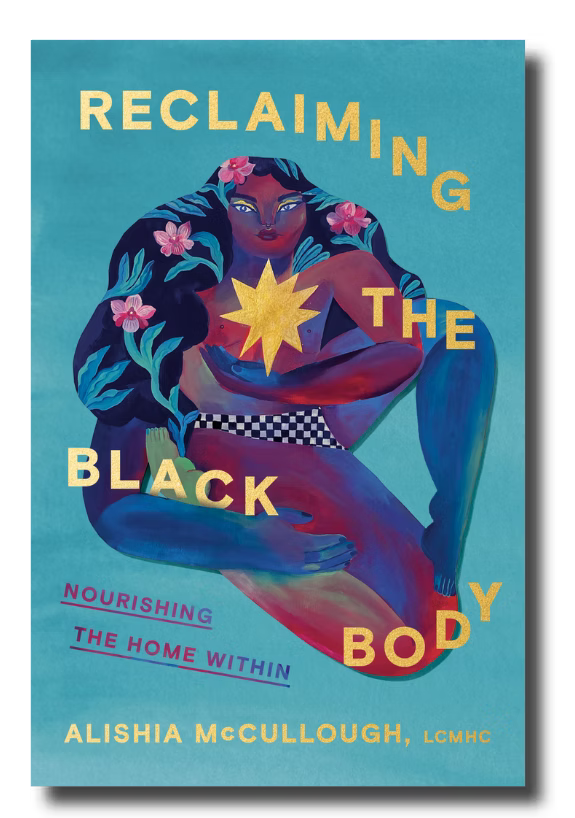
I am beyond thrilled to share this interview with Alishia McCullough, author of “Reclaiming the Black Body.”
Alishia is a licensed mental health therapist who has written a truly groundbreaking book about the impact of disordered eating on Black women, delving into how centuries of racism and misogyny in this country, generational trauma, and systemic and cultural oppression have impacted Black women and their relationship to their bodies. She offers somatic and mindfulness practices throughout the book to help guide healing for any and all of us who struggle with eating disorders and disordered eating. Alishia’s personal life—from her childhood through her experiences as a therapist—is also interwoven.
We cannot look at the prevalence of eating disorders among women without amplifying the ways in which anti-Black racism, misogynoir, and generational trauma impact Black women’s relationships to their bodies.
There are so many necessary reasons for this book to exist, but of note are the ways in which systemic racism impacts Black women’s ability to be diagnosed with eating disorders and to access treatment. There is a belief among health care providers and the general public that Black women don’t struggle with eating disorders.
According to Alishia, the odds of Black women receiving a diagnosis for an eating disorder are only 11 percent, compared to 44 percent for white women, when they present to health care providers with identical symptoms.
I am grateful and excited that Alishia will be a part of the anthology I am editing, “This Is Not Your Mother’s Eating Disorder.” Submissions are open through November 30th. If you have a story to share of a midlife eating disorder, poetry, illustrations, or cultural critique, please check out the call for submissions here.
Amie: Why did you write “Reclaiming the Black Body”? This is clearly a very personal book for you, but it’s also an important exploration of how and why Black women in our society struggle with disordered eating, eating disorders, and their relationship to their bodies; a beautiful honoring of Black women; and an incredibly helpful guide for anyone struggling with similar issues—no matter your race, gender, or age.
Alishia: I wrote this book because it was something that I needed to receive for my own healing and liberation. My complications with my relationship to food started when I was a teenager and followed me into adulthood. At that time, I did not have a roadmap. I needed a book like “Reclaiming the Black Body” to give language to what I was experiencing and to understand the root of my feelings and behaviors.
On a professional level, this book serves as a beacon of hope and possibility for Black women and femmes, especially by showing us that we are not alone and guiding us toward healing our relationships with how we nourish and exist in our bodies.
This book was written centering the experiences of Black women and femmes, and because of that, many other women, regardless of race, gender, or age, have also been able to see themselves.
When we amplify the most marginalized experiences, those who systems of oppression have most impacted, everyone else along that continuum also gets free and can locate their story of what restoring their relationship to their body feels like.
Amie: Can you share more about how generational trauma, anti-Black racism, and misogyny show up in Black women’s bodies and contribute to disordered eating and eating disorders?
Alishia: Attuning to our bodies is the process of connecting with what we are experiencing and responding to our needs in the present moment. For many Black women and femmes, this intuitive practice has been disrupted through generational trauma. Namely, generational trauma resulting from slavery, anti-Black racism, and misogynoir.
Enslavement created the conditions for us to learn how to leave our bodies in order to survive.
I reflect on the experiences of those who were once teachers, mothers, doctors, healers, and how one day their lives experienced complete upheaval, as a result of being sold into slavery.
I imagine how shocking that was to their nervous system, and they had no adequate space or capacity to process what was happening to them as they were forced into starvation, physically and sexually abused, placed into inhumane conditions on the colonizers’ ships that would land throughout the Atlantic and Caribbean, and then stripped of their identity.
How did their bodies respond to the threat that, for the rest of their lives, they would work the land while continuing to experience trauma, brutality, and torture every day? I think of what that would do to the spirit, soul, and psyche of a person to go through all of that and have their view of the world completely in disarray. Many died without having the opportunity to process what they were going through; their hearts gave out from the stress, and for those who survived through learned conditions and epigenetics (those genes that are passed down from mother to child), the legacy of this atrocity continued to be passed down, creating more disembodiment in order to survive.
In modern day, I think about the continuation of the oppression and trauma through systems of anti-Black racism and misogynoir, which is a specific type of misogyny that accounts for both the experiences of being a woman and of being Black. When we experience trauma in the body, our digestive system slows down, which is reflective of our body not being able to process what we are going through.
If we just examine that one aspect of the eating imbalance experience, Black women and femmes have not had space to digest all that we went through or had to be subjected to for generations, which creates stagnancy and disease in the body.
Our eating disorders/eating imbalances and disordered eating are complex, and many of us have carried forward patterns of being undernourished, starved, and nutritionally deficient from a space of punishment and control. Now we exist in a culture where it is mainstream, even popular, to diet and contort our bodies to European beauty and health standards; however, when we engage in these patterns, we reactivate a whole lineage of harm, triggering a longstanding pattern of intergenerational disembodiment and prolonging our healing and return to our bodies.
Amie: You write in the book that Black women you have worked with who have experienced eating disorders also have a history of sexual abuse and violence. Can you share more about this and how Western patriarchy relies on Black women’s disconnection from their bodies?
Alishia: Western patriarchy relies on Black women’s disconnection from our bodies because it keeps us in a space of mental and physical obedience to a system that does not benefit our highest good. The biggest tool of colonization is violence, and particularly violence against women and girls.
There was a time in America where Black bodies were property, and there were laws in place that stated that a slave owner could not rape his or her enslaved women because she was not seen as a woman with autonomy over her own body, but as property to the owner. There are many documented records of the casualty and frequency of sexual abuse on the plantation, many records indicating the victimization of girls as young as 5 years old.
When we think about the implications of generations of women being told that the sum total of their lives was to be property of a white man or woman, that their bodies do not belong to them and could be mutilated and violated routinely, and that there was nothing that they could do about it, this breeds the culture of silence and lack of recourse or justice for their bodies.
This has been passed down through the plantation into the homes and lives of Black women and girls who learn that it is safer not to say anything, and to suffer in silence because they feel as if they will not be believed and that speaking out will contribute to more harm than good, and can even be antithetical to their survival. Therefore, the eating disorder/imbalance becomes an outlet to try to gain control and authority over their bodies. It becomes a way to try to gain access to even a small amount of privilege by existing in alignment with what society has defined as the body of a worthy person.
The wounds we have experienced are deep, and I believe we must first contend with all that we have been through as we take steps on the pathway towards our restoration. Tending to our trauma creates more flow and capacity in the body to receive pleasure and joy, all of which we are deserving of. We then get to try on those expressions of our emotions and allow for them to take root in our sexuality, sensuality, and in the practice of attuning to and regulating our nervous system. This is how we begin to heal.
Amie: Can you share more about the fear white Americans have of Black women’s bodies, how white people and the dominant culture profit off trying to get Black women to lose weight, and why you see Black women’s bodies as a “legacy of resilience”?
Alishia: Ideas about body size, shape, and weight began to shift for white culture with the influence of European standards that were a direct response to the enslavement of Black bodies.
In the 18th century, the disdain for larger bodies became intertwined with the dehumanization of Black bodies and was used as a way to validate race, class, and gender oppression. Since writing my book, “Reclaiming the Black Body”, I realize that it was not that white Americans were trying to get Black women to lose weight, because that would be counterproductive to the plan to dehumanize Black bodies.
Instead, the thin ideal and Eurocentric standardization of value and worthiness have become such a staple in white communities that they reinforce it as the norm for all bodies without considering the completely different experiences that Black and other women of color are having in our bodies.
Black women have internalized these beliefs because we live in a culture where whiteness has been prioritized as the norm and standard; therefore, in order to survive, we have adapted or adopted similar practices and views about the ways that our bodies must assimilate to these standards. But we often don’t have context for all that our bodies have been through, as Black women.
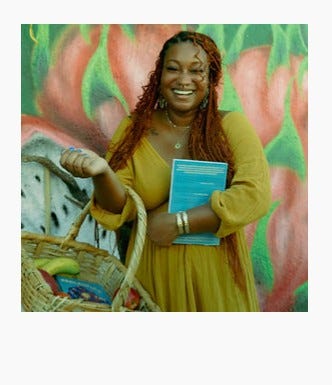
The system profits from our adaptation to these beliefs because it keeps us pursuing something unattainable rather than focusing on our own bodies’ wisdom and healing.
For example, even if a Black woman was able to assimilate to the body ideals set up by white culture, she would still feel as if she was not enough, and needed to control or change something else about herself, because the system was created to exclude Black bodies from accessing privilege and receiving humane treatment from the culture at large.
With these things in mind, I do see Black women’s bodies as evidence of our legacy of resilience because even with everything that our bodies have been through, we are still here.
Many of us are returning to our ancestral practices and choosing to exist in our bodies from a space of being embodied, and a lot of Black women have chosen to disconnect from the system and validate our own inherent value and worth without needing the approval from white mainstream culture.
Amie: Your personal struggles with your body and your healing process are a through-line in the book. Can you share a bit about how you grew up and your healing journey?
Alishia: My body story and personal struggles within my body began because I was unconscious about how my story weaved into the story of my ancestors, about the history of Black bodies, and didn’t have context into what was driving my desires and behaviors to pursue body ideals that were created to devalue me.
Some early memories I have of existing in my body were around ways that I needed to take up less space, to be silent and obedient, and within a familial and societal context, feeling as if someone had already dictated the way that I was allowed to exist in my body as a Black woman.
It wasn’t autonomous or even in the least bit collaborative, but what I felt was the ancestral trauma of being born into a system where disembodiment was a way to survive a lifetime of enslavement.
For me, those systems were less about a plantation and more about navigating through the roots of patriarchy within my family, religious indoctrination, and community and social life, steeped in anti-Black racism.
It was about the ways that my beauty was not reflected back to me within American culture, and how I experienced opportunity, value, and worthiness distributed unequally for women and girls who looked like me. These were all things impacting my life that I didn’t have the language or awareness for because I was so caught up in trying to conform and achieve something that wasn’t possible.
I started restricting food in my early adolescence in accordance with the teen magazines that I was reading at that time, the attention that I desired romantically, and the lack of being seen and treated with autonomy and dignity within my household. This pattern of restriction continued into adulthood, as a way to cope with the pressures of perfectionism throughout college, and it wasn’t until I was exposed to viewing what I was experiencing in my life as a problem that I began the process of unraveling the threads of what had been indoctrinated and was driving my life.
In graduate school for clinical mental health counseling, I was exposed to the diagnosis of eating disorders for the first time. It was a key that would open up a pathway into viewing eating disorders from the standpoint of white culture, but then beginning my own exploration of what this illness looked like in my life and community created a drive to intentionally work with Black women clients, and eventually began to pull back more layers into how imbalanced our relationship to nourishing and existing in our bodies was.
I explored the ways in which our health is a result of unresolved trauma and systemic oppression stored in the body, and I learned about how white standards of beauty influenced how we perceived our value and contributed to our experiences of colorism, texturism, and featurism.
My healing journey happened alongside my work; it was as if every new discovery repaired something deep within me that I did not have the words for, and I felt the salvation deep within my bones.
Learning about the racialization of the Black body through the work of Dr. Sabrina Strings, reading narratives of redefining body value from other Black women, such as Sonya Renee Taylor, and learning about my own ancestral and cultural healing practices allowed me to return to my body. It gave me language and context and the fortitude to move the needle forward by connecting the path between the unpacking of body trauma and the deeper healing.
Amie: When I was in treatment most recently for my eating disorder, we discussed movements like HAES (Health At Every Size) and body positivity. I found your critique of these movements important and fascinating—even as you acknowledge benefits in some of them. Why are these frameworks potentially limiting?
Alishia: In my work, I acknowledge that we are existing within systems that were intended to benefit a small number of people, and we are just beginning to get to a place where we are developing frameworks that will impact the system by exposing others’ lived experiences. HAES (Health At Every Size) is one example of a framework developed to expand the conversation about accessibility to health and wellness within your body.
HAES asserts that at any size, you can achieve health, and while I have adopted this framework with many of my clients and they have reported greater satisfaction with their bodies as a result, I can also identify its limitations.
One limitation of this [HAES] framework is that it does not make disability justice a primary tenet. Health is narrowly defined in our society, and in this framework, that definition is based on the idea that health correlates with being able-bodied and having access to movement that someone who is able-bodied would have, and then maps that belief onto the expectation that all bodies should be able to measure up to this standard. Would someone who is born with a heart condition be able to access this HAES model, or someone who has cancer? The reality is that, as it is defined, health is not accessible, and healthcare is not available to everyone.
There is also a centering on size, as if size is the problem that needs to be accommodated. When we reflect on the fact that we live in a society where stress, chaos, and fear are habitual, it is privileged to say that limited definitions of health, still mostly influenced by white cultural beliefs, are accessible or applicable to everyone.
I believe this framework could be expanded by allowing people to define what liberation feels like in their own bodies.
Liberation is a form of spaciousness, room to breathe, a place of discovery and realignment. As long as we are living, we all have access to tapping into that experience.
Amie: Your book offers anyone who is in recovery from an eating disorder a roadmap toward healing. Given that the anthology I am editing is focused on midlife women, I’d love to know what advice you have for Black women who have experienced an eating disorder in midlife or older.
Alishia: There can be this belief that “it’s too late for us” once we reach a certain age, and I like to tell people that, as long as you are still living, there is always an opportunity to restore your relationship to nourishment and to how you exist within your body.
My mother is in her late 50s, and my grandmother is in her late 70s. Both women read “Reclaiming the Black Body” and saw themselves and ways they could heal within it. My mom shared that for the first time, she felt validated in the experiences that she was having when she would visit her doctor’s office and they would make comments about her weight or health, insinuating that her body was a problem or that she was not educated on how to eat in accordance with white culture. My mom gained the confidence and language in order to advocate for herself, and she has found healthcare providers who are more affirming of her body.
Now, with the tools to listen inward to what her body is communicating, she knows what she needs to eat or how she needs to move her body to experience more flexibility, spaciousness, and ease within her body. My grandmother also shared that while no one was having these conversations when she was coming up, she was able to heal something within her by finally receiving validation and also being able to advocate for herself with her healthcare providers. She also developed practices that help her feel freer in how she moves her body and in speaking up for her needs.
Women across the world, spanning generations, races, and class statuses, have shared that “Reclaiming the Black Body” has given them an alternative to the status quo. They have a more intentional relationship with their bodies and newfound confidence to determine, through small actions, how they can heal and feel complete within themselves.
You can buy “Reclaiming the Black Body” here. And you can learn more about Alishia through her website and practice Black and Embodied Counseling and Consulting PLLC.
Alishia is contributing to the upcoming anthology I am editing “This Is Not Your Mother’s Eating Disorder” about midlife women and eating disorders. If you’re a writer and want to submit, check out the call for submissions (open until November 30, 2025).
Comments
Nothing yet. Say the first thing.
Sign in to join the conversation.