

Is it an understatement to say that everyone is freaking out about search right now?
Here’s a dirty little secret. The real question was never how do we win in SEO. It was whether SEO was ever the right channel for your company in the first place. Most companies don’t ask that.
While basic SEO hygiene matters for every company, SEO as a growth channel is a completely different game.
❗Note: If you’re actively evaluating agencies, the scope of SEO help you need is almost certainly smaller than what you’re being sold.
Agencies are incentivized to sell you a program (the works may include content production, technical audits, link building, monthly retainers…) whether or not your business is at the stage where that investment makes sense.
If you haven’t validated channel-market or search-market fit yet, you don’t need an agency. You need an honest audit of whether this is even the right bet.
Those are different conversations, and most agencies won’t initiate the second one because it’s not in their favor. If they do that, great. Most don’t.
SEO is changing, but here’s what didn’t
Many teams default to SEO because everyone else was doing it. AI search is that now.
They also defaulted to SEO because it seemed cheaper than paid options or because the agency said it would take 4–6 months to see results, which felt reassuring.
They produced the blog posts, hired someone or an agency to run it, and then wondered why nothing was happening two years later. But SEO as a channel wasn’t broken. It was just the wrong one for them, and they haven’t figured that out.
Defaulting without thinking hasn’t changed, and that applies to many growth channels, not just SEO.
More growth conversations about channel-market fit, please
We need to talk about channel-market fit. A lot more.
Channel-market fit is like product-market fit, but for distribution.
A startup without product-market fit won’t solve the problem by running better ads. A company without channel-market fit won’t solve the problem by producing better content. The fit has to be there first.
What do most people miss? To have channel-market fit with SEO, you need search-market fit first.
Search-market fit is proof that your buyers actually use search as part of their journey to your product.
It’s also proof that the intent behind their searches aligns with what you’re doing with SEO and content.
Lastly, it’s proof that the commercial transaction you want to happen is a natural next step from that search.
Without it, SEO is only for visibility, and you will be upset with the ROI.
Who SEO actually works for
When you’ve worked at an agency, you quickly learn which companies are a genuine fit for SEO as a growth channel, as I have.
It’s not every company. I cannot stress that enough.
Companies that win with organic search tend to share a handful of patterns. If your company doesn’t map to at least one of them, you should probably have a conversation with yourself about whether you’re choosing the channel or just defaulting to it.
Not everyone can win on organic, just like how not everyone can win on paid. Keep that in mind.
P.S. This also assumes you’ve gotten your core pages and navigation right. Basic SEO hygiene. SEO as a growth channel is a funnel accelerant, not a foundation. If your website messaging still describes the product in terms that make sense to the people who built it rather than to the people who might buy it, fix that first.
The companies that do win on organic show these patterns:
1. Their customers start the buying journey with search
It sounds obvious, but it isn’t?!?!
B2B enterprise buyers often don’t start with Google. They start with:
A vendor recommendation from their network
A Gartner report, or
A cold outbound sequence from a sales rep who somehow got their email
I’d be careful with the last sales tactic!
If your category is defined by relationships and reputation rather than discovery, SEO is not the right growth channel for you.
This is also where the gap between your product’s perception and where it actually is becomes a real consideration. Is the market ready for what you’re building?
Keep yourself honest about this. If it’s a completely new category, SEO is definitely not the right growth channel. Anything AI-related is having its moment now in search, but it was not 4 years ago. This could change as markets shift.
An interesting use case for SEO, however, is news outlets (at least to me, and especially sports betting) that capitalize on Query Deserves Freshness. Every time there is a breaking story of some sort, people turn to search for it first. This may not apply to many B2B companies.
Ask yourself: Does your buyer search before they buy?
2. Their category has enough search volume
There are niche B2B markets where the total addressable search volume for relevant terms is three thousand queries per month. You can win every single one of those and still not move the business.
This is especially true for early-stage companies trying to create a new category. If no one knows to search for what you’re building, you’re writing content for an audience that doesn’t yet know they need to find you.
Ask yourself: Is there enough demand in the category?
3. The product is the indexed content
Pinterest is the clearest example of this. Every pin, every board, every image is a crawlable URL. The product is also an SEO growth channel.
Yelp, TripAdvisor, and Zillow follow the same logic. While more educational or bottom-of-funnel, Canva's template library and Zapier’s integration pages do the same thing too. I love this Mobbin brand colors library too.
When users generate content that becomes indexable at scale, you get a self-funding SEO flywheel. This is more common among B2C companies, but it’s rare. Most B2B companies don't have this advantage.
4. They’re solving a problem with a standardized vocabulary
Vanta wins on “SOC 2 compliance” and “ISO 27001 checklist” because security compliance has a specific, googled vocabulary.
The buyer already knows what they’re searching for before they know which vendor they want. Same with HR tools, tax software, dev tools built around defined frameworks.
When your ICP searches specific terms before vendors exist in their minds, SEO captures that demand. The standardization of vocabulary deserves more credit than people give it. It's what makes content durable. "What is SOC 2" doesn't need updating the way a product comparison does.
5. Long-tail, evergreen questions exist at volume in their domain
HubSpot owns basically every foundational marketing definition.
Zapier built an SEO moat that drives millions of sessions per month, not by chasing broad automation keywords, but by going deep on the specific integration queries their users were already searching: “how to connect X to Y,” “best apps for [workflow],” building hundreds of listicles that compounded.
Ahrefs owns SEO education itself.
This works when the concept set is large, questions have stable search volume, and content doesn’t expire fast or at all. If your category generates that kind of perpetual curiosity at scale, SEO and content are your cheapest customer acquisition channel.
6. Comparison and alternative queries already exist in their market
Any market where buyers are actively evaluating options generates searches like:
“best X software,”
“Best X tool,”
“[competitor] alternative,”
“[X] vs [Y],”
This is why review sites like G2 and Capterra built their businesses around comparison content and insights, and why competitive intelligence platforms like Klue and Crayon exist at all.
Comparison intent is one of the most commercially valuable behaviors in the buyer journey; it happens at scale, and for a long time, the companies being compared didn’t do anything about it. These days, they are (a shout-out to all product marketers and content marketers!).
However, G2 and Capterra captured traffic during the gap. Klue and Crayon sold the intelligence back to the vendors so they could stop being blindsided by what their competitors were saying.
At the agency I worked at, some clients refused to create comparison content because they didn’t want to talk about competitors at all. However, if you’re not building your own comparison content, you’re:
Outsourcing the highest-intent part of your buyer’s decision to a third party that charges you to access it
Outsourcing narrative control to a third party
Probably spending more on analyst relations than you need to
The buyer was already looking for you and is already in decision mode. There’s demand in your category. Comparison content can make it easier for you and them.
If they don’t yet exist for your company, do it anyway and gain a first-mover advantage in SEO. If they already exist, do it and win with SEO.
7. They have structured data for programmatic SEO (pSEO)
When there’s useful structured data that can generate pages at scale (integration directories, job boards, salary data, templates by use case), you can build an SEO machine that compounds.
But before you go down this road: do you actually have the data, or do you need a data engineer to hunt it down first? After that, you need to think about how you want to design these pages and make sure they are published correctly, thousands of them, possibly. pSEO takes time. Make sure you have the resources to do this.
pSEO done well isn’t just about building pages on any structured data. Top-of-funnel pSEO is a waste of time. Glossaries and location data have been my least favorite. Imagine competing for users who were never going to filter by geography anyway. What a waste of time, right?
Ask yourself: Do you have structured data if pSEO is part of the plan?
What agencies don’t say
1. SEO is a growth channel that punishes impatience and ambiguity
Agencies know this and don’t lead with it.
Most companies don’t know who they’re trying to reach. Their ICP is vague. Their content strategy is whatever topics the team thought sounded smart and would attract people adjacent to the actual buyer, which is why their core pages aren’t converting. The usual suspects include curious generalists, competitors conducting research, and students writing papers.
This is not an SEO failure. The fundamentals weren’t even there, but SEO gets blamed as a growth channel.
Ask yourself: Are your core pages doing their job? Do your customers even convert on your page? Do they have transactional intent?
2. SEO is a growth channel with a long feedback cycle
What makes it worse is that the feedback cycle is long. I think agencies should be more upfront about this.
Paid gives you data in 48 hours. SEO takes months, sometimes years, to tell you whether you bet on the right thing. By the time you realize the content strategy was wrong, you’ve produced 200 posts optimized for keywords that don’t attract buyers, and the cost of that mistake is buried in two years of labor.
Ask yourself: Can you commit to 12–18 months?
3. Not every company should bet on SEO
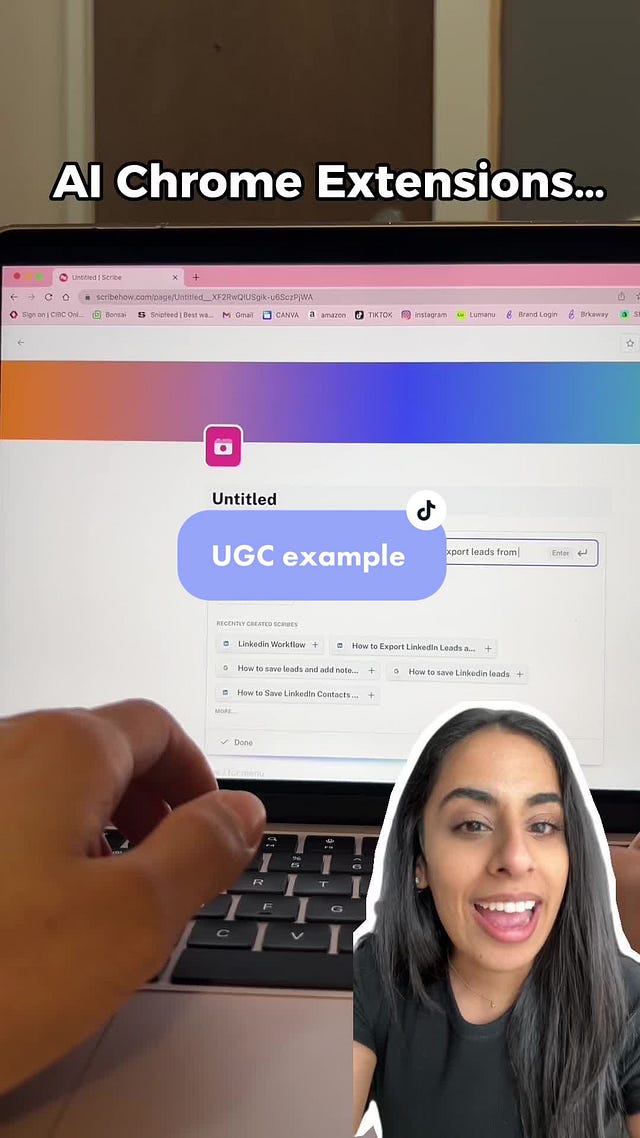
Scribd built real traction through paid social and creator GTM/UGC, unusual for a B2B tech company, but effective and very underrated. Paid socials and creator GTM are probably the most underrated growth channels in tech now.
I’m glad to see more companies hopping on it. I’ve even started learning more about filming and editing on my own. (I’m here for any CapCut tips!)
Tip: The most honest thing you can do as a growth marketer is ask whether SEO is really the right channel before you commit to the timeline.
 Tiktok failed to load.
Enable 3rd party cookies or use another browser
What to actually evaluate before betting on SEO
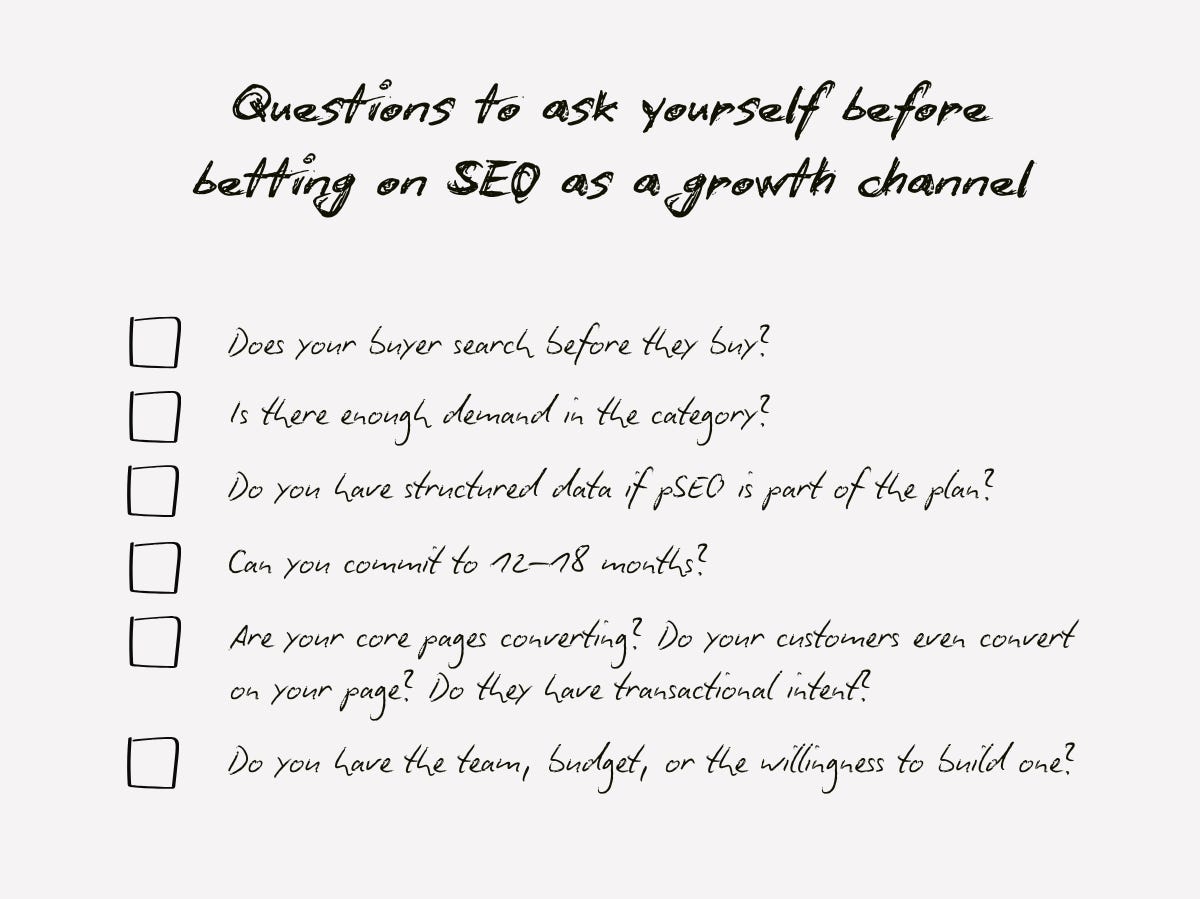
Some questions to ask yourself before betting on SEO as a growth channel:
1. Does your buyer search before they buy?
Validate this with customer interviews, search data, and by looking at where your existing customers came from before they ever heard of you. Never assume!
2. Is there enough demand in the category?
Pull the keyword data. Look at volume for your core pain points, solution categories, comparison terms. If the aggregate search universe is thin, SEO can still work, but the ceiling is low, and you need to know that going in.
3. Do you have structured data if pSEO is part of the plan?
Or do you need a data engineer to find it? It’ll affect your timeline.
4. Can you commit to 12–18 months?
If your runway is 8 months and you need leads now, SEO is not the play. That’s not a knock on the channel; it’s just not how it works.
5. Are your core pages doing their job? Do your customers even convert on your page? Do they have transactional intent?
If those pages can’t convert, you should question what search intent your customers are coming in with. If it’s not transactional, SEO is not the play for growth.
6. Do you have the team, budget, or the willingness to build one?
Lastly, SEO is an investment. You should expect to put resources into it. By resources, I mean writers, strategists, marketing budget, or just straight-up consistency and grit.
Where does the AI search conversation fit into this?
I’m going to Claude rather than Google for many searches, which makes me question which channel is the right one to market at any given moment. I’m imagining all the brands that are targeting me, and it must be a headache.
I’m looking at you, Renegade Running, Arc’teryx, OUAI, and a bunch of other brands because I’m just a girl!
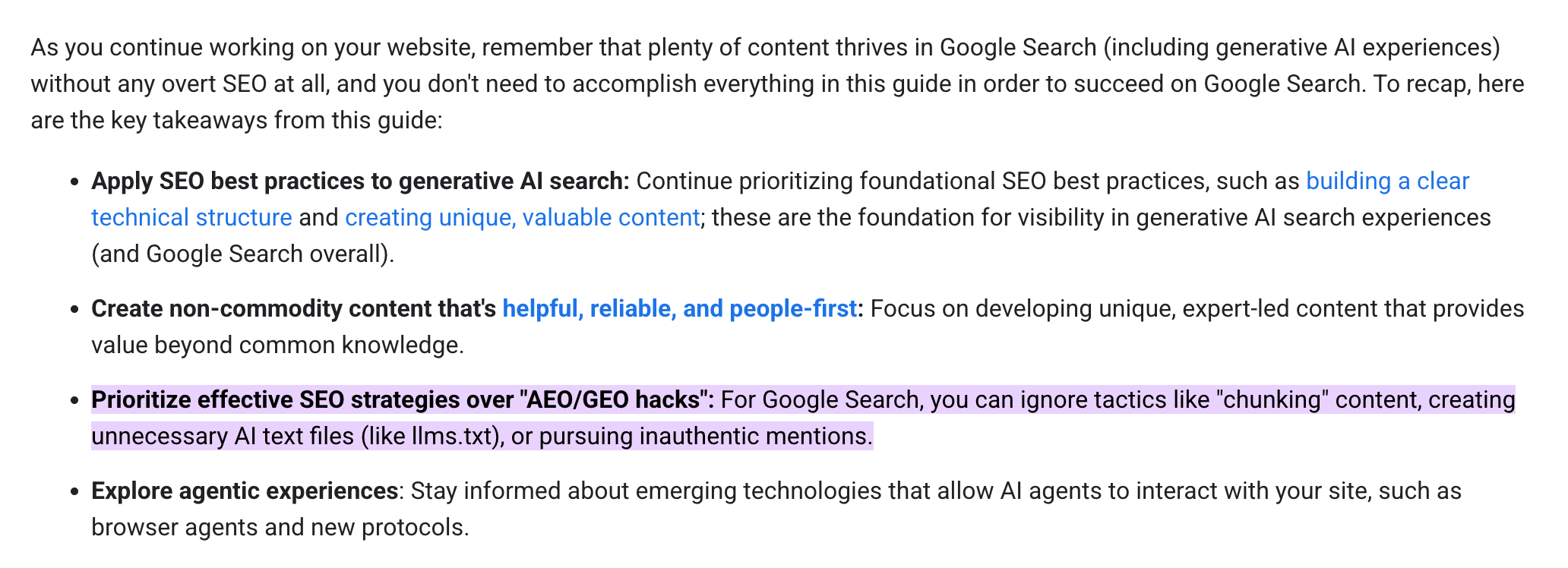
However, before you reshuffle your entire strategy, remember that the channel-market fit question doesn’t change just because channels evolve. If SEO was the right growth channel for your business, you now have additional optimization layers to invest in to pop up in AI overviews and LLM. Do it.
If SEO was never really the right channel, you have to face the music. The new acronyms can’t fix fundamental problems and don’t create demand that wasn’t there in the first place. There is no shortcut.
Getting channel-market fit right before you invest is even more important, not less.
The companies doing well in AI search are, almost without exception, the same companies that were doing well in traditional SEO, and for the same reasons:
Clear positioning,
Documented expertise on specific problems,
Content that genuinely helps people who need help
LLMs cite trustworthy, specific sources. The chase for AI visibility is, at its core, the same thing the chase for organic visibility always was: building something worth recommending.

The key to success is truly: make it f*icking good. Your product, content… just do it well! I’m a big believer that good anything (including SEO and content) comes from good product and good people. Just be good?!
Navigating times of (search) uncertainty
Anyone who tells you they have it figured out is pitching you some snake oil.
But the noise about what’s changing distracts from the most important question before all this noise even started: Is this the right channel for how your buyers actually behave?
SEO is not dead, but it’s also not automatically the answer. It is a channel with specific fit criteria, a long feedback loop, and a compounding return for companies that meet the criteria and commit to the timeline. For companies that don’t, no amount of programmatic content, AI workflows, or agent optimization will fix the mismatch.
My biggest takeaway from all things SEO and AI search is to ask the harder question before you commit: is there channel-market fit?
Other banging articles related to this topic that I love:

am i... a marketer? is a newsletter about the weird, specific experience of working in marketing right now. if this resonated, share it with someone who’s in the thick of it. i’m nicole, and i’m figuring it out in public!
📚 World Travel: An Irreverent Guide
🌉 Events I’m attending online + want to attend:
The Hidden Histories Behind Hollywood Filming Locations (SF, May 26)
Angel Investing for Operators (Without Writing $50K Checks) (Anywhere, May 27, OGC only, and online!)
How to Build a RAG Agent in n8n (May 29, online)
If you find this interesting, you can find me on LinkedIn! We don’t have to do that, though. You can also find me on X and Instagram.
🛜 See you on the internet! 🌐
if someone forwarded this to you and you want it in your inbox, subscribe by typing your email below. If you’re already subscribed: you’re my favorite person. thank you. if you could refer a friend, i’d so appreciate it! 🫶
Comments
Nothing yet. Say the first thing.
Sign in to join the conversation.