

I host small events for marketers, for women in tech, sometimes both. The format is simple: no panels, no speed networking or networking theatre, just a small group being honest about work. I always leave with more than I came with, so I thought I’d put it here!
I’m hoping to plan more wherever I am, and not just about AI (I’m a little burned out), but things we’re all wanting to learn, so subscribe to be in the know!
Every day, someone invents a new word, trend, sometimes even a religion. If you’ve read Cultish by Amanda Montell, you know it doesn’t take much to do that. A charismatic origin story, a language only insiders speak, a promise of transformation that’s always just one more step away, and a community of true believers who will defend the faith.
Tech is cultish. One day you’ve got Bitcoin and its anonymous prophet. The next you have web3 missionaries who wanted you to know, very urgently, that you were either early or you were dead. I’m clearly in the cult of Claude. I don’t know how many friends in Europe I have taught it to. Just spreading the good faith, baby!
AI has its own eschatology. The 10x productivity gains, the complete and total collapse of every profession you’ve ever held. You’ll lose your job in 2027. Thank you for the reminder, Lenny and Elena.
Someone at AI + Chill said it plainly: I think it’s just a group of men who get together every few years and decide to make a billion dollars. We all laughed. That was probably our favorite take.
AI + Chill @ Dude Chilling Park
I hosted a little meetup in Vancouver this past weekend. I called it AI + Chill and held it at a park called Dude Chilling Park. Yes, that’s the real name. Yes, it was on purpose.

I wanted to bring a slice of San Francisco to Vancouver, so in proper SF tech fashion, I invited a group of women to come talk about how we’re actually using AI. To be honest, I’m a little burnt out on AI, but I did want to meet cool women doing cool shit. I was also curious about how people outside San Francisco were using AI.
SF has a particular fever about AI. Someone in line could tell you about their “AI workflow for GTM” while ordering a $19 juice. That’s a good sign to make more friends. So here I am!
It’s complicated
The consensus was that AI is useful, but not as revolutionary as we’ve been told. Women, in particular, have a complicated relationship with tools that promise to do the thinking for us because we’ve spent most of our careers (and lives) cleaning up the mess when something goes wrong.
Our conspiratorial theory? It would be reductive to say that this is a coordinated grift by a small group of very ambitious men, but there might be some truth to that.
Every major tech wave of the last decade has followed the same pattern. A small, insular group of people (disproportionately male and in tech) decides something is “the next big thing”. They decide to build it and invent weird language as they do it. VCs say “hey, why not?” and then LinkedIn explodes with people who have mysteriously been “in the space” for years, even though the space is six months old. Money floods in. Employers say, “We must adopt this” or “We have to update our positioning.” Employees have to make it work. Everyone is told to adapt or die.
The employees that have to make it work? We’re figuring out which prompts (and now skills) are best for the work we do. We’re catching errors in competitive analysis reports where currency conversion was never mentioned because we thought it was obvious.
And as women, we wonder why we’re slower to adopt AI. The truth is there’s a lot of figuring out and things going wrong. We tend to evaluate risk first. I keep hearing this.
But it’s not just a tech phenomenon. Women take less risk across the board at first. Not because we’re timid, but because we evaluate risk.
As a woman who does extreme sports in my free time, I know this is true for me. I think we’ve been more liberal with AI, though. I mean, we’ve been hitting those risky sudo commands! At least a couple of us at the picnic were.
Women in extreme sports
Consider backcountry skiing. A large cross-sectional study of nearly 5,000 backcountry skiers and snowboarders in the US and Canada found that female respondents showed lower willingness to take risks and lower self-reported confidence in assessing avalanche terrain than males.
You could read that as a ding, or you could read it as being accompanied by a woman on a backcountry run tends to reduce avalanche risk. Having avalanche training, notably, does not.
68% of extreme sports participants are male. Yet, when researchers study who actually finishes — in endurance events that push past the point where raw power matters less than metabolic efficiency and pain tolerance — women demonstrate greater metabolic resilience, with completion rates comparable to men’s in the most extreme events. The women who enter are less likely to do so recklessly and more likely to finish what they start.
Research also shows that men respond to cortisol spikes with a fight response (like risk-taking), while women respond more conservatively with a need to protect. Under stress, men escalate. Women assess.
Translate this back to tech, and the pattern is there. Men full-send the AI workflow. Someone else figures out what breaks. These are not failures of confidence but rather reflections of risk assessment and risk aversion.
“I actually think I’m doing more work now”
While we’re all figuring things out, we’re also keeping tabs on the amount of work we’re doing. When someone AI + Chill said “I think I’m actually doing more work now”, the entire group nodded. But this wasn’t a complaint.

A tool that reduces friction in one part of the job and redistributes it into other parts of the job.
For example, AI is excellent at:
Renaming 300 photos with a custom naming convention while you sleep.
Pulling keywords from a job posting and cross-referencing them against your resume.
Collecting broad, open-ended research tasks for case studies
Interview prepping and coaching. It notices patterns in what you’re saying, like “I don’t know what I’m doing,” and tells you to stop.
Turning the fragmented notes you photographed off a napkin into a structured draft in under a minute.
But it doesn’t know what currency you’re operating in. It doesn’t know your tone. It doesn’t know that the competitive analysis it just built confidently and beautifully doesn’t add up.
To catch those errors, you need context and judgment. The two important human inputs these days. AI doesn’t know what you know unless it knows you know it.
If you don’t tell them exactly what you need, step by step, with context and examples, they’ll make something up until you correct them. They process fast. They produce fast. They just don’t know what they’re actually making.
AI reduces friction on repeatable, objective tasks. Starts research, structures interview answers, organizes chaos.
But it can’t replace the judgment that tells you when the output is wrong. It can’t write in your voice. It doesn’t know what you know so well you forgot it was knowledge.
It makes you realize how many things you take for granted. Things you don’t even think about anymore because they’re common sense. AI doesn’t have that common sense.
Or, apparently, understand that you are not going to hand a stranger root access to your laptop because a chatbot suggested it. Don’t take your knowledge for granted.
It’s good for some things and it’s not. It’s definitely not the silver bullet.
Many AI companies (specifically the meeting note-takers and “organizational memory tools”… honestly, who talks like this?) are also pitching “context as infrastructure.” If AI had all your organizational context, all the time, then it wouldn’t make those errors. But someone tried one of those tools, and her read was that you still don’t know how good the context actually is and how privacy plays into that.
Are we all about to lose our jobs in 2027?
If human inputs are still important, why do we think we’re going to lose our jobs?
Someone’s dad and brother were convinced that AI would eliminate most of the workforce. She wasn’t.
Companies are laying off employees or slashing hiring budgets. Many claim it’s because of AI, but they were going to make these “business decisions” anyway. If AI were truly the story, companies should have automated enough to eliminate entire functions and see their revenue go vertical. Yet, that’s not the case, and they’re rehiring for similar roles in a few months.
The reality is these execs are taking notes and generating first drafts faster. I was in an AI in marketing course, and many senior marketing execs were panicking. They still can’t function without a team, especially a team that is AI-native and has sharp judgment, knowledge, and voice.
Roles that are doing well include communications, copywriting, and marketing. These roles require judgment, knowledge, and voice. They’re about people and stories.
I must admit, though, it does feel like an employer’s market. I just don’t think we’re all about to lose our jobs, especially if you’re a smart cookie and keeping ahead of things, because after AI, there’s going to be another technology wave. You have to keep staying ahead. Companies pay for that.
AI flatness is a marketer’s ick
It doesn’t take my tone. It’s just words on a piece of paper. It’s like a list of words, and there’s so much more to it.
I have so much personality. I don’t want to lose that.
Let’s face it: AI is flat. The marketers at the picnic were vocal about this.
Some of us drew a hard line. Someone stopped using it for anything personal. She did not want AI to write a message to her sister or mum.
It’s interesting that the things marketers are most protective of (voice, personality, specificity) are exactly the things AI strips out first. Because the thing you’re selling (in your work, in interviews, in any communication that matters) is judgment, knowledge (or context), and voice.
Women who AI and more!
The moment that stuck with me most wasn’t about AI at all.
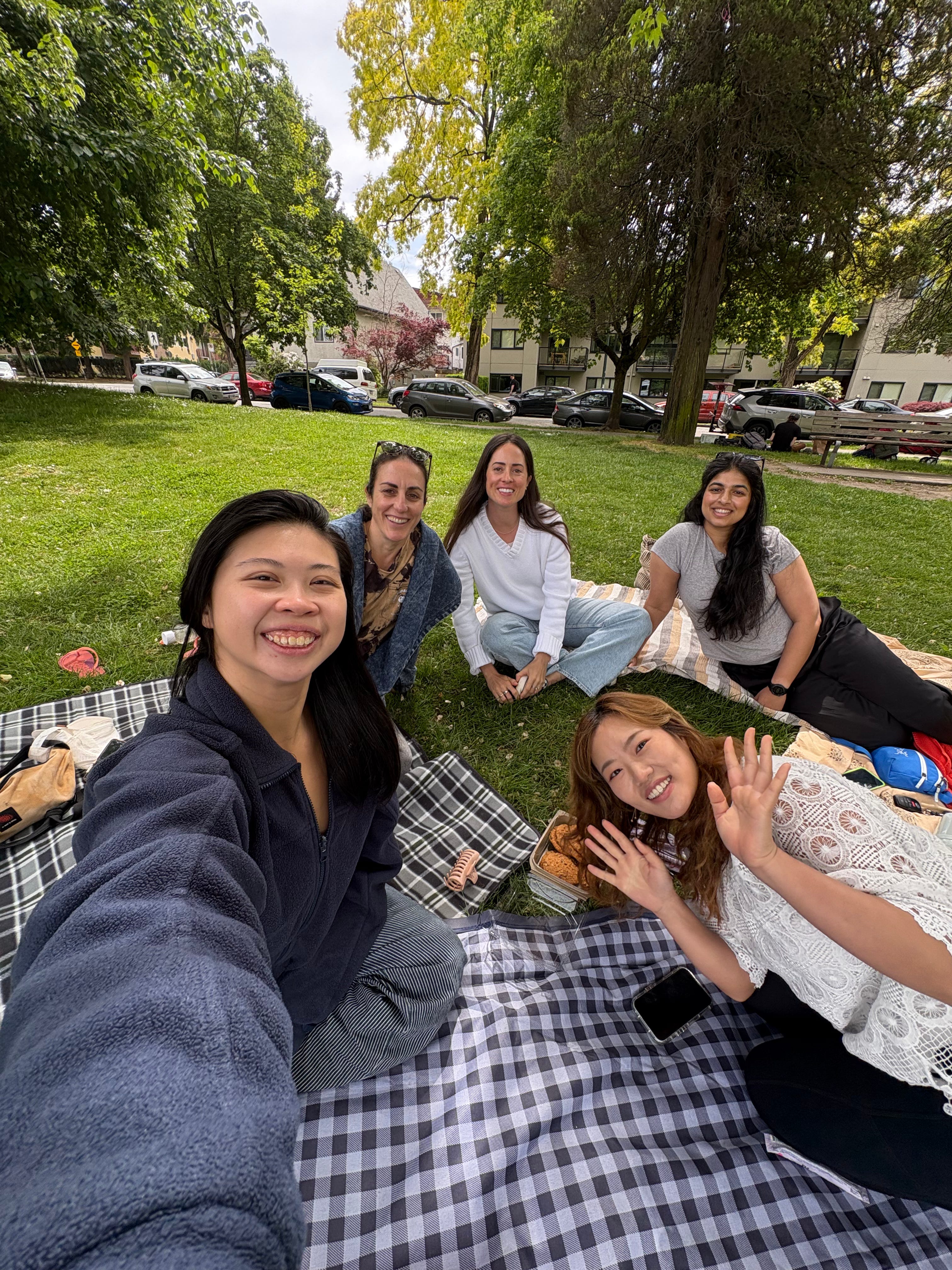
We were talking about ambition. Almost everyone at this table was at some kind of inflection point.
One person turned down a director role because of politics. She didn’t want to spend more of her time spent managing up instead of making things. Instead, she took a deliberate step down and told her manager on day one: your job is to protect me from the politics.
Another had been head of marketing, got into the rooms she’d spent years trying to get into, and realized she didn’t want to be there for the same reason. She couldn’t get her young CEO to a meeting. She was questioning whether to climb the ladder as an IC or as a manager and how that would affect motherhood.
The common theme was that as soon as someone was close to being on top of the career ladder, they saw the other side of the coin of being there. I also liked how careers and priorities might look at different stages in life.

i host these gatherings regularly, if you have any ideas on what you’d love to see, reply to this! if someone forwarded this to you — subscribe here.
if someone forwarded this to you and you want it in your inbox, subscribe by typing your email below. if you’re already subscribed: you’re my favorite person. thank you. if you could refer a friend, i’d so appreciate it! 🫶
Comments
Nothing yet. Say the first thing.
Sign in to join the conversation.