
Welcome to new readers of the American Geographical Society’s weekly, the AGS Globe! The Globe shares articles on geography and geospatial topics, as well as exciting opportunities and news from our network. As the world revolves, geography evolves. The mission of the AGS Globe is to bring our storied legacy of exploration and thought leadership into the frontiers of the future.

By Joel Pomeroy
Constant droughts, livestock dying, villages abandoned. In recent decades, these problems have become acutely familiar to the people of the Sahel region in Africa, the semi-arid transition zone between the Sahara Desert to the north and the humid Sudanian savannas to the south. Every year, the Sahara Desert creeps farther south, swallowing farmland, drying up rivers, and leaving communities in the sub-Saharan region struggling to survive. During some of the Sahel’s worst droughts in the early 1980s, Burkina Faso’s Marxist leader Thomas Sankara advocated a new vision for the region to combat desertification. This idea, revived in 2005, was to plant a wall of trees to hold back the encroaching desert. In 2007, the African Union, together with 11 Sahelian nations, formally adopted the initiative.
The initial plan, which came to be known as the Great Green Wall, involved planting a 10-mile-wide (16 km) barrier of trees stretching 4,350 miles (7,000 km) across the entire width of Africa. That is 250 million acres (100 million hectares), roughly four times the U.S. state of Wyoming. According to its founders, this ambitious undertaking would create 10 million new green jobs while removing 250 million metric tons of carbon dioxide from the atmosphere. With a target completion date of 2030, a global fundraising campaign and international collaboration were launched to bring the project to life.
It wasn’t long after it got off the ground that the project began to encounter serious challenges. The funding, the bulk of which came from the European Union and World Bank, proved insufficient for such an ambitious project. Ideological differences among the Sahelian countries also hampered coordination, resulting in some countries achieving far greater success in implementation than others. Civil wars and militant insurgencies, particularly in Sudan, Nigeria, and Mali, further complicated the initiative.
Most importantly, the project’s underlying approach came into question: around 80% of the planted trees died. In some areas, it was too dry to sustain the vegetation, while in others, unsuitable tree species had been planted. Even where the trees survived initially, they often received little follow-up care. Much of the sparsely populated region lacked enough people to maintain them, and in more populated areas, local communities (many of whom were pastoralists rather than sedentary farmers) had little incentive to keep the trees alive. Some experts criticized the project for reinforcing colonial-era narratives about desertification and for its reliance on Western funding, arguing that it represented a form of neocolonialism, just the opposite of Sankara’s original vision of self-reliance.
By the early 2010s, environmentalists and the project’s backers recognized these challenges and initiated a major strategic shift, fundamentally rethinking the initiative’s goals and methods. Instead of focusing just on a line of trees, the “wall” became more metaphorical. As Dr. Mohamed Bakarr of the Global Environment Facility later described it, the Great Green Wall would become a “mosaic” of sustainable land management projects tailored to local conditions and shaped by community participation. The new approach emphasized Indigenous land management practices which had already been used for centuries. In Niger and Burkina Faso, farmers revived traditional water-harvesting techniques such as zaï pits and demi-lunes (half-moon-shaped earthworks) to capture and retain rainwater in the region’s harsh, dry conditions. These methods concentrate water and organic matter around crops, improving soil fertility and increasing agricultural productivity on degraded land. According to Chris Reij, a Senior Fellow at the World Resources Institute (WRI) and an early critic of the project’s original design, these locally developed techniques are particularly effective because they inexpensively improve food security while restoring degraded land.
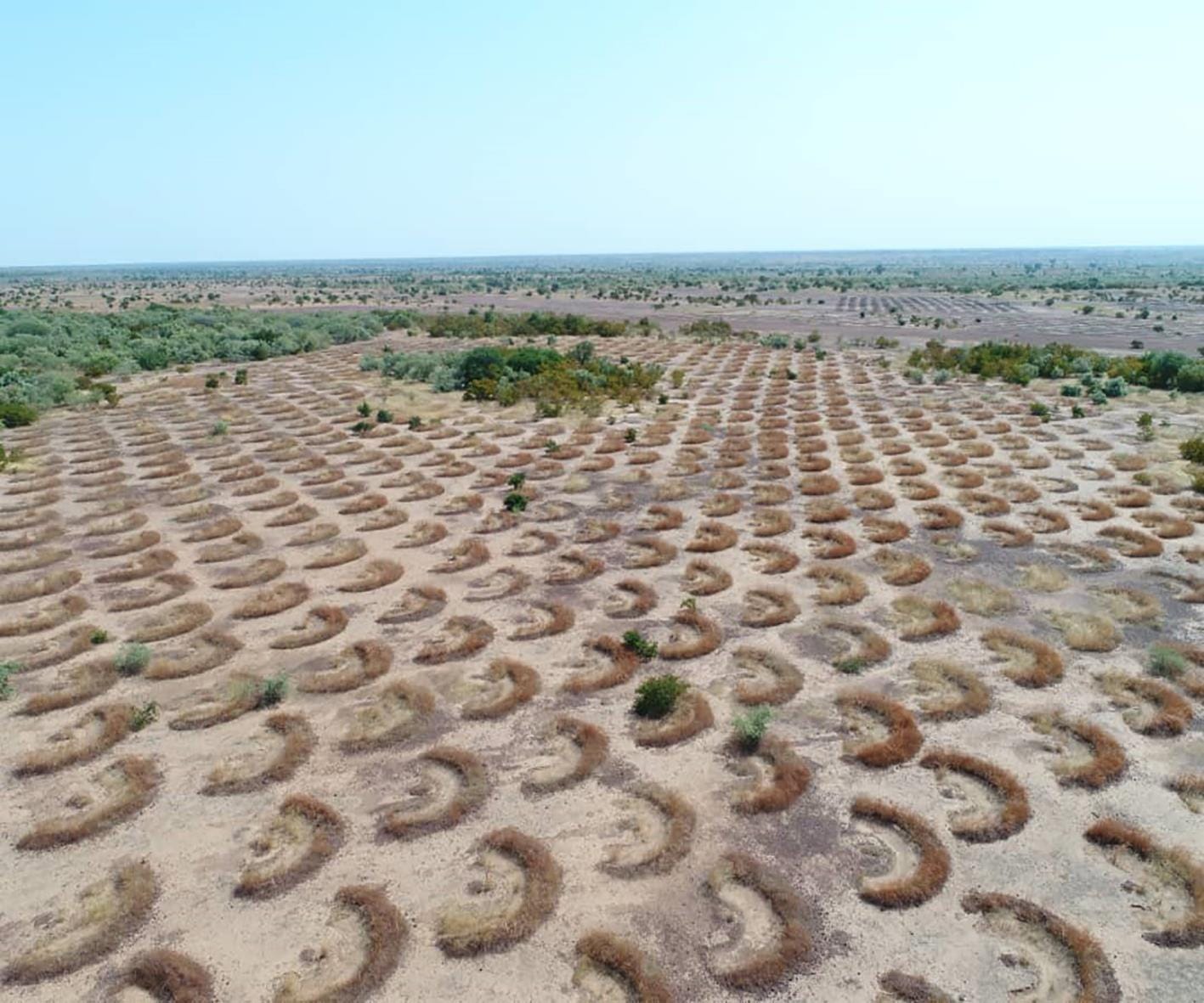
However, even with the refreshed focus, the project remained far behind schedule. A report released by the United Nations Convention to Combat Desertification (UNCCD) in 2020 found that less than 18% of the 250 million-acre target had been restored, which represents only 4% of the initiative’s original intervention zones. This is because some countries, notably Ethiopia, embarked on ambitious land restoration projects, much of which lay outside the initially designated area. The report also showed that the funding and monitoring issues had not been solved. Investors were concerned about the stability of some Sahel states, a foundational issue not addressed by the GGW. To reach the target by 2030, the project was estimated to cost at least $40 billion for land rehabilitation alone, not including other associated costs. The project’s finances would need to be dramatically revamped if there was any success to be had.
In response to these persistent funding and implementation challenges, world leaders, led by French President Emanuel Macron, launched the Green Wall Accelerator in 2021. The Accelerator raised additional funds for the project, beginning with an initial pledge of $14.3 billion and by 2025 raising $19 billion, still short of the amount required to complete the project. Beyond raising money, the Accelerator aims to improve coordination, strengthen local institutions, and ensure that funding reaches the communities carrying out the restoration work. As part of efforts to increase transparency and accountability, the Great Green Wall Observatory was launched in 2024, a dedicated online platform to monitor progress and track investments.
Despite the renewed support, the Great Green Wall still faces many of the same obstacles it did a decade ago. Without a single pooled fund, financing remains fragmented into a patchwork of slow, uncoordinated donor systems, and confusion over how pledged money is ultimately disbursed continues to delay projects on the ground. Political instability has only compounded these problems. A series of military coups in Mali, Burkina Faso, and Niger have reduced activity in some of the countries most affected by desertification, while making many international donors reluctant to invest there. Instead, funding has increasingly flowed to more stable countries such as Ethiopia and Senegal, rather than necessarily to those with the greatest need.
However, a few nations show promising signs. What began with 11 countries has since grown to more than 20 across Africa. Niger’s Farmer Managed Natural Regeneration (FMNR) program has revived traditional water-harvesting techniques to bring degraded land back into production at low cost. Ethiopia has restored nearly one million hectares and created roughly 218,000 jobs in the process, according to official statistics. Senegal, long considered the initiative’s exemplar, has restored some 850,000 hectares and benefited over 320,000 residents through its national reforestation agency, ASERGMV (though some questions remain about the survival rate of the millions of trees planted). These examples suggest that the Great Green Wall’s greatest achievements may not lie in the completion of a continuous “wall,” but in demonstrating what can be achieved when restoration efforts are adapted to local conditions, a foundation the initiative can build upon long after it inevitably falls short of its 2030 deadline.
References
Bourdin, Julie, Tommy Trenchard, and Maya Misikir. 2025. “COP30: The cautionary tale of the Sahel’s Great Green Wall” The New Humanitarian, November 11, 2025. https://www.thenewhumanitarian.org/investigations/2025/11/11/cop30-cautionary-tale-sahel-great-green-wall.
Bourdin, Julie, Tommy Trenchard, and Maya Misikir. 2026. “The Great Green Wall’s One of the World’s Most Ambitious Eco-Projects. Is It Working?” NPR, April 11, 2026. https://www.npr.org/2026/04/11/g-s1-114074/trees-africa-great-green-wall.
Brown, Audrey (presenter). 2023. “Is Africa’s Great Green Wall Failing?” The Inquiry. BBC, May 18, 2023. Audio, 24 min. https://www.bbc.com/audio/play/w3ct4wcv.
Food and Agriculture Organization of the United Nations (FAO). 2022. “Forest and Landscape Restoration and Sustainable Land Management in the Sahel: FAO Equips Six Rural Communities in Burkina Faso and Niger.” FAO Regional Office for Africa, March 7, 2022. https://www.fao.org/africa/news-stories/news-detail/Forest-and-landscape-restoration-and-sustainable-land-management-in-the-Sahel-FAO-equips-six-rural-communities-in-Burkina-Faso-and-Niger/en.
GGW Observatory. n.d. “Great Green Wall Observatory.” Accessed July 3, 2026. https://ggwobservatory.org/en/.
Great Green Wall Accelerator. 2025. Technical Brief #5. January 2025. https://static1.squarespace.com/static/564a15a0e4b0773edf86e3b4/t/67aa4f933aa8bc671830f867/1739214767650/5th+GGWA+Technical+Brief_JAN25+ok2.pdf.
Goffner, Deborah, Hanna Sinare, and Line J. Gordon. 2019. “The Great Green Wall for the Sahara and the Sahel Initiative as an Opportunity to Enhance Resilience in Sahelian Landscapes and Livelihoods.” Regional Environmental Change 19: 1417–1428. Published March 9, 2019. https://doi.org/10.1007/s10113-019-01481-z.
Hidri, Sghaier. 2023. “The Green Wall Project to Restore the African Sahara Is Collapsing.” The Independent, December 12, 2023. https://www.independent.co.uk/news/world/africa/great-green-wall-africa-sahel-b2462087.html.
IRIN News. 2011. “Opposition to Building the Great Green Wall.” IRIN News (now The New Humanitarian), April 8, 2011. https://www.thenewhumanitarian.org/feature/2011/04/08/opposition-building-great-green-wall.
Millison, Andrew. 2024. “How the UN Is Holding Back the Sahara Desert.” YouTube video, February 18, 2024.
Morrison, Jim. 2016. “The ‘Great Green Wall’ Didn’t Stop Desertification, but It Evolved into Something That Might.” Smithsonian Magazine, August 23, 2016. https://www.smithsonianmag.com/science-nature/great-green-wall-stop-desertification-not-so-much-180960171/.
Nature. 2023. Is Africa’s Great Green Wall project withering? Nature 616: 412. https://doi.org/10.1038/d41586-023-01293-6
Planet Wild. 2023. “Growing Hope: Africa’s Ambitious Great Green Wall Initiative.” Planet Wild Blog, November 7, 2023. https://planetwild.com/blog/africas-great-green-wall.
Schleeter, Ryan, and Rachel Graham. 2025. “The Great Green Wall.” National Geographic Education, last updated September 3, 2025. https://education.nationalgeographic.org/resource/great-green-wall/.
United Nations Convention to Combat Desertification (UNCCD). n.d. “Green Wall Accelerator.” Accessed July 3, 2026. https://www.unccd.int/our-work/ggwi/great-green-wall-accelerator.
United Nations Convention to Combat Desertification (UNCCD). 2023. Independent Review of the Great Green Wall Accelerator: Final Report. Bonn: UNCCD. https://www.unccd.int/sites/default/files/2024-05/GGWA%20review%20final%20report%20formatted.pdf.
United Nations Convention to Combat Desertification (UNCCD). 2020. The Great Green Wall: Implementation Status and Way Ahead to 2030. Prepared by Climatekos gGmbH. Bonn: UNCCD, September 7, 2020. https://www.unccd.int/sites/default/files/2024-08/1551_GGW_Report_ENG_Final_040920.pdf.
Zhu, Annah Lake, and Amadou Ndiaye. 2025. “Africa’s ‘Great Green Wall’ Is Stalling: In Senegal Very Few Planted Areas Show Progress.” The Conversation, October 7, 2025. https://theconversation.com/africas-great-green-wall-is-stalling-in-senegal-very-few-planted-areas-show-progress-265409
Thanks for reading The AGS Globe! This post is public, so feel free to share it.
Did you enjoy reading this? Support the American Geographical Society today with a donation of $50 to help us support Geography education.

Members of the American Geographical Society enjoy reduced-price access to AGS events and free access to the online version of Geographical Review.


Submit Lightning Talk and Exhibition Poster Proposals Today! Speak at our annual fall symposium, Geography 2050: Africa Shaping Tomorrow, taking place this November 19-20, 2026, at the Schomburg Center for Research in Black Culture in New York City! By 2100, over one-third of the world’s population will live in Africa, already the world’s youngest and fastest-growing continent, with profound implications for the interconnected human and environmental dimensions of the transformative demographic and technological boom across Africa. Submit proposals to speak at Geography2050 here!
Our Geography 2050 Trip Planning Page is Up! You can view information about this year’s venue and our partner hotels with Special Symposium Rates. Early birds can register for the lowest ticket price and book their stay at Aloft Harlem at this special rate TODAY by going to the Geo2050 Trip Planning page.
Comments
Nothing yet. Say the first thing.
Sign in to join the conversation.