
Welcome to new readers of the American Geographical Society’s weekly, the AGS Globe! The Globe shares articles on geography and geospatial topics, as well as exciting opportunities and news from our network. As the world revolves, geography evolves. The mission of the AGS Globe is to bring our storied legacy of exploration and thought leadership into the frontiers of the future.

By Ivana Mowry-Mora
Some artifacts preserve history. Others participate in it.
The American Geographical Society’s Fliers’ & Explorers’ Globe is one of the world’s most remarkable historical objects—not because of where it has been, but because of who has left their mark upon it. For nearly a century, this 18-inch (46 cm) globe has served as a living record of humanity’s greatest feats of exploration, bearing the signatures and routes of those who pushed beyond the known boundaries of Earth, the skies, the oceans, and even space.
The story of the Fliers’ & Explorers’ Globe began in 1929, when John H. Finley, then President of the American Geographical Society and Editor-in-Chief of The New York Times, presented the Society with an extraordinary gift.
Finley invited the leading explorers and aviators of his era to do something unique: trace their historic journeys directly onto an 18-inch globe and sign their names beside their routes. Rather than creating another commemorative object, he envisioned a globe that would continually evolve as new frontiers were crossed.
Nearly one hundred years later, that vision continues. With over eighty signatures, the globe has become a priceless symbol of humanity’s enduring desire to discover the unknown.
Unlike a traditional museum artifact frozen in time, the Fliers’ & Explorers’ Globe continues to grow with each generation of explorers.
Those invited to sign the globe have accomplished genuine geographic firsts or have expanded the limits of human achievement. Signers are individuals who have:
Explored regions previously unknown in recorded history.
Reached unprecedented heights, depths, or distances.
Pioneered new methods of exploration or transportation.
Set historic aviation records.
Advanced humanity’s understanding of our planet—and beyond.
Their achievements often came at extraordinary personal risk, reflecting the courage and determination that have long defined exploration.
The names inscribed on the globe read like a timeline of exploration.
Among them are aviation pioneers Charles Lindbergh and Amelia Earhart, whose flights transformed the possibilities of global travel. Mountaineer Sir Edmund Hillary, one of the first people to summit Mount Everest, represents the triumph of exploration at Earth’s highest elevations.
The globe also honors ocean explorer William Beebe, whose pioneering deep-sea expeditions revealed a world few had ever witnessed, and the Apollo 8 astronauts, whose mission carried humanity beyond Earth's orbit for the first time. Neil Armstrong's signature extends that legacy even farther, commemorating the first human footsteps on the Moon.
From the deepest oceans to the highest mountains—and ultimately into space—the globe reflects how every generation has redefined the meaning of exploration.
Signing the Fliers’ & Explorers’ Globe is among the American Geographical Society’s highest honors. A careful selection process ensures that every signature represents a truly exceptional contribution to exploration and geographic discovery. Each new signature adds another chapter to an ongoing narrative that spans continents, oceans, skies, and space.
The Fliers’ & Explorers’ Globe is far more than a collection of signatures.
It represents nearly a century of human curiosity, perseverance, and innovation. Every line drawn across its surface marks a journey into the unknown. Every signature reflects an individual willing to accept extraordinary risk in pursuit of discovery.
From crossing oceans by aircraft to climbing Earth’s highest peaks, from exploring the deepest seas to setting foot on the Moon, the globe tells a single, powerful story: humanity has always been driven to explore.
As the American Geographical Society continues this remarkable tradition, the Fliers’ & Explorers’ Globe remains a living testament to one of our species’ defining characteristics—the relentless pursuit of what lies just beyond the horizon.
For nearly a century, the American Geographical Society’s Fliers’ & Explorers’ Globe has documented the milestones of human exploration—from pioneering flights across oceans to journeys into space. Each new signature connects today’s explorers with the extraordinary individuals who came before them, preserving a legacy of courage, curiosity, and discovery.
On September 15, that legacy will continue as renowned explorer, oceanographer, and astronaut Dr. Kathy Sullivan adds her signature to the historic Fliers’ & Explorers’ Globe during a special ceremony at The Explorers Club in New York City. Dr. Sullivan made history as the first American woman to walk in space and later became the first person to both walk in space and reach the deepest point in the ocean, embodying the very spirit of exploration the globe celebrates.
Join us at this historic globe signing!
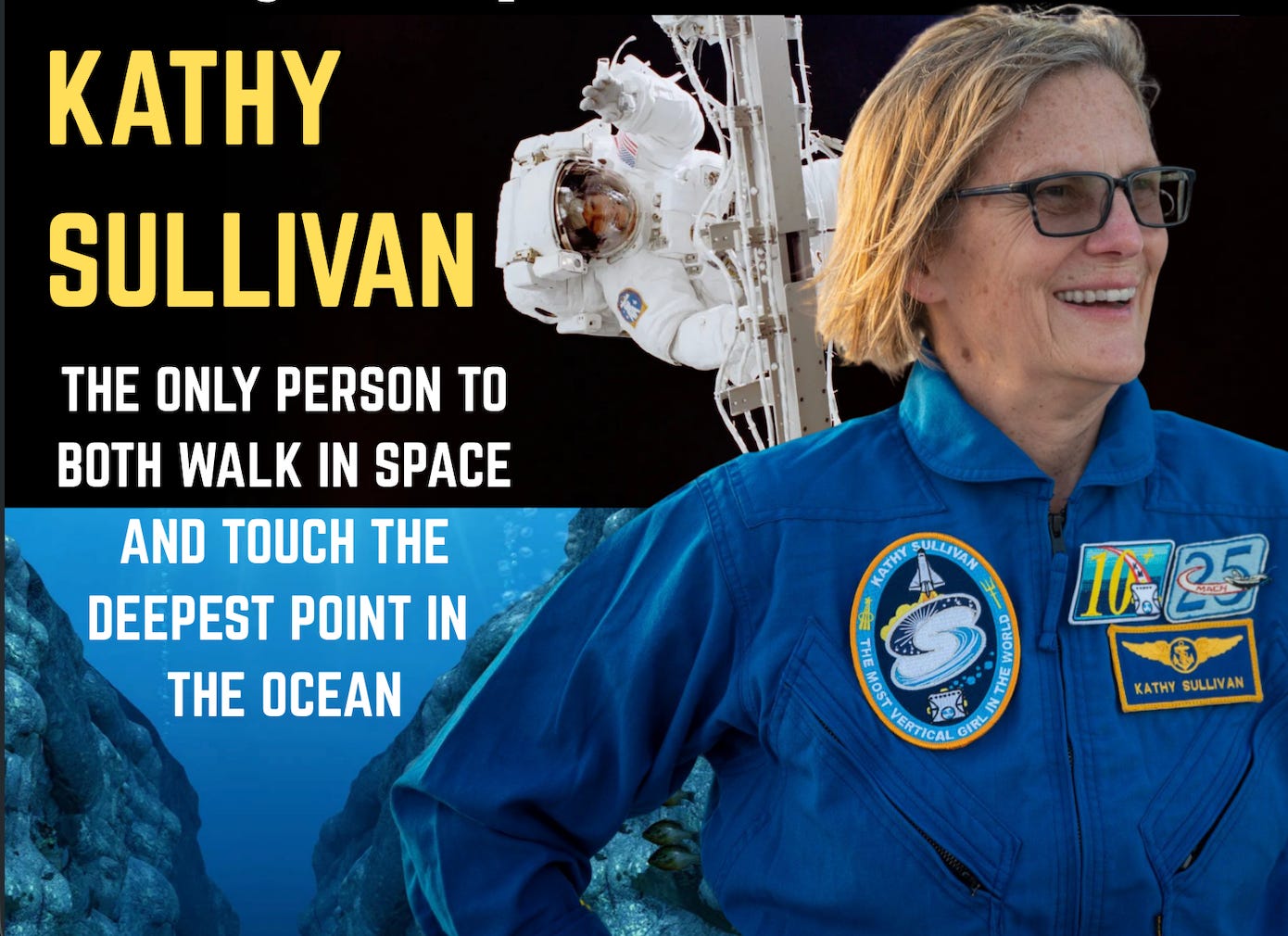
As the American Geographical Society marks its 175th anniversary, we invite you to witness this historic moment in person. Support the Society’s 175 Campaign with a gift of $175 or more and receive an invitation to this exclusive event, where you’ll have the opportunity to see one of the world’s most extraordinary historical artifacts gain its newest signature.
Spencer, Luke. The Most Remarkable Globe in The World Is in a Brooklyn Office Building. Atlas Obscura. https://www.atlasobscura.com/articles/the-most-remarkable-globe-in-world-is-in-a-brooklyn-office-building
Thanks for reading The AGS Globe! This post is public, so feel free to share it.
Did you enjoy reading this? Support the American Geographical Society today with a donation of $50 to help us support Geography education.

Members of the American Geographical Society enjoy reduced-price access to AGS events and free access to the online version of Geographical Review.


Submit Lightning Talk and Exhibition Poster Proposals Today! Speak at our annual fall symposium, Geography 2050: Africa Shaping Tomorrow, taking place this November 19-20, 2026, at the Schomburg Center for Research in Black Culture in New York City! By 2100, over one-third of the world’s population will live in Africa, already the world’s youngest and fastest-growing continent, with profound implications for the interconnected human and environmental dimensions of the transformative demographic and technological boom across Africa. Submit proposals to speak at Geography2050 here!
Our Geography 2050 Trip Planning Page is Up! You can view information about this year’s venue and our partner hotels with Special Symposium Rates. Early birds can register for the lowest ticket price and book their stay at Aloft Harlem or the Renaissance New York Harlem Hotel at this special rate TODAY by going to the Geography 2050 Trip Planning page.
Comments
Nothing yet. Say the first thing.
Sign in to join the conversation.