
Welcome to new readers of the American Geographical Society’s weekly, the AGS Globe! The Globe shares articles on geography and geospatial, along with exciting opportunities and news from our network. Our pieces fall under four categories: Exploring the World, Championing Geography, Mapping the News, and EthicalGEO. As the world revolves, geography evolves. The mission of the AGS Globe is to bring our storied legacy of exploration and thought leadership into the frontiers of the future.

By Lauren Johnson
In the Russian Far East region, ancient permafrost that covers the Siberian terrain has been thawing rapidly and transforming the physical landscape in ways not documented in recorded history. Yakutia, Sakha Republic, is an indigenous, semi-autonomous region in northeastern Siberia, known for its arctic landscape and extreme temperatures. The region is geographically expansive and covered by tundra, a landscape that makes up 65% percent of Russia’s landmass. Deep within the Siberian tundra, the world’s largest permafrost crater is eroding the landscape and growing rapidly. The Batagaika Crater (also known as the Batagay Megaslump) is a 3,000-foot-wide (914 m) depression of thawing permafrost. The crater formed after a nearby forest was clear-cut in the 1950s and 1960s, exposing the frozen ground and allowing the permafrost to start melting. In recent years, the accelerated thawing has made the ground unstable, creating new geologic features and unearthing prehistoric fossils. For Siberian communities, the Batagaika Crater is a visible warning of how a warming climate is reshaping one of the coldest places on Earth, and transforming the landscape into an encroaching danger.
The Batagaika Crater
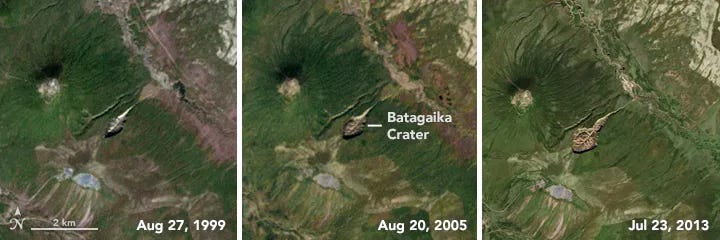
Named from the nearby Batagayka River and town of Batagay, the Batagaika Crater is the world’s largest megaslump, or rapidly expanding arctic landslide composed of frozen soil and ice. This type of mass wasting is unique to polar regions, where the ground is composed of permafrost. Although it’s called a crater, Batagaika is a type of landslide that occurs when permafrost thaws and loses structural support. The terrain slides downward and exposes more frozen organic material. Because of this, Batagaika is the largest known geologic feature of its kind. Since the 1990s, scientists estimate that the Batagaika megaslump has moved over 1.23 billion cubic feet (35 million cubic meters) of ground volume. Satellite records reviewed by the U.S. Geological Survey (USGS) show that the feature has widened and expanded dramatically over several decades. In recent years, new measurements show that the megaslump area has tripled between 1991 and 2018, with newer, rapid expansion between 2010 and 2014.
In Yakutia, the permafrost terrain contains large volumes of ice and ancient soil sediments, typically frozen for two consecutive years, but much of it has remained frozen for a millennium. Rising global temperatures have disturbed the soil surface layer, as well as deforestation, climate-induced wildfires, erosion, and new human development. Once the permafrost layer starts to thaw, the landscape underneath it loses its structure, buckles, and collapses unevenly. New geologic features are forming as a result of the rapid thawing, such as irregular depressions in the terrain, mounds, ravines, more slumps, and nearby thawing ponds contributing to more irregularities. This process is called thermokarst terrain, and it’s usually self-reinforcing. As the terrain collapses, more frozen material is exposed to air and sunlight, and that new exposure thaws what’s underneath, causing additional collapse and irregularities. At Batagaika, the thermokarst process began after nearby forests were clear-cut and removed in the 1950s and 1960s. Without a tree canopy to insulate the ground, sunlight warmed the exposed surface and accelerated thaw.
The instability of the land is weakening the physical and cultural foundation of communities that have long depended on the permanent stability of the land. Indigenous communities in Yakutia approach the area with caution. Scientists and locals describe the crater as quite noisy. There are ominous booming and crashing sounds from collapsing earth, trees snapping in half, and water crashing into the crater. Some have even nicknamed it the “Doorway to Hell”. For communities across Yakutia, permafrost thaw represents a new threat to the ground beneath homes, roads, pipelines, and community infrastructure. The expansion of the slump is “a sign of danger,” says Nikita Tananayev of the Melnikov Permafrost Institute. Settlements across this region are already experiencing damage. An airport runway has turned into a swampy field, transportation routes are buckling under the thaw, and traditional homes built on stable permafrost now have unstable foundations.
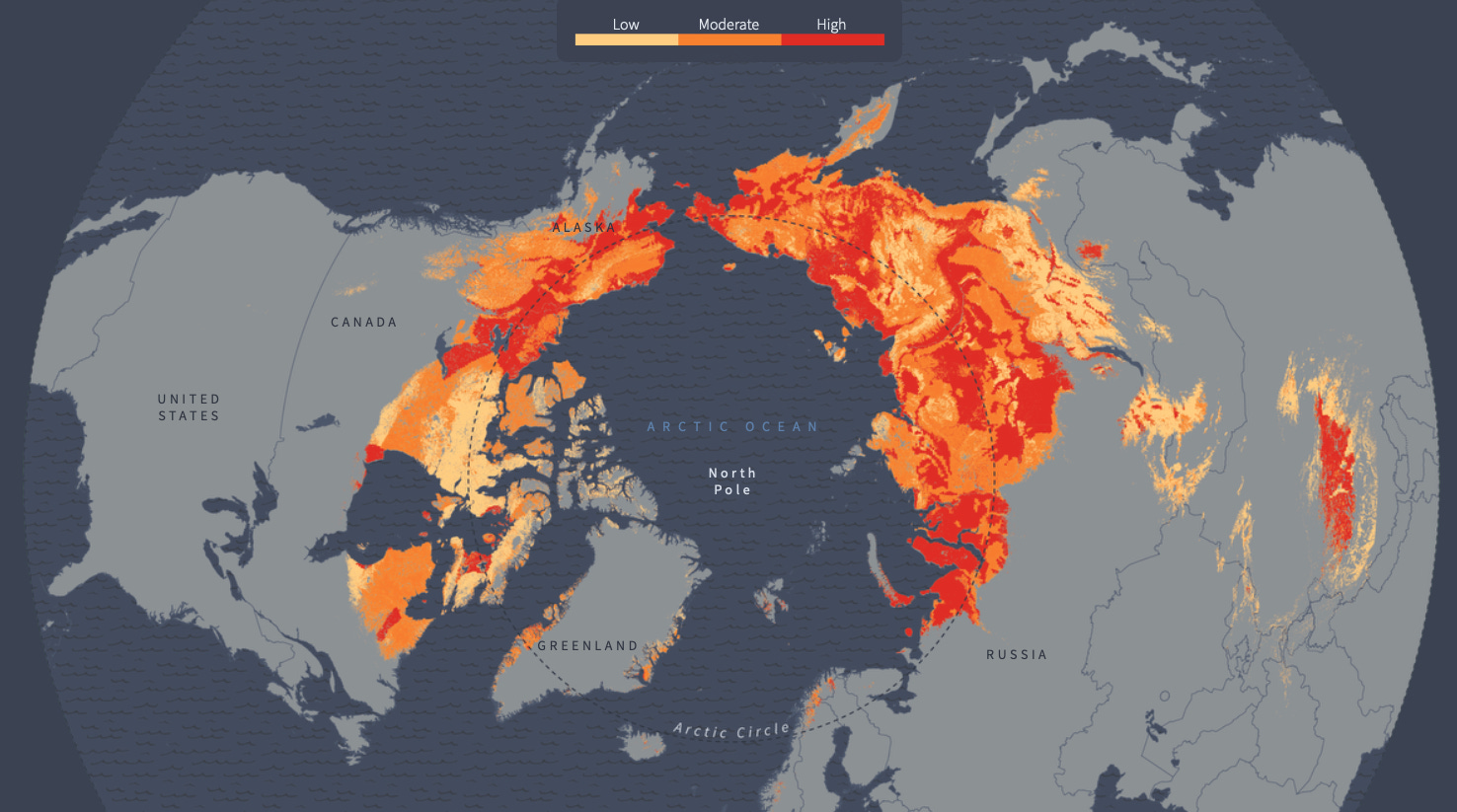
In spite of all the loss to communities, there are some benefits to science and archaeology, as rapid permafrost thawing is reshaping the landscape and opening a rare window into the ancient past. The exposed megaslump terrain walls now reveal frozen sediments that may date back hundreds of thousands of years. The USGS reports that some layers at the bottom of the crater may be up to 650,000 years old. Researchers can now examine ancient biological material within permafrost cross-sections that were previously inaccessible and study how Siberian environments changed across glacial cycles. The megaslump has also unearthed mummified wildlife and fossil remains. For example, in 2018, scientists discovered the remains of a 42,000-year-old extinct horse species. In 2024, a 50,000-year-old baby mammoth was uncovered and was described as the best-preserved mammoth carcass in the world. These discoveries are giving Batagaika immense scientific value, but at the cost of destroying the frozen ground that once preserved it.
A Global Impact
The consequence of the permafrost thaw will not be constrained to Siberia. Rapid permafrost thawing amplifies climate change by releasing greenhouse gases from deep, ancient carbon reservoirs that were previously stable. Permafrost contains organic matter that has been locked away from decomposition due to the arctic conditions of Siberia. When that organic matter thaws, microbes and bacteria begin breaking it down, releasing carbon dioxide, methane, and nitrous oxide into the atmosphere. At Batagaika Crater, the megaslump contains an enormous amount of organic carbon, releasing approximately 4,000 to 5,000 tons of carbon per year. The USGS reports that the thawing is creating a feedback loop. Rising temperatures thaw permafrost, thawed permafrost releases greenhouse gases, and those gases contribute to our warming climate. Russia is warming at least 2.5 times faster than the global average as a result of a thawing tundra that covers about 65% of the country’s landmass.
The Batagaika crater is both a local and global problem. It poses an imminent threat to the Indigenous and rural communities whose homes, roads, and livelihoods depend on stable ground. It also represents an imminent global threat due to the rapid release of greenhouse gases into our atmosphere. This Siberian anomaly reminds us that even in the most remote and frigid places on Earth, human activities everywhere contribute to a warming and dynamically evolving planet.
Batagaika Crater, Russia | EROS. (n.d.-b). https://eros.usgs.gov/earthshots/batagaika-crater-russia
Ellis, S. (2026b, June 1). Siberia’s ‘Gateway to Hell’ is getting bigger. And it’s spewing out prehistoric animals. Discover Wildlife. https://www.discoverwildlife.com/environment/batagay-crater-gateway-to-hell
Gibbens, S. (2017, March 2). Siberia’s growing “Doorway to Hell” offers clues on climate change. Science. https://www.nationalgeographic.com/science/article/siberia-batagiaka-crater-climate-change
Leffer, L. (2024, June 4). Earth’s ‘Gateway to Hell’ is growing. Popular Science. https://www.popsci.com/science/batagaika-crater-gateway-to-hell/
Murton, J., Opel, T., Wetterich, S., Ashastina, K., Savvinov, G., Danilov, P., & Boeskorov, V. (2023c). Batagay megaslump: A review of the permafrost deposits, Quaternary environmental history, and recent development. Permafrost and Periglacial Processes, 34(3), 399–416. https://doi.org/10.1002/ppp.2194
Shemetov, M. (2021, October 18). Russia’s remote permafrost thaws, threatening homes and infrastructure. Reuters. https://www.reuters.com/world/europe/russias-remote-permafrost-thaws-threatening-homes-infrastructure-2021-10-18
Pinkham, S. (2024, May 23). A Giant Crater in Siberia Is Belching Up Russia’s Past. The New York Times. https://www.nytimes.com/2024/05/23/opinion/russia-oil-mining-permafrost.html
Papachristou, L. (2023, July 21). World’s biggest permafrost crater in Russia’s far east thaws as planet warms. Reuters; https://www.reuters.com/business/environment/worlds-biggest-permafrost-crater-russias-far-east-thaws-planet-warms-2023-07-21/
Thanks for reading The AGS Globe! This post is public, so feel free to share it.
Did you enjoy reading this? Support the American Geographical Society today with a donation of $50 to help us support Geography education.

Members of the American Geographical Society enjoy reduced-price access to AGS events and free access to the online version of Geographical Review.


Attention APHG Teachers - Join AGS in New York City this November as a Geography 2050 Teacher Fellow! In addition to regular symposium sessions, our fellows participate in two days of specialized workshops where they can connect with other educators, get access to new classroom tools, and learn about college and career pathways for their students. Applications are open until June 14th and can be found on the Geography Educator Initiative page of our website.
Submit Lightning Talk and Exhibition Poster Proposals Today! Speak at our annual fall symposium, Geography 2050: Africa Shaping Tomorrow, taking place this November 19-20, 2026, at the Schomburg Center for Research in Black Culture in New York City! By 2100, over one-third of the world’s population will live in Africa, already the world’s youngest and fastest-growing continent, with profound implications for the interconnected human and environmental facets of the transformative demographic and technological boom across Africa. Submit proposals to speak at Geography2050 here.
Comments
Nothing yet. Say the first thing.
Sign in to join the conversation.