

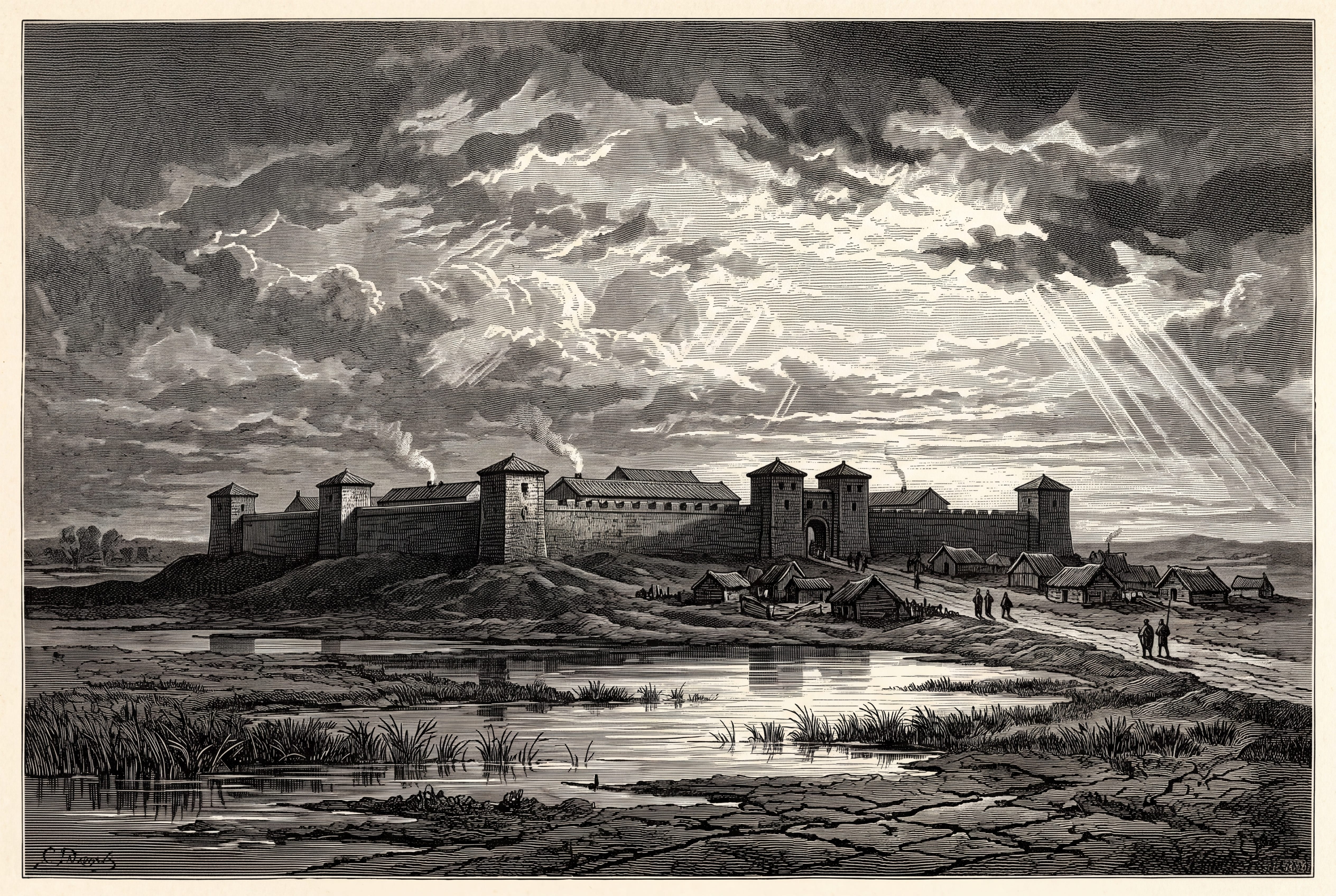
On memory, murder, and justice for the powerless: the themes behind The Defixio, a literary mystery set on Rome’s northern frontier.
In AD 364, on the worst-supplied edge of the Roman Empire, a drain backs up under a barracks floor and a physician finds a child’s skull packed in lime. Next to it lies a thin sheet of lead, rolled tight, pierced through the center with a bent iron nail. The writing runs backward, right to left, so you need a polished surface to read it. Hold a mirror to the metal and the letters resolve into a sentence. A name. A curse. A demand that the ground refuse to keep the secret it was forced to hold.
That object is a defixio, and it gives my first novel its title.
A defixio is a Roman curse tablet: a sheet of lead inscribed with a grievance, addressed to the gods of the underworld, then rolled, nailed, and dropped into a well or a grave. People wrote them when the law had nothing to offer. The Defixio is the story of what happens when a trained, exact, deeply skeptical man finds one, and cannot make himself look away.
The idea underneath the whole book is simple. A Roman fort ran on writing. Grain counts, duty rosters, sick lists, supply requisitions, the daily arithmetic of keeping several hundred men fed and armed at the end of the supply line. That official record is the spine of the garrison. It is also the murder weapon. Wax tablets can be scrubbed flat and rewritten. A requisition can be forged in a clean hand. A name can be lifted out of the ledger as if it had never been entered, and once it is gone, there is no body, no crime, no boy.
So the powerless kept a second record. They wrote their dead into lead and gave them to the gods. That record cannot be edited, because no officer in the garrison can touch it without admitting he knows what he would be responding to. A curse tablet exists in a category Roman command cannot reach.
My physician, Zoilos of Pergamon, spends the book caught between those two archives. One is admissible and worthless. The other is illegal and true. The question the novel keeps asking is which one a person should trust, and what it costs to choose.
Most period mysteries hand you an amateur sleuth with a hunch. Zoilos is something more specific, and it changes the whole texture of the book. He is a military medicus trained in Pergamon, one of the great medical centers of the ancient world, and his mind works the only way it knows how: clinically. He counts a pulse. He reads a tremor. He notes the temperature of his own hands the way he would note a patient’s, as a symptom to be filed.
When he kneels over a skeleton, he does not feel a thriller coming on. He runs a differential. He examines the suture line at the crown and registers that the margin is smooth and unweathered, which is wrong for the age of the bones. He builds an evidence chain link by link, and he refuses to let himself feel anything until the diagnosis holds at every junction.
That detachment is the engine of the book, and it is also the thing the story breaks. Watching a careful man’s clinical armor crack, one observed detail at a time, turns out to be far more frightening than any chase.
Curse tablets are real, and they are everywhere in the Roman world, from Bath to Uley to Carthage. The largest British cache came out of the sacred spring at Bath, where the scholar Roger Tomlin has read well over a hundred of them. Most are not the work of witches. They are ordinary people seeking redress for ordinary wrongs: a stolen cloak, an unpaid debt, a betrayal. They are petitions for justice, filed with the underworld because the surface world would not hear them.
Three miles from the fort in my novel sits Coventina’s Well, a real sacred spring that yielded thousands of Roman coins along with inscribed lead tablets across the centuries of the garrison’s life. People deposited there for the same reason people have always turned to ritual when the system fails them. They wanted the wrong to be on the record somewhere. They wanted it to count.
That is the heart of the book. A curse tablet is the testament of someone with no standing, no Latin education, and no recourse, who refuses to let an injustice vanish. In The Defixio, a Brigantian brewer named Brica has been making them, one per missing day, scratching a dead child’s name into lead with her own semi-literate hand. They are the most damning evidence in the fort, and the only honest dated document that records the boy existed at all.
Romans did not bury their dead inside the walls. They buried them outside, along the roads, where the living passed and remembered. To put a body under a barracks floor was to break that rule on purpose, and breaking it on purpose meant the burial was never meant to be found.
This is where the novel touches something genuinely unsettling from the ground itself. A child’s skeleton was recovered from beneath a barrack floor at Vindolanda, set in a shallow pit in a way that violated every Roman funerary norm. The real find dates earlier than my story, and I moved it forward in time, but the wrongness of it is documented. Someone, at some point on that frontier, put a child where a child should never go, and the soil kept the evidence for seventeen centuries.
The buried child is the moral center of The Defixio. The institution wants the body to stay a drainage problem. Zoilos wants it to have a name. Everything in the book turns on that distinction, because a name is the one thing the official record was edited to destroy.
This is the question I most want readers to ask, because the answer is the whole pleasure of the genre.
The world is built on fact. In 1973, archaeologists pulling thin wooden leaves from the waterlogged mud at Vindolanda recovered the richest cache of everyday Roman writing to survive anywhere: duty rosters, a strength report for the First Cohort of Tungrians, requests for beer, and a birthday invitation from one officer’s wife to another written around AD 100, which carries the earliest known example of a woman’s handwriting in Latin. Those tablets, edited by Alan Bowman and David Thomas, gave me the texture of frontier life: the grain shortages, the petty corruptions of supply, the multilingual units, the quiet evidence that Roman justice on the empire’s edge was pragmatic, sometimes venal, and rarely the tidy instrument later ages imagined.
The conspiracy at the book’s edges is real too. The arcani, the late-Roman frontier scouts whose betrayal the historian Ammianus Marcellinus blamed for the Barbarian Conspiracy of AD 367, existed. A fragmentary Vindolanda tablet even carries the partial inscription MILES ARCAN, which scholars still argue over.
None of my named characters are historically attested. Zoilos, Brica, the murdered child, the officers who buried him, are all invention. But every element they are built from was present on that frontier. No source records this particular scene, and every ingredient in it is documented. That, to me, is the contract of good historical fiction.
If you read Lindsey Davis for the texture of Roman administration, Robert Harris for the pressure of an individual conscience against a system, or Umberto Eco and Iain Pears for the slow, intellectual unspooling of a historical mystery, The Defixio is built for you. It is a slow burn with forensic rigor and a moral spine, closer to a literary procedural than a fast thriller. The investigation is medical. The stakes are bureaucratic, and somehow that makes them worse. The horror is not a monster. It is a scrubbed wax tablet and a forged signature in a hand that looks almost exactly like your own.
It is a book about a stubborn, principled outsider who decides that keeping faith with the dead is worth more than his own safety, and about the two kinds of record a frontier leaves behind when justice is not available: the one a system can erase, and the one it cannot.
What does defixio mean? It is the Latin term for a Roman curse tablet, an inscribed sheet of lead used to petition the gods for justice or vengeance, usually rolled, pierced with a nail, and deposited in water or a grave.
Where is The Defixio set? At a Roman auxiliary fort on the northern British frontier in AD 364, in the late-empire world of Hadrian’s Wall.
Is it based on real history? Yes. The Vindolanda writing tablets, the curse-tablet tradition, the intramural child burial, and the arcani are all attested. The characters and plot are invented and grounded in that record.
Do I need to know Roman history to read it? No. The novel carries you through its world from inside one man’s eyes. The history rewards you if you know it and never blocks you if you don’t.
What kind of mystery is it? A literary, slow-burn historical mystery with a forensic and medical core and an ethical center, for readers of intelligent historical crime.
The Defixio is Book One of The Frontier Physician Series. You can read it here.
If the idea of two records, the one that can be forged and the one that cannot, stays with you the way it stayed with me, subscribe. I write about the history under the fiction, the frontier, and what it costs to keep a name on the record. [SUBSCRIBE]
Comments
Nothing yet. Say the first thing.
Sign in to join the conversation.