

Two episodes, and we have not yet let the legend stand.
In the first, we built the machine. A name that stood level with kings. A husband who taught cruelty by example and called murder excessive. A frontier so soaked in war that a beaten girl did not register. A law that gave a noblewoman near-total power over the bodies of the people beneath her, and gave those people no door to knock on. And then, one January morning in 1604, the death of the one man who had ever told her no.
In the second, we went into the cellars. And we found that the machine ran for twenty years on the bodies of servant girls, and nothing happened, because nobody counts a servant. It only jammed when she started taking in the daughters of the gentry, girls with names, girls with families who could write to a King. We found the three hundred witnesses, and we found that most of them were repeating rumor, and that the famous six hundred and fifty came from one woman describing a book that was never found. And underneath all of it, when we stripped the hearsay away, we found something real and small and terrible. A shoemaker’s daughter named Illonka. A young mother named Modl. Eighty counts of murder. And a woman who was never put on trial for any of it.
That last part is where tonight begins. She was never tried.
The most notorious woman in European history, and there was no trial. No verdict. No sentence. A wall, a slot for food, and four years of silence.
Tonight we ask why. And the answer is going to lead us somewhere the legend never wants to go.
To the money.
It is 1610. A woman rides to collect a debt.
She is a widow now, six years widowed, and she is one of the wealthiest landholders in the kingdom, and the kingdom owes her money. A great deal of it. Loans her late husband made to the crown, to pay for the war against the Turk, back when the crown could not pay for its own war. That debt did not die with him. It passed to her, the way the land passed to her, the way everything passed to her.
So she does what any creditor does. She goes to be paid.
The man who owes her is the King. Matthias, the second of that name. And Matthias does not have the money. Matthias never has the money. He is a Habsburg on a broke throne, propping up a war with borrowed coin, and here is this Protestant widow at his door with a ledger of her own, a real one, asking for what is hers.
Some weeks later, the King writes a letter.
He asks the Palatine of Hungary, the highest officer in the land, to look into some troubling rumors about the Countess Báthory.
Some weeks. That is the gap. She asks to be paid, and some weeks later the machinery of her destruction begins to turn.
I want to be careful with you tonight, more careful than usual, because tonight is the episode where it would be easy to lie to you. And the lie is seductive in both directions.
There is a version of this story where she is a monster, full stop, and the number is six hundred and fifty, and she bathed in blood, and justice found her. We spent two episodes taking that version apart. It is not true.
But there is a second version, and it has become fashionable, and it is just as clean, and I do not fully trust anything that clean. In this version she did nothing. She was innocent. A powerful widow with land the crown wanted and a debt the crown could not pay, and they invented the whole thing, the girls, the graves, the confessions, all of it, to take her property and cancel their debt. A woman destroyed for the crime of being rich and female in a country run by frightened men.
That version is powerful because most of its pieces are true. The debt was real. The motive was real. The trial was no trial. The confessions came out of torture. The most famous historians of her own country have argued exactly this.
So tonight we do the hard thing. We build that case, the case that she was framed, as strongly as it can be built. We bring in the money and the politics and the collapse of her family and the rotten legal process, and we make it stand up. And then we test it. We push on it and see what holds.
Because the truth of Elizabeth Báthory is not that she was a monster, and it is not that she was innocent. The truth is worse than either, and it is this. Both things happened at once. Real girls died in that castle, and powerful men used their deaths for profit. She was guilty, and she was framed. Those are not opposites. In this story, they are the same event.
And at the end, we will follow her out of the grave, into the two hundred years of invention that turned a Hungarian widow into a vampire, and we will ask the only question that finally matters. Not what she did. Why we needed her to be so much worse.
Start with the debt, because the debt is the engine.
Ferenc Nádasdy, the Black Bey, spent his life fighting the Ottomans on the crown’s behalf. And war is expensive, and the crown was poor, and so, like many great nobles, Nádasdy lent the crown money to keep its own armies in the field. That was normal. That was how a broke monarchy fought a long war. It borrowed from the men who were doing the fighting.
When Ferenc died in 1604, that loan did not vanish. It became an asset of his estate. And his estate became his widow’s to manage. So Elizabeth Báthory was now, on paper, a creditor of the Habsburg crown. The King of Hungary owed her family a fortune, and the fortune was overdue, and she was within her rights to want it back.
Now put yourself behind the King’s eyes.
Matthias the Second is not a strong king. He is a Habsburg holding a fractured Hungary together with debt and prayer, in the aftermath of a thirteen-year war that emptied every treasury it touched. He owes this woman more than he can pay. And there is only one clean way in the world to make a debt disappear.
You make the creditor disappear.
If Elizabeth Báthory were convicted of a serious crime, her estates would be forfeit. Confiscated by the crown. And a strange and convenient thing happens to a debt when the crown seizes the estate that holds it. It is cancelled. You do not owe money to a traitor. You do not repay a convicted murderer. The whole obligation simply evaporates, and on top of that, you take her land.
So look at the timing again, because the timing is the most damning fact in the entire case, and it cuts against the crown, not the countess. She goes to demand repayment. Weeks later, the King asks the Palatine to investigate rumors. The investigation that ends her life begins in the same season she asks to be paid.
I am not going to tell you that proves a conspiracy. I am going to tell you that if you saw that sequence in any other case, in any courtroom, you would want to know a great deal more before you trusted the verdict.
Now the second man. The Palatine. György Thurzó.
You met him in Part Two as the officer who rode up the hill and arrested her at her dinner. Here is what I did not tell you then, because it belongs here.
Thurzó was not a stranger to this family. He was her relative. He was connected to the Nádasdy household closely enough that Ferenc, on his deathbed, is said to have entrusted his family’s affairs to him. The man who investigated Elizabeth Báthory, who collected the testimony against her, who arrested her and sealed her fate, was a kinsman who had been asked to look after her.
And Thurzó had ambitions of his own. He was an ally of the King. He wanted his own son to rise, possibly to the princedom of Transylvania, which put him in direct competition with the Báthory family’s power in that region. He had already been involved in moves against her cousin, Prince Gábor Báthory. Whatever else Thurzó was, he was not a neutral party handed a case. He was a man with a stake in the outcome, investigating a relative whose downfall would clear his own path.
And here is where it stops looking like justice and starts looking like a negotiation.
Because Thurzó did not push for a trial. He pushed against one.
Think about what a public trial of Elizabeth Báthory would have meant. Her guilt argued in open court. Her estates confiscated by the crown on conviction. The Nádasdy and Báthory and Zrinski families, some of the greatest houses in Hungary, watching their wealth vanish into the King’s treasury over the crimes of one woman.
Nobody with power wanted that. Not really.
So a deal was made. Thurzó sat down with her son, Pál Nádasdy, and with her sons-in-law, Nikola Zrinski and György Drugeth. And what they arranged was not justice. It was containment. Elizabeth would not be tried. She would not be executed. She would be walled up in her own castle, quietly, and she would stay there until she died. No public trial meant no public confiscation. The estates would stay in the family. The scandal would stay in the family.
And the King’s debt? The King’s debt was gone either way. A woman sealed in a room does not ride out to collect what she is owed.
Look at what everyone got.
The King got his debt cancelled and his creditor silenced, without the mess of a trial that might have raised questions about why a Habsburg owed a Protestant widow so much money in the first place.
Thurzó got a rival family neutered and a case closed on his own terms, with his own kinswoman as the price, and the gratitude of her heirs for keeping the property in their hands.
The heirs, Pál and Zrinski and Drugeth, got the estates. All of it. The land that would have gone to the crown on a conviction stayed with the family, because there was no conviction. There was only a wall.
Everybody at that table walked away richer or safer or both.
Everybody except the woman in the room upstairs. And, of course, the girls in the garden, who had no one at the table at all.
That is the deal that decided her fate. Not a court. Not a verdict. A conversation between powerful men about how to divide what she left behind while she was still breathing.
And if that were the whole story, she would be a martyr. A woman devoured by men who wanted her money.
But it is not the whole story. Because the men who profited from her fall did not invent the bodies. The bodies were already there.
Let me now make the strongest case I can that Elizabeth Báthory was innocent. Not a weak version. The real one, the one serious historians have spent careers building. I want you to feel its full weight before I touch it.
It starts with two names. László Nagy. Irma Szádeczky-Kardoss. Hungarian historians who looked at this case and concluded that what happened to the countess was, in large part, a political killing dressed as a criminal one.
Here is their country in 1610.
Hungary is broken into pieces, and the pieces hate each other. The Habsburgs, Catholic, hold the west. The Ottomans hold the center. And Transylvania, in the east, sits half-independent, leaning toward the Turk. Religion runs through all of it like a fault line. The Habsburgs are pushing Catholicism back onto a country that has gone heavily Protestant. And the Báthorys are a great Protestant house. Elizabeth was a Calvinist. In that world, on that map, her faith was not private. It was a side. It marked her as the other kind.
Now add her family’s politics, because this is the piece most retellings leave out entirely, and it may be the most important piece of all.
Her cousin, Gábor Báthory, was the Prince of Transylvania. And in exactly these years, 1610 and 1611, Gábor was becoming a disaster.
He was reckless. He seized a Saxon town and trampled the old privileges and started an uprising at home. Then he marched on Wallachia and declared himself its prince, which was a direct insult to the Ottoman Sultan, who considered Wallachia his. By 1611 Gábor had managed the rare achievement of enraging everyone at once. The Saxons, the Ottomans, and the Habsburg King Matthias, who saw Gábor’s adventures as treachery and invaded Transylvania to punish him.
The Báthory name, in other words, was radioactive in precisely the window when Elizabeth was arrested. Her family was the great Protestant threat on the eastern frontier, allied by blood to a prince who was picking fights with both empires at once. And Elizabeth held vast estates, strategic land, wealth that could fund exactly the kind of Ottoman-backed Hungarian independence that Gábor represented and that Matthias feared most.
So look at what the frame-up thesis can now say. Here is a rich Protestant widow, of a dangerous family, sitting on land the crown wants and money the crown owes, at the exact moment her cousin is threatening the whole Habsburg position in the east. Destroying her solves a debt, seizes strategic territory, and cuts one more root out from under the Báthory family in a season when the crown is trying to kill that family’s power. You would almost have to invent a reason not to move against her.
And then the thesis turns to the evidence itself, and this is where it is strongest.
She was never tried. I keep returning to this because it will not stop being astonishing. There was no court, no defense, no chance to answer the charges. A trial would have required the crown to present verifiable evidence and let her lawyers tear at it. They chose not to hold one. Ask yourself why you skip the trial when you are sure of your evidence. You skip the trial when you are not.
The confessions came out of torture. The four servants who supplied the lurid details were tortured before they ever spoke, by the men who already knew the answer they wanted. We covered this in Part Two. Under torture, a human being will say whatever ends the pain. That is not evidence. That is an echo of the interrogator’s own question, played back in a broken voice.
And the numbers never held still. Thirty-seven from one accomplice. Fifty from another. Six hundred and fifty from a servant describing a book nobody ever found. Eighty in the formal charge. When the count of the dead swings from thirty-seven to six hundred and fifty depending on who is being hurt and how badly, you are not looking at a body count. You are looking at a story being negotiated in a torture chamber.
Put it together and the frame-up thesis stands up tall. A politically dangerous, religiously suspect, extravagantly wealthy widow, whose death paid a King’s debt and seized a rival’s land, condemned without trial on testimony extracted by pain, in numbers that made no sense, in the exact season her family was being dismantled across the whole kingdom.
If I stopped here, you would close this episode certain she was innocent.
So I am not going to stop here.
Here is the first crack, and it is a bad one for the frame-up thesis.
The complaints did not start with the debt. They started years earlier, and they came from a man with no stake in her money at all.
In Part Two I mentioned a Lutheran minister named Magyari. Between 1602 and 1604, from the pulpit and at the court in Vienna, he was already denouncing her. Publicly. Naming what was happening in her houses. And here is the thing about the dates. 1602. 1604. Her husband was still alive in 1602. The debt crisis, the widow’s demand for repayment, the whole financial motive, none of that exists yet. There is no land to seize, because she is still a wife, not a widow. There is no King’s debt to cancel by killing her, because that machinery is years away.
A frame-up needs a framer with a motive. In 1602, the men who would later profit had nothing yet to gain. And still the accusations were being spoken aloud, by a clergyman, in the capital. The story was already in the air before anyone had a reason to invent it.
Second crack. Not all of the testimony came from the torture chamber.
This is the piece the frame-up thesis has to hurry past, and I will not let it. We met these men in Part Two. Benedek Deseő, who ran the household staff. Gergely Paztory, a court judge. Jakab Szivassy. These were not peasants repeating a rumor and they were not servants broken on the rack. They gave detailed, specific, firsthand accounts, and the record does not show them being tortured to do it. Deseő named Illonka, the shoemaker’s daughter, and described what was done to her. Paztory and Szivassy described Modl, the young mother made to play a child.
You can throw out every word the four tortured accomplices said. Throw it all out. Be as ruthless as the most skeptical historian alive. And you are still left with untortured witnesses, close to the household, naming specific dead girls and describing specific deaths. The frame-up thesis explains the coerced confessions beautifully. It has no good answer for Benedek Deseő.
Third crack, and this one dismantles the argument that gets used most often.
She was never tried, people say, as if that alone proves conspiracy. As if the absence of a trial is the smoking gun.
It is not. And to see why, you have to understand the law of her own country.
There is a master’s thesis, careful legal history, that lays this out. In Royal Hungary in 1611, under the old law code, the aristocracy did not face justice the way commoners did. A high noble was, in large part, immune to the ordinary courts. When a noble was suspected of a crime, you did not haul them into a public trial. You held an inquest, you gathered testimony, and grave cases were resolved among the powerful, quietly, often by confinement. Her servants, who were commoners, got trials and executions, exactly as the law demanded for their station. She, a noble, got house arrest, exactly as the law tended to deliver for hers.
In other words, the single most cited piece of evidence for the conspiracy, she was never tried, is not evidence of conspiracy at all. It is evidence of business as usual. A great noble being walled up instead of publicly tried was not the exception that proves a frame. It was the normal machinery of a system built to protect its own from public shame. The trial you keep waiting for was never coming, for anyone of her rank, guilty or innocent.
So where does that leave us. Honestly.
It leaves us in the uncomfortable middle, which is the only place the evidence actually supports.
The politics were real. The debt was real. The men who brought her down profited enormously and arranged her fall to keep her money in friendly hands and out of a courtroom. If she had been poor, if she had been Catholic, if her cousin had not been threatening two empires at once, the investigation might never have been pressed so hard, or at all. The machine that destroyed her was oiled with money and politics. That much the frame-up thesis gets right, and it is not a small thing to get right.
But the girls were also real. Something genuinely evil happened in that castle, to real people with real names, and it was happening before the money ever became a motive, and it was described by witnesses who were never tortured to describe it.
She was not a vampire. And she was not a martyr. She was a woman who did monstrous things, and who was then destroyed, not for the monstrous things, but for her land and her faith and her family’s dangerous name. They did not frame an innocent woman. They framed a guilty one. They took a real crime and they used it, the way you use a tool, to get something that had nothing to do with justice.
The horror of Part Two was that the killing was ordinary. The horror of Part Three is that so was the injustice. Nobody in this story wanted the truth. They wanted the outcome. And the truth, the actual girls in the actual garden, was just the raw material everyone built their profit on.
Allow me a moment of self promotion.
Because this, right here, is the thing I cannot stop writing about. The moment when the truth stops mattering and the use of the truth takes over. When a real horror becomes a story that powerful people, or frightened people, or faithful people, tell for reasons of their own.
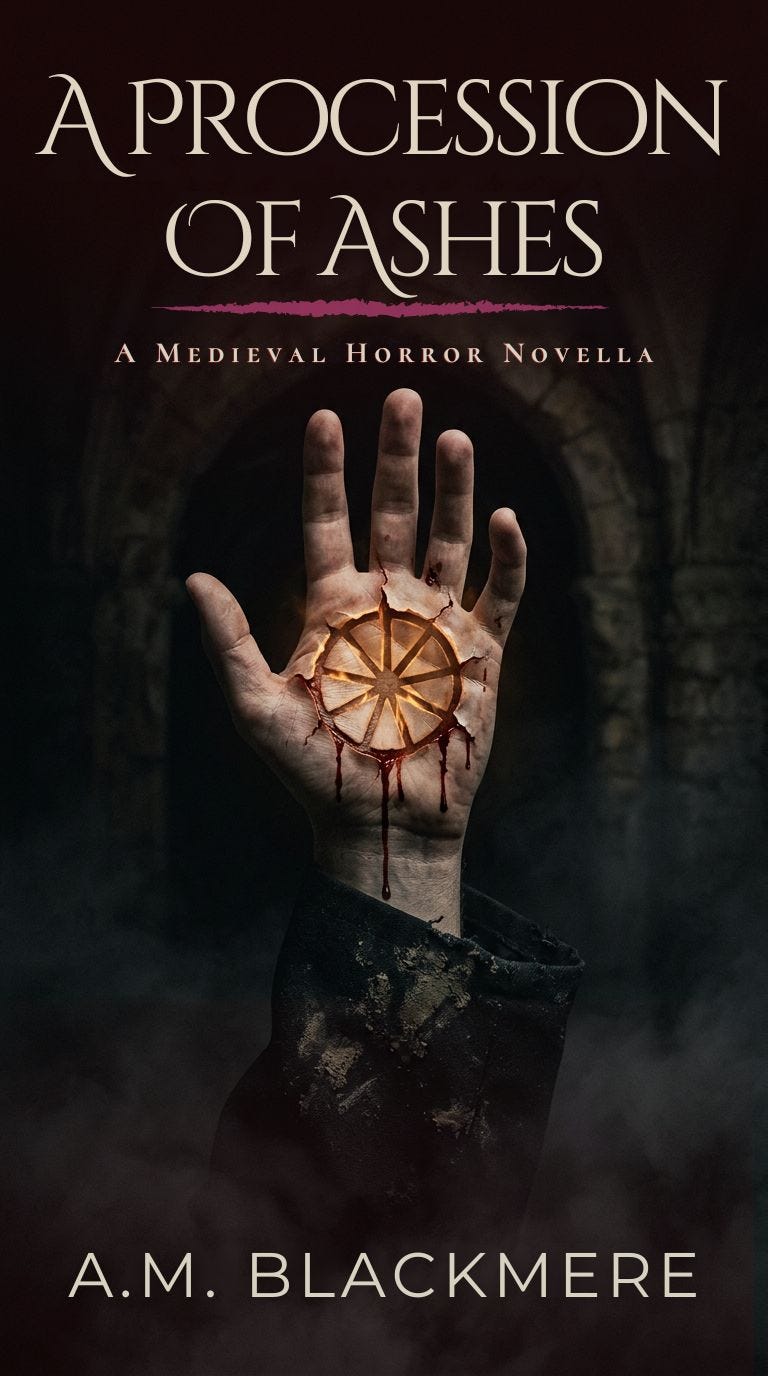
I wrote a book that lives in exactly that moment. It is called A Procession of Ashes.
It begins in the year 1349, in Piacenza, in northern Italy, with the plague coming through and a priest named Father Matteo burying the last of his flock. And then the flagellants arrive. The Brotherhood of Broken Flesh, a ragged procession that has whipped itself across a dying countryside, turning its own suffering into scripture, led by a man named Fra Aureliano who is raising something that is not quite a hymn. And beside Matteo stands a physician, Tommaso Bellini, a man of observation in an age that does not want any, trying to find the pattern underneath the faith and the fever, the place where devotion and disease stop being two different things.
It is a book about a crowd that catches a belief the way a body catches a plague. About how a story moves through frightened people and takes them over. Which is, I think, the same thing we have been watching happen to Elizabeth Báthory for four hundred years. A real horror, caught and spread and shaped, until nobody can find the truth underneath it anymore.
If this trilogy has its hooks in you, that is the country I was writing in. Cold, and faithful, and afraid.
A Procession of Ashes is the first book of The Black Hours, and it stands completely on its own. It is short, meant to be read in one or two sittings, preferably after dark.
Take it. Read it somewhere with the lights on.
Now. One last place to go. We have buried her. Let us see what climbs back out.
Elizabeth Báthory died in the walled room in 1614.
And that should have been the end of her. A guilty woman, quietly contained, her crimes real but modest by the standards of a savage age, her name deliberately kept out of open court so that no one would have to say aloud what everyone had arranged. By every intention of the men who buried her, she was supposed to vanish.
Instead she became immortal. And I want to show you how, because the how is the real subject of this whole trilogy.
In Part Two, I told you the blood-bath was born in 1729, in a Jesuit’s book, more than a century after she died. That is where the myth enters print. But a myth does not stop the moment it is written down. It grows. And watching it grow is like watching something feed.
By 1796, another writer, Michael Wagener, takes the blood-bath and repeats it, hardens it, passes it along as fact, and now it has two authorities behind it instead of one, and a century of retelling to give it weight.
Then the nineteenth century gets hold of her, and the nineteenth century loves a monster. Somewhere in there she acquires an iron maiden, a spiked torture device that closes on its victim like an embrace. It is a wonderful, terrible image. It is also almost certainly an invention. The iron maiden as we picture it is largely an eighteenth and nineteenth century fantasy, and its attachment to Báthory is late, bolted on because it fit the growing legend, not because it was ever in the record.
The count hardens too. Six hundred and fifty, that number from a servant describing a book no one ever saw, sheds every doubt the notary once wrote beside it and becomes simply the number, printed on covers, recited in documentaries.
And eventually she gets pulled into the orbit of Dracula. You will hear, constantly, that Elizabeth Báthory inspired Bram Stoker, that the blood and the youth and the Carpathian setting fed directly into the vampire. Historians who have actually gone through Stoker’s notes find no real evidence for it. But it does not matter. The claim is too good. It welds the real Hungarian widow to the greatest vampire in fiction, and the weld holds, because we want it to hold.
Here is what I find almost unbearable about all of it.
Her own words survive. Dozens of her letters are still held in the archives. Careful, literate, ordinary letters, about money and property and family and the running of estates. A meticulous woman managing a small kingdom from a writing desk. That is the documentary record of Elizabeth Báthory in her own hand. Account-keeping. Administration. The texture of a real life.
Nobody wants those letters. They do not sell. They cannot compete with a woman rising naked and young out of a bath of virgin blood.
So we kept the bath and we threw away the letters. We took a guilty, ordinary, administrative woman who tortured servants because her rank and her world let her, and we drowned her, on purpose, in an ocean of invention, until she was something grander and cleaner and further from us than she ever was.
Because the real Elizabeth Báthory is the unbearable one. A vampire you can hang on the wall with the other monsters. But a woman, an intelligent, ordinary, administrative woman, who did those things simply because the people below her did not count, and who was then sold off in pieces by men who did not care whether she was guilty, that one does not stay safely on the wall. That one could be a neighbor. That one could be a system. That one, God help us, could be us.
Three episodes ago, I told you I did not want to show you the killing. I wanted to show you the machine.
I hope you see now why.
Because the killing, in the end, is the least interesting thing about Elizabeth Báthory. The killing is what a person does when a law, and a war, and a name, and a house of frightened servants, and a marriage to a cruel man, all agree that certain other people do not count. Take the restraints off a human being like that and this is what you get, and it is not rare, and it is not supernatural, and it is not even, in the long history of the powerful, unusual. It only became a legend because the woman at the center of it was wealthy enough to be worth destroying and strange enough to be worth remembering.
And everything after, the trial that was never held, the debt that quietly vanished, the estates that stayed in the family, the bath, the maiden, the vampire, the number on the cover, all of it was other people, reaching into her story and taking what they needed. The King took his debt. The Palatine took his rival. The heirs took the land. The Jesuit took a moral lesson. The novelists took a monster. And we, tonight, four hundred years on, we have taken three hours of story out of a garden full of girls whose names were never written down.
So here is the question I will leave you with. The one I cannot answer, and I have tried.
We remember the woman who is supposed to have bathed in blood. We put her in films. We know her name.
We do not know the name of a single girl who actually died in that castle. Not the servants. Illonka, we have, because a man happened to say it once. The rest are a number, and the number is probably wrong.
We remembered the killer and we forgot the killed. We remembered the legend and we forgot the truth. And I am not sure, after three episodes, that we did it by accident. I think the monster is easier to live with than the machine. I think she always was.
That is the Blood Countess. Not a vampire. Not a martyr. A woman, a name, a debt, and a garden.
And a story we have been telling ourselves, for four hundred years, so that we would never have to look too closely at the parts of it that were ordinary.
I am A.M. Blackmere. Thank you for listening. To all three parts. And thank you for sitting with something this dark, and this human, all the way to the end.
Thanks for reading A.M. Blackmere! This post is public so feel free to share it.
Comments
Nothing yet. Say the first thing.
Sign in to join the conversation.