


A churchyard in the south of England, summer 1361. The sexton has been working since Prime and the ground lies open in nine places. Six of the holes are short. Three feet of trench where a man would take six, and he has stopped pacing them out, because he knows the length now by the width of his own shoulders and how much less is wanted. Flies hang over the yew in the heat. Behind the church a woman says a name, then says it again, then again, the way you test a sore tooth. The priest is thirty-one. He was ordained in a hurry eleven years ago, when the last one died, and this week he has run out of oil. He has been improvising the words. Nobody has corrected him. There is nobody left who would.
The second pestilence, or pestis secunda, was the second major wave of plague to strike England and Wales. It ran from the spring of 1361 into late 1362, roughly twelve years after the Black Death. It arrived in London around Easter 1361 and worked south to north across more than a year. Its signature was the age of the dead. At the St Mary Graces cemetery in London, infants, children, and adolescents made up about 51 percent of burials during the outbreak, against 36 percent in non-plague years.
England had a working explanation for plague. It had been built in 1348, tested at scale, and it held. Then the pestilence came back and took the children, and the explanation did not survive contact with the evidence. What happened next, in the bishops’ correspondence and the ordination records and the sermon literature, is one of the strangest silences in the English archive.
Five claims that circulate freely, each of which current scholarship complicates or kills outright.
1. It was an aftershock. Philip Slavin’s 2024 study in the Journal of Medieval and Early Modern Studies argues close to the reverse. Working from manorial court rolls, inquisitions post mortem, and episcopal registers at national scale, he concludes that the second pestilence, rather than the Black Death, drove the severe long-term demographic and economic damage in England and Wales. 1348 killed people. 1361 killed the generation born to replace them.
2. Survivors of 1348 were immune, so it took the children. This is the explanation almost everyone reaches for, and Slavin rejects it directly. The two waves came from different phylogenetic branches of Yersinia pestis, Branch 1 for the Black Death and Branch 1B for the second pestilence, with additional mutations accumulated in between. Surviving the first strain conferred no reliable protection against the second.
3. It came back from Asia. Genomic work published in PLOS Pathogens in 2023 by Cody Parker, Alina Hiss, Maria Spyrou and colleagues, with Slavin among the authors, points instead to local European evolution. The pathogen appears to have diversified from a source inside Europe, with first human cases around 1356 and a gap of roughly three years between the end of the Black Death and the emergence of the second wave.
4. “Children’s plague” is a modern nickname. Contemporaries used it. Latin sources give pestis puerorum and mortalitas puerorum, and Samuel Cohn has noted that chronicles from 1361 onward reach for these terms across Europe. Slavin does caution that the usual English rendering as “children’s plague” is inaccurate, so the label carries a shade the Latin does not. The observation itself belongs to the people who watched it happen.
5. Plague killed the poor hardest. In 1361 it did the opposite. Slavin’s figures put mortality among the nobility at 27 percent, above their 22 percent in the Black Death, and above rustics at 21 percent. Town dwellers fared worst of all, at 41 percent.
On 24 October 1348, with the pestilence approaching his diocese, Bishop William Edington of Winchester issued a mandate. It survives, printed by Francis Gasquet in 1908, and it is a remarkable document: frightened, furious, and completely specific about what was to be done.
Every Sunday and Wednesday, clergy assembled in their monastery choirs were to recite the seven Penitential Psalms and the fifteen gradual psalms on their knees. Every Friday, those psalms again, and a long litany chanted through the marketplace of Winchester, the participants walking barefoot and fasting with their heads bowed. Edington granted indulgences to anyone who confessed their sins and prayed for the plague to stop.
The logic underneath it is a closed circuit. Pestilence is punishment for sin. The remedy for sin is penance. Perform the penance and the punishment lifts. The doctrine identifies the cause, prescribes the response, and promises the outcome, which is more than most explanations manage.
It held in 1348 for a simple reason: everyone had sinned. A plague that kills indiscriminately fits a doctrine of universal human sinfulness perfectly. The chroniclers filled in the particulars. Sensuality. Pride. Outlandish, fashionable clothing, which contemporaries cited even though fashion belonged to the rich and the dying did not. Henry Knighton, an Augustinian canon at Leicester writing up his chronicle in the early 1390s, treated divine punishment as the default account of misfortune, and his open hostility to laborers colored everything he wrote about what came after.
The explanation also did real work. It gave people something to do. Walking barefoot through a marketplace on an empty stomach on a Friday in October is an action, in a situation that otherwise admits of none.
Because of who died. A six-year-old in the summer of 1361 had been born into a world already scoured, three years after the first pestilence burned out. The provocations the chroniclers had named were adult provocations, and mostly the provocations of the wealthy. Applied to a child of six, they collapse.
You can watch contemporaries register the problem in what they called it. Northern English sources use secunda pestilentia, the second pestilence, a plain chronological marker that says only that this has happened before. But the label that spread across Europe was pestis puerorum, and its cousin mortalitas puerorum, the mortality of the children. Scholars working on the Crown of Aragon have found narrative sources describing a crebis et maxima mortalitas puerorum, a widespread and very great mortality of children. The age of the dead was the fact worth writing down. It was what made this a different event rather than a repetition.
The theology had no good move. Original sin covered infants in principle, and the Church had positions on the unbaptized, but neither answered the question a parish actually faced in the summer of 1361, which was why God had taken the specific children who had done nothing, while leaving standing the adults who had done every single thing the chroniclers complained about in 1348.
An explanation can survive being terrible. It cannot survive being visibly, locally wrong in front of people who are burying the evidence.
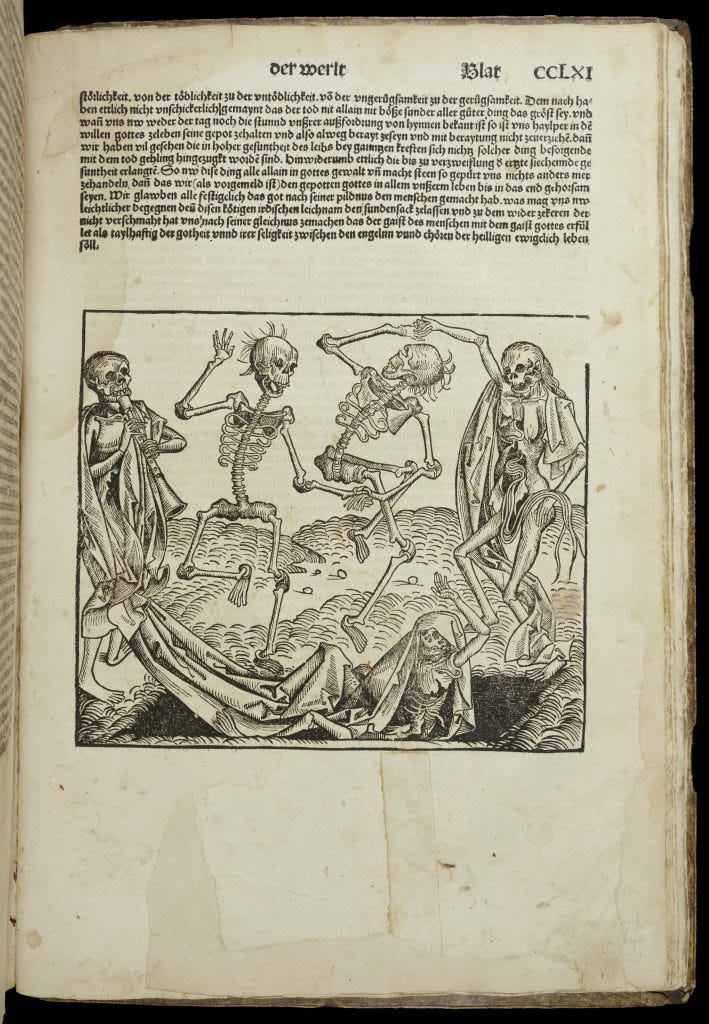
Slavin’s reconstruction of mortality by social group makes the problem worse. His approximate rates for the second pestilence run like this:
• Town dwellers: 41 percent.
• Other, including migratory workers: 34 percent.
• Regular clergy, meaning monks, canons, and friars: 32 percent.
• Nobility: 27 percent, against 22 percent in the Black Death.
• Parish priests: 23 percent.
• Rustics: 21 percent.
Read that list against the sin explanation and something uncomfortable surfaces. The monks and friars, whose entire occupation was prayer, died at half again the rate of the peasants in the fields. The nobility died at a higher rate in 1361 than they had in 1348, when the doctrine was minted.
Henry of Grosmont, first Duke of Lancaster, founding member of the Order of the Garter, one of the wealthiest men in England and among Edward III’s most trusted commanders, died at Leicester Castle on 23 March 1361. He is generally reckoned a casualty of the second pestilence, and his death carried the Lancaster inheritance toward John of Gaunt.
The manorial economy points the same direction. Slavin found that heriots, the death duty owed to the lord, attached to holdings over fifteen acres in 22 percent of cases during the plague years, against 15 percent in normal years. The bigger the holding, the likelier the tenant died.
Geography behaved just as strangely. From 129 manors across England and Wales, the Midlands and the north, Yorkshire above all, took the heaviest mortality, while the eastern counties of Norfolk and Suffolk came off comparatively lightly. Manors a short ride apart had entirely different years, which rules out topography as the driver. Slavin’s working hypothesis is that the smaller plots of eastern smallholders were simply less attractive to the plague’s vectors and hosts than the larger holdings of their wealthier neighbors.
So the explanation did not fail for children alone. It failed hardest on the consecrated, the great, and the prosperous, which is to say on the people whose standing was supposed to be evidence of God’s regard.
In 1348, Edington produced a document, and it survives. It is detailed, anguished, prescriptive, and it tells you exactly what the institution thought and exactly what it wanted done.
For 1361, no comparable English mandate survives at all.
The diocese of Hereford makes the gap visible. William Dohar’s study of pastoral leadership there established that Bishop John Trillek died in December 1360. The see then stood vacant. And through most of 1361, while the second pestilence moved through Hereford and much of England, the ordination records are absent. There is nothing there.
The available reasons are mundane. A vacant see disrupts everything, and record-keeping is among the first things to go. It is also possible that the response had been standardized after 1348 and therefore generated less paper, a routine that no longer needed writing down. Both are plausible. Neither changes what a historian actually holds, which is a silence at the precise point where the institution’s answer ought to be.
You can argue about what the silence means. It is harder to argue that a diocese in the middle of a plague, with no bishop, ordaining no priests on the record, was an institution operating normally.
The clergy did not fall quiet. J. Richards points to a concentration of sermons and treatises in this period, so the pulpits were working and the interpretation was being handed down. What is hard to locate in the surviving pastoral literature is a direct confrontation with the innocents problem: the death of the blameless, addressed as a theological question in its own right rather than folded into a general account of divine will.
That may be an artifact of survival. It may be a real reluctance. The scholarship has not settled it, and I want to be honest that this is the softest ground in the piece. But if the silence is real, it is the most eloquent thing in the archive.
The imaginative literature has no such difficulty. William Langland sets pestilence and sin side by side explicitly in Piers Plowman. Chaucer’s Pardoner rides through a landscape organized entirely around death. The Pearl Poet’s Cleanness keeps returning to ruined bodies. M. M. Alcaro’s work on late fourteenth-century English writing argues that the trauma runs underneath the whole period, surfacing whether or not the writer names the plague.
And one figure was in exactly the right place at exactly the wrong age.
Julian of Norwich was born around 1342. When the second pestilence reached England in 1361 she was about nineteen years old. She later had herself enclosed as an anchoress in a cell built against the wall of St Julian’s church in Norwich, and she spent the remainder of her life on one question: how a God she experienced as entirely loving could permit what she had watched happen. She never produced a clean answer. She produced the one about all things being well, which readers have argued over for six hundred years, and which reads very differently once you know what she was nineteen years old for.
An anchoress sees her parish through a slit in a wall.
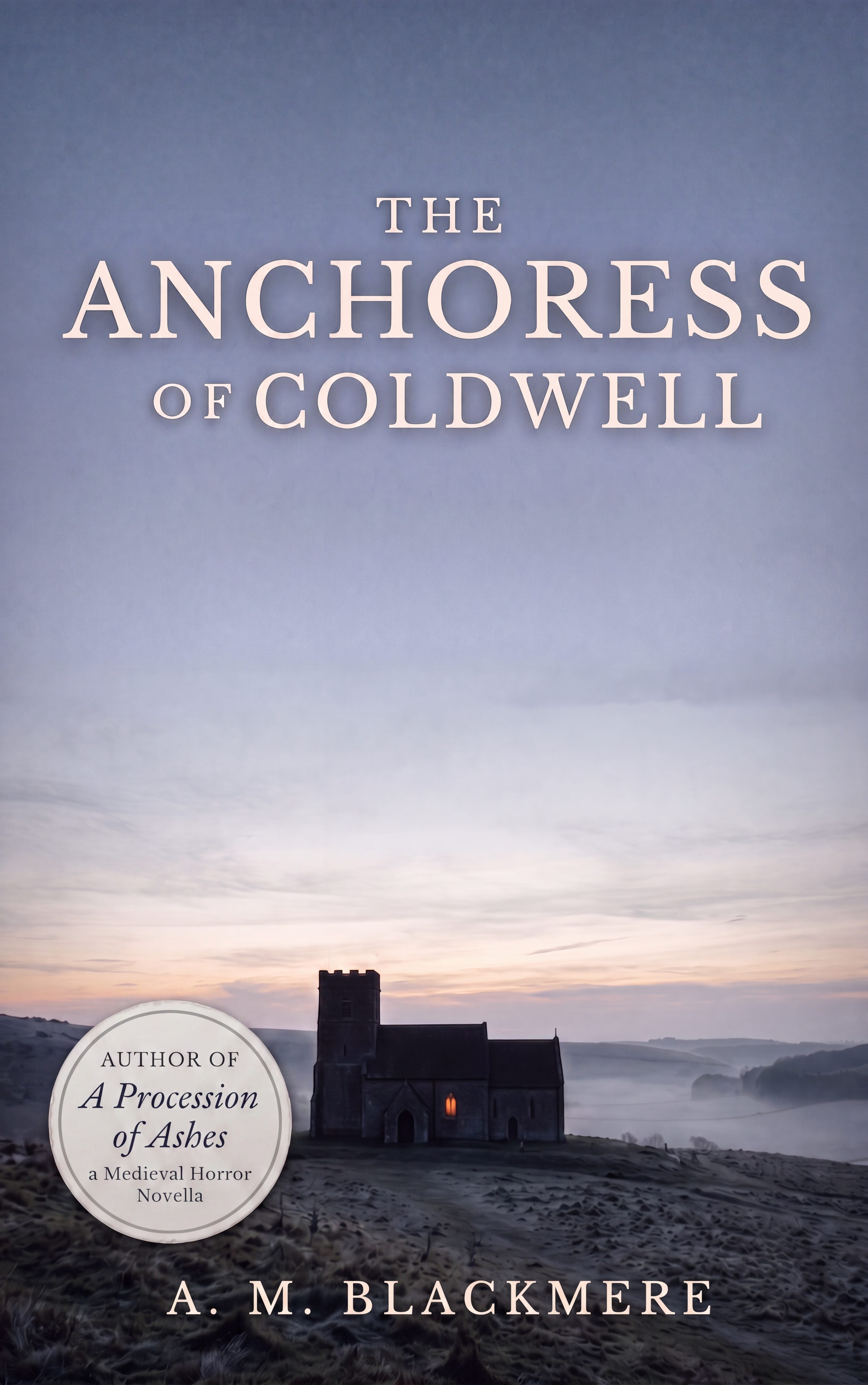
The Anchoress of Coldwell is set in the summer of 1361, in a village that remembers 1349 the way you remember a fire. Avice is walled into a cell against the church. Everything she knows of the pestilence outside comes to her through the squint, a hand’s width of light cut through stone, and through the voices that arrive at it. The parish brings her their confessions. Then they bring her their children. She has taken a vow that obliges her to intercede for both, and the intercession does not work. What she does with that, and what begins to answer her through the wall after the parish stops coming, is the book.
They improvised, inside the rules, and the Church let them.
Emergency lay baptism was already well established by the twelfth century, and the second pestilence made it ordinary. Any layperson could perform it, provided they used water and got the Trinitarian formula right. A midwife could do it. A neighbor could do it. A parent could do it for their own child, which is worth sitting with for a moment, given who was dying in 1361.
For the dying who had no priest, there was votum sacramenti, the desire for the sacrament standing in place of the sacrament. Sincere contrition and a genuine wish for confession, the Church taught, could suffice where no confessor could be found. It is a doctrine of last resort, and 1361 was the kind of year that turns a doctrine of last resort into a Tuesday.
The dead went into the ground faster than the ground had been designed for. St Mary Graces, the London cemetery whose bones supply the age data at the top of this article, was founded in conjunction with this outbreak.
One thing that did not happen in England was the flagellants. The movement had real force on the continent, and English commentators watched it with a mixture of awe and suspicion, but it never took hold here, in 1348 or in 1361. The English response stayed inside official channels, which is a tidy way of saying that it stayed inside an institution that was itself dying at 32 percent among the regular clergy.
The pestilence burned down through 1362. On 16 January of that year, the sea came.
It is known now as the Grote Mandrenke, the Great Drowning of Men, and as Saint Marcellus’s flood. An extratropical cyclone crossed the British Isles, the Netherlands, northern Germany, and Denmark, arriving on a new moon and a spring tide, driving northwesterly winds ahead of a North Sea surge that ran far inland. In England the storm is often dated to St Maur’s day, 15 January. The peak came on the sixteenth.
It broke islands apart and made islands out of mainland. It destroyed 44 villages. The death toll is put at 25,000 at the low end, with estimates running as high as 100,000. Rungholt in North Frisia was erased. Ravenser Odd, a port at the mouth of the Humber, was erased. The harbour at Dunwich in Suffolk was destroyed. Cultivated land became tidal flat. The storm belongs to a sequence of thirteenth and fourteenth century surges that opened the Zuiderzee, and to the unsettled weather at the leading edge of the Little Ice Age.
Put yourself in the parish for a moment. You have spent a summer burying children that nobody can explain to you. In January the sea comes over the wall and takes the fields.
A realm that has just been told its suffering is a message will read that as a second sentence.
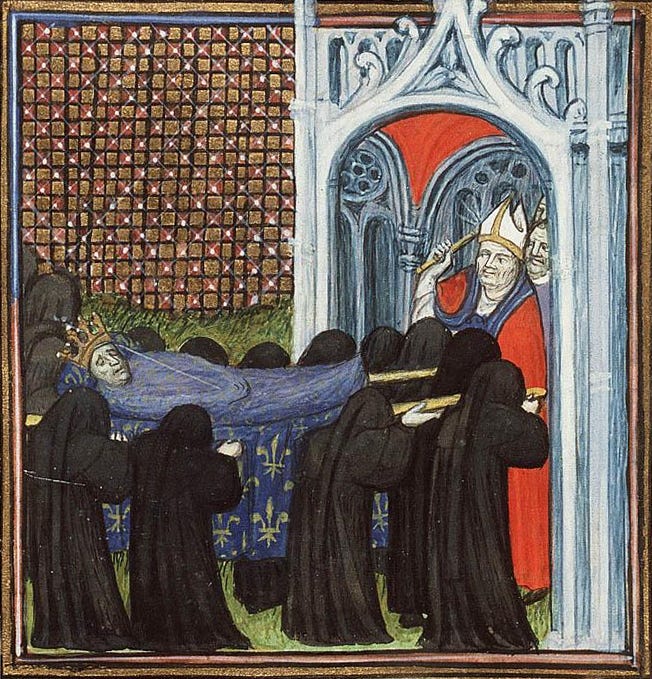
Everything above rests on four kinds of evidence, and they contradict each other in every direction.
• The chronicles say children. Latin sources across England and Europe reach for pestis puerorum and mortalitas puerorum.
• The bones say children. At St Mary Graces, infants through adolescents were about 51 percent of burials during the outbreak, against 36 percent in non-plague years. The twenty to thirty-nine bracket ran to 32 percent, against 19 percent.
• Higden says men. The Polychronicon continuation describes a pestilence beginning in London around Easter 1361 and advancing from the south of England to the rest of the country, killing many men but few women.
• The manorial rolls say men too. Across 184 manors, the proportion of female heirs rose from roughly 40 percent to 52 percent during the outbreak. On the Bishop of Winchester’s estate, studied by J. D. Mullan in 2007, inheritance by sons collapsed from 34 percent to 17 percent. Women inherited only when male heirs were absent, so the paperwork implies the male heirs had gone.
• The same bones say no sex difference at all. Sharon DeWitte’s analysis of the St Mary Graces assemblage, using a Gompertz mortality model, finds no significant difference in risk of death between men and women.
• And the rolls contradict the age story. On fifteen manors that recorded the ages of underage heirs, children inheriting rose to 18 percent, up from 11 percent in the years 1355 to 1361. A children’s plague should push that number down. Slavin calls the sample too small to generalize from, and calls the whole question open and largely unsolved.
• Knighton, who lived through both, says everyone. His Latin records a general mortality that oppressed the people, called the second pestilence, and the dying, he writes, were tam majores quam minores: the greater and the lesser alike.
The churchyard at the top of this article is reconstructed. No source records that sexton, that woman, or that priest. Every element in it is attested: the short graves, the clergy ordained in haste after 1349, the shortage of oil, a parish improvising rites with nobody left who could check them.
What was the pestis secunda?
The second major wave of plague to strike England and Wales, running from spring 1361 into late 1362, about twelve years after the Black Death. Contemporaries called it the second pestilence, secunda pestilentia, and also the plague of the children, pestis puerorum. Mortality estimates run from about 20 percent in London to roughly 24 percent nationally.
Why was the plague of 1361 called the children’s plague?
Because the dead skewed young and contemporaries noticed. Latin chronicles across England and Europe used pestis puerorum and mortalitas puerorum. Bone evidence from St Mary Graces in London supports the pattern: infants, children, and adolescents were about 51 percent of burials during the outbreak, against 36 percent in non-plague years. Philip Slavin cautions that “children’s plague” is an imprecise rendering of the Latin.
Was the second pestilence worse than the Black Death?
Fewer people died, but Slavin’s 2024 study argues the long-term damage was worse. The Black Death killed a standing population. The second pestilence killed the cohort born to replace it, which is a large part of why English population did not recover for more than a century.
Did surviving the Black Death make you immune in 1361?
No. The two waves came from different phylogenetic branches of Yersinia pestis, Branch 1 and Branch 1B, with additional mutations accumulated in between. Slavin concludes that survivors of the first strain were not necessarily immune to the strains causing the second.
Which parts of England were hit hardest in 1361?
From 129 manors across England and Wales, Slavin found that the Midlands and the north, especially Yorkshire, took the heaviest mortality, while eastern counties such as Norfolk and Suffolk fared considerably better. Manors close to one another sometimes diverged sharply.
How many people died in the second pestilence?
Around 20 percent of Londoners and roughly 24 percent of England’s population, with bioarchaeological ranges spanning 10 to 30 percent. By social group, Slavin’s figures give town dwellers 41 percent, regular clergy 32 percent, nobility 27 percent, parish priests 23 percent, and rustics 21 percent.
Back to the sexton. He finishes the nine holes before Vespers. He does not pace out the short ones, because the measurement is in his shoulders now, and it will stay there for the rest of his life.
What he does not have, standing in that yard in the summer of 1361, is the count. He knows he is in the second one. He is right about that. He also believes that “second” describes the shape of the whole thing, a disaster and its echo, and that when this passes the world will go back to being the world.
The third pestilence came in 1369. The fourth in 1375. The fifth ran from 1379 to 1383. Between 1351 and 1485, England had thirty plague years, and the population did not climb back for a hundred of them.
He is standing in the second of thirty, in a churchyard where six of the nine graves are short, and he believes the worst of it is behind him.
The sources, in reading order
If you want to go further than this article, here is the order I would take it in, and why.
• Rosemary Horrox, The Black Death (Manchester Medieval Sources, 1994). The translated primary sources with commentary, and the 1361 material sits around pages 85 to 86. Cheap, in print, and the fastest route to reading the chroniclers rather than reading about them. Start here.
• Philip Slavin, “Plague Strikes Back,” Journal of Medieval and Early Modern Studies 54:3 (2024), 457 to 491. The current benchmark, and the source of most of the numbers above. Read it twice. The methodology section is the part that teaches you how a medieval death turns into paperwork.
• Cody Parker, Alina Hiss, Maria Spyrou, Philip Slavin and colleagues, PLOS Pathogens 19:7 (2023). Open access, free, and it tells you what the thing physically was. The local European evolution finding is the most interesting result in plague studies this decade.
• J. D. Mullan, “Mortality, Gender and the Plague of 1361 to 1362 on the Estate of the Bishop of Winchester” (Cardiff University Historical Papers, 2007). The study that opened the gender question, covering roughly forty-nine to sixty southern manors.
• William Dohar, The Black Death and Pastoral Leadership: The Diocese of Hereford in the Fourteenth Century (2005). Where the blank register comes from.
• Samuel Cohn, The Black Death Transformed (2002). The argument that lost, worth knowing for why it lost. His age-structure analysis around pages 210 to 215 survives the defeat.
• John Hatcher, Plague, Population and the English Economy 1348 to 1530 (1977). Ninety-five pages, nearly fifty years old, still the clearest frame anyone has built for what the plagues did to England.
A.M. Blackmere writes medieval horror and dark historical fiction. The Anchoress of Coldwell is available now for preorder.
Thanks for reading A.M. Blackmere! This post is public so feel free to share it.
Comments
Nothing yet. Say the first thing.
Sign in to join the conversation.