
Hello Starlings,
I had intended to send this on Sunday. I also tried, more than once, to make it smaller.
But Venus would not cooperate.
The further I went into the old material, the more immense she became. And perhaps I have a particular investment in this as a maker, because Venus touches so much of what I care about: desire, beauty, value, form, sensory life, the mysterious force that makes one thing feel alive to us while another does not. Still, even I was startled by how thoroughly she has been flattened in the modern imagination. We have reduced an astonishingly complex and powerful being into a handful of pleasant stereotypes, while almost entirely overlooking the stranger and more formidable Venus waiting beneath them.
So although I had planned to wait, today is Friday, her day. The Moon is in her own home, and Venus has just entered Virgo, where she possesses a quieter dignity that almost no one seems interested in discussing. It felt wrong to hold this until Sunday.
This is a long letter. Make yourself a drink and settle in and enjoy this Venus sermon.
I believe it contains some of my best writing, and more than anything, I hope it opens a door into the true scale of Venus: what she means in the life of a maker, certainly, but also what she may be shaping in every life through desire, value, beauty, and the things that we have found over time are strangely, sneakily necessary.
There are now only 7 Creative Court Reports remaining at the founding rate of $197.
Once those 7 have been claimed, the report will move to its standard rate of $247.
Each one is a bespoke written study of your physical creative process through the traditional birth chart: your taste, method, momentum, bodily rhythms, material instincts, recurring tangles, and the agreements your inner Court requires in order to make together.
Commission Your Creative Report
I have been trying to write about Venus.
Or perhaps, more truthfully, I have been trying to find a doorway large enough for her.
This has proven difficult because Venus has been made so terribly small in the modern imagination. We have folded her into the pleasant surfaces of life: romance, attraction, cosmetics, sweetness, charm, the colors we prefer, the clothes we wear, the things we find pretty.
None of those associations are exactly false. But they are fragments. Bright shells washed onto shore after some much larger temple sank beneath the sea.
Because when we go backward into the older chambers of the tradition, we find a Venus of almost incomprehensible scale.
In one of the Orphic hymns, Aphrodite is invoked as sea-born, night-loving, crafty, all-connecting, and of awful mien—awful in the older sense of the word: full of awe, formidable, majestic, capable of inspiring wonder and dread.
And then the hymn says something so extraordinary that I have not been able to stop thinking about it:
From her, Ananke (Necessity) first came.
And the three Fates are ruled by her decree.
The Fates. Those ancient sisters who spin, measure, and cut the thread of mortal life. The powers before whom even the gods bend. Those who determine what is allotted, what must unfold, what cannot be escaped.
And somehow, impossibly, behind them stands Venus.
Not decorating the edge of fate.
Directing it.
This is not the Venus we have inherited. This is not the harmless patroness of pretty things, reclining languidly while the supposedly more consequential planets govern war, law, death, time, and destiny.
This Venus is implicated in the hidden machinery of the cosmos.
Desire does not merely distract us from necessity.
Desire gives birth to necessity.
I keep turning that idea over because it rearranges nearly everything. What if the things we desire most deeply are not incidental to the life we live? What if attraction is not merely a soft preference floating over the hard architecture of fate?
What if desire is one of the powers by which fate enters us, takes hold of the senses, and quietly begins directing the course of a life?
Because we do not choose our deepest attractions through reason.
The original enchantment compels us.
We do not choose the particular quality of light that enters us like a blade. We do not choose which colors seem to contain an entire world. We do not choose the music that catches beneath the ribs and makes the air in the room feel altered. We do not choose which textures our hands ache to touch, which landscapes haunt our dreams, which forms we continue drawing in the margins long after we believed we had moved on.
Something appears. Something in us recognizes it.
And then the trouble begins.
Because once a thing has been recognized as beautiful—or true, or alive, or worthy of love—it becomes very difficult to return to the life we inhabited before that recognition.
The painter sees a blue that does not yet exist on the palette. The ceramicist glimpses a vessel whose curve is not quite available to the hand. The weaver begins to understand that roughness and softness must somehow be made to live together in one cloth. The sculptor becomes haunted by the figure hidden in a form that everyone else still sees as stone.
At first, perhaps, this is only attraction. Then it becomes a question. Then a devotion.
Then an irritation, a restlessness, an ache, an impossible standard waiting at the far edge of one’s present skill.
Until finally it begins reorganizing the life around itself.
You buy different materials. You study particular masters. You reject techniques that can produce a competent object but cannot produce the thing you have seen inwardly (dammit). You spend months learning how one pigment behaves beside another. You become preoccupied with the grain of wood, the softness of fiber, the pressure required to lift an edge of charcoal back into light.
You return to the workbench after disappointment. You build your days around the possibility of touching it again—maybe, one day (dammit).
And this is the point at which preference begins to resemble fate.
Desire directs attention. Attention alters choice. Choice becomes repetition. Repetition becomes practice.
Practice, continued over years… becomes a life.

Part of our difficulty is that we have inherited a very thin understanding of aesthetics.
We tend to think of aesthetics as the surface appearance of a thing, separated from its deeper substance. A work has content, meaning, technique, ethics, perhaps political consequence—and then, somewhere toward the end, it also has an aesthetic draped over it nicely.
Aesthetics: the pretty arrangement laid over the serious thing beneath? I think not.
In the ancient geocentric imagination, aesthetics was not a passive theory of appearances. It was a physical and sacred science of alignment.
The cosmos above was understood as an ordered and ensouled structure, while the world below the Moon was the unstable realm of matter: clay, blood, weather, growth, decay, color, texture, heat, moisture, fracture, and change.
To shape matter beautifully was therefore not merely to decorate terrestrial life. It was to bring something of celestial order down into physical form.
The maker stood at the threshold between worlds.
Through proportion, color, rhythm, material, ornament, and touch, something invisible could be translated into a thing the body could see, hold, wear, inhabit, or offer. The workbench became one of the places where the order of the heavens could enter the raw matter of the Earth.
This is one of the older and stranger meanings hidden inside the word cosmos.
In modern English, cosmos generally means the universe. But the Ancient Greek kosmos could mean both order and ornament. It is also the root of our word cosmetic.
To ornament a thing was not necessarily to add a frivolous flourish after the meaningful work was complete. It was to order the sensory experience. To dress raw structure in a form through which its inner nature could become visible.
A chair may already stand. A vessel may already hold water. A wall may already keep out the weather. But when the maker refines the edge, chooses the glaze, repeats a motif, balances weight against emptiness, or places one color so that another begins to sing, they are doing more than embellishing utility.
They are performing an act of kosmos.
They are asking matter to enter harmony.
This makes Venus not merely the patroness of beauty, but the mistress of ordering through beauty. She understands that the sensory world can be arranged so that the eye, the hand, and the spirit are led into concord.
She knows that ornament is not always excess.
Sometimes ornament is revelation.
And this makes our apprenticeship to Venus much more demanding than the pursuit of prettiness. Under her tutelage, the maker learns how to dress the raw bones of reality in the form that allows them to become luminous.
Saturn may give us the hard fact of the material world: weight, limit, resistance, structure, finitude. Mars may cut, strike, fire, scrape, and force matter across the threshold of change. Mercury may measure, calculate, design, and discover the method.
But Venus knows toward what form the labor is moving.
The clay is heavy. The wood is mute. The pigment is only powder. The cloth is a loose gathering of thread.
And yet through the maker’s attention, each may become an agalma: a vessel of delight, a crafted thing capable of holding presence.
An agalma was not merely a pleasing object. The word carried associations of glory, delight, and sacred offering—something made beautiful enough to invite the presence of a god.
There is something almost unbearably beautiful in that idea.
That a material object might be shaped with such care, proportion, grace, and devotion that spirit would be compelled to dwell within it.
That the work could become a trap for… delight.
That the maker might take cold, heavy terrestrial matter and make it luminous enough to host a little of the cosmos.
This is the larger vocation hidden inside aesthetics:
Not style for style’s sake. Not the polishing of appearances.
The creation of a body capable of receiving presence.
The Greek word aisthesis, from which our word aesthetics descends, referred first to sensory perception: the living act of apprehending the world through the body.
The eye receiving color. The skin meeting texture. The ear recognizing interval, dissonance, and resolution. The body sensing proportion before the intellect can explain why one arrangement feels whole and another feels violently wrong.
Before we can argue that something matters, some part of us has already leaned toward it.
And the ancient phrase to kalon, often translated as “the beautiful,” carried an even stranger doubleness. It could also mean the noble, the excellent, the worthy.
Beauty and goodness were not understood as entirely separate territories.
The beautiful was not merely what decorated the good. It was one of the ways value disclosed itself.
This does not mean that every pleasing object is morally pure, nor that every ethical act must be conventionally attractive. The world is considerably more complicated than that. But it does mean that aesthetic choice is never as empty as we pretend.
When you choose austerity over excess, or excess over restraint, you are making a declaration about what deserves space. When you preserve the crack, the scar, or the visible repair, you are saying something about damage, endurance, memory, and what remains worthy of care. When you smooth every trace of the hand from an object, you are saying something different.
When you let shadow consume half the image, crowd a surface with ornament, leave a field almost bare, or insist that beauty must contain decay, discomfort, tenderness, humor, strangeness, violence, or grief, you are not simply styling a surface.
You are creating a small physical manifesto.
You are showing us how you believe things should exist together.
This is one of the deeper meanings of Venusian concord.
Concord is often treated as simple harmony: everything pleasant, balanced, and in agreement. But concord is also a treaty.
A concord is what happens when separate forces, each with their own nature, find a way to enter relationship without being annihilated.
At the workbench, concord might mean teaching rough wood and delicate gold leaf to inhabit the same object. Allowing a bitter green to remain bitter while discovering the red that makes its bitterness necessary. Finding the exact proportion through which weight and emptiness begin to answer one another.
Venus does not always make things sweet.
She makes them belong.
She is the connective intelligence that senses where kinship is possible, what must be brought nearer, what must remain distinct, and when the disparate parts of a work have entered into a living agreement.
This is why aesthetics matter so profoundly. They reveal the maker’s instinct for relationship.
How should darkness relate to light? How much tension can a form hold before it breaks? What deserves emphasis? What should be softened, sharpened, concealed, repeated, interrupted, or allowed to remain unresolved?
How should the world be arranged?
Your answer appears in the work long before you are able to speak it.
Your taste is your philosophy becoming material.
And perhaps it is also something more.
Perhaps taste is one of the ways the invisible necessity of desire begins reaching toward physical destiny.
Because when Venus places a value inside us—this blue, this form, this quality of movement, this impossible relationship between softness and stone—it is still only inward. It is a summons without a body.
The Fates may hold the thread, but the maker must still take it up.
The maker becomes the instrument through which Venusian desire enters material reality.
This is the crossing-place where Ananke and the Moirai meet the human hand. The necessity is inward: the thing that must be pursued because it has become beautiful enough to command devotion. The weaving is outward: every choice, repetition, sacrifice, technical problem, abandoned method, changed material, and physical act through which that desire begins taking form.
And suddenly fate is not only something that happens to us.
Within the limited sphere of our hands, our attention, and our materials, fate is also something we participate in crafting.
Not because we are omnipotent. Not because desire guarantees fulfillment. But because every time we bring an inward value into matter, we alter the world that will be available to us and to others.
We make a new object. A new image. A new arrangement of color and form. A new vessel through which someone else may encounter beauty, recognition, grief, delight, or truth.
The Kingdom below aligns, however briefly, with the Kingdom above.
The invisible becomes tangible.
The stars enter clay.
To make a physical thing is to become apprenticed to this Venus.
Not the Venus of generic beauty, because there is no single Venusian beauty.
One maker’s Venus wants the polished, symmetrical, lucid, and almost impossibly refined. Another wants erosion, patina, the edge worn down by weather and handling. One wants luminous abundance, ornament multiplying across every available field. Another wants the quiet authority of almost nothing.
One seeks tenderness. Another, impact.
One is compelled by the classical body, another by the malformed, the haunted, the hybrid, the creature that seems to have crawled out of a dream and refuses to explain itself.
Venus does not dictate one aesthetic law to every maker.
She issues the particular law of value inside a particular life.
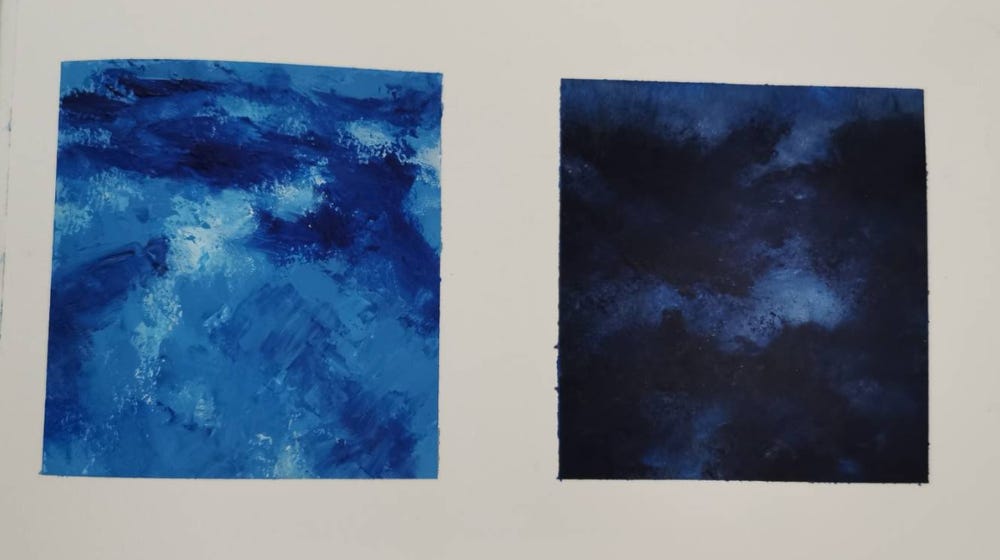
For me, that law often arrives as a deep blue.
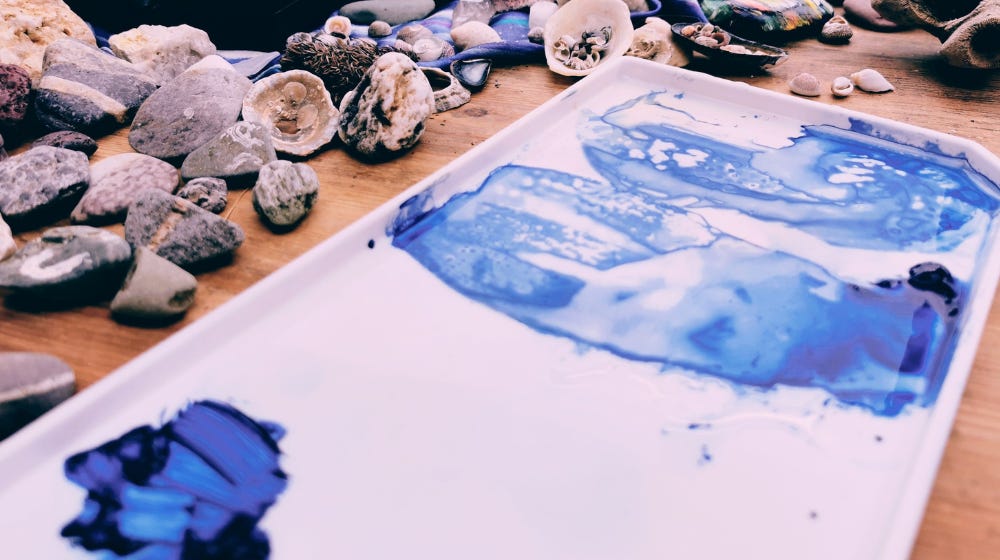
Anthraquinone blue is the mother color of my palette. It appears in nearly everything I make, sometimes openly, sometimes buried beneath so many layers that no one looking at the finished painting would know it was there.
But I know.
Without it, the world of the painting often feels uninhabited.
This is not a decision I made for the sake of consistency. It is not branding. It is not a rational conclusion about what color will make my paintings recognizable.
It is closer to allegiance.
The blue keeps returning because I keep finding something inside it that I have not yet exhausted: night, sea-depth, storm, distance, sorrow, shelter, the bruised threshold before rain, melancholic romance.
It is not the only color I love. But it is one of the colors through which the world becomes most fully itself to me.
And perhaps every maker has some version of this.
A color. A pressure. A shape. A material. A subject. A scale. A quality of motion. A silence. A type of edge.
Something that may change its outward form over the years while retaining an inward continuity. A secret instruction.
This is what it means to be apprenticed to Venus.
She plants in us an image of value that we did not invent and cannot entirely explain, and then leaves us with the lifelong problem of incarnation.
How will you bring it here?
How will you take what exists only as longing, sensation, attraction, or half-glimpsed inward form and give it weight, texture, edge, temperature, and body?
Venus herself does not necessarily perform this labor. Her power lies not in force, but in attraction so complete that force begins organizing itself around her.
Mars may possess the heat to act, the courage to cut, the strength to strike, scrape, press, or alter matter. But Mars alone does not know what deserves to be made.
Mercury may possess method, calculation, dexterity, cunning, and the thousand technical adaptations by which an inward image can cross into form. But Mercury alone does not know which image is worthy of translation.
The Moon receives the entire affair into the breathing and fluctuating conditions of the body: stamina, habit, hunger, fatigue, mood, repetition, and the actual physical life through which a work must gestate.
But Venus issues the decree.
This color. This relationship. This world.
Build toward this.
She does not lift the hammer because the sovereign does not quarry the stone. She makes the imagined temple so necessary that the rest of the Court begins to labor.
Under this older philosophical framework, Venus becomes something like the final cause of physical action: the end toward which the work is secretly moving.
We do not cut, calculate, measure, mix, sand, polish, carve, revise, and repeat merely for the sake of remaining in motion. The toil is not the final destination. The technique is not the final destination. Even mastery is not the final destination.
The labor moves toward the moment when the object has entered concord. When the proportions settle. When the disparate materials begin breathing together. When grace arrives, and the hand finally understands that nothing more is required.
Then the work ceases. The maker steps back.
And Venus, who set the whole Court in motion, also grants the final rest: the pleasure of beholding, the sweetness of completion, the quiet permission to savor what has been made.
This, too, is part of her power.
She is not only the desire that begins the journey.
She is the delight waiting at its end.
This is part of what I study in the Creative Court Report.
Not simply your Venus sign, reduced to a few generalized preferences, but the actual condition and authority of Venus within your creative kingdom.
What has your Venus deemed worthy? What forms, materials, sensations, atmospheres, and standards of beauty have become necessary in you? Whose values are you serving when you make?
Does your Mars know how to act on Venus’s decree? Can Mercury discover a method capable of translating it? Can the Moon sustain the bodily conditions through which the vision must become real?
And where might you still be mistaking admiration for belonging—trying to make another person’s beauty because you have not yet learned to recognize the particular law of your own?
The Creative Court Report is a bespoke written study of these relationships: Venus, Mercury, Mars, and the Moon as the intimate working Court through which desire, skill, action, and embodiment meet the materials of the Earth. It is designed to help you understand not only what is beautiful to you, but what your entire creative process requires in order to carry that beauty into form.
There are 7 reports remaining at the founding rate of $197 before the price moves to $247.
Commission Your Creative Report

This is why I have struggled to find a doorway large enough for Venus.
She does not remain politely in the chamber we assigned her.
Follow beauty backward and it opens into perception. Follow perception backward and it opens into value. Follow value deeply enough and it becomes desire.
Follow desire across years of attention, choice, labor, pleasure, sacrifice, failure, and return, and it begins to look very much like fate.
Until suddenly we find ourselves again before that astonishing old hymn, looking at Aphrodite not as decoration at the edge of destiny, but as the dark, sea-born power from whom Necessity arises.
The one who places the image within us.
The one who turns toward the Fates and says:
Spin the thread here.
Around this blue.
This body.
This longing.
This impossible thing asking to be made.
And then turns toward us…
Places the thread into our hands...
And waits.

It’s clear from this letter, reduced to one third of its original length, that Venus cannot be contained in a single email.
There may be an entire interactive workshop here—something participatory and hands-on, devoted to desire, taste, aesthetic fate, creative devotion, and the forms that have been asking to enter the world through us.
If you feel the pull of that, reply and tell me. I am listening.
No posts
Comments
Nothing yet. Say the first thing.
Sign in to join the conversation.