
It is Saturday morning in Singapore, the coffee already going cold beside me, and my body has not entirely agreed to be here yet. Two weekends ago, I woke up in Bangkok, where Shona and I had flown to plan my fiftieth. The weekend before that, London. The one before that, New York. Three cities, three Sunday ceilings. And here is the punchline: as I write this, my sister and her family are in Bangkok too, this very week, on a holiday of their own that needed no coordinating with ours. In August, I turn fifty, and the question of where to mark it had, after remarkably little deliberation, answered itself. Bangkok, of course. Where else.
That “of course” is the whole essay: a preference on the surface, a verdict underneath.
Our days in Bangkok happened to fall in the same week that India’s Prime Minister, watching the rupee slide and the nation’s foreign currency with it, appealed to Indians to holiday at home and spend their money inside their own borders. It was a fair request from a man with a real problem. And going by my phone, not one person alive was heeding it. The feed was a slideshow of the unbothered: a school friend in Krabi, a former colleague’s “destination” wedding in Phuket, because nothing says I have arrived quite like a destination wedding, however small. Nobody had stayed home.
They had not defied their Prime Minister out of disloyalty. They had defied him out of arithmetic. Bangkok, for a week, with the flights and the four-star hotel and the food and the sheer frictionless ease of it, simply beats Goa, and everybody with a passport and a calculator already knows it.
I make no claim to virtue here. I want the good time and the easy week as much as the next traveller; what I also want, and cannot get, is to spend that money at home. I had flown in to book a birthday and found myself instead, forty-one floors up at dusk, watching a verdict being delivered in real time, one boarding pass at a time. So this Saturday, in place of the party, I have been thinking about the verdict: about why my own enormous, ancient, astonishing country keeps losing, and what on earth it would take to make its Prime Minister’s plea unnecessary.
A fortnight ago, this blog, This Month I Discovered I Was Richer Than I Thought I Was, was about the quiet wealth of friendship, counted on that same London-and-New-York leg of the journey. This week the subject is wealth of another kind, and a poorer story: the fortune in India’s tourism economy that the country leaves lying in the sun, unsold, while its own people, and almost everyone else’s, holiday somewhere easier.
Here is the strange thing about waking up in Bangkok as an Indian: it does not feel like waking up abroad.
The marigolds gave it away first, looped in garlands over a shrine on the corner, the same saffron-and-orange the flower-sellers thread outside every temple from Chennai to Chandigarh. Then the rest arrived in a rush of recognition. The cat’s-cradle of overhead wires. The perfume of frying garlic and chilli. The unembarrassed press of people. The little roadside shrine with its incense and its offerings of rice and cola. The warmth of strangers who fold their hands rather than shake yours. The chaos is familiar. The community is familiar. The food is a marvel, and that is familiar too. Bangkok is not a foreign country to an Indian so much as a cousin who left home young, did rather well, and quietly kept the family religion.
That is not a metaphor. It is history.
For roughly seventeen centuries, from around 290 BCE, the cultures of Southeast Asia were shaped by an Indian export so complete that the French scholar George Coedès gave the region a name: Farther India. It travelled not by conquest but by commerce, carried along the maritime routes by merchants, Brahmin priests and Buddhist monks. What crossed the water was the software of civilisation itself: a religion, a script, a cosmology, a theory of how a king should be a king.
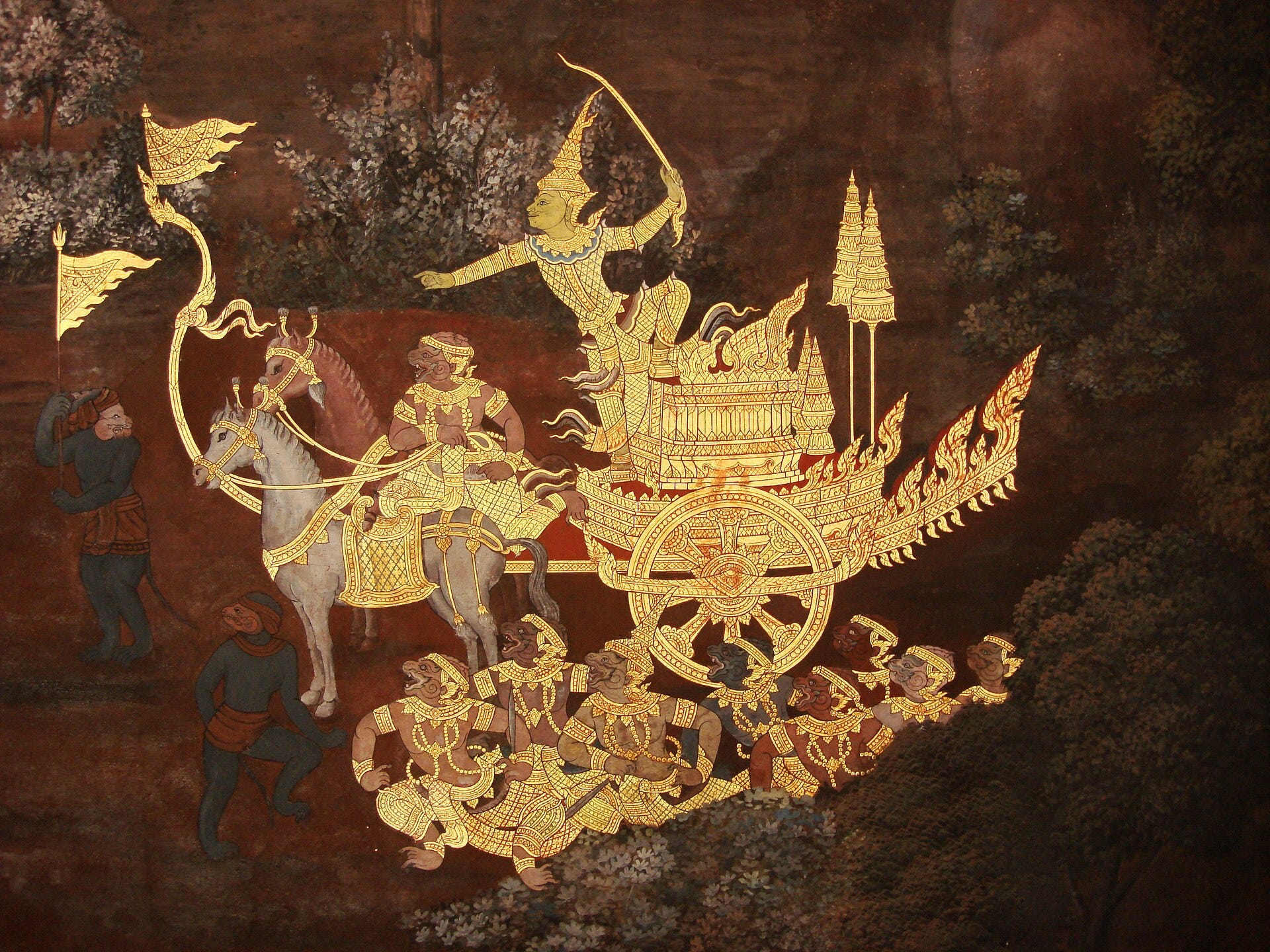
Thailand received the whole of it and never let it go. Its faith, Theravada Buddhism, was born in the Magadha region of ancient India. Its national epic, the Ramakien, is the Ramayana wearing Thai silk. Its old royal capital, Ayutthaya, is Ayodhya respelled, and its kings still take the title Rama to borrow Rama’s legitimacy. The Erawan Shrine in the heart of Bangkok, where those marigolds hang and millions come to pray, is dedicated to Phra Phrom, who is Brahma. Songkran, the water-drenched Thai New Year, is the Indian Sankranti, sent east two thousand years ago and never returned.
I find this moving, and then I find it maddening, and the two feelings always arrive in that order.
Because here is the inversion at the centre of the whole story. India is the source code of the experience Thailand sells. The gods on the shrines are Indian gods. The epic on the temple walls is an Indian epic. The serenity in the wellness brochure is, at root, an Indian serenity. And it is Thailand, not India, that has packaged this inheritance into something a frazzled professional from Mumbai or Munich can buy in a four-day weekend, while India leaves the same assets crowded, chaotic and unsold.
Soft power is not the same thing as heritage. Heritage is what you own. Soft power is what you can package, and India owns the intellectual property of half of Asia’s spiritual life while licensing the operating franchise to the neighbours.
India wrote the scripture. Thailand built the box office.
To see how India came to rent out its own franchise, go back to the room where the new republic chose what kind of economy it would be, and notice what was deliberately left out of it.
After 1947 India adopted a broadly socialist, centrally planned model in which tourism was filed under suspicion: an elite indulgence, a frivolity of the leisured few, rather than an export industry or an engine of mass employment. Foreigners arriving simply to enjoy themselves did not fit the moral architecture of a nation built on steel mills and self-reliance. So the sector was starved, and the starving was a policy, not an accident.
The dates read like a confession. A Department of Tourism in 1958. The India Tourism Development Corporation on 1 October 1966. “Operation Europe” in 1968, going looking for Western visitors with Air India. And then, astonishingly, nothing structural for another fourteen years, until a National Policy on Tourism appeared for the first time in 1982, thirty-five years after independence. A country that found the time to nationalise its banks in 1969 took until the 1980s to concede, on paper, that welcoming people might be an industry at all.
The modern record is far better, and fairness demands it be said. Incredible India gave the country a genuine global brand. The e-Tourist Visa cuts real friction at the border. The Swadesh Darshan schemes have funded 110 projects across thematic circuits, Ramayana, Buddhist, coastal, and tribal, while the UDAN connectivity scheme has opened 53 new tourism air routes into places that had none. The intent is no longer missing. What is missing is the follow-through, the unglamorous, unending labour of making the experience as good as the advertisement.
And there is a precise irony here that ought to be named aloud. In 1991, staring down a balance-of-payments crisis, India tore up the licence raj and freed its industry, unleashing three decades of growth that lifted hundreds of millions out of poverty. The factories were liberated. The welcome was not.
India liberalised its economy in 1991. It never got round to liberalising its welcome.
Surely, then, the cure is money and marketing. It is not, and the proof is the most uncomfortable number in this essay, because it demolishes the excuse India most likes to offer for itself.
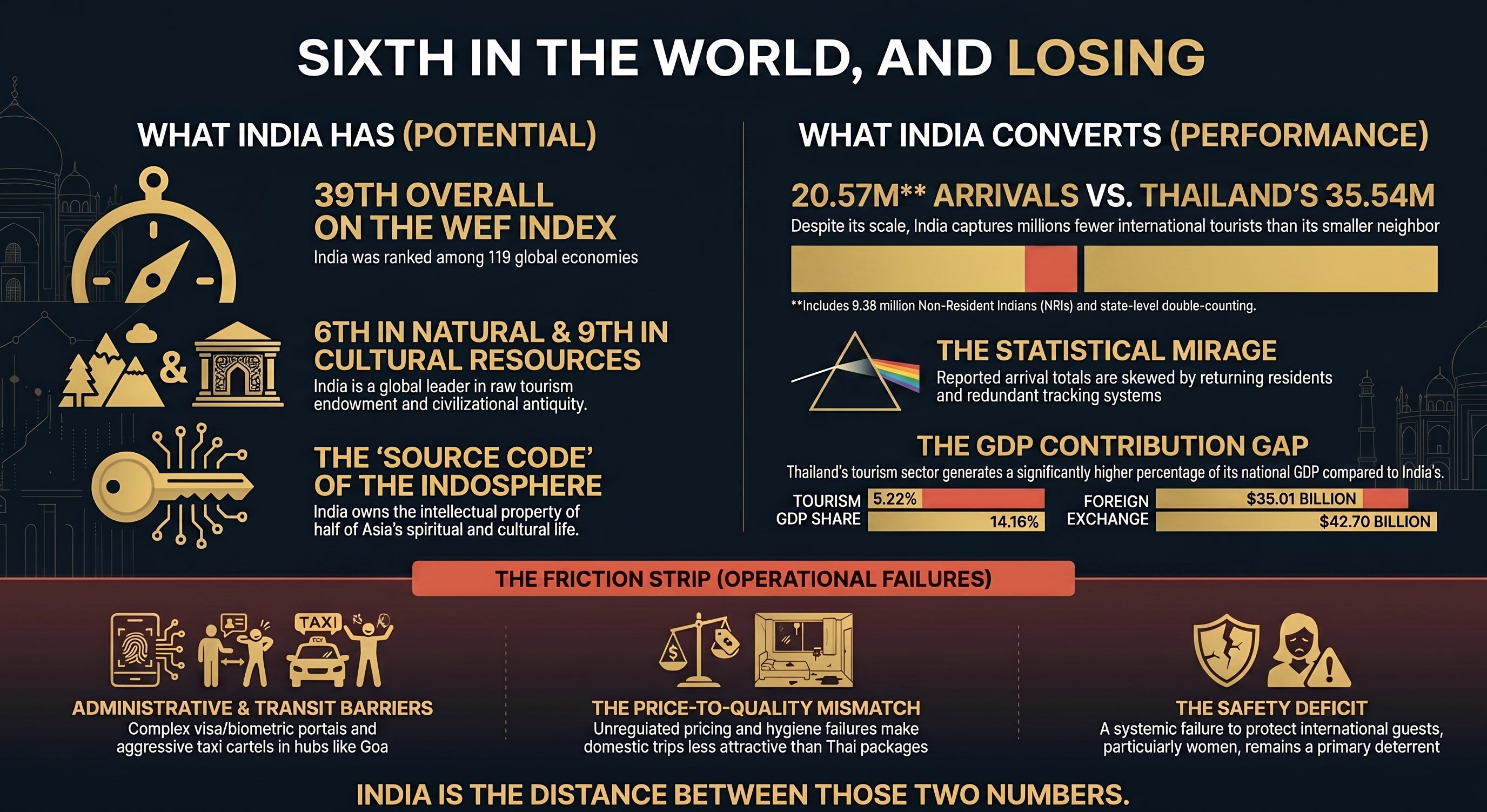
In the World Economic Forum’s Travel and Tourism Development Index for 2024, which scores 119 economies, India ranks a respectable 39th overall. Look closer and the picture is more flattering still: India places sixth in the world for natural resources and ninth for cultural resources. By the arithmetic of raw endowment, India is one of the best-equipped destinations on the planet.
And it converts almost none of it. In 2024, India logged around 20.57 million international arrivals against Thailand’s 35.54 million, and the Indian figure is softer than it looks. A large slice of it, some 9.38 million in 2023, is Non-Resident Indians coming home to family, which is migration, not tourism. The habit of counting visits rather than arrivals means a single visitor landing in Delhi, seeing the Taj in Uttar Pradesh, and flying on to Kerala can be tallied three times over. Strip out the diaspora and the double-counting, and the true foreign-leisure number shrinks again.
So the assets are not the problem. The assets are staggering. The problem is everything that happens between the asset and the arrival, and none of it is an asset at all. It is operations.
Read the operations honestly, and they are a litany of friction. The visa, even improved, still wants portals and biometrics where Thailand simply waves you in for sixty days, using openness as a weapon to seize the impulse traveller. The transit is a fight: Goa’s taxi cartels gouge for short hops while Bangkok offers the cold, cheap certainty of the Airport Rail Link. The rooms too often fail to justify their price. By 2025, a seven-day Thai package for a couple, flights, a four-star hotel, visa and sightseeing included, ran to roughly INR 1,47,500 and delivered an experience a comparable Indian holiday could not match at the money.
Then there is the failure that towers over all the others, the one no marketing budget can outrun. India is not reliably safe for every visitor, and least dependably so for many a woman travelling alone. The episodes that travel furthest are the ones the country would most like to bury: assaults on foreign women in Goa, in Jharkhand, in Maharashtra, and, as recently as September 2025, the molestation of a tourist in Varkala, in a state that markets itself as women-friendly. This is the part that should silence the room, because the high-value independent traveller who roams Southeast Asia freely and safely is precisely the visitor India most needs and most frightens away.
Thailand, by contrast, treats the removal of friction as the work of the state. It runs a dedicated Tourist Police force, holds its homicide rate to 2.6 per 100,000, and even turns the exit into a pleasure: a streamlined VAT refund processed at customs kiosks set neatly beside the duty-free counters, so the last thing a visitor feels is the state working smoothly on their behalf. Call it the hospitality contract: the unwritten promise that a guest will be safe, will not be fleeced, and will leave with a good final impression. Thailand keeps it. India breaks it daily, then wonders why the rankings never convert.
A nation can rank sixth in the world for what it owns and thirty-ninth for what it does with it. India is the distance between those two numbers.
Measure that distance in money, and it becomes the part that should keep a finance minister awake at night.
Tourism contributes 14.16% of Thailand’s GDP; in India, the figure is 5.22%, and even that is propped up by domestic travel rather than foreign earnings. India’s foreign exchange earnings from tourism reached USD 35.01 billion in 2024; Thailand, with a fraction of India’s people and territory, earned an estimated USD 42.7 billion. A country a fortieth of India’s size out-earns it on the very thing India has more of than almost anyone.
Now the thought experiment, with the honest caveat stated first. No serious person expects a four-trillion-dollar economy to draw 14% of its output from tourism the way a smaller one can; the larger and more diversified you are, the lower that share naturally sits. But the gap is so wide that even partial closure is transformative in the strict, measurable sense of that overused word. Lifting tourism from 5.2% to around 8% of GDP, closing barely a third of the distance to Thailand, would add on the order of USD 100 billion a year and tens of millions of jobs.
That is the cleanest hundred billion dollars India will ever find, because the raw material is already built, already ancient, already standing in the sun waiting for someone to sell a proper ticket to it.
But the size of the prize is not the deepest argument for it. The kind of prize it is, is.
India built its modern economic identity on information technology and outsourcing, the code shops and call centres that turned Bengaluru into a global verb. It was a triumph, and it is now the most exposed flank in the country’s economy, because work that can be sent down a wire to a graduate in India can increasingly be done by a model with no graduate and no wire. The very thing that made the Indian IT miracle, its capture of routine cognitive labour, is exactly what artificial intelligence was built to absorb.
Tourism is the precise inverse. A houseboat must be poled through the Kerala backwaters by a person who is in the boat. A Kathakali face is painted by hands, in a room, on a particular night. A meal is cooked by a chef who is present, a temple explained by a guide who is there, a bag carried, a bed turned, a welcome given. Call it the presence premium: the value that exists only because it cannot be delivered remotely, scaled to nothing, or automated, because the entire point of it is that a human being is there. India’s travel and tourism sector already generated some 84.63 million jobs in 2023–24, and they are jobs at the base of the pyramid that IT never reached: the young, the less-credentialed, women, people in towns no software park will ever visit. They are also, almost alone among the jobs of the next twenty years, safe from the machine.
So the choice is sharper than tourism against IT as rival growth stories. The sector India worshipped is the one the machines are coming for. The sector it ignored is the one they cannot touch.
India taught the world to code. It forgot the world would learn to code itself.
And here the Prime Minister’s plea returns, wearing a different face. He is right that money is leaking. Indians abroad are now among the most courted travellers on earth: Vietnam’s Indian arrivals rose 363% in 2024 against 2019, and Thailand took 2.1 million Indians in a single year, chasing 2.55 million by 2026. Every one of those trips is a double debit, foreign currency flowing out and domestic revenue never earned. But the leak has a cause, and the cause is not a deficit of patriotism. It is a product deficit. The Indian on the beach in Krabi is not disloyal. He is rational, and he is voting with the one ballot that never lies, his own money.
You cannot run a current-account policy on shame.
The Giant in the Mirror
Keep your eyes on the foreign visitor, but do not miss the giant standing behind him. India’s domestic travel is colossal: 3.03 billion domestic visits in the year to August 2025, and domestic spending of roughly INR 15.5 trillion that dwarfs the INR 3.1 trillion foreigners spend. It is the only domestic market on earth that approaches China’s, and China’s is the one to study. In 2024 China logged 5.61 billion domestic trips and some 5.75 trillion yuan, around USD 790 billion, riding high-speed rail that reaches deep into its smaller cities. India has the demand China has. It lacks the trains, the last mile and the consistent product to capture the yield, which is exactly why so much of that demand defers to a Thai beach. The liberating part is that the investment which keeps the Indian traveller home and the investment which draws the foreign one are the same investment. China built the trains, and the tourists came. India has the tourists, and is still waiting for the trains.
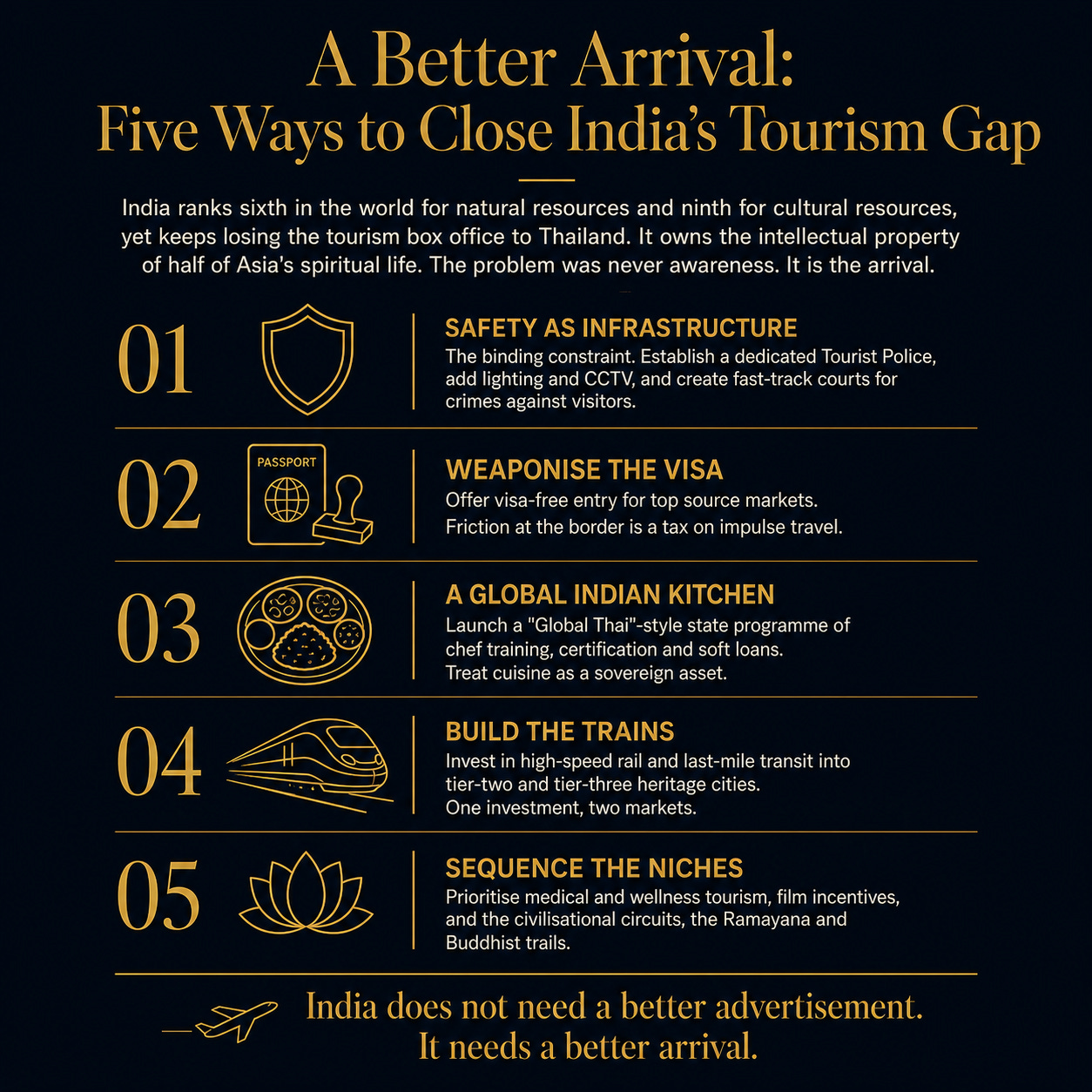
All of which returns us to the plea we began with, and to the only honest answer to it. Not another campaign. The Taj Mahal does not need an advertisement; the planet already knows it is there. India’s problem was never awareness. It was conversion. Move every rupee from the billboard to the last mile. Drawn from what Thailand has proven abroad and China at home, here is the short version.
Treat safety as infrastructure, not public relations. This is the binding constraint, and nothing else on this list matters until it holds: a visible, well-trained Tourist Police on the Thai model, lighting and cameras at the marquee destinations, fast-track courts for crimes against visitors. Safety is not a soft virtue here. It is the precondition for every dollar that follows.
Weaponise the visa. Thailand uses sixty days of visa-free entry as an offensive weapon to catch the traveller who decides on a Thursday to leave on a Saturday. India should match it for its top source markets. Friction at the border is a tax on impulse, and impulse is where the growth lives.
Build a Global Indian kitchen. In 2002, Thailand spent 500 million baht, about USD 15 million, on its “Global Thai” programme, training chefs, lending to expatriate restaurateurs and certifying authenticity. Thai restaurants worldwide passed 10,000, wildly out of scale with a Thai-American population of barely 0.1%, and the spread correlated with a doubling of tourism. Indian food is among the most loved cuisines on earth and has almost no strategy behind it. India’s restaurants abroad are a private accident; Thailand’s are a sovereign asset.
Build the trains. The China lesson and the retention lesson at once. High-speed rail and dependable last-mile transit into the tier-two and tier-three heritage cities are the single piece of capital spending that serves both the Indian who would otherwise fly to Phuket and the foreigner who would otherwise skip the interior entirely. One investment, two markets.
Sequence the niches India is already built for. Medical and wellness tourism, where India holds both the cost advantage and the genuine Ayurvedic heritage, the West is busy reinventing. Film tourism, the cheapest pre-arrival marketing there is. And above all the civilisational circuit, the Ramayana, Buddhist and temple trails that Swadesh Darshan already maps and badly undersells. India should not be learning the worth of its own gods from a Thai brochure.
A final caution, because volume without limits is its own disease. Spain, which draws over 90 million visitors a year, is now fighting its own residents, with protests across Barcelona and the Canaries against the housing crisis that unmanaged mass tourism brings. Grow toward carrying capacity, not past it. The goal is the high-value guest, not the highest possible number.
India does not need a better advertisement. It needs a better arrival.
In August, I will turn fifty in Bangkok, because that is where the weekend led, and because every rational instinct I own as a traveller pointed the way my phone had been pointing all year.
This week, as it happens, Narendra Modi passed Jawaharlal Nehru to become the longest-serving Prime Minister in India’s history. Earlier this year, in From Bhai-Bhai to Buy-Buy, wrote about how much these two political opposites quietly share common fabric. Here, at last, is a place they need not share a thing. The instinct that filed joy under suspicion in 1947 was Nehru’s: the Western-educated socialist who built the republic on steel and self-reliance and could not quite see a holiday as more than a frivolity. It is the one piece of Nehru’s economic inheritance Modi has left almost untouched. If he wanted to add to his legacy, unmistakably his own, genuinely different from the man he has just overtaken, he could do far worse than to make tourism the transformative force, in jobs and foreign exchange and standing, that Nehru never allowed it to be.
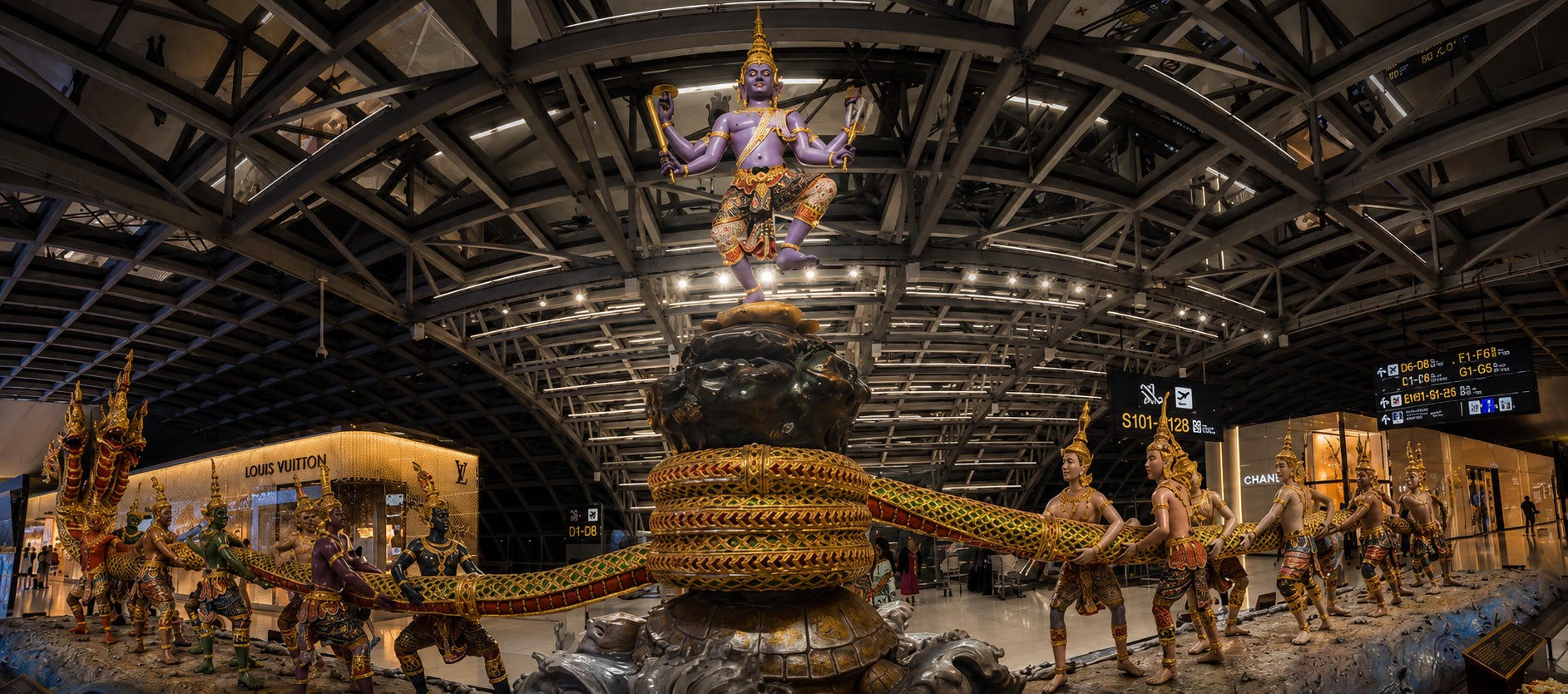
Because a sermon will not do it. You cannot ask a citizen to holiday at home out of duty; you have to build a home worth not leaving. The leak in the rupee is real, but you do not plug it by guilting the traveller. You plug it by being better than Bangkok, which India, of all places on earth, has every god-given asset to be.
That is the part I cannot stop turning over. When I raise a glass on a Thai rooftop in August, I will be doing it under the gods my own country gave away. Phra Phrom on the shrine is Brahma. The name on the throne is Rama. The marigolds are our marigolds. India’s civilisation is already in Bangkok, working the room, charming the guests, smoothing the path and earning a fortune, doing for Thailand the precise job India has never once thought to ask it to do at home.
The fix is not a mystery, and it is not even expensive. It is a decision. India’s tourism gap is not a gap in what the country has; it is a gap in what it is willing to build between the gods and the guest.
And so every one of my closest friends, from West Virginia to South Korea, will fly in for the party and land at an airport called Suvarnabhumi. It is a Sanskrit word. It means the Golden Land, and it is the name Indian antiquity gave to the rich shores that its own merchants and monks once sailed east to reach. The world will descend on the Golden Land, exactly as I had always half-imagined it might for a fiftieth. It will simply be the wrong one.
The gods promised they would be at my party. They have been working in Bangkok for centuries. The least India could do is bring them home.
Aman Narain was born in the UK, raised in India, educated in the United States and France, and lives in Singapore, which qualifies him to feel homesick for four countries at once. A 25-year veteran of global banking and payments, he founded A2Z Advisors, co-hosts the A2Z Fintech podcast, and writes A Man Who Blogs. He is, for the record, still planning the party in Bangkok, has no plans to book the Goa alternative, and at the current rate suspects he never will.
No posts
Comments
Nothing yet. Say the first thing.
Sign in to join the conversation.