
Last winter, a US Army Master Sergeant named Gannon Ken Van Dyke sat inside an intelligence operation at Fort Bragg, North Carolina, codenamed Absolute Resolve. The target was the President of Venezuela. So he switched on a VPN to hide that he was on a military base, logged into Polymarket, and put somewhere between $32,000 and $33,000 on the thing he had just been briefed on. A few hours later, at 4:21 in the morning, the news caught up with the bet. The payout has been put at somewhere between $400,000 and $436,000. Call it the price of a house.
The same season, in Switzerland, a 36-year-old Google engineer opened an account under the handle AlphaRaccoon
. He used his internal access to open a tool with a red banner across it that read “Google Confidential”, and behind it the Year in Search data, weeks before the public would see a word of it. He was not forecasting which names would trend. He was reading the answer sheet. He risked $2.75 million across some twenty-three contracts, the data published on the 4th of December, every prediction landed, and roughly $1.2 million moved into a private crypto wallet.
Two men, two worlds, one exploit. Both knew tomorrow before tomorrow arrived.
The unsettling part is not that they cheated. It is that a prediction market is supposed to be good precisely because it absorbs what people actually know, and these two simply knew more than anyone else in the room. So when the people who know are also the people writing the outcome, is the system being robbed, or is it working exactly as designed?
It’s been a few weeks since we spoke, on Machines, Mandates & Money, which was about machines that spend on your behalf: the four-layer agentic-commerce stack, and the quiet end of software as we bought it. The machine acted before you could.
This week, the focus turns to prediction markets and to the machines that now know before you do. Zubin and I spent this week’s A2Z Fintech podcast, The People Who Knew First (Season 2, Episode 16), walking the order books with the lawyers’ blessing, and this blog is the companion piece. The numbers in this sector arrive as ranges rather than facts, so where the reporting conflicts, I have said so. We are reporting the tape, not waving the flag.
For now, the markets.
The instinct is to treat all of this as new. It is one of the oldest ideas in economics. It begins with Friedrich Hayek, who won the twentieth century’s great argument about whether you needed a central planner to run an economy by pointing at the one thing that did the planner’s job better than the planner: a price. A price quietly gathers thousands of fragments of knowledge no single mind could hold and compresses them into one number. A prediction market simply takes Hayek to his logical end. If a price can aggregate everything the world knows about the value of wheat, why not everything it knows about whether a candidate wins or a hurricane makes landfall?
The economist Robin Hanson gave that instinct a name and a politics in the 1990s, proposing betting markets for forecasting and pushing the idea all the way to a model of government he called futarchy. The slogan is the cleanest thing in the field: vote on values, but bet on beliefs. Then the political scientist Philip Tetlock did the homework that turned theory into evidence. His Good Judgment Project pitted trained volunteers against career intelligence analysts who held security clearances and read classified cables. The volunteers won. He called the best of them superforecasters, and the finding ought to make every spy agency on earth uncomfortable: the analyst with the clearance loses to the diffuse wisdom of people with skin in the game.
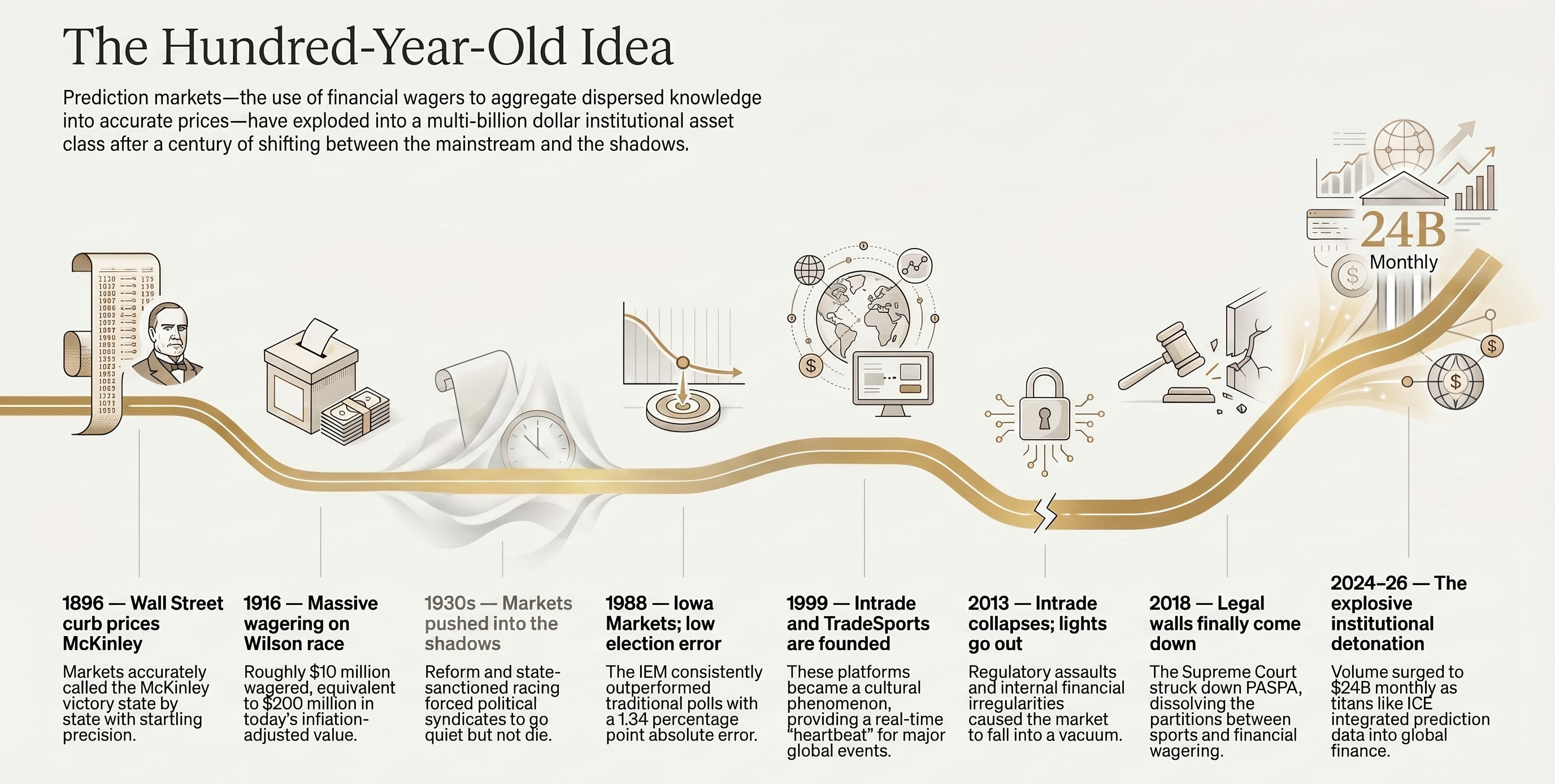
Here is the part that genuinely surprised me in the research. None of this is twenty-first century. In the late 1800s and early 1900s, the New York financial district ran a vast, completely unregulated political betting market out of the Wall Street curb that became the American Stock Exchange, wired into the Tammany Hall machine, with volumes that sometimes rivalled stocks and bonds. A month before the 1896 election those markets called William McKinley’s wins state by state. In 1916, the Wilson against Hughes race drew a reported $10 million on Wall Street, roughly $200 million in today’s money. The delicious detail is that Charles Hughes, the challenger, had as Governor of New York personally signed the anti-gambling law his own candidacy then fuelled into one of the largest gambling events in the city’s history.
The market did not die in the 1930s. It went quiet, pushed into the shadows by moral reform and state-sanctioned horse racing. The academics resurrected it. The Iowa Electronic Markets, launched in 1988 under a no-action letter from the CFTC, ran real money at small stakes and, over thirty years, posted an average absolute error of 1.34 percentage points on US presidential elections. A handful of students with lunch money, out-forecasting Gallup. The public first felt it through Intrade, the Irish-run market that became a heartbeat monitor during the 2012 Obama–Romney race, before its founder died on Everest, the CFTC sued, and the lights went out in 2013. The vacuum sat there until 2018, when the Supreme Court struck down PASPA in Murphy v NCAA and the walls between sports wagering, financial derivatives and event contracts began to dissolve.
Takeaway: The machinery that prices the future is not a crypto invention. It is a century-old Wall Street business that went dormant. What is new is not the market. It is who is now allowed to read it.
The mechanics are elegant, which is why most people get them wrong. A prediction contract is a binary option: it pays a dollar if the event happens and nothing if it does not, which means the price is the probability, stated out loud. A contract trading at 67 cents is the market saying there is a 67 per cent chance. Buy the “yes” for 67 cents, and being right pays you the full dollar. That is the entire instrument. The only real fork after that is how you settle and who is allowed to play. One world settles in dollars through a regulated US exchange with your name on file. The other settles in stablecoins on a blockchain, with a wallet instead of a name. Hold that distinction. It explains almost everything that follows.
So who is on the board? At the top sit two titans that are philosophical opposites. Polymarket lives on the Polygon blockchain and settles in USDC, which sidesteps the banking rails entirely and clears across borders instantly for anyone with a wallet, its superpower and its legal problem in the same sentence. Kalshi is the mirror image: domestic, CFTC-regulated, headquartered in New York, built for institutional capital with strict know-your-customer rules. One asks you for your wallet address. The other asks you for your passport.
Now the thing that reorders your assumptions. Everyone, the two of us included, would have bet this was a politics business, because elections are where the journalists look. The trading data says otherwise. On Kalshi, 80 per cent of volume is sport. Crypto is about 7 per cent. Politics is 4. On a platform the media calls a political prediction market, politics is a rounding error. The split then diverges violently between the two houses: on Polymarket, politics runs around 32 per cent, sport 39, crypto 20, which makes Polymarket roughly the political market the public imagines and Kalshi something else entirely. Combined monthly volumes went from under $5 billion in September 2025 to roughly $24 billion by April 2026, per Pew’s reading of The Block. For scale, US legal sports betting was running near $14 billion of handle a month in 2025, and 30 per cent of American adults under thirty placed a sports bet last year.
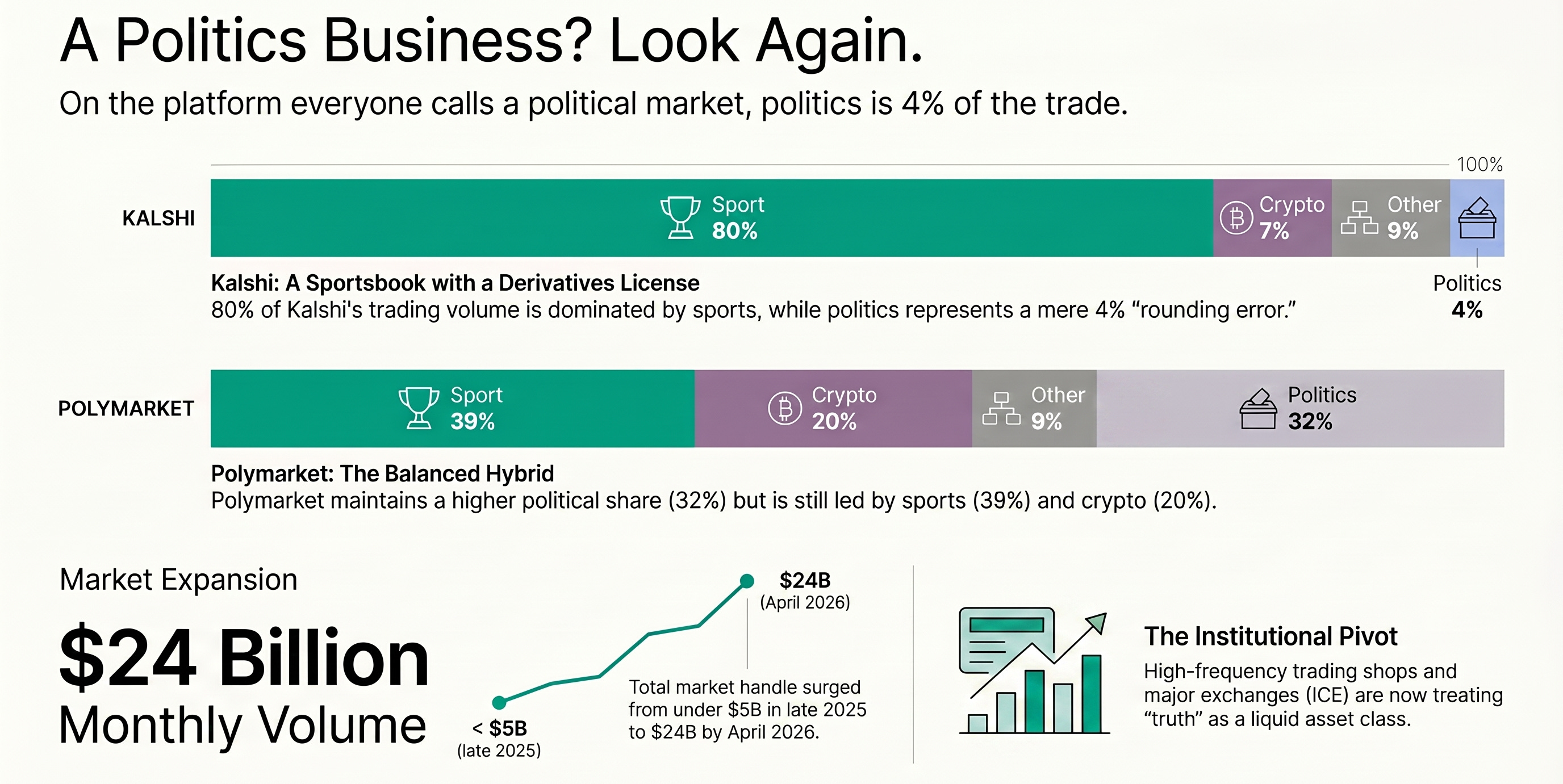
This is not, mostly, a market for pricing the world. It is a sportsbook wearing a derivatives licence, in Zubin’s phrase. Same industry, two completely different animals.
Takeaway: The media files prediction markets under politics. The tape files them under sport. That mislabel is not trivia: it is the difference between a forecasting utility and a regulated casino, and it is the fault line every regulator is now standing on.
Why did a century-old idea, dormant since the 1930s, detonate between 2024 and 2026? Three forces converged almost on cue, and only one of them is the one everybody talks about.
The first was a door opening in Washington. On the 2nd of October 2024, the DC Circuit ruled in KalshiEX v CFTC that the agency had overstepped by branding election contracts as illicit gaming. The twist nobody priced is that the ruling did not restrain the CFTC. It armed it. Once the court confirmed these were legal derivatives, the agency, under its chair Michael Selig, could claim exclusive federal jurisdiction, which pre-empts every state gambling law in the country. The states tried to slam a door. The court took the door off its hinges and handed the frame to the federal regulator.
The second force is the one this newsletter keeps returning to: the rails. The thing that strangled Intrade was banking. You could not reliably move money in and out. The passage of the GENIUS Act in July 2025 changed the chemistry by setting federal rules for payment stablecoins, with final implementation scheduled for January 2027 and Treasury and FinCEN already drafting the anti-money-laundering provisions. Settle in USDC and you get instant, around-the-clock, global clearing. No T+1, no waiting for a bank to wake up. For a market trading on a war that starts at dawn, that is not a convenience. It is the entire product. We watched the same institution arrive at the same rail from the other direction in #32: Chains, Clocks & Capital, when ICE moved to tokenise NYSE equities on a crypto exchange. The plumbing is converging faster than the coverage.
The third force is the loudest and the least analytically interesting. On the 26th of May 2026, the President weighed in on Truth Social, writing that it was “critically important that the CFTC’s exclusive authority over Prediction Markets is maintained”, and going on to name specific state-level opponents, among them Chris Christie, Letitia James, Tim Walz and JB Pritzker, in characteristically blunt terms. We described this on the podcast as the tape, not the flag, and the same applies here: the relevant fact for an investor is not the phrasing but that the most powerful office in the country has put a thumb on the federal side of the scale.
Takeaway: The catalyst that matters is not the politics. It is the settlement rail. A ruling made these markets legal and a President made them loud, but it was the stablecoin that let them finally trade at the speed of the news.
Then the most establishment institution in global finance walked through the door. In October 2025, the Intercontinental Exchange, parent of the New York Stock Exchange and a business that has been pricing the present since 1792, bought into Polymarket. Be honest about the figure, because it is another conflicting range: the headline was up to two billion dollars, but the cash that can actually be tracked is $1 billion in October 2025 and a further $600 million in March 2026, so roughly $1.6 billion deployed. ICE chief executive Jeffrey Sprecher called Polymarket, in his own words, “a forward-thinking, revolutionary company”.
Here is what the money was actually for. Alongside the cash, ICE and Polymarket signed a global distribution deal to pipe Polymarket’s event-driven sentiment data straight into ICE’s network of institutions. ICE did not buy the casino. It bought the sensor: a live, probabilistic read on the world that it can sell to every hedge fund and bank on its terminal. That is the thesis in a line. ICE bought the data, not the gambling. Piper Sandler reckons the sector could generate $8 billion in annual revenue by 2030. This is the same move we traced in #32, the incumbent choosing to build the replacement rather than be disrupted by it, except this time the incumbent is not buying a faster pipe. It is buying the foreknowledge premium, the resellable value of seeing tomorrow a few hours before everyone else.
The quants have already landed. Susquehanna, one of the largest options firms on earth, became Kalshi’s first designated market maker and wired itself into Robinhood’s back end, while shops like DRW and Tyr Capital stood up funded desks offering junior quants $200,000 base salaries to run cross-platform arbitrage. The sector posted a single-day record of $701.7 million on the 12th of January 2026. Robinhood has told regulators it projects 70 billion event contracts traded annually by 2028, and Interactive Brokers, through its ForecastEx venue, has started paying yield on the idle cash behind your open position. That is the moment a betting balance starts to behave like a brokerage balance.
And the valuations? Vapour, by Zubin’s honest account. Polymarket was valued near $1.2 billion in early 2025, then $8 to $9 billion after ICE got involved, then about $14.2 billion in March 2026, with Bloomberg separately reporting talks in the twelve-to-fifteen range. Kalshi is messier still: one set of announcements describes a Series E at $11 billion led by Paradigm, another from the same window a Series F at $22 billion led by Coatue, with Morgan Stanley and Sequoia in the room. So Kalshi is worth eleven billion, or twenty-two, depending on which press release you believe. The asset is real. The pricing is vapour.
Takeaway: The deepest signal in this whole story is not the soldier or the engineer. It is the building. When the institution that is American capital markets pays over a billion dollars for a window into the future, it is no longer betting. It is reading, and reselling the read.
Strip away the scandal and the strongest case for these markets is genuinely serious, and it runs in three layers. The shallowest is insurance: parametric contracts that pay instantly when objective conditions are met, letting venues hedge event risk and letting institutions trade contracts on hurricane landfalls. Risk transfer, not a wager. The middle layer is high finance: in October 2025, Boaz Weinstein of Saba noted that Polymarket priced recession risk at 50 per cent while credit markets implied 2. Buy “no recession” on Polymarket, short traditional credit, and you have a cleaner way to hedge a macro view than anything the bond desk will sell you. That canyon is why the quants are getting paid.
The deepest layer is Hayek again, and it is the best argument in the field. These markets are information infrastructure. Forecasting intelligence that used to be locked inside hedge funds and intelligence agencies is now, in principle, readable by anyone with a browser. The reflex is to assume that leaders have the best view of the future. The data says the opposite. Internal markets run at Ford, Hewlett-Packard and Google found that employee contracts routinely beat executive forecasts, cutting mean-squared error by up to 25 per cent. The factory floor predicted the launch delays and the real sales numbers better than the corner office did. And the same machinery is now pointed at our era’s biggest question: AI researchers using Manifold and Metaculus correctly called the collapse in AI capability doubling time from seven months to four. Hanson’s futarchy, becoming real. A market reading the future of the thing that is reading our future.
I will not sell you a clean story. These markets failed badly during Brexit and the 2016 US election, mispricing populist sentiment because the traders were not representative of the voters. When a market is thin or uniform, it stops aggregating knowledge and starts echoing a consensus.
It is not an oracle. It is a mirror, and only as honest as the room it is standing in. But an imperfect mirror beats no mirror. These markets put a liquid price on what people are willing to lose money on, rather than what they tell a pollster, and nothing else captures that data quite so cleanly.
Takeaway: The bull case is not that the market predicts the future. It is that it ends the monopoly the powerful held on reading it. The corner office was never the best seat in the building. It was just the one with the clearance.
Now the prosecution. Our two men from the cold open have lawyers attached, and there are two more behind them. The Google engineer was charged by the SDNY on the 27th of May 2026 with fraud and money laundering and released on a $2.25 million bond. The soldier, Van Dyke, faces five charges for stealing government data; he tried to have his Polymarket account deleted, which, on a public blockchain, is the digital equivalent of returning to the scene with a mop. A third case sits beside them: an Israeli Air Force major who, as the story goes, leaked a briefing around June 2025 as planes flew toward Iran, and an accomplice who bet on Polymarket and netted $162,663 . Same crime in three uniforms: turning secrets into positions.
The fourth case is the reassuring one. MrBeast’s video editor placed a $4,000 bet on Kalshi using insider metrics, and Kalshi’s compliance caught it automatically and fined him $20,000, five times the trade, before Beast Industries fired him and Kalshi made the enforcement public. A regulated venue catching a four-thousand-dollar insider trade by machine is the optimistic footnote buried inside the scandal sheet. The transparency cuts both ways. The same on-chain trail that let a man call himself AlphaRaccoon and move a million dollars is exactly the trail the FBI followed to find him.
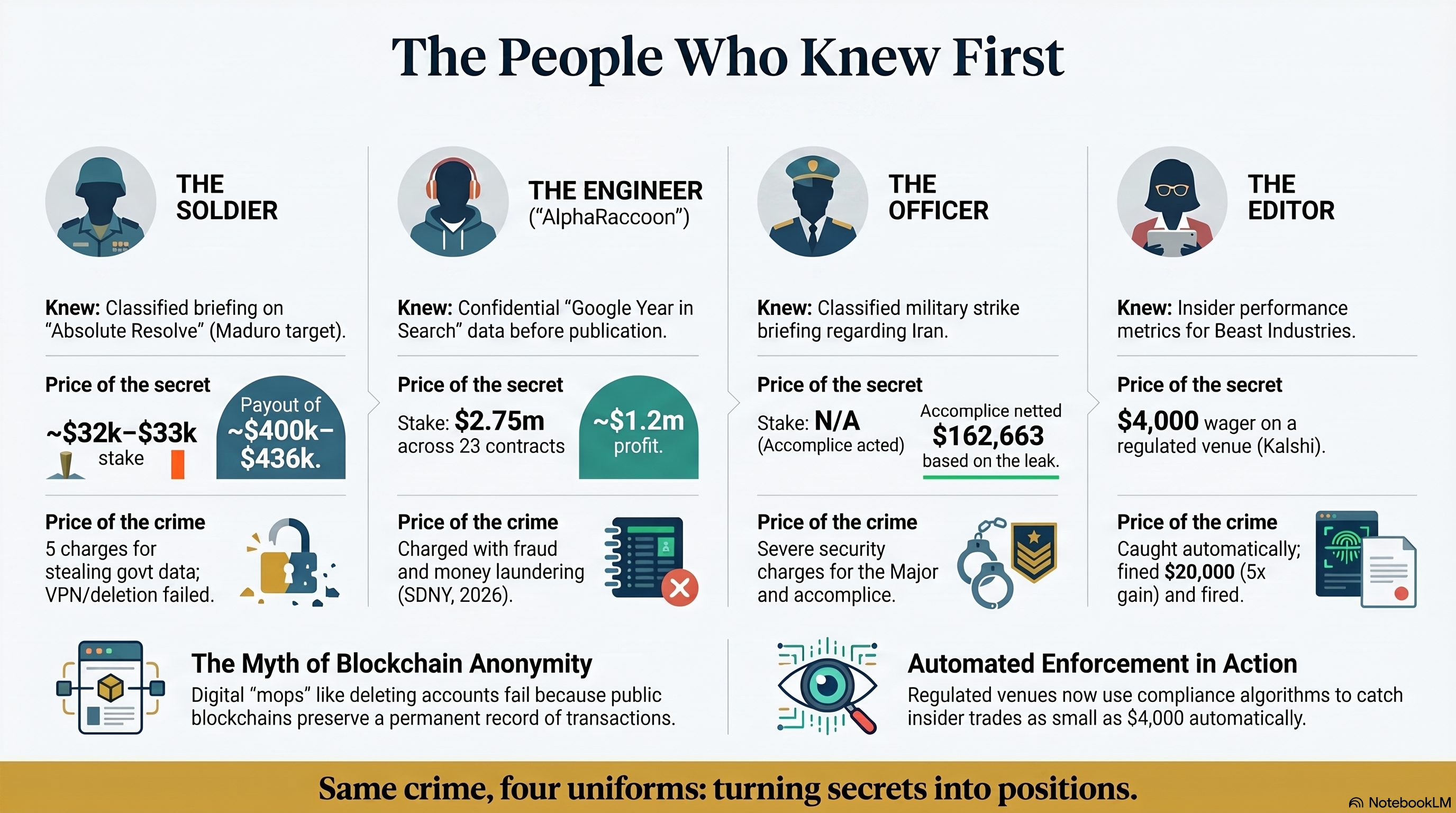
That is the paradox at the centre of all of this. The thing that makes the market exploitable is the thing that makes it honest, and you cannot have one without the other.
The structural worry is larger than any single felony, and it has a name. Call it the information-hazard market, the point at which reflexivity stops being an academic word. If you can bet on whether an attack happens, the market creates a financial incentive to cause it. At that point the forecast is not reading the future. It is commissioning it. The defences against all of this are leaky: Polymarket geofences US addresses, and Van Dyke walked straight through with a VPN and a wallet, because a wallet and a VPN do not care about rules. And underneath the national-security drama sits the quieter, larger harm, the one the volume numbers already told us. When 80 per cent of a platform’s trade is sport and a third of young adults are betting, the addiction conversation is not hypothetical. This is gambling at derivative scale, with a clean institutional logo on top.
Washington has noticed. The CFTC sued six states by April 2026; an Arizona court blocked state enforcement in May, citing federal pre-emption; and Minnesota’s governor signed a statutory ban anyway. A federal court says states cannot touch this, a state law says it can, and a collision like that resolves in only one building. If the states win there, the market does not die. It migrates offshore, beyond US law, and you lose the one thing that made it valuable: the ability to see it.
Takeaway: Transparency is the bug and the feature. A market honest enough to price the world’s secrets is, by construction, a market you can rob, and a market you can rob in full public view is the only kind worth regulating. The exploit and the integrity are the same wire.
For most of history, knowing the future first was the ultimate private privilege. Kings had spies, banks had sources, generals had briefings, and information flowed downhill while the rest of us read about it the next morning in the news, which is a polite word for too late. What these markets have done, for better and for worse, is take that privilege and turn it into a number sitting in public that anyone can read and anyone can challenge.
Three things will decide how this resolves, and all three carry dates.
One. The GENIUS Act clock. Final stablecoin rules land by January 2027. When they do, settlement stops being the bottleneck and becomes the accelerant. That is not a maybe. It is a timer.
Two. The federal-versus-state collision. Pre-emption has won the early rounds, but Minnesota’s defiance is engineered to reach the Supreme Court, and the ruling there decides whether the future trades onshore where regulators can see it or offshore where they cannot.
Three. The first bank to file. JPMorgan and Goldman are said to be circling institutional clearing for binary event contracts, but there is no public CFTC filing confirming it. The day one lands, this stops being a quant’s side hustle and becomes infrastructure.
The boundary between the people who watch history happen and the people who price it before it does has quietly dissolved. The only question left is the one Zubin asked at the very start, when the market knows before the news does. The prize was never the payout.
It was the knowing, and the knowing is no longer private.
The three-layer bull case and the sensor-not-the-casino reframe we traced today are the analytical lens A2Z Advisors brings to institutions trying to work out where they sit in a market that is repricing information itself, whether you are an exchange deciding whether to buy the data or build it, a bank weighing a clearing framework, or a board trying to tell a forecasting utility apart from a regulated casino before the regulator does it for you. I am in Singapore, with New York, London and São Paulo on the calendar this quarter. Let’s talk.
🎧 For the unedited back-and-forth, including the history we could only gesture at here, the A2Z Fintech podcast episode The People Who Knew First: Polymarket, Kalshi & The Truth Economy (Season 2, Episode 16) is live now on YouTube (embed below), Spotify, Apple Podcasts, and 12 additional platforms.
A mention in dispatches, with genuine gratitude: this edition and the episode behind it had a research intern, our first, Samyak Sharma, a school student in Mumbai who came to us unprompted because he was fascinated by prediction markets and then did real work on the spine, the sourcing and the structure. The errors are mine. A good deal of the texture is his.
Aman Narain is the Founder and Principal of A2Z Advisors, and co-hosts the A2Z Fintech podcast with Zubin Vandrevala on YouTube, Spotify, Apple Podcasts and 12 platforms. Writing from Singapore, or a plane, for the world.
Until next week.
No posts
Comments
Nothing yet. Say the first thing.
Sign in to join the conversation.