
When I read Kathleen Stock’s recent article asking why young women are using walking sticks, I found myself getting increasingly angry.
Then I found myself asking, why has one women’s opinion upset me so much.
Perhaps it’s because I recognised something in the argument that has followed me for most of my life: the suggestion that perhaps I cannot quite be trusted with my own instincts.
Stock’s argument is essentially that some young women (she targets Gen Z), may be interpreting ordinary bodily sensations through the lens of illnesses they have encountered online. She talks about social contagion- this idea that behaviours, beliefs, emotions and even symptoms can be spread through groups of people.
And I actually think social contagion is a fascinating idea. It has been witnessed in the past.
BUT, and it’s a big but, I don’t think we should only look at the ways it can make us sicker. I think she is taking a very complex issue and coming up with a false conclusion.
Because if we are going to accept that humans are social creatures who are influenced by the people and environments around us, then surely we have to accept that this influence can go both ways.
Fear spreads
Anxiety spreads
Negativity spreads
Racism spreads
Sexism spreads
Ableism spreads
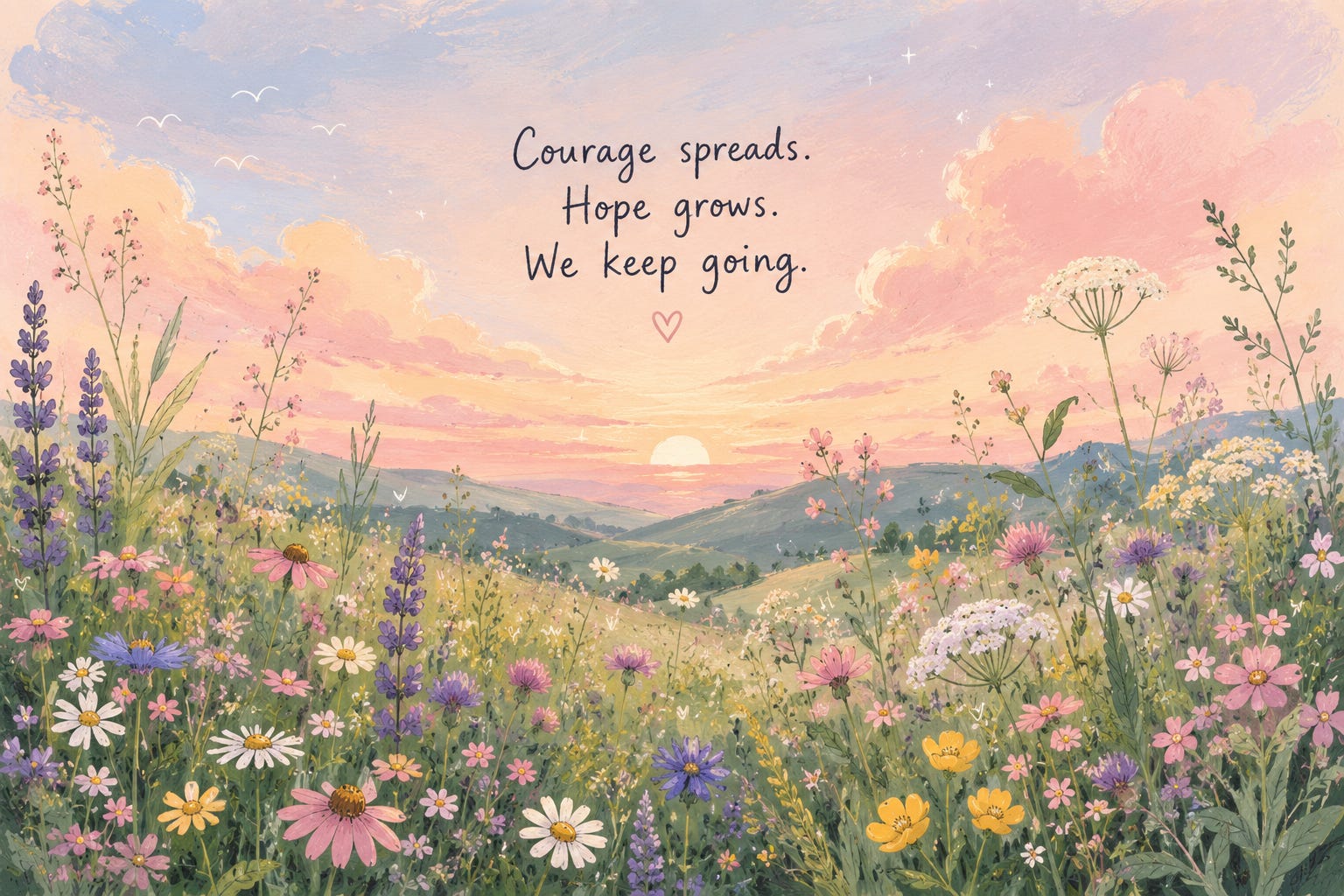
But so do hope, courage, compassion and empowerment.
So perhaps the question isn’t just: Are young women becoming ill because they are influenced by one another? Perhaps we should also ask:
What if they are becoming BRAVE because they are influenced by one another?
And I think that makes for a much more compelling article.
I want to start off with my own experience because it’s the only thing I know for sure.
I was sick before I joined chronic illness groups or saw them on social media. I didn’t see someone with chronic pain and decided that I wanted that to be my story. I didn’t read about ankylosing spondylitis online and convince myself I had that.
I had symptoms for years before I even had a name for what was happening to me, 20 years in fact. I was told repeatedly that it was just anxiety.
And this is where I think the conversation becomes complicated. Yes, the symptoms of anxiety can overlap with symptoms of illness and chronic pain. Symptoms such as: dizziness, fatigue, a racing heart, brain fog, breathlessness, to name but a few. These things can have a psychological cause, BUT they can also have physical ones. Similar does not mean the same. Similarity does not equal causation. Anyone who has done GCSE science knows that.
But it becomes complicated, like a chicken-and-egg situation. If a doctor keeps telling you your symptoms are anxiety, you may begin to believe them. You become anxious about your symptoms, which can create more physical sensations. And suddenly it becomes very difficult to know where one ends and the other begins.
But sometimes the original problem really was physical. It was in my case. Eventually I was diagnosed with ankylosing spondylitis, 20 years after the symptoms started. By that point, I already had permanent damage to my spine and pelvis.
But not only was I damaged physically, it left an emotional scar too.
I sometimes wonder what might have happened if somebody had listened earlier. Because being told to ignore your body not only damages your body, but also your relationship with yourself. We begin to doubt our own perception.
And this worries me beyond the chronic illness scope, because what if we teach girls from a young age that their bodies are unreliable messengers? What happens when we teach them that pain should be endured, that discomfort should be ignored, that being ‘difficult’ is worse than being uncomfortable, and that their instincts are less trustworthy than somebody else’s opinion?
We aren’t just teaching them to ignore stomach aches and boo boos. We may be teaching them how to override themselves and our instincts- the very same instincts that keep you alive, that help you survive, that help you know when you are unsafe.
Those lessons follow her into her work place, her friendships groups, her relationships. And we all know how that can turn out...
Society first told me to silence myself. Then the really insidious thing started to happen, I began to do it myself. Society’s voice became my voice.
I learned to question my own pain. To wonder whether I was being dramatic. To push through. To feel guilty for needing help. To feel deep shame in resting.
And perhaps that is a social contagion too? Perhaps sometimes the thing we catch from society isn’t an illness, but the belief that we aren’t allowed to be ill- a deeply human part of life.
All of this has affected me so deeply, and the reason I have been so quiet of late, is because I have been studying to become a counsellor. Last year I completed Level 2, and through these studies I can see just how much of ourselves is shaped by others.
Our childhoods shape us. Our relationships shape us. Our culture shapes us.
The messages we repeatedly hear about ourselves become part of how we see ourselves.
In Level 2 of the studies, we spent most of that time trying to unravel all the biases and prejudices we have picked up along the way- both the conscious and the unconscious, so they don’t become barriers to our listening. We aren’t born with a fully formed understanding of the world, we learn it.
So if ideas can spread socially, why are we so interested in the possibility that women are catching illness from each other, and not more interested in the possibility that women might also be catching courage?
Maybe I see another woman using a walking stick and think ‘Oh. She isn’t hiding it. Maybe I don’t need to hide either’.
Maybe I see someone talking openly about their illness and I think ‘Maybe I’m not imagining this’.
Maybe someone else’s story doesn’t give me their illness, but maybe it gives me the language to describe my own. There is a difference.
Stock actually asks an interesting question in her article ‘Why does this seem to be particularly affecting young women?’
But, she missed the mark by miles. Instead she goes down the overdone and quite frankly boring route of, it must be the woman’s fault. Instead, she should have asked ‘What is happening AROUND these women?’ Because yes, we aren’t raised in a vacuum.
Gen Z has grown up through a pandemic (which she totally forgot to mention). They are entering adulthood in a world of economic uncertainty, impossible housing costs, social media, political instability, climate anxiety, loneliness and enormous pressure to succeed and look a certain way.
That doesn’t mean these things cause chronic illness. Yes surely they can influence our nervous systems, our stress levels, our relationships with our bodies, our mental health and the way we understand what happens to us. BUT perhaps the women are not the problem. Perhaps they are the canaries in the coal mine. Maybe they are telling us something about the environment we have created.
Maybe our bodies are a reflection of our culture in some ways. And I don’t know about you, but I think that would have made for a far more compelling article.
If you are still with me, thank you, bear with me! But I just can’t stop thinking about the walking stick. Stock sees it as some kind of prop to say ‘Oh look at me I’m special’. BUT, what if it’s actually a tool? What if the walking stick isn’t saying ‘Look at me, give me special attention because I’m disabled’, what if it’s actually saying ‘I’m still here. I’m still going’.
And that is what I see when I look at many of the women I have met through chronic illness communities. They aren’t giving up. They are adapting.
They are figuring out how to live in bodies that don’t always cooperate. They are using whatever tool they can find to keep participating in life. And perhaps seeing someone else do that gives you permission to do it too.
For years, disabled people have been expected to hide their disabilities, including when they aren’t visible disabilities.
They throw out the age old lines ‘You don’t look sick. You walked here yesterday, why can’t you do it today. You look fine, bla bla yawn bla’. Not understanding the complexity of illness.
So perhaps there is something quite radical about a young woman walking through the world with a stick and not apologising for it. She is saying ‘This is what I need and I’m continuing life anyway’
That’s not a weakness, that’s adaptation.
One of the parts of Stock’s argument that I found particularly annoying, was the suggestion that people might receive some kind of social currency from being ill- attention, sympathy, special treatment or exemption from the pressures of life. I literally had to laugh out loud to that. Tutting so loudly that my dog looked up at me in confusion.
I kept thinking ‘What bloody social currency?’
Because, if you actually speak to many people living with chronic illness (which Stock didn’t), you hear a very different story. Before they became ill, many had careers, friendships, financial freedom, holidays, future plans.
Then they became sick.
And suddenly they were losing income. Losing independence. Losing friendships. Cancelling plans. Being frightened of the future. Spending hours researching and trying to get medical appointments.
They were learning how to navigate a healthcare system that often gives you medication but very little help with everything else that comes with becoming chronically ill.
Where is the social currency in that?
I myself barely see anyone these days. No one comes to visit anymore. My world has become a lot smaller. I don’t feel special. I feel lonely.
When I was spending most of my nights researching, trying to find a name for my symptoms, everyone else was moving on with their lives. Getting married, having children, getting ahead on their careers, saving money, enjoying hobbies. I was left behind.
And yet, when I listen to other women with chronic illness, what strikes me the most, isn’t how much they pity themselves. It’s how much they keep going despite of it all.
Of course, they have their bad days, as do all of us, but they adapt.
They learn.
Then try again.
They help each other.
And I am constantly amazed by their strength and empathy. You probably won’t ever see them on the front of glossy magazines, but I have learned more about resilience from them, then I ever learned from magazines telling me what a woman is supposed to look like.
There is a deep void in healthcare when it comes to chronic illness. I’ve seen both sides. From both being a Nurse and from being a patient.
You finally get the diagnosis (sometimes, if you’re lucky, if you can call that luck?)
You get given a prescription (sometimes…)
And then what?
What about the grief…the confusion…what about losing the future you thought you were going to have? The friendships you lose…Work…Sex…relationships….money…identity.
What about learning how to live in a body that has suddenly become unpredictable.
Who teaches you that?
Very often, absolutely fucking no one.
So of course, we look sideways, we find one another, we swap advice. We tell each other what doctors didn’t have time to explain. We say ‘This happened to me too’.
And sometimes that is the FIRST time someone feels believed.
Maybe chronic illness communities aren’t evidence of social contagion creating illness, BUT maybe they are filling a giant fucking hole that healthcare and society has left behind.
Stocks article is aimed particularly at Gen Z women. I myself am a millennial, but I don’t want the next generation of women to inherit the same bullshit we did.
Because I keep noticing something. The same thread seems to run through women’s history. Every generation seems to give it in a different disguise, but the message is the same:
Once a woman was hysterical
Then she was neurotic
Then she was oversensitive
Then it was all in her head
Then she was anxious
And now perhaps the language is:
You’ve caught the idea from the internet you silly little girl.
The terminology changes, but underneath it all is the message sent to young women saying:
Don’t trust yourself…Don’t trust your body…Don’t make too much noise…Don’t ask for too much…Don’t take up too much space…Don’t make other people uncomfortable…..
And if you hear that enough times, you don’t need society to say it, you start to silence yourself!
I know, because I’ve done it. And I don’t want the next generation of women to spend half their lives learning to distrust themselves and the other half learning how to trust themselves again. What a deep waste of potential that is.
I have found myself wondering what shaped Stock’s views. What did she grow up around? What messages did she hear? What experiences influenced the way she thinks about illness, women and resilience? I ask myself what social currency is she gaining from writing that article?
But then I catch myself. Not out of some moral sainthood and trying to be the better person, but because I actually don’t know. And perhaps that’s the point.
We should be careful about constructing psychological explanations for other people without evidence. The same applies to people with chronic illness. We shouldn’t assume we know why someone uses a walking stick because we’ve seen them on the street or on TikTok. We shouldn’t assume we know what someone gains from being ill. Or assume we know whether their symptoms are psychological or physical simply because they resemble anxiety.
And having an Oxford education, an OBE and a platform like the Times, doesn’t make someone right.
My own doctors were trained for decades and yet they still missed my diagnosis.
Medicine is an incredible thing, but it’s also a human thing. It gets things wrong. It changes all the time. It learns. It adapts. But it takes a while. It also doesn’t help that we’ve only just started to properly research women’s bodies in recent years!
And we are still all living with the aftermath of a completely new disease in Covid, with huge amounts we still don’t understand about chronic illness and the relationship between body and mind and pain.
That uncertainty should make us humble and curious and encourage us to put our thinking caps on. To band together as a society.
Not to throw blame on the vulnerable and be so dismissive.
I don’t want to dismiss the possibility that social media can influence the way people understand their health. Of course it can. Some people will misinterpret symptoms. Some people will become frightened by information they find online. Some people identify with diagnosis that don’t apply to them because they are so desperate for an answer. We should talk about all that, BUT we should also be able to talk about the opposite.
What happens when someone who has been ignored, finally finds language? When someone who has felt ashamed, finally sees someone else refusing to hide? What happens when a woman who has spent years apologising for taking up space, sees another woman take up hers?
Maybe that spreads too.
Hope spreads. Courage spreads. Empowerment spreads. Stories spread.
And sometimes that story doesn’t make you sick. Sometimes it gives you the courage to keep going.
So I don’t think the answer is to tell women to put down their sticks and stand on their own two feet.
Perhaps the answer is to ask why they needed the walking stick in the first place.
And before we decide that the problem is the woman, we should look at the world she is trying to walk through.
Because maybe the most dangerous social contagion isn’t believing that you’re sick.. Its believing that you aren’t allowed to be sick.
And maybe the greatest message we can give young women is:
I believe you.
I believe you.
I believe you.
Let that message spread like wildflowers.
Lots of Love and Hugs, Amanda x
P.S Let me know how that Times article affected you in the comments x
Text within this block will maintain its original spacing when published
'The over-domesticated woman is one who has been trained to be too nice...She has been conditioned to ignore her own deep instincts, to remain quiet when she should speak, and to distrust the very messages her body and soul are sending her'- Clarissa Pinkola Estés No posts
Comments
Nothing yet. Say the first thing.
Sign in to join the conversation.