
Many senior leaders struggle to grasp the significance of leading people who know more than you do.
Most of your career your expertise was your safety.
It’s how you proved your worth, earned respect, and got promoted.
When things got tough you would double down into building more knowledge.
But in a senior leadership role, expertise stops being your edge.
And holding onto it: clinging to the need to be the most knowledgeable in the room, the one with all the answers will limit your impact and kill your career.
Most start their your career as an individual contributor, where your value comes from knowing how to do the work. When you progress in to co-ordinator, team leader and management roles: your value comes from knowing how to manage others doing the work. All early stage roles need the detail and expertise to be within the individuals and the people that directly manage them.
But as an Associate Director or senior leader, your value shifts again and moves away from what you know and toward how you lead.
Most significant within this leadership isn’t the flow of tasks and work; or the ability to solve complex queries. It is about who you are while you lead.
Who you are being while you lead is what creates or destroys trust; and what stifles or unlocks the potential in others.
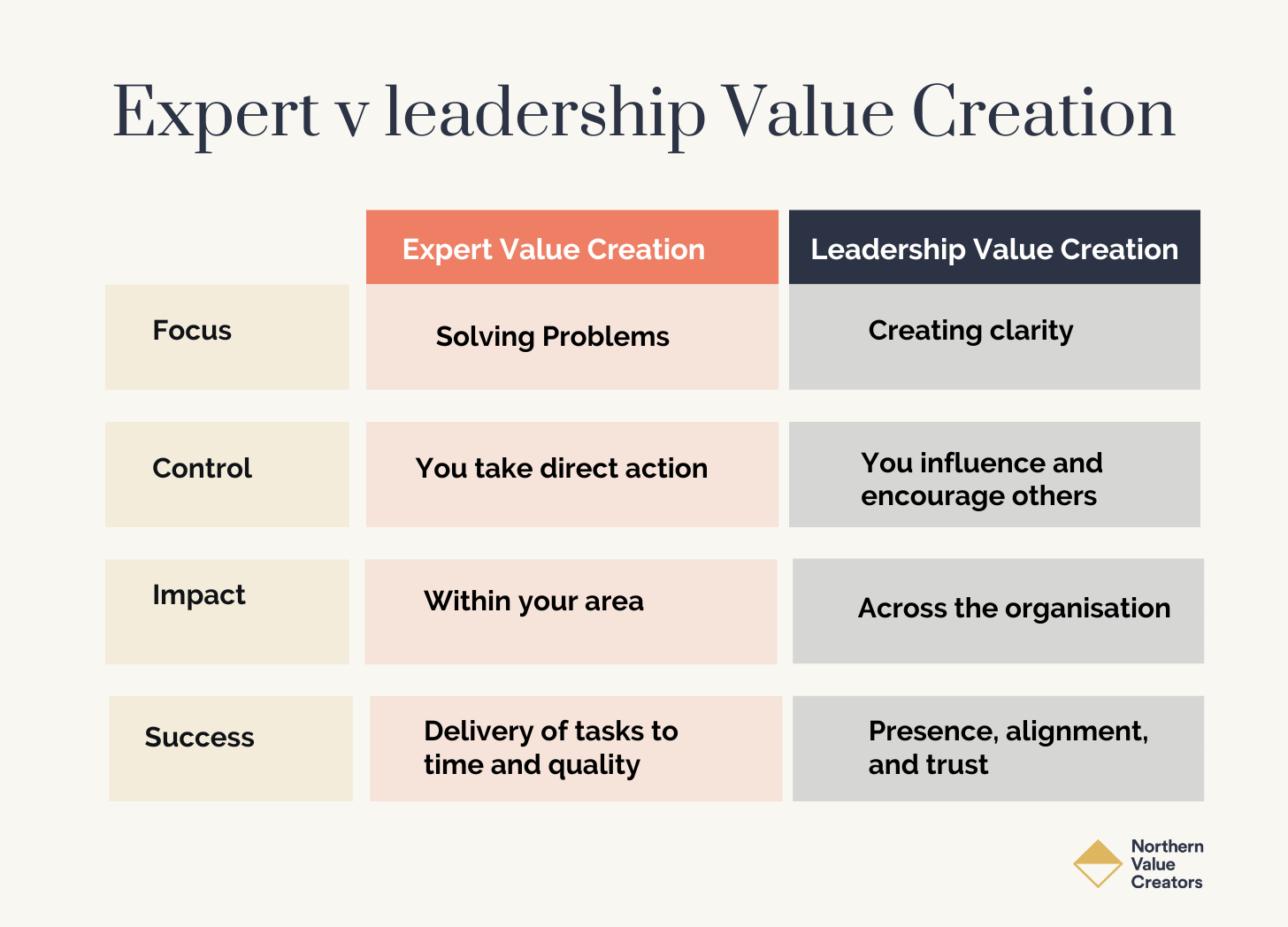
Your expertise as a senior leader doesn’t become irrelevant, it stops being your main currency. Your credibility now depends on how well you manage uncertainty, navigate relationships, and regulate yourself and your team.
Neuroscience tells us your brain is wired to detect threats; not just physical ones, but social ones too.
A raised eyebrow in a meeting, being excluded from an email chain, or an unclear comment from the VC can all trigger the same threat response as being chased by a bear.
The moment that happens, your brain flips into protection mode.
Blood flow moves away from your prefrontal cortex: the part responsible for empathy, logic, and creativity and towards your muscles. You stop thinking and get ready to fight or flee.
You start reacting. And when you’re reacting, you’re not leading.
You’re running survival strategies.
When your brain feels threatened, you’ll instinctively use the five survival strategies outlined below. These are what your brain does when your prefrontal cortex goes off line and you are reacting on instinct rather than intentionally choosing the best approach.
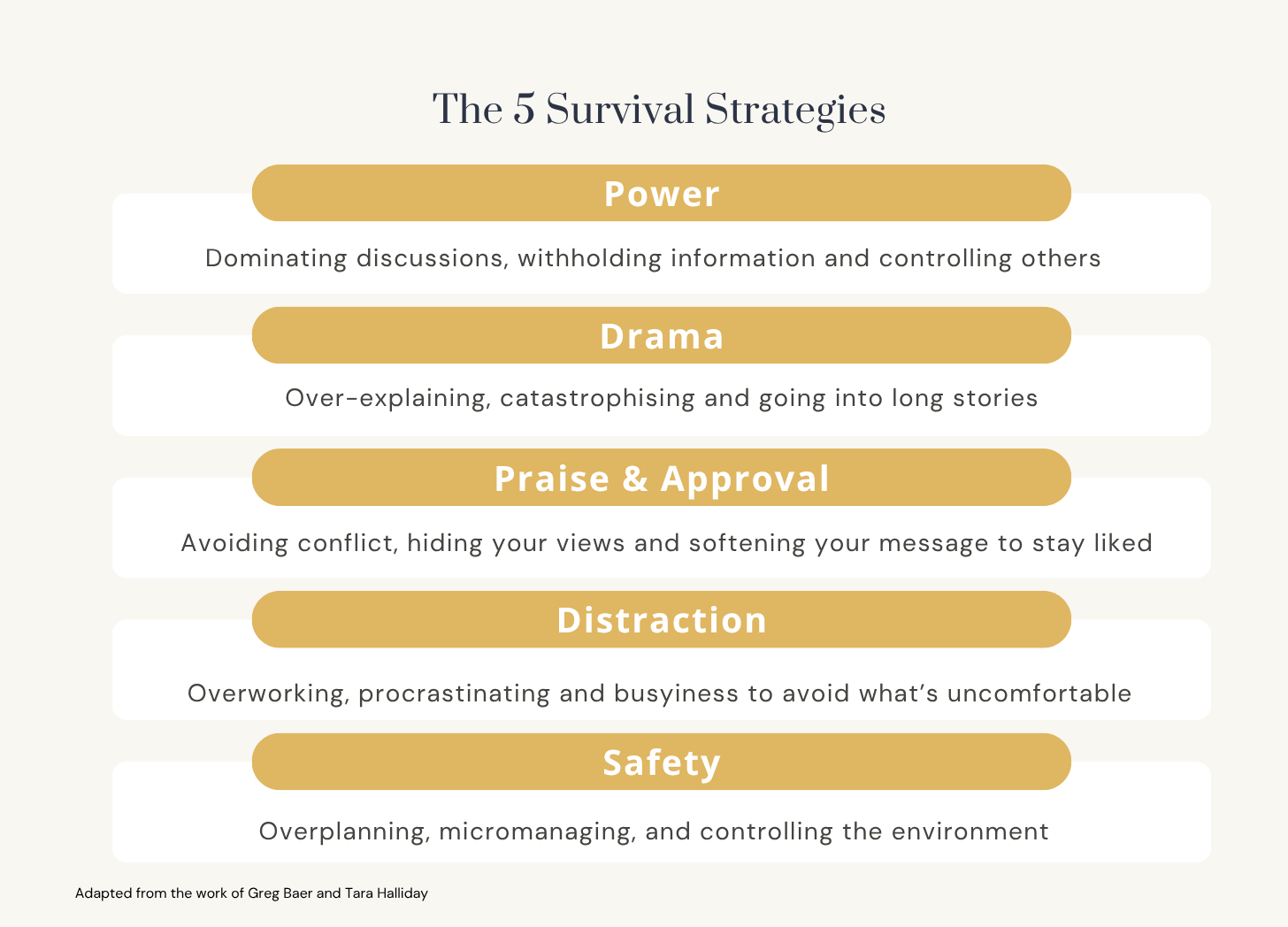
None of these are “bad.” They’re are the protective behaviours we use as human beings when we are under threat.
They’re what you do when your brain’s says, “I don’t feel safe right now.”
Survival strategies are reactive, they harm your impact as a leader and the more senior you are in an organisation, the more visible they become.
Mood is contagious.
When your brain flips, others’ brains flip too.
As a leader, your emotional state sets the tone for everyone around you.
If you walk into a meeting tense, defensive, or distracted, your team’s brains pick up on that threat signal and they mirror it.
The best leaders don’t just lead others.
They lead themselves first.
They notice when they’re triggered.
They pause before reacting.
They lower their lid before they open their mouth.
That’s what allows them to stay curious, ask better questions, and think strategically under pressure.
Imposter feelings, that sense that you’re not quite good enough, or that someone’s about to realise you’re faking it are just another version of threat detection.
They’re your brain scanning for social danger:
Do I belong here?
Do I deserve this role?
Am I enough?
If you ignore what’s going on inside you and impacting your mood, those thoughts and feelings will steer your behaviour.
You’ll overwork (Distraction)
Overcontrol (Safety)
Overplease (Praise & Approval)
Overassert (Power)
Be ‘over the top’ (Drama)
But if you notice these imposter feelings and can say to yourself , “Ah, this is that imposter voice again” you can interrupt the threat loop. Stop reacting, and start leading again from a space of presence.
As a senior leader, leadership isn’t about knowing the answer. It’s about staying steady enough to find it collaboratively.
When you can manage your internal state, you make it easier for everyone else to manage theirs. Safe to ask questions, share uncertainties and explore new thinking.
That’s what psychological safety looks like in practice.
You create value by:
being calm in uncertainty
offering clarity in confusion
staying curious in conflict
Leadership value creation starts with managing your mood and your nervous system.
So if you’ve just stepped into an interim or Associate Director role, the question isn’t:
How can I prove I know enough?
It’s:
How can I lead from a space where I feel I am enough?
That means:
Noticing your triggers. When do you feel unsafe, small, or exposed?
Spotting your strategy. What’s your go-to: Power, Drama, Praise & approval, Safety, or Distraction?
Regulating your mood. Slow breaths, noticing your thoughts and being intentional
Returning to curiosity. Ask: What might they need right now? What am I missing?
Learning to master your mood means you bring out the best in others when it matters most. When you stop being the most expert in the room, getting more expertise for yourself isn’t helpful.
You can’t lead experts by competing with them.
You lead them by creating the conditions for them to think, contribute, realise their potential and grow.
That’s how you move from expert value creation to leadership value creation.
No posts
Comments
Nothing yet. Say the first thing.
Sign in to join the conversation.