
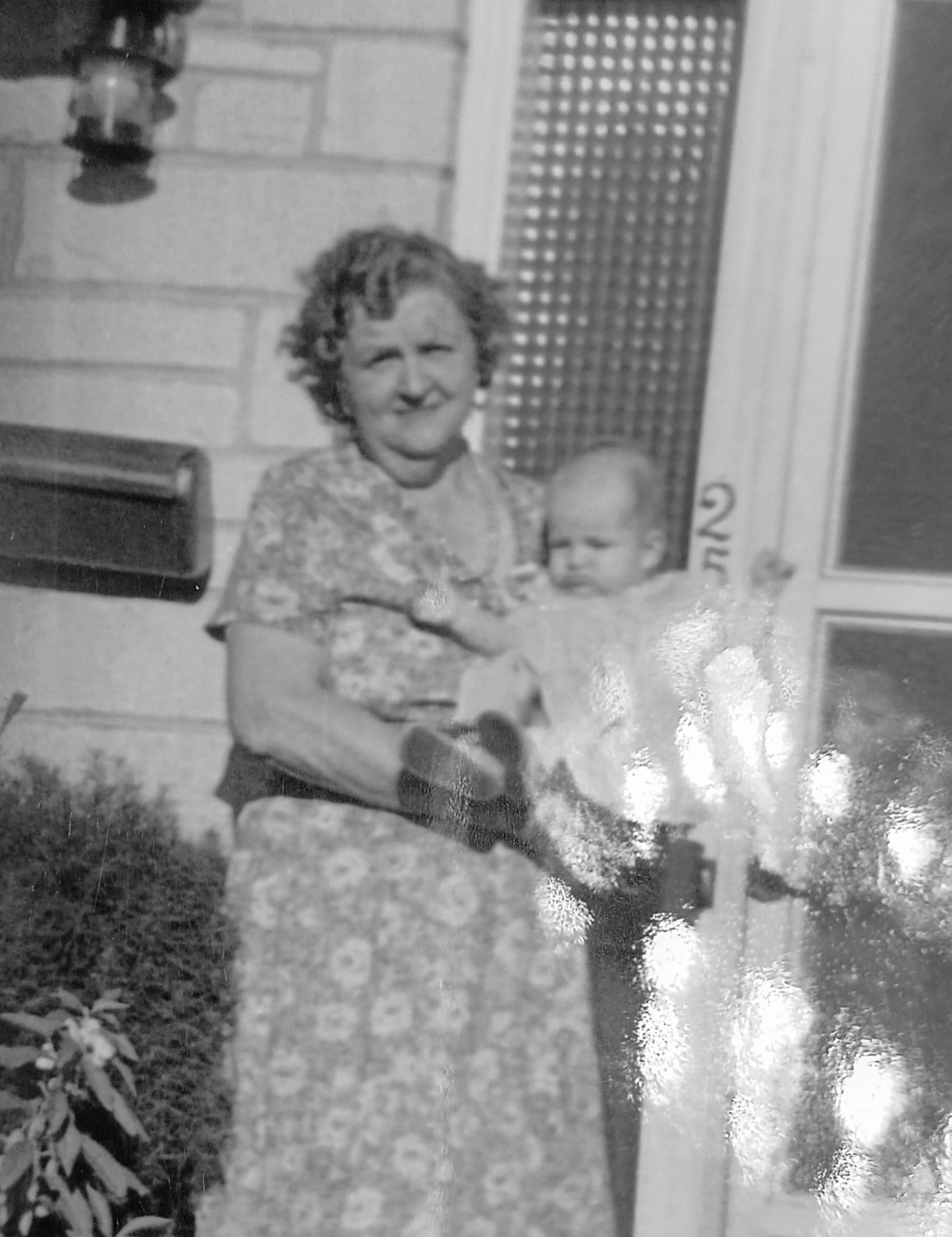
It’s our Gramma Noren’s birthday today, June 5th, our dad’s mom, shown here with our sister Stephie. Our dad Bob, her youngest child, was born one day later on June 6th. My mom’s dad, The Baron’s birthday, was one day after that, June 7th. Growing up it was a trifecta weekend of celebrating our elders in the western suburbs of Chicago, Illinois. Both our parents were born in these same suburbs west of the City.
My grandmother wasn’t. Where she was born, none of us alive know anymore. Where she grew up, mostly likely Chicago. Yet even this I can’t say for sure. One can see her in her face a stalwart determination. She was a quiet, kind person who thought about things more than she spoke about them. She wasn’t usually visually expressive. This is the closest thing to a smile I’ve ever seen. Her parents, like her husband’s parents, arrived in the US sometime in the late 19thcentury from Sweden. I don’t know if she had any brothers or sisters; I don’t know her maiden name.
I learned what I do know about her mostly when I went to her funeral, my first funeral, at thirteen. I was surprised to realize that my taciturn Swedish American grandmother had lots of women friends, who obviously respected her a lot. They had all been Eastern Stars together. I’d had no idea what an Eastern Star was, or that they were linked to the Masonic Order. When I read now that members’ aim was to make a positive difference in the world with charitable works, lasting friendships and loving kindness to all mankind (sic), this makes sense. For sure this was my grandmother.
I also know she made a mean angel food cake. When my dad would drive over to Villa Park from Wheaton many Sunday afternoons to pick up her for a visit with all of us, they invariably carried angel food cake back with them. It was his favorite, and she knew it. Myself, it wasn’t until I hit my anorexic early teens that I fully appreciated the low-caloric content of angel food cake.
I was young when she died. And now even all her children are gone. Only my mom, her daughter-in-law, is alive to substantiate the bits of what I remember. That Gramma’s family had been strapped financially, so she was raised as a foster child, or possibly adopted into another family, in the early 1900s. Who these people were, we don’t know. I don’t know how she made her way in the world, or how she and my grandfather met. I know all her five kids adored her, and had the highest love for her. She and my mother had a relationship of mutual respect, which my mom remembers today.
For me, she was kind of an enigma. She sort of scared me as a little kid. She was very serious and seemed to notice my every mistake. She wasn’t harsh or scolding; she would just raise an eyebrow and start to say mildly, Robin – (my name growing up) and I would wither inside. Shot down again. No way to impress Gramma. I so wanted to impress her.
Yet writing about it now, I can see she was a master of subtle nuance, and that I was pretty good at reading her. Ours was not an oblivious relationship.
She had five children: Agnes, Wally, Dorothy, Chuck, and Bob. Wally lived with his family on the same block as Gramma in Villa Park, with Agnes and her family not far away. She had her own small frame house surrounded by flowers (she must have grown them) in this neighborhood near the Ovaltine factory. The whole neighborhood smelled like malted milk to me. Gramma’s most obvious neighbors, besides our Uncle Wally and Aunt Phyllis, were the Stefanis. The Stefani family’s home occupied a large part of the block, at least a third of it, from the corner down. They seemed quite well to do and lived behind a high stone wall. We wondered what they did there.
Our dad Bob and our mom Margie had a big family, six of us stretching across sixteen years of births. Because our dad was the youngest child, we too were the youngest grandchildren, by a long shot. Our cousins conversed together with the high sophistication of someone 16 or 17 – Wally’s kids Laurie and Rick were stars, standouts; Little Dort wore her amazingly black hair in a giant beehive; it was the fifties after all. Her brother Tommy wore very white T-shirts, like James Dean. They were teenagers; we were grade school kids, far down the mountainous hierarchy of childhood. We shrubs hung out on the floor by the toy box in Gramma’s sunny front room as the teen gods and goddesses lounged in the living room. It was the same house where years later at her death I learned about the Eastern Stars.
There were more Eastern Stars
While all the Eastern Star ladies I met back in Gramma’s living room were White, there are also Black Eastern Stars, the Prince Hall Order of the Eastern Star, actually the oldest black sorority-based organization in the US. In these last few years, I’ve learned what I can about the Eastern Star Francis Tyrrel of the Bay Area. She and her family remind me of different times, different possibilities. She also embodied those ideals of charity, friendship, and community that Gramma did. Yet their lives were further apart than the many miles between Chicago and San Francisco, I’m guessing.
I wonder about Our Gramma Noren’s life
In 1900, Chicago was home to 150,000 Swedes and Swedish Americans. It was widely considered the second largest Swedish city in the world. Was my gramma surrounded with friendly faces, or did she have to work hard to survive? Or maybe both?
From 1850 to the 1930s, one and a half million Swedes left Sweden, mostly for the Americas and Australia, due to crop failures, poverty, and religious persecution. Catholics in Lutheran Sweden risked banishment. Farmers, factory workers, and ordinary folks were the vast majority of people who chose, or were forced, to leave. Close to half of them settled in three states – Minnesota, Illinois, and New York. The Congressional passage of the Immigration Act in 1924 set strict quotas on immigration. What had been called The Great Emigration in Sweden abruptly halted. Now, of course, ironically, in some circles, they’d be heartily welcomed again.
My husband Gord’s Grandma Dorothy caught the last stagecoach out of Nevada at twelve, heading for California. What I remember, about the same time, was that my mom’s parents, both German Americans, were admonished not to speak German outside their homes, what with WWI and later WWII. Yet asking my mom about this today, she did not substantiate this. What language did our Gramma Noren hear inside her head and heart? How did she see the world? I have very little idea.
Something new is being born
Lately I’m drawn to these pictures of loved ones holding babies. I’m realizing it’s a metaphor for the current moments. Something new will come from all this turmoil, and how it plays out, we have no idea.
Today I send love and respect to my grandma and all the ancestors, and all of us here alive in this moment.
Image: Our Gramma Noren with Stephie, probably taken by RB Noren, 1959 or 1960
Bio: I’m a writer, Ayurveda health educator and Polarity Therapist practicing in Santa Fe, NM. My most recent seasonal cookbook Easy Healing Drinks from the Wisdom of Ayurveda is on special now.
No posts
Comments
Nothing yet. Say the first thing.
Sign in to join the conversation.