
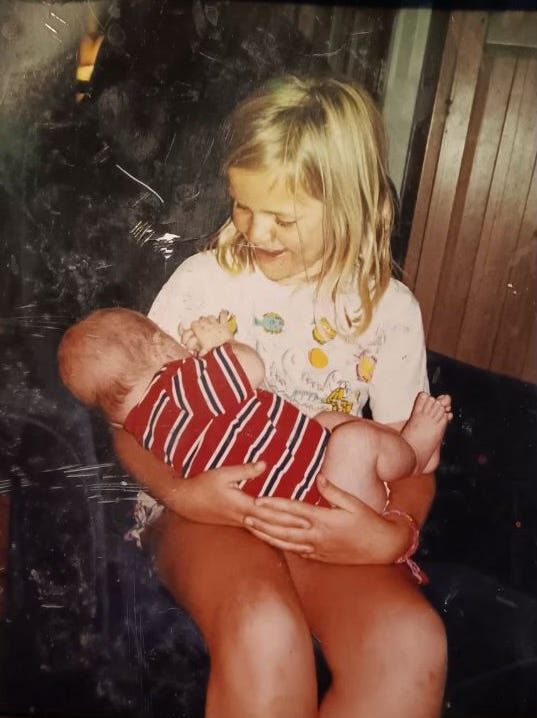
Photo: Iza and James
It takes a tremendous amount of emotional and spiritual maturity to witness in full force the collective shadow of humanity and keep your heart open. - Roshi Joan Halifax
This photo was taken in the 1990s, long before our daughter Iza became a counselor and our friend James a painter, each following their own unique paths in life. It was a moment of opening to wonder, the sheer remarkableness that either of these two beings could meet, let alone thrive. Yet both have.
Time as luxury: a leisurely dinner with friends last night
We’d gathered, five of us, in an unusual moment of slow-down to look at family photos and enjoy a delicious meal made by our friend Mich. The conversation turned to how rare such times are; they’ve almost become extinct in the pressured economic realities of the US today. Especially for the younger members among us, connecting like this was not a regular occurrence.
Looking at the pictures, Iza reflected that she’d had an unusual upbringing, in terms of the ratio of kids to adults. We’d been a part of a local group of friends who called ourselves Sustainable Presence from the time Iza was small through her teenage years. It was self-organized to create gatherings, work parties, and a kind of unique savings club-lottery for sustainable projects. While there were a few families in our group, the large majority of committed members were single adults. Iza grew up with many adult friends with no biological connections to her for most of her young years. (Thinking of James’ family, I bet that was true for him too.)
The conversation turned toward other kinds of kid-connections. The point was made that these days in our area, having birthday parties with your school mates was unusual, unless you were rich and white. Most parents were too strapped and each working multiple jobs to be able to take time to invite a bunch of kids to a party. Time to connect has become a luxury under these conditions. Opening to wonder in the midst of the reality of so much injustice and suffering can be almost unimaginable at times.
The redistricting of Tennessee
As we talked about all this, my grief went to the recent news from Tennessee. In a special session called by the governor, the Tennessee state legislature created a new voter map on May 7 that would eliminate the last Democratic-leaning and majority Black district in the state. It divides Memphis into three parts and dilutes its Black vote into minority presences in the surrounding White districts. In doing so, it wipes out a voting district that has been in existence for more than 100 years.
Nashville’s Black influence had already been similarly eliminated in 2022. The chances that every Congressional member from Tennessee will be now White is extremely high.
Understanding Voting Rights in the US
In earlier times, the Supreme Court emphasized the right to vote was the fundamental political right…preservative of all rights. Today this right is widely regarded as the primary essence and end point of democracy. (Astra Taylor, Democracy May Not Exist, But We’ll Miss It When It’s Gone, 2019, p. 174) The UN’s Universal Declaration of Human Rights of 1948 underscored the importance of universal and equal suffrage and free voting procedures. (Taylor, ibid.)
The 14th and 15th Amendments to the Constitution prohibit intentional discrimination on the basis of race, color, or nationality. (Though the 14thAmendment did manage to leave out ironically native-born indigenous people from this protection.)
There were many illegal work-arounds to this law of the land by states. In 1965, after years of struggle, Congress passed the Voting Rights Act to ensure that citizens would get the rights they deserve, as guaranteed by the Constitution. For a number of decades, civil rights protections for voters improved. Section 2 of the Voting Rights Act, preventing discrimination through unscrupulous gerrymandering, was the focus of a lot of pressure. In 1982, Congress amended the Act to clarify that proving intentional discrimination was not necessary to win a case under section 2.
However since 2013, there have been significant erosions to this protection through the actions of the Supreme Court. Section 2 was the primary strong functional part of the Act to survive - up until last month. In light of these weakening moves, the John Lewis Voting Rights Act was proposed to block states and counties from enacting restrictive discriminatory voting laws and policies. It has yet to pass Congress.
The Supreme Court decision on Louisiana v Callais
On April 29, 2026, the landmark decision effectively gutted Section 2, the last remaining powerful provision of the 1965 civil rights law that prevented racial discrimination in voting. Section 2 has long been used to ensure minority voters are treated fairly in redistricting. Intentional discrimination would have to be proved in court, something extremely difficult to do.
In bizarre Mindspeak, Justice Alito speaking for the conservative majority in Louisiana v Callais labeled compliance with section 2 as an unconstitutional racial gerrymander.
Dissenting Justice Kagan wrote that the decision gives lawmakers virtually unlimited leeway to justify drawing districts that discriminate based on race.
In other words, a white supremacist minority in the US is changing basic law to be able to hold on to power, no matter how unpopular their actions and policies are. In 2017 in North Carolina, the Reverend William Barber II called out such deceptive practices: Wealthy oligarchs know they cannot hold on to power in truly democratic elections. If you can’t win on the issues, stop cheating to keep yourself in office. (Taylor, p. 171)
Not only this. Having reversed the law, the Supreme Court hustled along its implementation. Not only did the Court destroy key voter protection, in an unusual move blasted by Justice Ketanji Brown Jackson, it allowed the ruling to take effect ahead of schedule, so that Louisiana (and other eager states) can redraw their maps before the midterms. As Jackson pointed out, the Court has only hastened its ruling like this twice before in the last 25 years. Guardian last
Tennessee is the first state to take advantage of the reversal of voter protection, a scant week after the Court decision passed. Fair Fight is just one of many excellent non-profits standing up for justice; they’re based in Georgia.
Family Counseling in these times
Struggling under the weight of our own dysfunctional patterns and this kind of news, our family started counseling at the Sky Center last December. While the non-profit Sky Center’s strong focus is suicide prevention among youth, they also offer family counseling for people of all ages with their interns. We were relieved they took us. Our intern counselor Megan was astute, compassionate, and joy-oriented. She graduated this week, so of necessity, we did too, that is, our healing sessions with her are now over.
In the remarkably short time – 16 weeks, one hour a week – that we worked with Megan, we were able to find better ways to connect with each other, opening to wonder, and hugs. If you’ve thought about change in this way, I’d sure recommend it.
Opening to Nourishment
Kids need help in tangible ways. World Central Kitchen is feeding families in Gaza and Lebanon, and so many other places
Opening to the wonder of long-term connections
Happy birthday, Jim! As James’ dad, you’ve created magic in countless ways. Nancy, as James’ mom, you’ve invited him into myriad new worlds. Both of you, with your shared wisdom and resilience – wow! Thanks for keeping our mutual family friendship connections so alive through these many changing years.
With love, Amadea
It takes a tremendous amount of emotional and spiritual maturity to witness in full force the collective shadow of humanity and keep your heart open. - Roshi Joan Halifax
Bio: I’m an Ayurveda health educator and Polarity Therapist practicing in Santa Fe, NM. My most recent seasonal cookbook Easy Healing Drinks from the Wisdom of Ayurveda is on special here.
No posts
Comments
Nothing yet. Say the first thing.
Sign in to join the conversation.