
By Hiya Jain
In June 1933, a new statistics journal, bearing the name Sankhyā, was founded by Prasanta Chandra Mahalanobis [PCM] in Calcutta. The name was deliberate as the editor’s note explained in the first issue: “As we interpret it, the fundamental aim of statistics is to give determinate and adequate knowledge of reality with the help of numbers and numerical analysis. The ancient Indian word Sankhyā embodies the same idea.” Sankhyā is Sanskrit for number – but also, by philosophical extension, for adequate knowledge. This was the program that Mahalanobis was to champion.
The first five volumes illustrated an ambitious and independent agenda comprising forty theoretical and eighty-seven applied papers. These articles were a formalization of the newly founded Indian Statistical Institute’s (ISI) mission: to remove guesswork and produce precise estimates for hard-to-track problems in a fragmented, still-developing country. Where previously questions such as ‘how much jute is really grown in Bengal’ and ‘what is the yield per acre in any given season’ would have been answered by the subjective patwari system (of village revenue officials looking at a field and providing an estimate by eye), this was replaced with techniques like stratified random sampling and crop-cutting experiments.
“It is both the duty and the pleasure of the editors of a statistical journal on the verge of its centenary to offer a very hearty welcome to Prof. P.C. Mahalanobis and his colleagues who have launched Sankhya and its first part (June 1933) reflects great credit on all responsible… The editorial committee have set themselves a high standard. Their colleagues in London will watch the progress of Sankhya with hopeful interest.”
- Journal of the Royal Statistical Society
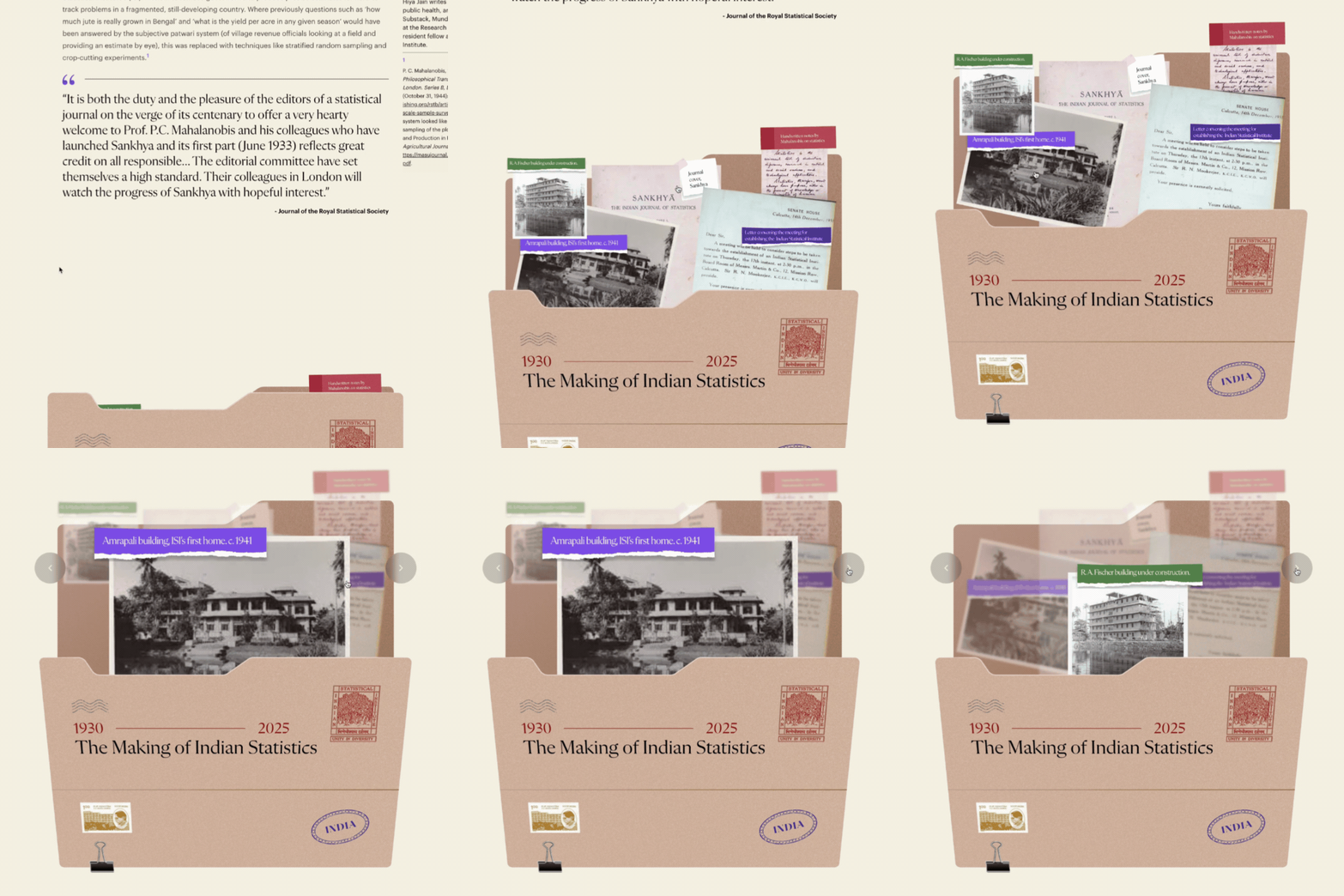
But the ISI did more than apply existing statistical methods to Indian problems – it developed new ones. Mahalanobis' most distinctive methodological innovation was high-quality interpretation of a network of sub-samples: instead of drawing a single sample from a population, you draw two independent sub-samples processed by separate field teams, so that any divergence between results immediately flags a non-sampling error. The resulting estimates could then be compared. Sampling theory tells you how far apart two such estimates should fall by chance alone and any divergence beyond that benchmark has to come from somewhere else – investigator bias, recording errors, inconsistent application of instructions. This converted non-sampling error into a quantity that could be measured, traced back, and corrected between rounds. Harold Hotelling, then among the foremost statisticians in the world, eventually wrote that “no technique of random sample has, so far as I can find, been developed in the United States or elsewhere, which can compare in accuracy with that described by Professor Mahalanobis.”
This is the story of how India built, then lost, and is slowly regaining the infrastructure of national self-knowledge. The ISI under Mahalanobis was, for a quarter century, one of the most productive research institutions in the developing world – a place that attracted first-rate mathematical talent, developed novel survey methods, and generated the data on which an entire nation's economic planning depended. It was also, by design, a fragile institution dependent on a unique set of circumstances. When those conditions disappeared, the system disappeared too, with consequences that are only now becoming fully clear. How did a laboratory with a first-year budget of ₹238 ($2.5) produce all of this to begin with? And why couldn't it last?
Find answers in the complete article:

Alter Magazine's Issue #4 is the story of how India built, then lost, and is slowly rebuilding the infrastructure of national self-knowledge. In 1950, nobody knew what the average Indian ate, earned, or whether they had work. P.C. Mahalanobis changed that, building the system that let a newly independent nation of 350 million people see itself clearly for the first time.
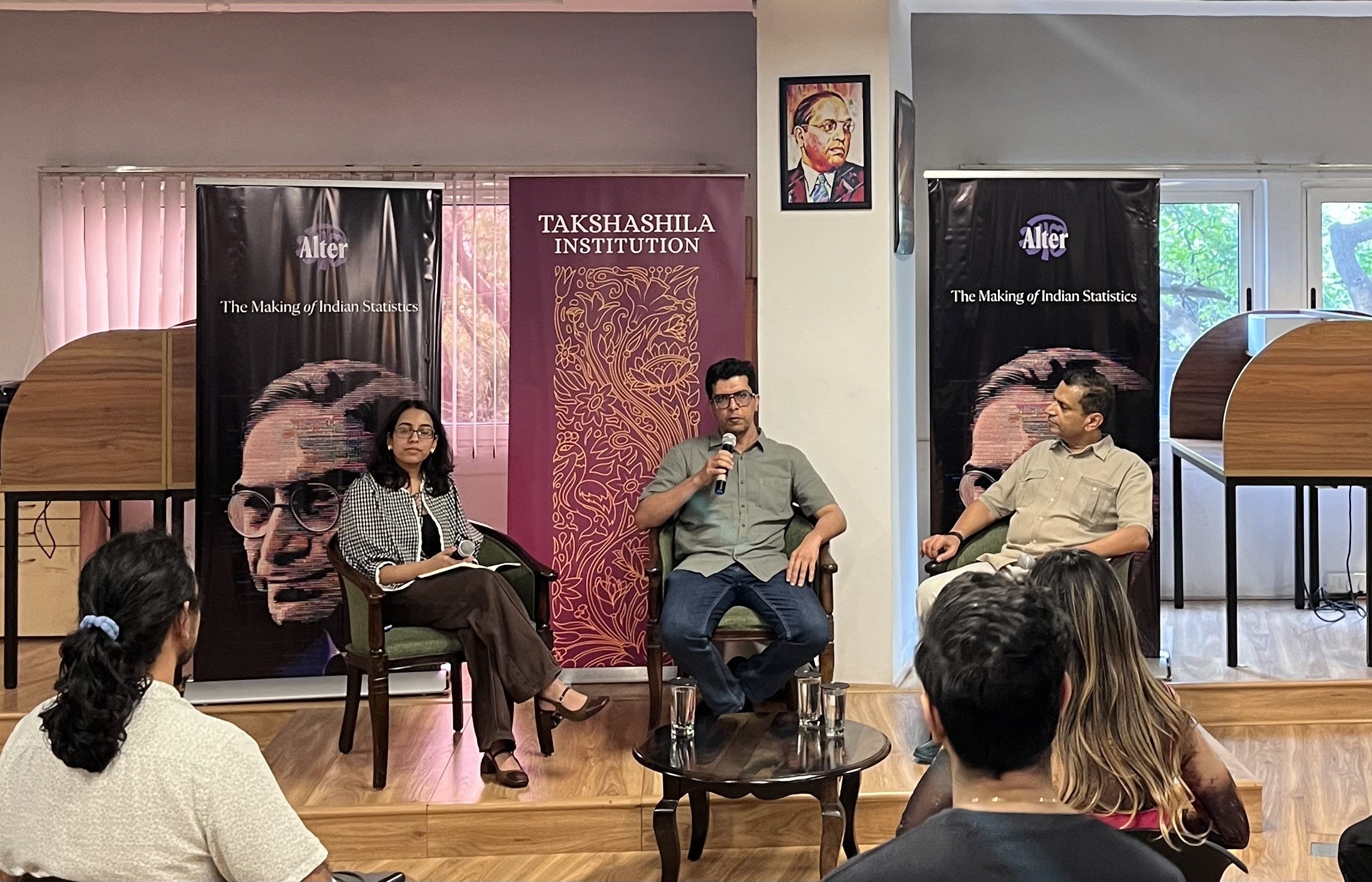
We hosted the launch of Issue #4 at The Takshashila Institution, Bangalore. The panel brought together Narayan Ramachandran, Co-Founder of Takshashila, who has spent his career moving capital, talent, and ideas across Morgan Stanley, RBL Bank, and TeamLease, sat alongside Pramit Bhattacharya, researcher at Data for India, who has spent years making India’s public numbers sharper and harder to ignore, and who is now writing a book on the very history of national accounting that the issue traces. Moderating was Hiya Jain, the writer behind Issue #4 and a fellow at the Roots of Progress Institute.
Alter Magazine hosts a launch event in Bangalore for every new issue, an evening where the ideas on the page find a room to breathe. Subscribe to our Luma to stay up to date with the latest.

Issue #4: The Making of Indian Statistics, written by Hiya Jain, designed & built by Alt Carbon
No posts
Comments
Nothing yet. Say the first thing.
Sign in to join the conversation.