
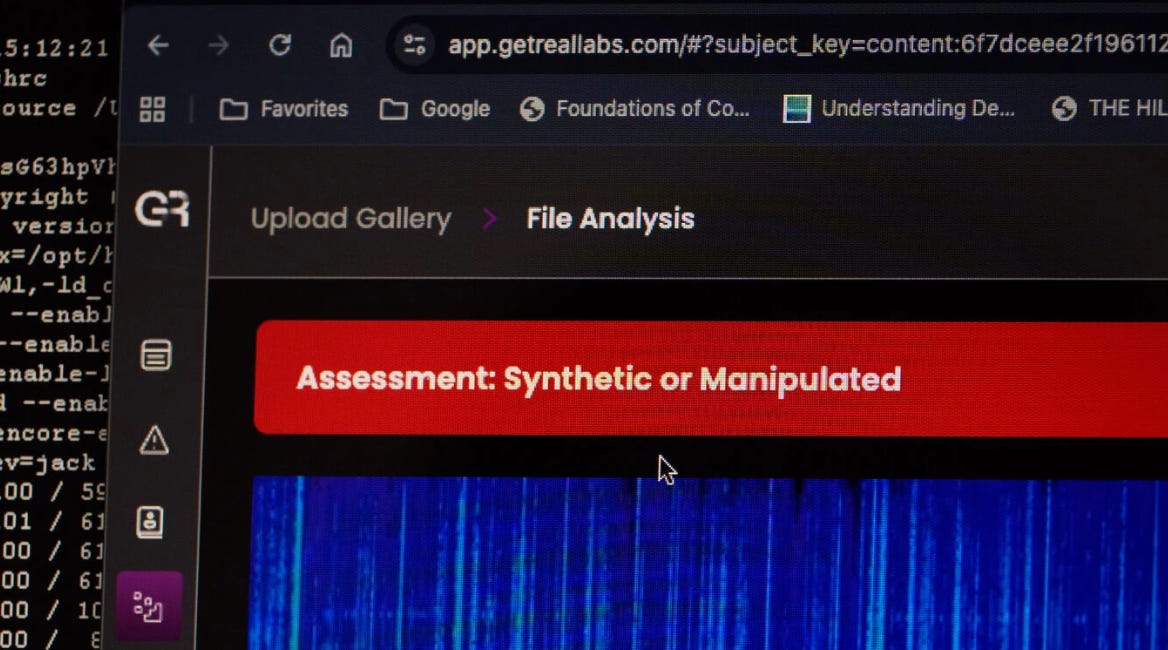
Many of us bemoan the fact that AI is destroying reality, but as we think we know the problem well, we stop educating ourselves.
Don’t become complacent.
This NYT article shows, in detail, the difficulty of making a call on images. It profiles Hany Farid, the world’s leading expert on deepfakes. Reading it, I was struck by how Farid’s techniques mirrored what we tried to do in the intelligence community, which was to come up with analytic methods to determine whether or not an image or video was fake. It’s harder than it sounds, and—reading this article—it now sounds impossible.
AI-generated images flood the internet, flood every social media channel. Some of it is generated by bored individuals indulging passing whims and idle thoughts, but too much is generated by disinformation actors, state actors or black hat operators who are paid to make people doubt their eyes. People whose goal is to manipulate you, whether for political or commercial gain.
As you will see in the article, determining whether an image or video was manufactured is not something you can do solely with your own eyes anymore. It requires validated methods, often involving mathematical calculations. It requires research—are the things seen in the image consistent and accurate? are there anomalies? Sleuthing requires work and time.
Yet, making an instantaneous judgment is what we’re being asked to do each second that we’re online. How much propaganda is our brain absorbing in those split seconds that our eyes skim over those images, believing our eyes before our brains can tell us it’s all lies?
When even the leading expert in the world says it’s over, we should be outraged at what tech companies and hapless politicians have foisted on us.
“These major tech giants will burn everything to the ground as long as they’re making a profit. They’re not interested in anything that’s going to slow them down.” - Hany Farid
I’m begging you to click on the link above and read the entire NYT article. We all need to get good and angry. Really angry. That’s what it’s going to take to get politicians to stop acting in the best interest of tech companies and start protecting the rest of us, who are being victimized and harmed by these technologies.
One thing that struck me was that Farid and his wife, Emily Cooper, a professor and leading vision researcher, made the decision to leave Silicon Valley and move to the wilds of Vermont. When the world has been poisoned by tech and we’re all being made myopic by our steady visual diet of close-up screens, they decided the answer was to move to the woods. To spend more time in nature, to look over long vistas, to live in the real world. It was the same decision I made after years tracking disinformation all over the internet and trying to get the powers that be in the world of intelligence to take the threat more seriously, only to constantly run into political malaise—or outright opposition.
When I first came up with the idea of writing a novel about the horrors of technology, the two technologies that immediately came to mind were social media and deep fakes. The term “deep fake” is already becoming historical, replaced by AI. (I’ll do a future post on the technology behind deep fakes.) Some version of it has been with us since the dawn of photography—think of the Cottingley Fairy pictures, 1917, when two young British girls convinced willing dupe Arthur Conan Doyle that fairies were real—but in the modern age, deep fakes picked up steam in the 2010s when researchers began using generative adversarial networks (now known as plain ole generative AI) to improve quality.
Of all the technologies I’ve written about for the intelligence community—quantum computing, nanotech, material research, all stripes and flavors of computational science—it’s these two technologies, social media and deep fakes, that present the biggest threat. They are already upending societies, economies, and most importantly, our perceptions of reality.
Winner, winner: Congratulations to Melissa K. of NY, winner of the Stokercon goody bag! Thanks to everyone who entered. There will be more contests coming.
Comments
Nothing yet. Say the first thing.
Sign in to join the conversation.