
I love Widow’s Bay, the horror/comedy show on Apple TV. I didn’t think I would at the beginning, because it seemed to be predicated on horror tropes, which generally rubs me the wrong way. I was afraid it would be…cliche.
I’ve never been so happy to be wrong.
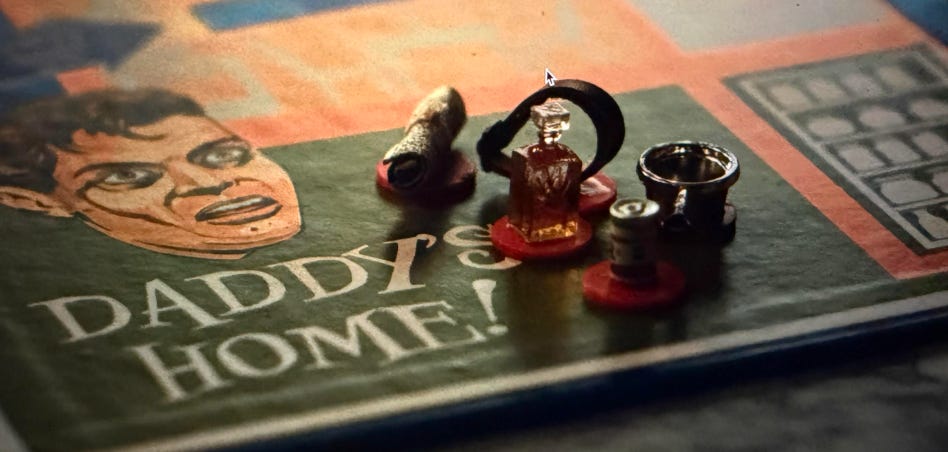
The writing has gotten more barbed and, hence, funnier, with each episode. In turned out that the showrunner, Katie Dippold, was a writer for Parks and Rec, a wonderfully rebellious, genre-breaking show. Somehow, it’s managed to be both horror and comedy, two genres that don’t seem to go together (though many of my horror writer friends would disagree) and, for this reason, is probably harder to make work. Let’s face it, Widow’s Bay is not truly scary (though maybe it comes at the end of the season, who knows?) but it is truly funny and has many genuinely insightful, touching moments. (My favorite may be the twisted board game, Daddy’s Home, in episode two, “Lodging”. Hee hee!)
The action really starts to ratchet up in episode four, “Beach Reads”, and then reaches it's zenith (you think) in episode five, “What to Expect on Your Trip”. Then things shift dramatically in episode six, “Our History”, which goes back to show the town’s founding in Puritan times and reveals the dark secret at the heart of Widow’s Bay. Horror and history, my sweet spot! The show did not disappoint.
And it only got better from there.
Turns out, the show is chock-full of valuable lessons for writers of both horror and comedy. I felt this instinctively but it is expertly unpacked by James Poniewozik, chief TV critic for the NYT. The premise of the show is so obvious that you might think there’s nothing new here, but as Poniewozik explains through his analysis, you’d be wrong. He shows how Dippold was able to find something new in a retelling of old tropes and this was only possible by thoroughly understanding those tropes and knowing where to press: to exploit for fresh insights, to expose rot.
At the heart of the story is the trope of the small town full of eccentrics, a place with a history that locals are loath to change. Enter the newcomer who pushes change in order to save a dying place, and this conflict becomes the engine for the story. We see each of the featured characters’ relationship to the past, in each case not good, but they don’t know how to change things to resolve their particular issue. There’s also other newcomers who are similarly stuck (the sheriff in the show, for instance) and can’t seem to solve their own problems.
As Poniewozik shows, the real issue is history: the “legacy of patriarchs”. The town is bound by a deal made by the town’s founder hundreds of years ago, but it is echoed (and dwarfed) by the daddy issues the main characters must struggle with today. Those issues are cleverly, subtly referred to in the earlier episodes, only to be blow apart in inventive ways in the later episodes. It really is a tour-de-force of writing and bears repeated watching.
So… there you have it. If you’ve ever been tempted to write a small-town horror story, Widow’s Bay offers an excellent lesson in how to do it without succumbing to cliche.
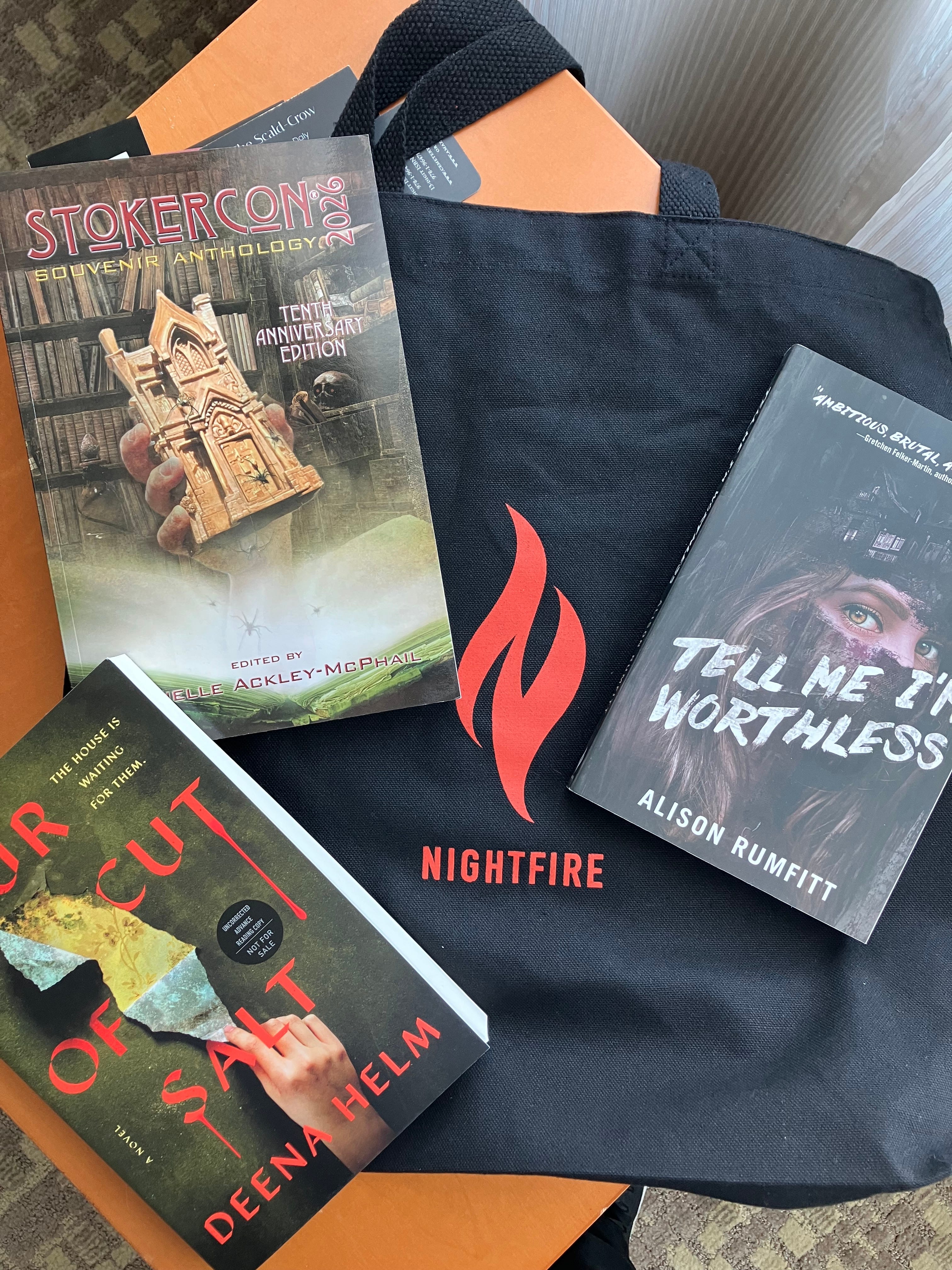
Let’s do another contest! Would you like the goody bag from the recently held Stokercon? There’s an ARC of Our Cut of Salt and the paperback of Tell Me I’m Worthless, as well as the con anthology. Not pictured: a bunch of bookmarks, stickers, and a Nightfire key fob. All you have to do is leave a comment (please make it clear you want to be entered in the contest). Winners must provide a U.S. mailing address. Bon chance!
Comments
Nothing yet. Say the first thing.
Sign in to join the conversation.