
Sonny Sharrock
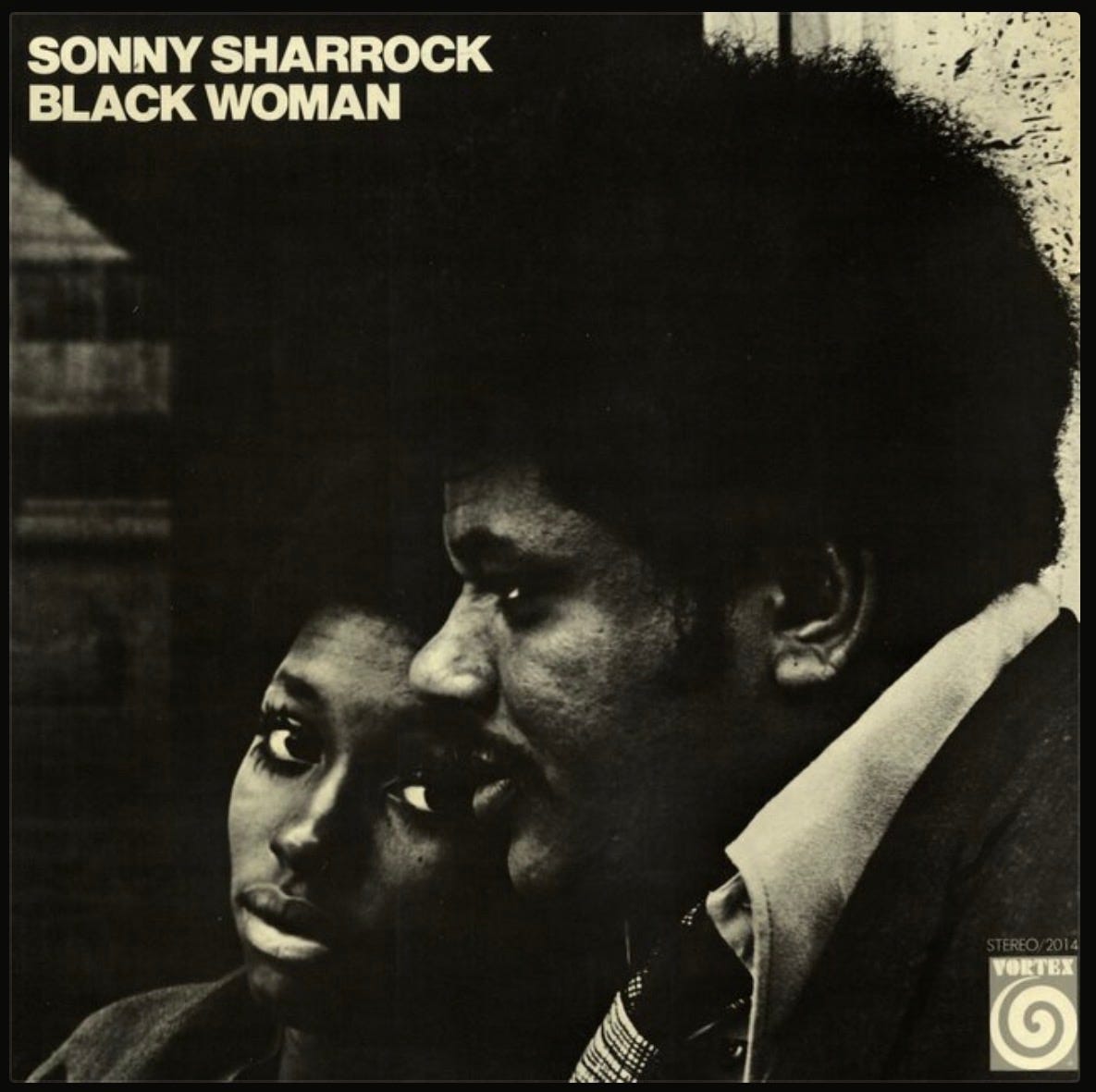
Black Woman (1969)
Sonny Sharrock - electric & acoustic guitar
Dave Burrell - piano
Norris Jones - double bass
Milford Graves - drums
Linda Sharrock - vocals
Ted Daniel - trumpet
Richard Pierce - bass
Gary Sharrock - bells
My favorite tracks
“Bialero”
https://youtu.be/yrTU6kmSAyc?si=wqBLSLWPvtA73er_
“Blind Willie”
https://youtu.be/5O_MH3M7qnw?si=Wn5pltoQylaK7Y42
Sonny Sharrock came to the guitar only after his other preferred musical paths were no longer viable. He’d first wanted to sing, honing his initial craft in doo-wop as a teenager, but it was hearing John Coltrane on Miles Davis’s Kind of Blue that redirected his ambition toward tenor saxophone. Asthma made both impossible long term, so he picked up a guitar instead, spending the next decade figuring out how to make six strings carry the same strain and harmonic tension he’d once expected from a horn.
He never stopped thinking of himself that way. “I’m a tenor player, man,” he told an interviewer years later. “I’ve always thought of myself as one. I hear the tenor.” By the time Black Woman was recorded in 1969, his evolution had pushed him far outside the established language of jazz guitar. He treated feedback, distortion, and bent notes as the backbone of his musical vocabulary, giving the instrument a physicality that hadn’t been seen from other jazz guitarists before him.
That made Sharrock an unusual figure in the first generation of free jazz. The movement had already produced radical new approaches to saxophone, trumpet, piano, bass, and drums, yet guitar remained relatively untouched. Sharrock stepped into that void with very little interest in adapting traditional guitar technique to his new music. He built his approach around the changing tastes of the moment instead, using volume, unique improvisation, and sheer force to build a guitar language all his own.
His appetite for abstraction was fed early in his career. By the late 1960s, he had already worked with Pharoah Sanders, Byard Lancaster, Archie Shepp, and Herbie Mann, moving between spiritual jazz, free improvisation, and more commercially acceptable settings without distorting the vision he was crafting for his own sound.
Mann became particularly important to Sharrock’s development. His commercial success gave him enough institutional leverage to support musicians whose work lived outside conventional market categories. That stamp of approval ultimately led to Mann producing Black Woman for Vortex, Atlantic’s short-lived experimental subsidiary.
The timing is critical. Jazz in 1969 was changing rapidly. Miles Davis had gone electric, leaning fully into the experimental world of fusion and looser forms. Pharoah Sanders and Alice Coltrane had extended and evolved the spiritual language John Coltrane was developing prior to his death. Free jazz had already broken apart assumptions surrounding harmony, tempo, and form, while younger musicians were challenging themselves to go further in deconstructing the accepted language of American popular music.
Black Woman became Sharrock’s first album as a leader, yet the record already sounds completely committed to its own terms. It arrived from a musician who had spent a decade searching for a way to make the guitar carry the weight he once expected from a horn, and who believed that search was less a break from tradition than its logical next step, an evolution suited to a moment when jazz itself was shedding its old rhythmic and harmonic tethers. His playing on the record still carries blues and gospel DNA even at its most abstract, because for Sharrock, abstraction was never just dissonance for its own sake.
The guitar could scream because screaming humanized the music as much as restraint and space did. As he put it, “I’ve been trying to find a way for the terror and the beauty to live together in one song. I know it’s possible. I remember seeing John Coltrane standing there, his saxophone screaming, hearing the Flamingos sing at the Apollo. All that pretty music! I hope I’m as greedy as those musicians were. I want the sweetness and the brutality, and I want to go to the very end of each of those feelings. I want it all!”
That ambition needed the right ensemble to hold it. Dave Burrell joins him on piano, Norris “Sirone” Jones on bass, Milford Graves on drums, and Gary Sharrock on bells and percussion, forming a band built for the kind of raw, unresolved intensity Sharrock was chasing. Linda Sharrock’s vocals function as an equal improvisational voice throughout the album, and her presence changes the character of the entire session, pushing it further toward the joy, sorrow, grief, and ecstasy Sharrock wanted the music to carry in its rawest form. “Your improvisation must have feeling,” he wrote. “It must swing, and it must have beauty, be it the fragile beauty of a snowflake or the terrible beauty of an erupting volcano. Beauty, no matter how disturbing or how still, is always true.”
The album opens with the title track. The shimmer of bells, Graves’s crashing cymbal work, and the winding, cinematic interplay between Sharrock’s guitar and Burrell’s piano create a haunting setting for Linda Sharrock’s vocals. Her initial cries are reminiscent of an old school Black church devotional, with the emotional tension rising as the cries grow louder and the music circles more aggressively. By the song’s end, her cries have turned to screams. The hymn like quality of the track has become something more physical.
The song’s disruptive progression carries meaning beyond its structure. As noted earlier, Sharrock was explicit about wanting contradictory emotions to coexist rather than resolve. That same tension echoes a broader shift in Black consciousness that ran through free and spiritual jazz of this era, and it strikes me on a personal level.
Both of my parents came of age in Los Angeles during this period, raised as preteens by Southern born parents whose racial consciousness was largely in line with those who led mainstream civil rights groups. Between the generations, there was a shared acknowledgment of inequality, but the posture toward it changed. The more stoic, patient tone of the early civil rights movement gave way to something more militant and unapologetic by the decade’s end. I don’t want to project that arc onto Sharrock’s intentions, but it’s certainly the lens through which the track’s shifting nature lands for me.
“Bialero” is built around a traditional melody, and the performance moves with greater tonal stability, allowing Linda Sharrock to lean into a more operatic vocal style. The elegance of Burrell’s piano, matched with the rumbling tension of Sharrock and Graves on guitar and drums, gives Linda a beautiful yet contentious background against which to stretch harmonically. “Bialero” represents the challenge this album can present to listeners. The Sharrocks clearly possessed the ability to work within more structured melodic and song parameters. That makes the abstraction elsewhere on the album come into sharper focus, knowing that the versatility required to execute multiple visions was not an easy needle to thread, yet they succeeded anyway.
On “Blind Willy,” Sharrock is alone. He balances blues and folk sensibilities with a modal sophistication that highlights how advanced he was from both a technical and conceptual standpoint.
The album closes with “Portrait of Linda in Three Colors, All Black,” gathering its central tensions into a culminating performance. What emerges is chaotic intimacy in the form of improvisation. There’s clashing, intimacy, and reconnection without ever losing the thread of togetherness. It’s Sharrock’s vision of terror and beauty finally sharing the same song.
Black Woman arrived during a period when jazz musicians were testing almost every inherited assumption surrounding the music, but Sharrock’s contribution remains unusually specific. He gave electric guitar a viable language inside free jazz without forcing the instrument to imitate the established roles of piano or saxophone.
Linda Sharrock’s role is equally important. Her performance expands the possibilities of jazz singing by treating the voice as equal parts melodic and percussive. She gives the album a unique advantage because even when she’s not supposed to be the focal point, she becomes it. Her voice is too commanding to ignore. The partnership between guitar and voice gives the album an identity that no purely instrumental free jazz session could reproduce.
The title itself also carries particular weight. This was an era when Black cultural movements across the United States were challenging how Black identity, beauty, politics, and artistic ownership were represented. Within that broader climate, Black Woman feels as unapologetic as the emerging Black culture around it. This isn’t an album built for easy consumption. It can be a difficult listen at times because of how raw and unfiltered it is.
There’s beauty in Linda’s voice and sophistication in Sonny’s playing, but nothing here is polished smooth. That’s the point. Sharrock found a way to humanize the guitar, and everything built around it, so that it could carry every element of human feeling without flattening any of them.
Black Woman doesn’t resolve its contradictions because insisting on them is necessary. Terror, beauty, restraint, chaos, joy, and grief all occupy the same breath and coexist in Sharrock’s musical world. That friction is what connects the music to his idea of the human experience.
-All Things Jazz-
No posts
Comments
Nothing yet. Say the first thing.
Sign in to join the conversation.