
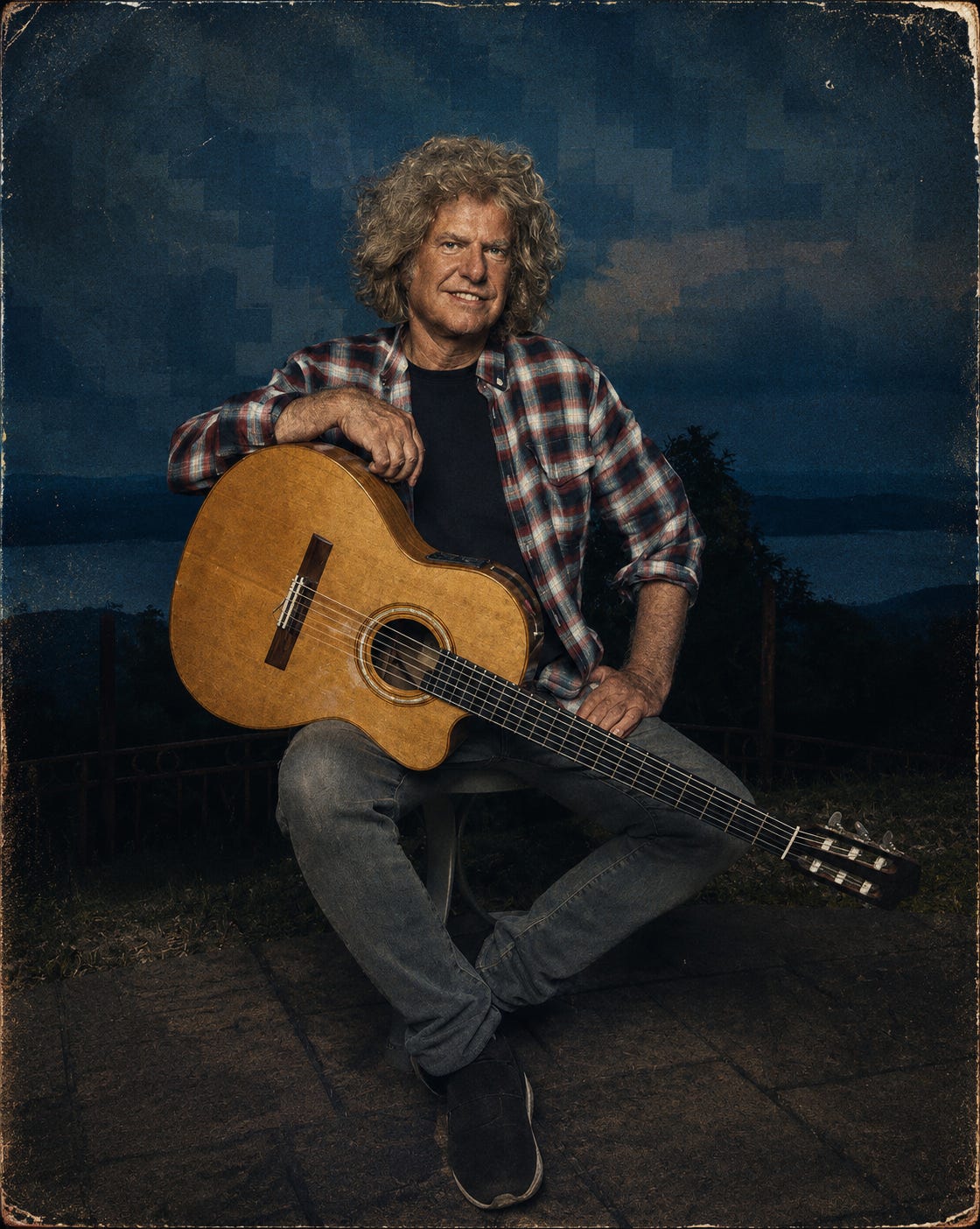
Born on this day in 1954. Happy 72nd birthday to the legendary Pat Metheny!
Pat Metheny has spent more than five decades making the boundaries around jazz feel unnecessary. Without losing his own musical identity, he has incorporated bebop, free jazz, rock, folk, Brazilian music, electronics, contemporary classical ideas, and sounds from around the world into a cohesive artistic philosophy. That versatility was nurtured long before he became one of the most influential guitarists of his generation.
Born on August 12, 1954, in Lee’s Summit, Missouri, Metheny grew up in a musical family that had generational ties to the trumpet. His father played, his maternal grandfather had been a professional trumpeter, and his older brother Mike became an accomplished jazz trumpeter in his own right. Metheny followed the family tradition and began playing trumpet at eight, although he never fully took to it. By twelve, he had moved to guitar, partly because his braces made playing the trumpet increasingly difficult and partly because the explosion of guitar driven popular music had captured his imagination.
The Beatles were especially important, but two jazz records changed his understanding of what music could become. Hearing Miles Davis’s live album Four & More was a revelation for Metheny, introducing him to a level of improvisation that permanently altered his ambitions. Wes Montgomery’s live album Smokin’ at the Half Note soon provided an equally powerful model for Metheny as his interest in playing the guitar grew. Metheny has consistently identified the Beatles, Davis, and Montgomery as the three most important early influences on his musical development.
Ornette Coleman expanded his sensibilities even further. Metheny encountered Coleman’s New York Is Now! while still young and became fascinated by the freedom and logic of his music. That influence became a recurring thread throughout Metheny’s career. He recorded numerous Coleman compositions, collaborated extensively with musicians from Coleman’s orbit, and eventually recorded and toured with Coleman himself. Their 1986 album Song X remains one of the clearest demonstrations of Metheny’s willingness to challenge musical assumptions, even if they happen to be his own.
His development happened quickly. At fifteen, Metheny received a DownBeat scholarship that brought him into contact with guitarist Attila Zoller, who recognized his talent and helped connect him with Jim Hall and Ron Carter. Bassist and educator Bill Lee later offered him a scholarship to attend the University of Miami. While Metheny’s musical abilities were unquestionable, he wasn’t prepared for college academics as a student. Lee understood how advanced Metheny was as a musician, so he quickly pivoted and offered him a teaching position. Metheny was only 18.
He eventually moved to Boston to teach at Berklee College of Music, where another important relationship developed with vibraphonist Gary Burton. Metheny joined Burton’s band in 1974 and entered the international jazz scene alongside musicians who encouraged the same openness he had been developing since his youth. His early professional years also connected him with the enigmatic Jaco Pastorius, whose approach to the electric bass shared Metheny’s interest in expanding the vocabulary of the music they were playing.
Metheny’s first album as a leader, Bright Size Life, was released on ECM in 1976 with Pastorius and drummer Bob Moses. The record introduced many of the qualities that would remain central to Metheny’s work: melodic clarity, open harmonic spaces, and a willingness to draw from influences beyond jazz without weakening his commitment to improvisation. Watercolors followed in 1977 and introduced pianist Lyle Mays into Metheny’s recording inner circle.
Mays soon became essential to the Pat Metheny Group, which Metheny formed with bassist Mark Egan and drummer Danny Gottlieb. Their 1978 self titled debut established a musical identity that expanded considerably over the following decades, particularly as percussionists such as Nana Vasconcelos entered the ensemble. Mays remained Metheny’s most important creative partner within the group, contributing significantly to the sound of albums including American Garage, Offramp, First Circle, Still Life (Talking), and Letter from Home.
The popularity of the Pat Metheny Group occasionally overshadowed how adventurous Metheny remained outside it. 80/81, featuring Charlie Haden, Dewey Redman, Michael Brecker, and Jack DeJohnette, leaned firmly into a more straight ahead approach. Song X embraced Ornette Coleman’s musical ideas directly, while Secret Story expanded his compositional framework through orchestration and world music influences.
His collaborative discography became equally expansive. Metheny recorded with artists including Herbie Hancock, Jim Hall, Charlie Haden, Brad Mehldau, Joni Mitchell, David Bowie, Steve Reich, Joshua Redman, Roy Haynes, and Michael Brecker, among many others. These collaborations reflected the same curiosity that had shaped his childhood musical ambitions. Music was for exploration, not for creating boundaries.
In 2012, Metheny formed the Unity Band with saxophonist Chris Potter, bassist Ben Williams, and drummer Antonio Sánchez, returning to the horn and guitar quartet format for the first time in decades. The subsequent addition of multi instrumentalist Giulio Carmassi expanded the ensemble into the Unity Group and allowed Metheny to combine the flexible improvisation of the quartet with the broader compositional range that had become his signature.
Metheny’s career has produced twenty Grammy Awards across an extraordinary range of categories, but the awards only partially explain his significance. His greatest accomplishment may be the consistency with which he has remained identifiable without neatly settling into any particular category. The guitar tone is unmistakable, as are his melodic instincts and phrasing, yet the environments surrounding the music have continually changed.
At 72, Pat Metheny remains one of our most important living connections to several generations of jazz. He learned directly from musicians who helped establish the modern language of the music and worked alongside several others who successfully pushed it past conventional boundaries. More importantly, he has carried that experience forward without treating jazz as something that needs to be preserved behind glass. Metheny’s career has been guided by a relentless intellectual curiosity, expanding his sense of what music can be when it refuses to be confined. More than fifty years later, he continues to follow that curiosity wherever it leads, still widening the frame without losing the sound that makes it unmistakably his.
-All Things Jazz-
Comments
Nothing yet. Say the first thing.
Sign in to join the conversation.