
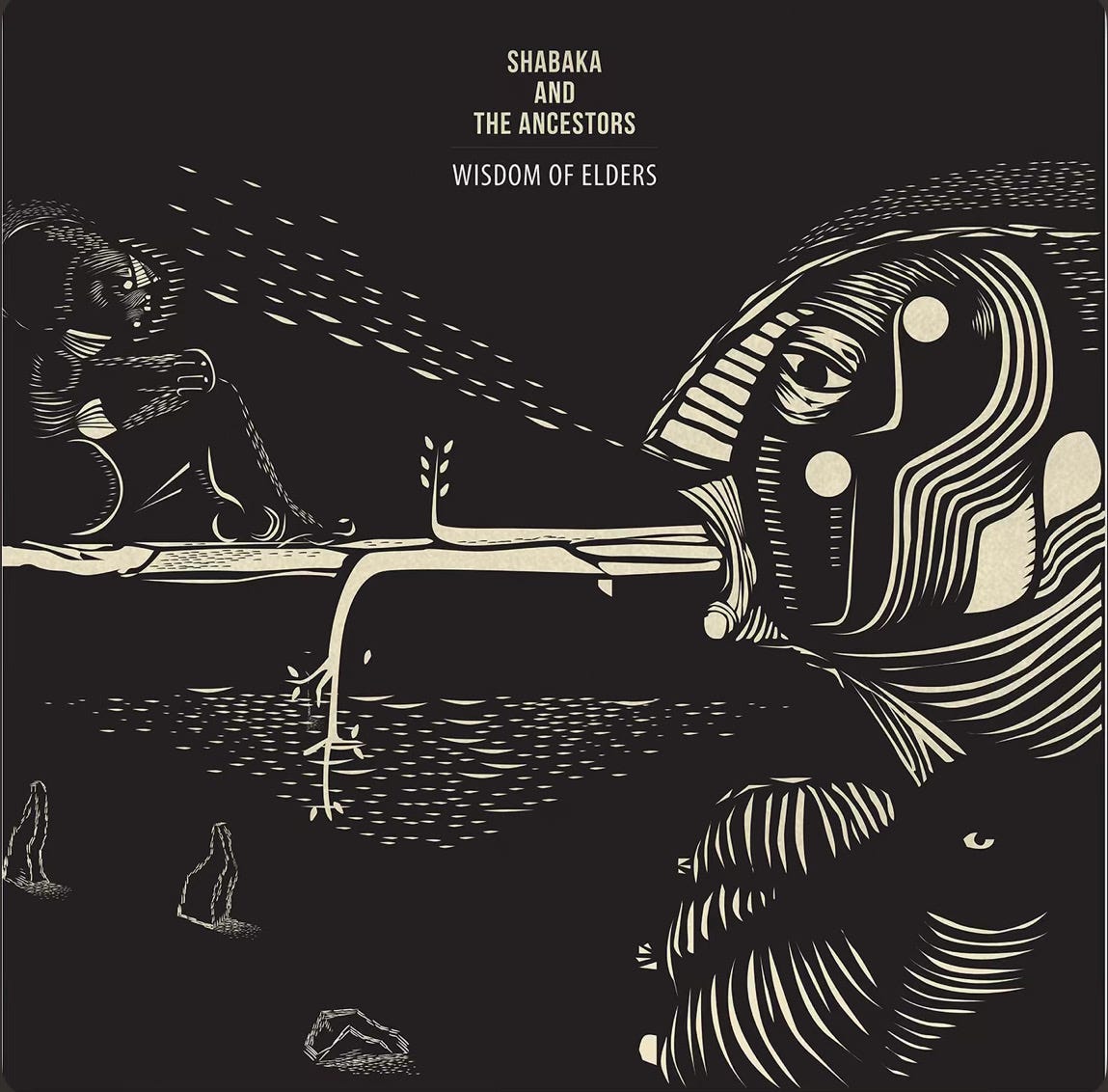
Shabaka and The Ancestors
Wisdom of Elders (2016)
Shabaka Hutchings - tenor sax
Mthunzi Mvubu - alto sax
Ariel Zamonsky - bass
Gontse Makhene - percussion
Siyabonga Mthembu - vocals
Mandla Mlangeni - trumpet
Nduduzo Makhathini - piano
Tumi Mogorosi - drums
My favorite tracks
“Mzwandile”
https://youtu.be/Uby8JG3PdBs?si=QYlrAl4KeIBRcYu2
“The Sea”
https://youtu.be/S3JnR5teamg?si=aWiyFTchB8CNYP9Q
Shabaka Hutchings stood near the center of something the press hadn’t figured out how to name yet, and by 2016, that hadn’t changed. The scene itself needed no introduction: musicians were already deep in it, clubs were filling nightly, and the wiring between jazz, grime, dub, Afrobeat, electronic music, and Caribbean rhythm had long since fused into a single South London sound. What was missing was the vocabulary, the critical framework that would eventually give the movement a coherent name.
Despite his immense talent, grasping Hutchings’s musical vision isn’t a linear task. The various groups he led all had their own identities. Sons of Kemet fused brass-band propulsion, Caribbean rhythm, and the physical intensity of the dance floor. The Comet Is Coming carried jazz improvisation into electronic music, psychedelic repetition, and science-fiction imagination. Melt Yourself Down moved with the structured disruption of post-punk and the volatility of club music. Across those groups, Hutchings was helping build a version of British jazz that reflected the multicultural realities of London.
Wisdom of Elders extended that search beyond London. Recorded in Johannesburg with a hand-selected group of South African musicians, the album placed Hutchings inside a lineage he had long admired but had never encountered firsthand as a musician. Now, he was in direct conversation with musicians whose rhythmic and melodic instincts had been shaped by South African jazz traditions and the broader influence of township music, church harmony, resistance culture, and the particular social energies of Johannesburg.
Hutchings had already spent years thinking about jazz as a form of diasporic communication. His childhood in Barbados had exposed him to calypso, soca, Carnival rhythm, and the communal role music could play. His later development in Britain introduced him to classical training before jazz improvisation and the magnetic pull of London’s experimental underground expanded his musical vocabulary. He had also performed with the Sun Ra Arkestra, whose conception of music as mythology and lineage offered an important model for his own thinking.
South Africa gave those ideas a different foundation. The country possessed one of the deepest jazz traditions outside the United States, shaped by musicians who had transformed American swing, bebop, and modal improvisation through local rhythm and melody. Abdullah Ibrahim, Hugh Masekela, Dudu Pukwana, Johnny Dyani, Chris McGregor, Mongezi Feza, Bheki Mseleku, and countless township musicians had built a tradition in which jazz functioned as spiritual practice and social witness, as Black South Africans fought for cultural survival under apartheid.
Trumpeter Mandla Mlangeni helped connect Hutchings to the players who would become the Ancestors. The ensemble included alto saxophonist Mthunzi Mvubu, vocalist Siyabonga Mthembu, pianist Nduduzo Makhathini, bassist Ariel Zamonsky, percussionist Gontse Makhene, and drummer Tumi Mogorosi. Together, they created a group whose sound emerged from a collective musical sensibility shaped by histories of class, race, and resistance.
That shapes the entire album. Hutchings remains the most recognizable voice, but Wisdom of Elders doesn’t unfold like a saxophone showcase. The music develops through layered rhythm, repetition, vocal invocation, collective horn lines, and an unresolved tension that gradually becomes an urgency that could only be conjured by musicians committed to something bigger than themselves.
The album opens with “Mzwandile,” named for the South African name given to Hutchings by his collaborators. The initiation gesture immediately aligns the recording with the gravity Hutchings envisioned. A bass figure establishes the foundation before percussion and drums begin applying pressure from several directions. The groove is grounded, but there’s an underlying instability that gives the music the fluidity to shift.
Siyabonga Mthembu’s voice enters with the subtle authority of an invocation. Hutchings responds with a tenor sound that is rough but deliberate, building phrases through repetition before extending them into longer cries. Nduduzo Makhathini’s piano provides spacious harmonic movement beneath the horns, allowing the rhythm section to remain dense without pushing too hard.
“Joyous” offers a warmer, more expansive feeling without losing the record’s ritual focus. There’s a sense of lament and beauty that coexist seamlessly. Mandla Mlangeni’s trumpet eases into a spacious pocket where his phrasing probes and ultimately ascends, rising above the rhythm section with a bright tone that draws from South Africa’s long line of lyrical trumpet voices. Mthunzi Mvubu and Hutchings answer through a restrained but intense alto and tenor interplay. Their lines frequently converge into ensemble phrases that feel more important than any individual solo. The band demonstrates how spiritual jazz can resonate through restraint and discipline and not just abstraction or volume.
“The Observer” is dedicated to a Barbadian calypsonian Hutchings remembered from his youth. The composition connects Johannesburg to the Caribbean world that shaped his earliest understanding of music. Its melancholy carries several histories at once. Blues phrasing, Caribbean memory, South African rhythm, and spiritual devotion meet with an understanding of each other that doesn’t need to be exaggerated to be felt. Mthembu’s chanting introduces a sense of hope that never erases the sadness beneath it. Hutchings responds conversationally, allowing his tenor to hover around the vocals without crowding them. The track demonstrates how Hutchings’s diasporic perspective differs from a search for musical purity. His identity was formed across Barbados, Birmingham, London, and the wider Black Atlantic, and the music gains depth from allowing those geographic influences to blend naturally without being filtered or condensed.
“The Sea” functions as the album’s spiritual equilibrium. A repeated bass pattern creates a meditative foundation while the horns stretch across it in long, searching phrases. The influence of Abdullah Ibrahim can be felt in the relationship between repetition, melody, and contemplation. The music carries the spaciousness of a prayer, but the rhythm circles around something more urgent. Hutchings and Mvubu move through the composition as parallel voices. Their saxophones sometimes rise together and sometimes separate, producing a coordinated dissonance that keeps the track refreshingly unsettled. Makhathini’s piano avoids crowding the harmony, offering small clusters and carefully placed responses that accent and shade without diverting attention from the horns.
“Nguni” closes the album by returning to the bass-led rhythm of “Mzwandile.” The parallel creates a sense of circular motion, though the emotional atmosphere has changed. The opening track carried targeted urgency. “Nguni” moves with greater patience, allowing vocal chants and dirge-like layers to gather gradually before reaching their final crescendo. The title invokes the broad cultural and linguistic family that includes Zulu, Xhosa, Swazi, and Ndebele peoples, locating the music within a history that extends far beyond traditional jazz confines.
The album landed right as British jazz was pulling in a crowd that had never thought of itself as jazz audiences at all. Nubya Garcia, Yussef Dayes, Kamaal Williams, Moses Boyd, Theon Cross, Joe Armon-Jones, and the Ezra Collective crew were all building something out of London’s club culture, its African and Caribbean communities, pirate and independent radio, grime, broken beat, and hip-hop. The results leaned melodic and rhythmically blunt, structured less around sprawling harmony and more around riffs that hit and repeated, the kind built to move a room rather than unfold slowly for it.
Some traditionalists and outside observers heard those qualities and mistook them for a lack of sophistication. That reading missed the point entirely. These musicians weren’t reaching for an American standard. They were building a regional language true to their vast cultural experience and the London scene that connected it all.
Wisdom of Elders complicated that emerging narrative. While much of the excitement around London jazz involved the relationship between improvisation and contemporary British youth culture, Hutchings traveled to Johannesburg and confronted an older source. He recognized that a truly diasporic British jazz could not be built through London alone. It required relationships with the African and Caribbean traditions that had already shaped the city’s population, rhythm, politics, and cultural imagination.
The record also arrived before the international press had fully consolidated the idea of a British jazz revival. By the following year, sold-out concerts, major festival appearances, influential compilations, and widespread profiles would turn the movement into a broader, recognizable cultural narrative. Wisdom of Elders sits just before that moment, capturing its most visible bandleader already pushing beyond the boundaries of the scene he was supposed to represent.
Wisdom of Elders captures Shabaka Hutchings at the moment his role in contemporary jazz becomes larger than that of a gifted saxophonist or prolific bandleader. He emerges as a connector between cities, generations, and branches of the African diaspora. He understands that lineage carries responsibility for the musician who inherits it. The elders provide more than inspiration. They leave unfinished questions, surviving languages, and pathways that the next generation must decide how to use. Hutchings and the Ancestors answer by creating music that remembers without standing still. After all, stagnation is the ultimate betrayal of any ancestral legacy.
-All Things Jazz-
Comments
Nothing yet. Say the first thing.
Sign in to join the conversation.