
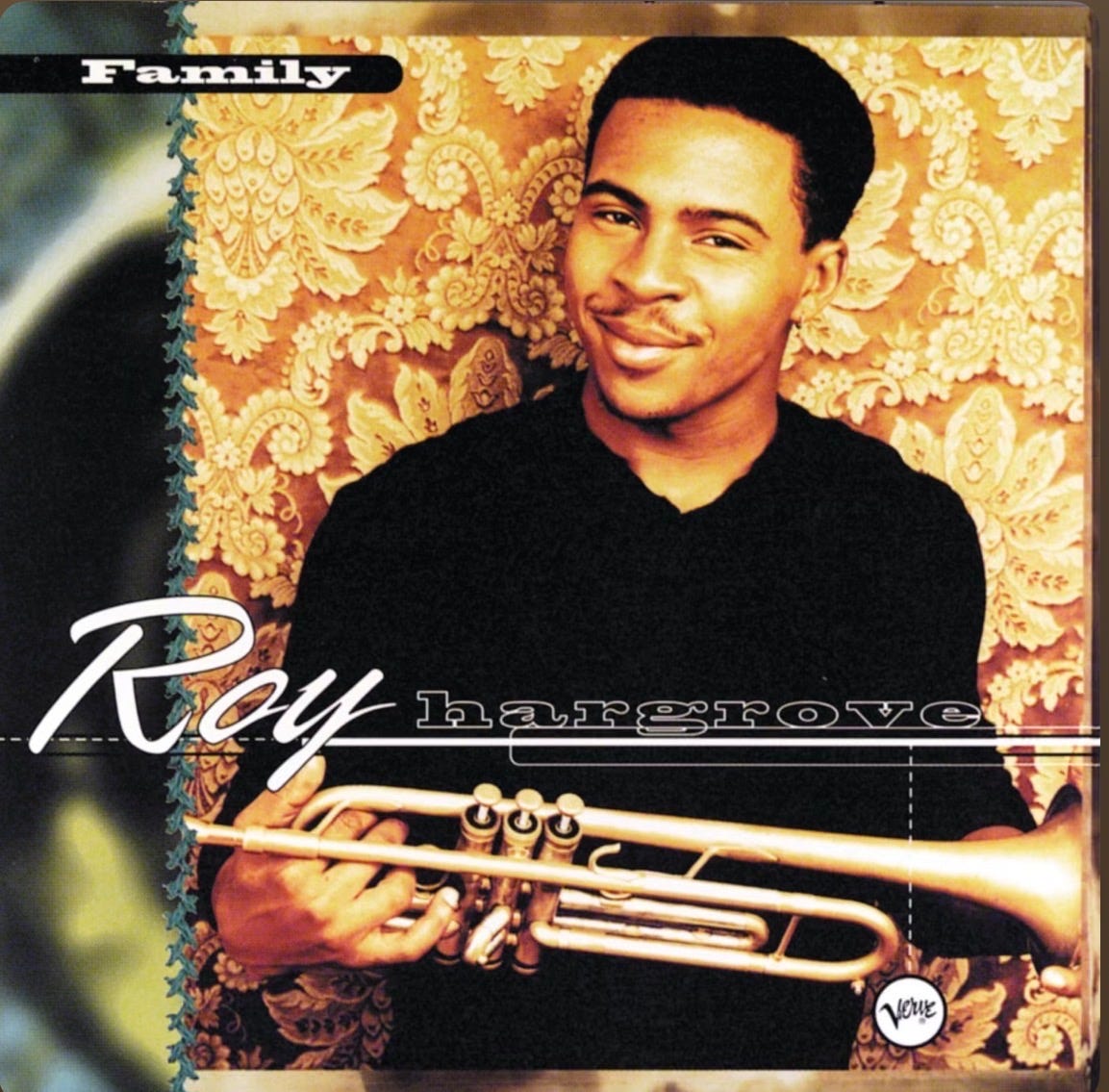
Roy Hargrove
Family (1995)
Full album credits ⬇️
https://www.discogs.com/release/839191-Roy-Hargrove-Family
My favorite tracks
“Roy Allan”
https://youtu.be/p1OtfWl3zxI?si=2wJpOYOpTpmE_P20
“Thirteenth Floor”
https://youtu.be/WI1uqn-Vwps?si=mXLLkJI067zUpQ98
By 1995, Roy Hargrove had already earned the title jazz kept handing him: standard-bearer for a new generation. He was barely 25, yet his résumé read like a career decades in the making. Championed early by Wynton Marsalis, courted by major labels, and praised by critics for a trumpet command that moved with equal ease between hard bop tradition and contemporary expression, Hargrove seemed destined for greatness. But he never mistook that acclaim for the actual measure of the work. “If you take care of your music, your music will take care of you,” he’d often say, and for him that meant something closer to stewardship than stardom: honoring the elders who shaped him, building community around the horn, and making sure the next generation had somewhere to stand.
That understanding shapes everything about Family. Instead of cutting another straightforward quintet session, Hargrove built the album like a filmmaker assembling an ensemble cast, bringing together different combinations of musicians for different scenes rather than relying on one static band. Recorded over four days in January 1995 and released later that year on Verve, the record moves between multiple rhythm sections, mixing longtime collaborators, rising peers, and veteran elders across its runtime. Wynton Marsalis appears alongside David “Fathead” Newman. Jimmy Cobb shares the drum chair with Gregory Hutchinson, Lewis Nash, and Karriem Riggins. Christian McBride, Larry Willis, Ronnie Mathews, John Hicks, Walter Booker, Jesse Davis, and Ron Blake each anchor their own chapter, turning the record into less a single statement than a gathering of them.
The album opens with “Trilogy,” a three-part suite dedicated to Hargrove’s mother, father, and younger brother. Rather than functioning as separate compositions, “Velera,” “Roy Allan,” and “Brian’s Bounce” unfold like connected reflections on the people who shaped him long before the public fell in love with his artistry.
“Roy Allan,” written for his father, stands as the emotional centerpiece of the suite. Built on an unforgettable melody that balances hard bop structure with warm soulfulness, it has since become one of Hargrove’s most celebrated compositions. Christian McBride has frequently cited it as one of the finest pieces Hargrove ever wrote, and it is easy to understand why.
“The Nearness of You” finds Hargrove switching to flugelhorn. Joined by the great tenor saxophonist David “Fathead” Newman, he delivers a deeply lyrical reading of the Hoagy Carmichael standard. Hargrove had always possessed extraordinary technical command, but performances like this remind listeners that his greatest strength may have been his tone. The warmth of the flugelhorn allows every phrase to unfold deliberately, while Newman answers with the relaxed confidence of a musician whose career stretched back to Ray Charles and the golden era of soul jazz.
“Lament for Love” reaches even further into jazz history. Pianist Ronnie Mathews joins bassist Walter Booker and drummer Jimmy Cobb, musicians whose résumés extend directly into the hard bop era that shaped Hargrove’s own musical identity. Rather than attempting to modernize their vocabulary, Hargrove meets them where they are, allowing the performance to unfold with the relaxed authority that only decades of experience can produce.
“Another Level” returns the spotlight to Hargrove’s working quintet. Gregory Hutchinson’s drumming provides remarkable flexibility throughout, while Ron Blake and Hargrove trade increasingly adventurous improvisations. The chemistry between the group members reflects countless nights spent developing trust on the bandstand, and the performance captures the confidence of a young ensemble discovering its collective voice.
“The Challenge” hands the drum chair to the 19 year old Karriem Riggins, and the choice pays off immediately. Riggins, who would go on to become one of the most accomplished drummers of his generation, plays with a youthful urgency that gives the track its edge, living up to the competitive spirit its title promises. But the energy never tips into chaos. Instead, the improvisation carries a celebratory charge, the kind of friendly one-upmanship that has always pushed jazz musicians to sharpen one another rather than simply outplay each other.
“Ethiopia” is one of the album’s most focused moments. Larry Willis’ composition creates an introspective atmosphere, and Hargrove responds with unusual restraint, phrasing conversationally while making extraordinary use of space. The performance unfolds with an almost cinematic quality. Walter Booker’s bass shares that conversational approach, giving the music a chamber like intimacy that contrasts beautifully with the album’s harder swinging moments. It remains one of the record’s masterpieces.
David “Fathead” Newman’s “Thirteenth Floor” introduces another welcome change of pace. Newman switches to flute, bringing a lighter touch that allows Hargrove to explore a different side of his musical personality. Jimmy Cobb’s relaxed swing anchors the performance while the ensemble gradually settles into an easy, soulful atmosphere that swings with the authority of great jazz from any era.
Family’s lasting importance comes down to a simple refusal: it never treats generations as separate camps. Plenty of young musicians make their names by pushing away from what came before, drawing a hard line between the new and the old. Hargrove did the opposite, treating tradition and innovation as partners in conversation rather than opponents in competition. By bringing veterans, peers, and younger players into the same sessions, he made his argument without ever saying a word: jazz remains healthiest when every generation has a seat at the same table.
The album also reveals Hargrove’s remarkable maturity as a bandleader. Although he is undoubtedly the centerpiece, Family rarely feels dominated by him. He graciously creates space for everyone around him to contribute, trusting that the collective strength of the various lineups will ultimately elevate the music beyond any individual performance. That generosity would become one of the defining characteristics of his career, eventually extending beyond straight-ahead jazz into hip-hop, R&B, Latin jazz, and the groundbreaking work of RH Factor.
Family captures a young master already thinking beyond individual achievement and toward something larger. Before he became one of jazz’s great ambassadors across genres, Roy Hargrove first demonstrated that the strongest musical voices are never built alone. They are shaped by family, strengthened by community, and sustained by generations willing to listen to one another.
-All Things Jazz-
No posts
Comments
Nothing yet. Say the first thing.
Sign in to join the conversation.