
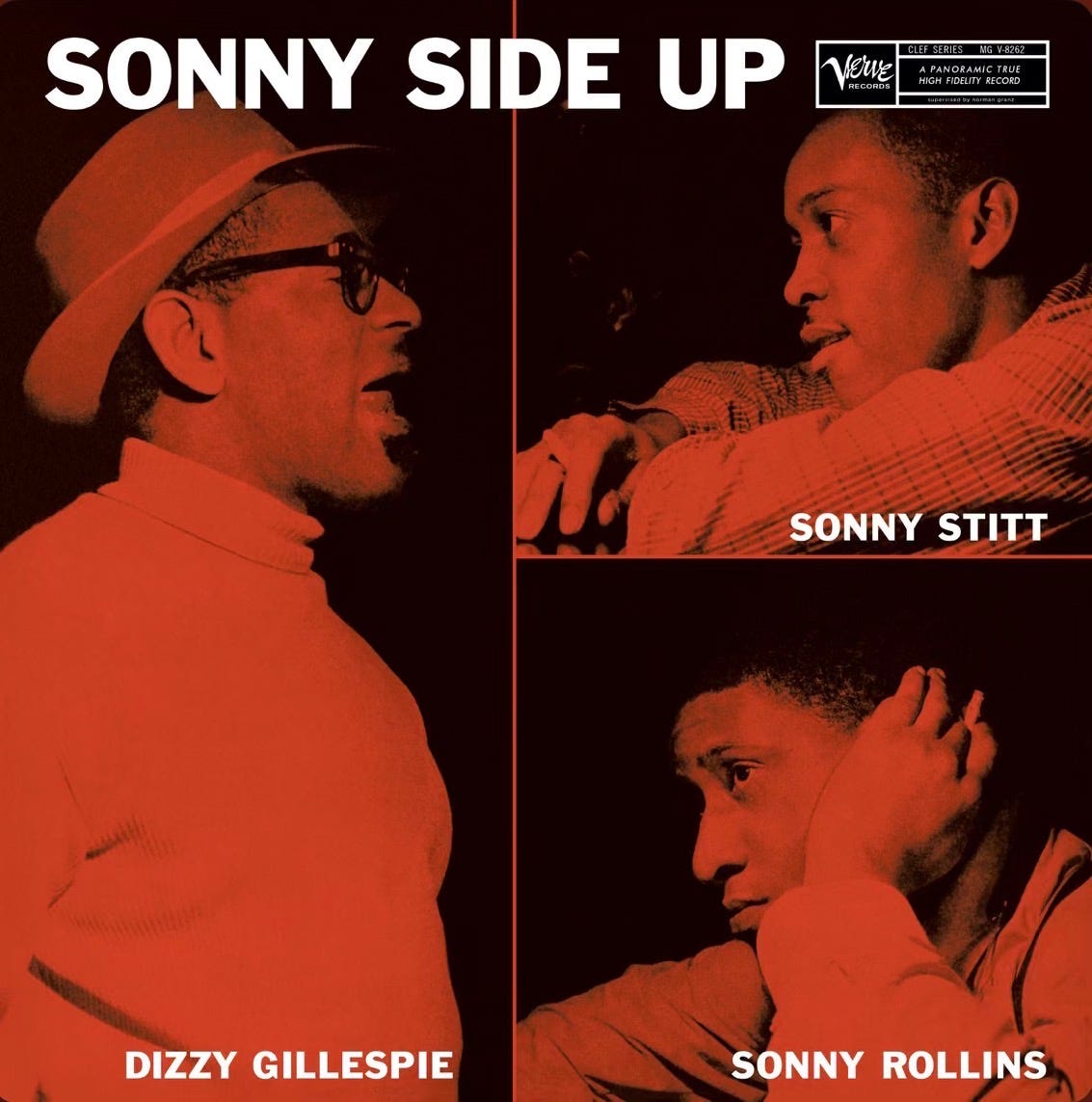
In December 1957, Dizzy Gillespie set a trap disguised as a studio session. Working through a marathon week of recording for Norman Granz’s Verve label, Gillespie reportedly called Sonny Rollins and Sonny Stitt separately, telling each one that the other Sonny was already “loaded for bear” and ready to burn. Both men showed up primed for a fight that Gillespie himself had instigated, and Sonny Side Up became the record where that manufactured rivalry turned into something genuinely memorable.
What made the pairing work wasn’t just shared nicknames or a punning title. It was the stylistic contrast between two fundamentally different tenor voices. Stitt carried a subtler, more contained tone. He was lyrical, a master practitioner with a straight ahead approach. Rollins brought a bigger, rawer sound that embraced exploration. He would chase an idea wherever it led, bending phrases and doubling back on himself mid solo, treating the tune less like a fixed destination and more like an endless starting point.
Recorded on December 19, 1957, at Nola Recording Studios in Manhattan’s Steinway Building, the session captured Dizzy Gillespie, Sonny Rollins, and Sonny Stitt at remarkably different stages of their careers, yet equally capable of dominating a bandstand. Granz understood that difference was an advantage, not an obstacle. He had spent much of the 1950s building all-star sessions around carefully chosen personalities, trusting that contrasting musical temperaments would produce something no single band, however tight, ever could: friction that lived up to the old adage that steel sharpens steel.
The album arrived during one of the most remarkable periods in modern jazz history. After bebop transformed the language of improvisation, hard bop was flourishing. Miles Davis was redefining the small group aesthetic while John Coltrane continued pushing the harmonic boundaries, developing a new vocabulary that would soon reshape the tenor saxophone. Rather than competing with those developments, Granz looked sideways. His gift was recognizing that jazz history was often made through encounters. Bring extraordinary musicians together, remove unnecessary restrictions, and trust that competition would become creativity. Few producers understood that formula better.
By December 1957, Dizzy Gillespie had nothing left to prove. More than a decade removed from his revolutionary work alongside Charlie Parker, Gillespie had become one of jazz’s great ambassadors. His harmonic innovations had already entered the language. His Afro-Cuban collaborations had permanently expanded jazz’s rhythmic vocabulary. His big bands had introduced countless musicians to modern jazz while simultaneously proving that bebop could thrive in large ensemble settings.
Yet Gillespie remained remarkably curious. His partnership with Norman Granz had already produced successful collaborations with Stan Getz, Roy Eldridge, Coleman Hawkins, and others. More importantly, Gillespie had become one of the music’s great facilitators. Younger musicians trusted him, and veterans respected him. He possessed enough confidence to encourage competition without feeling threatened by it.
That quality became essential to Sonny Side Up. The rhythm section itself reflected Gillespie’s working world. Pianist Ray Bryant and drummer Charli Persip were members of his touring big band, while bassist Tommy Bryant joined the session at his brother Ray’s recommendation. The foundation already understood Gillespie’s musical instincts before the tape ever rolled.
Across the studio stood Sonny Rollins, perhaps the most celebrated young tenor saxophonist in jazz. If 1956 had announced Rollins as a major voice through Saxophone Colossus, 1957 confirmed he was becoming something even larger. Within a single year he recorded Way Out West, Newk’s Time, The Sound of Sonny, and several other landmark sessions, solidifying his place among jazz’s standard bearers.
By 1957, Stitt had spent years carrying the burden of comparisons to Charlie Parker. Early listeners heard so much of Bird in his alto playing that critics often dismissed him as an imitator despite his astonishing originality. His eventual move toward tenor saxophone allowed him greater freedom to establish his own personality, though Parker’s influence remained an undeniable part of his musical DNA.
Sonny Side Up was almost an experiment before it became an album. Eight days earlier, on December 11, Granz recorded Gillespie and the same rhythm section with Rollins and Stitt separately, producing material later released as Duets. Only after hearing how each saxophonist interacted individually with Gillespie did he bring all three together for the December 19 session.
The album opens with Jimmy McHugh’s breezy “On the Sunny Side of the Street.” The vibes must’ve been immaculate in the studio because Gillespie even sings. The arrangement unfolds comfortably, allowing each soloist room to establish his personality. Rollins immediately demonstrates his gift for thematic improvisation. Rather than flooding the harmony with ideas, he patiently stretches phrases, utilizing space to his full advantage. Stitt answers with characteristic directness. His lines attack the harmony with remarkable clarity, and each phrase is delivered with lyricism and confidence.
“The Eternal Triangle” serves as the much-anticipated showdown between the two tenor titans. Written by Sonny Stitt over the chord changes to George Gershwin’s “I Got Rhythm,” the composition has become one of the definitive recorded tenor battles in jazz history. Rollins takes the first solo and unleashes at a furious pace. Then Stitt responds, slicing cleanly through the rhythm section with breathtaking harmonic command. Gillespie, perhaps inspired by the sheer energy surrounding him, delivers an exhilarating solo. His upper register rings out, and his rhythmic placement turns playful and unpredictable. Just as you’d expect with Dizzy, his technical control never falters, even as he pushes into the horn’s outer edges. Ray Bryant follows with a piano solo that somehow restores balance without reducing momentum before Gillespie and Charli Persip go back and forth to conclude one of the great ensemble performances of the era.
The bluesy masterpiece “After Hours” is a perfect change of pace after the intensity of “The Eternal Triangle.” Originally associated with Avery Parrish and the Erskine Hawkins Orchestra, in the hands of this ensemble it gets a supercharged, muscular revamp. The piano-centric nature of the composition instantly positions Ray Bryant as the central figure. His piano provides the backbone, rolling out thick, church-inflected chords and slow, dragging turnarounds that lock into some of the deepest blues sentiment ever displayed in jazz.
Gillespie’s muted trumpet is a perfect companion for Bryant. The bluesy rhythmic pulse provides a sturdy palette for Gillespie’s lyricism. Rollins and Stitt follow with warm, fully rounded tenor solos that fully explore the bluesy depths Bryant and Gillespie established. This is music of the highest order, regardless of genre. Audible reactions from those present in the studio can be heard on the song, reinforcing the sense that everyone understood they were witnessing something special unfold in front of them.
Sonny Side Up isn’t an ambitious compositional statement. Redefining jazz or making some larger philosophical musical statement was never the point. The magic here is born from extraordinary musicians gathering in one room and pushing one another beyond what they might have reached alone.
The album also captures an important generational moment. Gillespie represents bebop’s revolutionary founders, now mature enough to nurture younger voices without surrendering his own authority. Rollins stands on the threshold of becoming perhaps the defining tenor saxophonist of his generation. Stitt remains one of jazz’s fiercest improvisers, still proving that technical brilliance and emotional depth could exist together. For one afternoon in December 1957, those careers briefly overlapped.
Norman Granz had assembled countless all-star sessions throughout his career, but few achieved the effortless chemistry found here. He understood that jazz’s greatest moments rarely emerged from careful calculation alone. They required personality, confidence, preparation, mutual respect, and just enough competitive tension to push even the most gifted musicians beyond their normal comfort zones.
Sonny Side Up remains one of the finest examples of that philosophy ever captured on tape. Nearly seventy years later, the album still sounds less like three virtuosos showing off than three master conversationalists discovering, in real time, just how far they could push one another. Granz’s greatest gift wasn’t simply bringing extraordinary musicians together. It was recognizing that brilliance has a way of rising to meet brilliance. All he had to do was put the right people in the room and trust the music to do the rest.
-All Things Jazz-
No posts
Comments
Nothing yet. Say the first thing.
Sign in to join the conversation.