
Ramsey Lewis
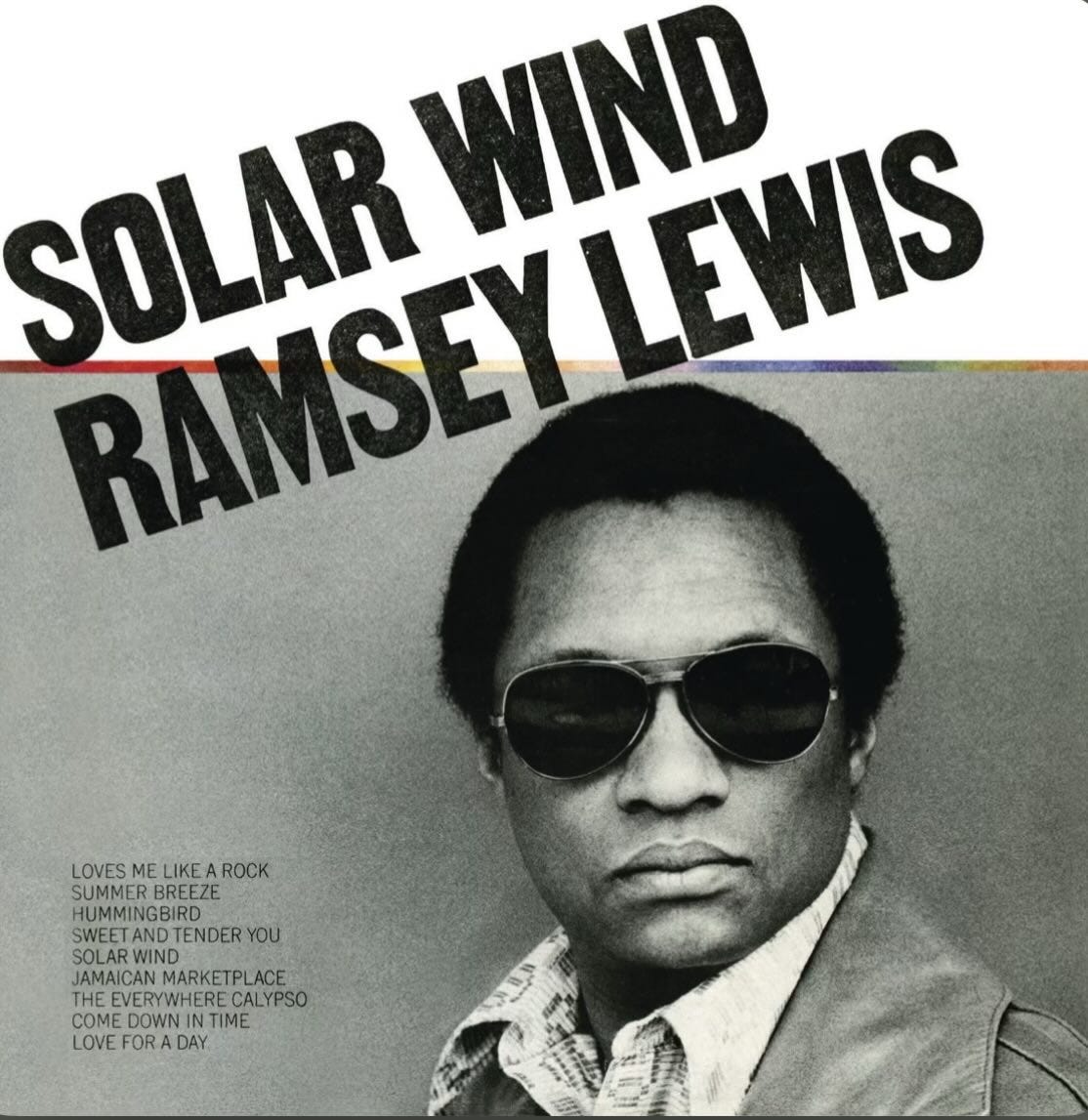
Solar Wind (1974)
Ramsey Lewis - keys, ARP & Moog
Cleveland Eaton - bass, electric bass
Morris Jennings - drums, percussion
James L. Herson - Moog
Calvin Barnes - percussion
Carl Marsh - drums
Ron Capone - drums
Steve Cropper - guitar
My favorite tracks
“Jamaican Marketplace”
https://youtu.be/TN-8Sc5ZlcI?si
“Summer Breeze”
https://youtu.be/Hnztvc49u6I?si
Few musicians could read the shifting patterns of Black popular music the way Ramsey Lewis could. He had a rare kind of ear, one that knew the difference between trends and trajectories. He could sense where the music was headed while never letting go of the voice that made him one of jazz’s most well rounded talents. Gospel, R&B, pop standards, and contemporary soul all became part of a musical vocabulary that remained unmistakably his own.
By 1974, Lewis had already experienced a career that most musicians would have considered complete. His 1965 live recording The In Crowd transformed him into one of jazz’s first true crossover stars, earning Grammy Awards and introducing millions of listeners to a pianist whose melodic clarity made modern jazz feel like a communal gathering, welcoming listeners of all musical tastes. Throughout the remainder of the decade, his trio became synonymous with elegant accessibility, balancing gospel warmth, blues feeling, and polished swing in a way that appealed equally to jazz audiences and mainstream radio.
The musical landscape of the early 1970s, however, demanded another evolution. Soul music had become increasingly sophisticated, and funk was reshaping rhythm. Electric keyboards and studio production were expanding the sonic possibilities available to jazz musicians. Artists across the genre faced a choice between remaining rooted in acoustic traditions or embracing the changing sound of Black popular music. Lewis chose neither extreme. He pursued a middle path that allowed contemporary grooves and electric instruments to coexist with the melodic discipline and rhythmic clarity that had always defined his playing.
Solar Wind captures him testing those boundaries in real time. Recorded between Memphis and Chicago and released by Columbia Records in 1974, the album finds Lewis refining the sound that would soon blossom into the commercial triumph of Sun Goddess. While that later record often receives greater attention, Solar Windprovides the essential bridge. Here, Lewis experiments with synthesizers, broader production, and contemporary songwriting while preserving the elegant touch that had established his reputation nearly a decade earlier.
The personnel surrounding him reflects that balance between continuity and exploration. Cleveland Eaton anchors the music with bass lines that move effortlessly between jazz flexibility and funk authority. Morris Jennings provides crisp, economical drumming that consistently prioritizes groove and momentum. “The Colonel” Steve Cropper’s appearances on guitar bring unmistakable Memphis soul sensibilities, while the addition of ARP and Moog synthesizers broadens the album’s harmonic landscape without allowing electronics to dominate the performances.
The opening “Sweet and Tender You” immediately establishes the album’s identity. Steve Cropper’s understated guitar pairs comfortably with Eaton’s bass while Lewis introduces the melody with characteristic warmth and precision. Rather than announcing a dramatic stylistic departure, the performance gently reveals how naturally Lewis could inhabit a more contemporary rhythmic environment.
“Hummingbird” demonstrates Lewis’s gift for interpreting contemporary popular songs. Originally written by Seals & Crofts, the composition already possessed an elegant melodic structure that fits comfortably within Lewis’s musical wheelhouse. His arrangement adds subtle electronic touches while preserving the song’s gentle lyricism. The trio never overwhelms the melody, instead allowing small harmonic variations and rhythmic nuances to gradually reshape the familiar tune.
“Solar Wind” embraces funk without surrendering to it. Eaton’s bass and Jennings’ drums establish a steady rhythmic foundation while Lewis layers electric keyboard phrases over Steve Cropper’s economical guitar work. Lewis understood that groove functioned best as a framework for melody rather than a substitute for it, and the composition succeeds because its memorable thematic ideas remain at its foundation.
“Jamaican Marketplace” introduces an upbeat Caribbean influence. The buoyant rhythm immediately distinguishes it from the surrounding material, while Lewis’s bouncy blues improvisation reveals the depth beneath the accessible surface. His phrasing is measured without sacrificing lyricism. Regardless of where a track draws its broader influence, Lewis knew how to find its melodic center and improvise accordingly. It reflects a quality that often defined Lewis throughout his career, sophistication presented with remarkable ease.
“Summer Breeze” finds Lewis transforming another Seals & Crofts hit into something warmer and more harmonically expansive without sacrificing the song’s natural feel. Electric piano and synthesizers deepen the arrangement while the rhythm section gives the performance greater momentum than the original recording. Lewis demonstrates once again that contemporary pop could provide fertile ground for meaningful jazz interpretation when approached with imagination rather than novelty.
Solar Wind‘s timing is critical in Lewis’s career arc. He was no longer simply preserving the success of The In Crowd, nor had he fully arrived at the polished jazz-funk sound that would define Sun Goddess. Instead, he occupies the productive space between those two landmarks, experimenting and finding where he fit within jazz’s rapidly changing landscape. The contemporary songs become vehicles for interpretation rather than pure commercial calculation.
The album also illustrates why Ramsey Lewis remained relevant across multiple decades while many of his contemporaries struggled with changing musical tastes. He understood that accessibility was not the opposite of artistic seriousness. Strong melodies, memorable grooves, and thoughtful arrangements could coexist with sophisticated musicianship. Lewis simply refused to believe that jazz needed to become less inviting in order to remain meaningful.
Solar Wind rarely gets mentioned in the same breath as The In Crowd or Sun Goddess, but that’s exactly what makes it one of the more telling entries in Ramsey Lewis’s catalog. Here was an artist who had nothing left to prove, yet was still reaching forward instead of settling into the shape of his own legacy. Lewis had already taught jazz how to speak to a room full of strangers and be understood. Solar Wind makes a quieter argument, that reinvention was never really the point. Sometimes evolution simply means letting new light fall across a voice that was already unmistakable.
-All Things Jazz-
No posts
Comments
Nothing yet. Say the first thing.
Sign in to join the conversation.