
Ahmad Jamal
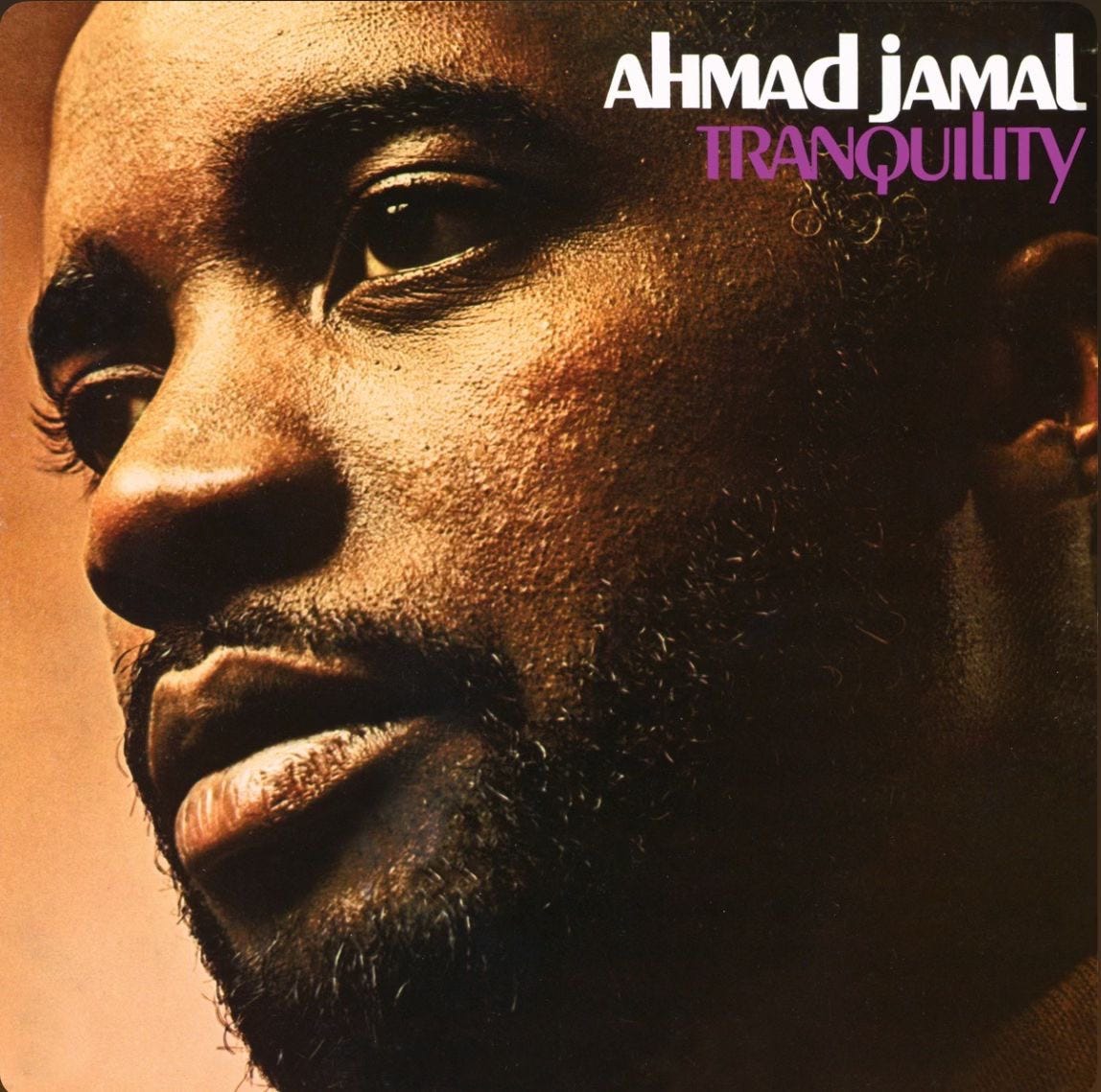
Tranquility (1968)
Ahmad Jamal - piano
Jamil Sulieman - bass
Frank Gant - drums
My favorite tracks
“The Look of Love”
https://youtu.be/9CoHLND1fdE?si=u6KQ1vqxzVOBAOM7
“Tranquility”
https://youtu.be/5zBGa03PAhQ?si=RBA2zIdEjPhAagpM
Ahmad Jamal entered 1968 operating from a position of absolute artistic authority, having completely rewired the mechanics of the piano trio a decade earlier. The staggering commercial reach of 1958’s At the Pershing: But Not for Me, anchored by the hypnotic, cyclical momentum of “Poinciana,” positioned Jamal as one of the era’s most quietly influential pianists, someone whose command of space and restraint reshaped how other musicians thought about the piano trio. Jamal dismantled the prevailing mandate of relentless velocity by treating negative space as a primary instrument, proving that a deliberately withheld note could dictate the tension of an entire record or room. That philosophy of restraint resonated so clearly that Miles Davis openly integrated Jamal’s pacing and repertoire into his own working groups, permanently embedding the pianist’s reverence for silence into the foundation of modern jazz.
Influence, however, can become its own form of expectation. By the late 1960s, jazz itself had changed dramatically. Modal improvisation had reshaped harmonic thinking. McCoy Tyner had introduced a new vocabulary of quartal harmony and orchestral power. Herbie Hancock was expanding the piano’s scope through harmonic exploration and rhythmic elasticity. Bill Evans continued refining impressionistic lyricism. Jamal now occupied the strange vantage point of watching his own influence outpace him, of hearing his ideas filtered back and expanded through the very musicians he’d shaped, now leading the conversation he’d initially started.
Rather than resisting those changes, he quietly absorbed them. Tranquility captures Ahmad Jamal at one of the most fascinating moments of his career. Leaving behind his long association with Chicago’s Argo and Cadet labels, he signed with ABC-Paramount, whose relationship with Impulse! placed him alongside artists such as Alice Coltrane, Archie Shepp, and Pharoah Sanders. Produced by Bob Thiele in 1968, the album introduces a slightly different Jamal. The unmistakable sense of space remains intact, but the performances unfold with greater dramatic scope, longer developmental arcs, and a willingness to push further against the edges of the restraint that had become his signature.
His trio had also evolved. Bassist Jamil Sulieman Nasser and drummer Frank Gant were now several years into their partnership with Jamal, having stepped into a rhythm section once defined by Israel Crosby and Vernel Fournier, the pairing that shaped Jamal’s classic recordings of the 1950s. Nasser and Gant understood, as their predecessors had, that playing with Jamal demanded restraint above all else. Their role was never simply to accompany the piano; it was to sustain a constantly shifting conversation built on anticipation, contrast, and carefully measured time and space.
The album opens unexpectedly with Burt Bacharach’s “I Say a Little Prayer.” Rather than treating contemporary popular music as lightweight material, Jamal approaches the composition with the same seriousness he would bring to the Great American Songbook. The familiar melody unfolds gracefully, supported by Nasser’s understated bass lines and Gant’s delicate rhythmic touch. Jamal’s gift had always been his ability to hear possibilities inside melodies others overlooked, and this performance immediately demonstrates that instinct.
“The Look of Love” continues that approach. Bacharach’s harmonic sophistication naturally complements Jamal’s own musical sensibilities, allowing the trio to expand the song without overwhelming its elegance, and every phrase is placed with deliberate care. Jamal rarely fills space simply because it’s available; he lets individual ideas resonate fully before moving forward, trusting silence to do as much work as sound. Beneath him, Gant’s drumming is quietly authoritative, laying down a driving backbeat over which Jamal and Nasser shift fluidly between pockets, locking into the groove without ever surrendering to it.
“When I Look in Your Eyes” slows the pace. Jamal’s interpretation leans into atmosphere, letting subtle shifts in touch and dynamics shape the performance rather than any overt statement. Nasser’s bass playing deserves particular recognition here; rather than simply marking harmony, he continually reinforces Jamal’s phrasing, creating the impression of two melodic voices moving in tandem. Above them, Gant’s cymbal work supplies exactly the right rhythmic tone, shading the groove that Jamal and Nasser are locked into without ever disrupting it.
“Emily” stands among the album’s most beautiful interpretations. Johnny Mandel’s melody had already become a favorite among jazz musicians, but Jamal uncovers new emotional depth through his remarkable control of pacing. His voicings remain spacious, allowing the melody to breathe naturally while Gant colors the performance with subtle cymbal touches that never draw attention away from the piano.
The album reaches its emotional center with the title composition. “Tranquility” marks a significant departure from the concise forms that defined much of Jamal’s earlier work, stretching to nearly nine minutes and unfolding patiently, gradually accumulating emotional intensity without ever sacrificing the composure its title promises. Jamal builds the performance through repetition, subtle variation, and dynamic control rather than dramatic harmonic shifts. Even within this more expansive soundscape, it’s his mastery of space that fortifies the composition; in his musical conception, space isn’t about playing sparsely so much as knowing how and when to phrase. Even when Jamal becomes more harmonically active, the way he layers those ideas remains the truest testament to his discipline of restraint.
Tranquility‘s significance lies in what it reveals about Ahmad Jamal’s remarkable adaptability. Many influential artists eventually become custodians of their own legacy, repeating the ideas that first brought them acclaim. Jamal chose a different path. Even after fundamentally changing how the jazz piano trio functioned during the previous decade, he remained curious enough to continue listening to the younger generation that had grown up studying his work. If McCoy Tyner, Herbie Hancock, and countless others had learned from Jamal’s use of space, Jamal now quietly absorbed aspects of their expanding harmonic and emotional vocabulary without compromising his own identity.
The album also demonstrates how completely Jamal understood the relationship between popular song and jazz improvisation. Throughout his career, he consistently selected contemporary material that many jazz musicians overlooked, trusting strong melodies to provide lasting foundations for improvisation. His Bacharach interpretations here reinforce that philosophy. Great songs, regardless of their origin, deserved serious artistic attention.
Tranquility often sits in the shadow of At the Pershing, The Awakening, and several of Jamal’s later recordings, yet it occupies one of the most important places in his artistic journey. It captures a master refusing to become static, embracing growth without abandoning the principles that made his voice unmistakable. Jamal had already taught jazz how to value restraint, patience, and space. Tranquilitydemonstrates that those lessons were never fixed principles. They remained living ideas, capable of growing alongside the music itself.
-All Things Jazz-
No posts
Comments
Nothing yet. Say the first thing.
Sign in to join the conversation.