
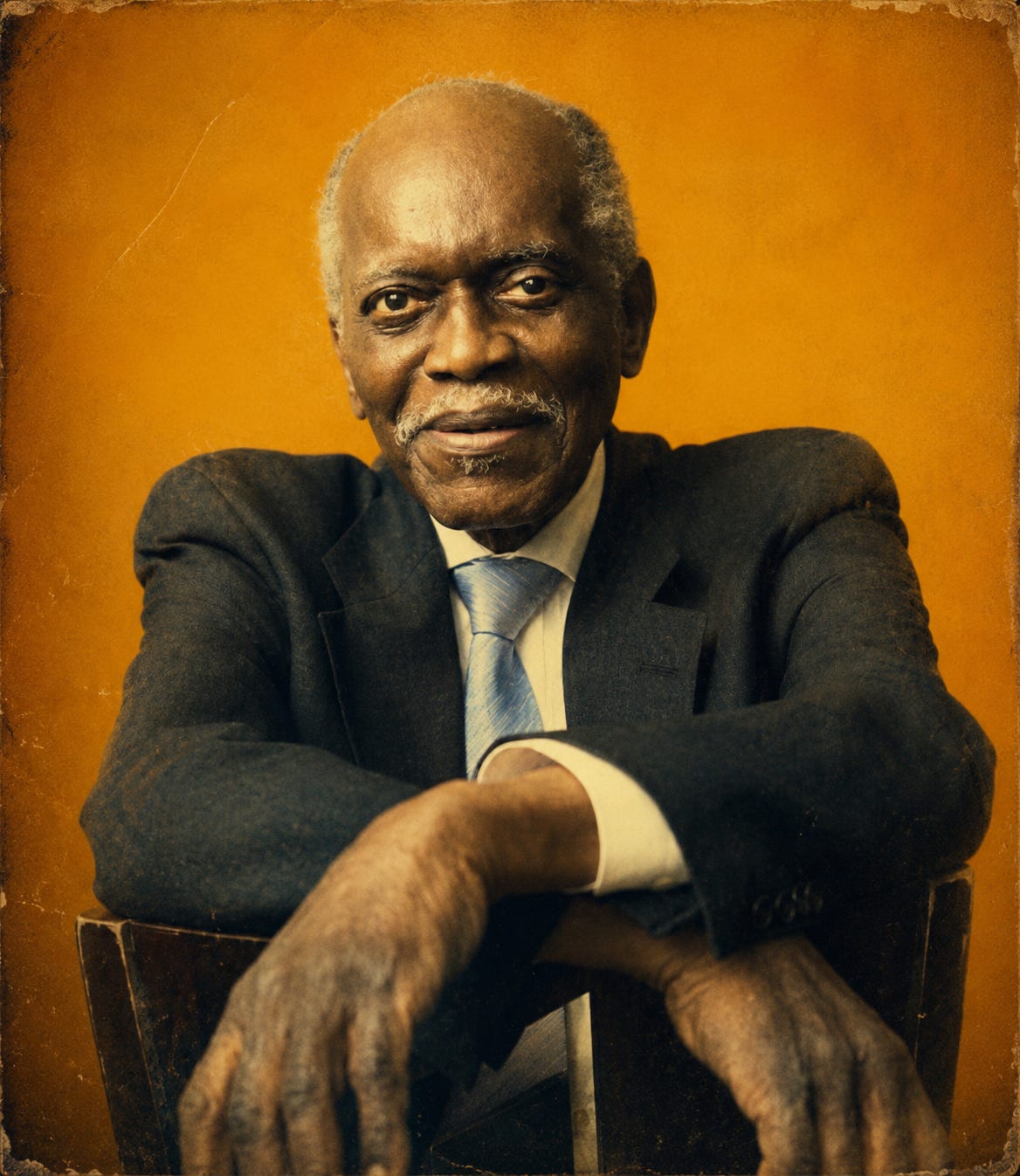
Born on this day in 1918. Happy posthumous birthday to the legendary Hank Jones.
Hank Jones belonged to one of jazz’s most remarkable musical families, but his greatness was never dependent on lineage. Born Henry Jones Jr. on July 31, 1918, in Vicksburg, Mississippi, and raised in Pontiac, Michigan, he grew up in a household that also produced trumpeter and composer Thad Jones and drummer Elvin Jones. Each brother developed a distinct musical identity, yet all three shared an unusual combination of discipline, intelligence, and emotional depth that revealed itself in their music.
Hank began playing professionally at thirteen, working in Michigan and Ohio territory bands while absorbing the piano language of Earl Hines, Fats Waller, Teddy Wilson, and Art Tatum. Those early years gave him more than technical experience. They taught him how to adjust to different ensembles, read a room, support other musicians, and maintain his own identity without forcing it to the point of distraction.
His move to New York in 1944 changed the course of his career. After meeting saxophonist Lucky Thompson, Jones accepted an invitation to work at the Onyx Club alongside Thompson and trumpeter Hot Lips Page. New York placed him near the center of modern jazz at the moment bebop was rewriting the rules. Within a short period, he was working with Coleman Hawkins and Billy Eckstine, two figures whose bands connected the swing era to the emerging modern sound.
Jones fit naturally into that transition because his playing carried both elegance and rhythmic authority. He had the touch required for singers and the harmonic command demanded by bebop. His work with Charlie Parker confirmed that he could move through the most advanced music of the period without losing clarity or balance.
Norman Granz soon brought him into Jazz at the Philharmonic, where Jones toured alongside some of the most important musicians of the era. From 1948 to 1953, he also served as Ella Fitzgerald’s pianist, a role that sharpened his already exceptional sense of accompaniment. Jones understood how to support a singer without crowding the melody. He could provide lift, harmony, and momentum while leaving enough space for every lyric to fully register.
That combination of flexibility and taste eventually made him valuable well beyond traditional jazz circles. From 1959 to 1975, Jones worked as a staff pianist for CBS, a position he obtained in part because Andy Williams admired his playing and helped open the door. The job placed him inside the commercial machinery of American television, where he contributed to programs including The Ed Sullivan Show and other network productions that demanded rapid preparation, precise sight-reading, and stylistic adaptability.
He also worked as a pianist and conductor on Broadway, another setting that rewarded his command of form and his ability to remain dependable under pressure. These positions could have reduced a lesser musician to anonymity, but Jones maintained an active jazz career throughout them. His identity remained intact because his skill and versatility was too complete to disappear inside any single role.
As a leader, he recorded extensively in solo, trio, and small group settings. His records illustrate the qualities that made him so widely respected: a refined touch, firm swing, lyrical phrasing, and an instinctive understanding of restraint. He never relied on excess.
His later career expanded that legacy. Jones worked across generations and idioms, collaborating with artists whose approaches ranged from swing and bebop to modern jazz and popular music. The Great Jazz Trio became one of his most important later projects, giving him a setting where his sense of balance, interaction, and restraint could be heard with modern clarity. He continued recording and performing well into his advanced age, remaining relevant because his style was adaptable while still being rooted in fundamentals and musical intelligence.
Jones’s awards reflected the depth of that contribution. He received the National Endowment for the Arts Jazz Masters honor, the ASCAP Jazz Living Legend Award, the National Medal of Arts, and a Grammy Lifetime Achievement Award. Those honors recognized a career of extraordinary longevity, but they only partially explain his importance.
Hank Jones never needed volume to lead a room, and that quiet authority became its own kind of standard. Sophistication came easily to him, but never at the cost of warmth, the two lived together in his playing without friction. Trace his career and it reads like a map of jazz itself: Midwest territory bands giving way to 52nd Street, Charlie Parker and Ella Fitzgerald giving way to CBS television, Broadway, and decades of late career trio work.
What stayed constant through all of it was the man at the piano, poised, clear-headed, and quietly dependable in a way few musicians ever manage across so many rooms. That consistency is exactly what made him one of jazz's great stabilizing forces, and arguably its most complete pianist.
-All Things Jazz-
Comments
Nothing yet. Say the first thing.
Sign in to join the conversation.