
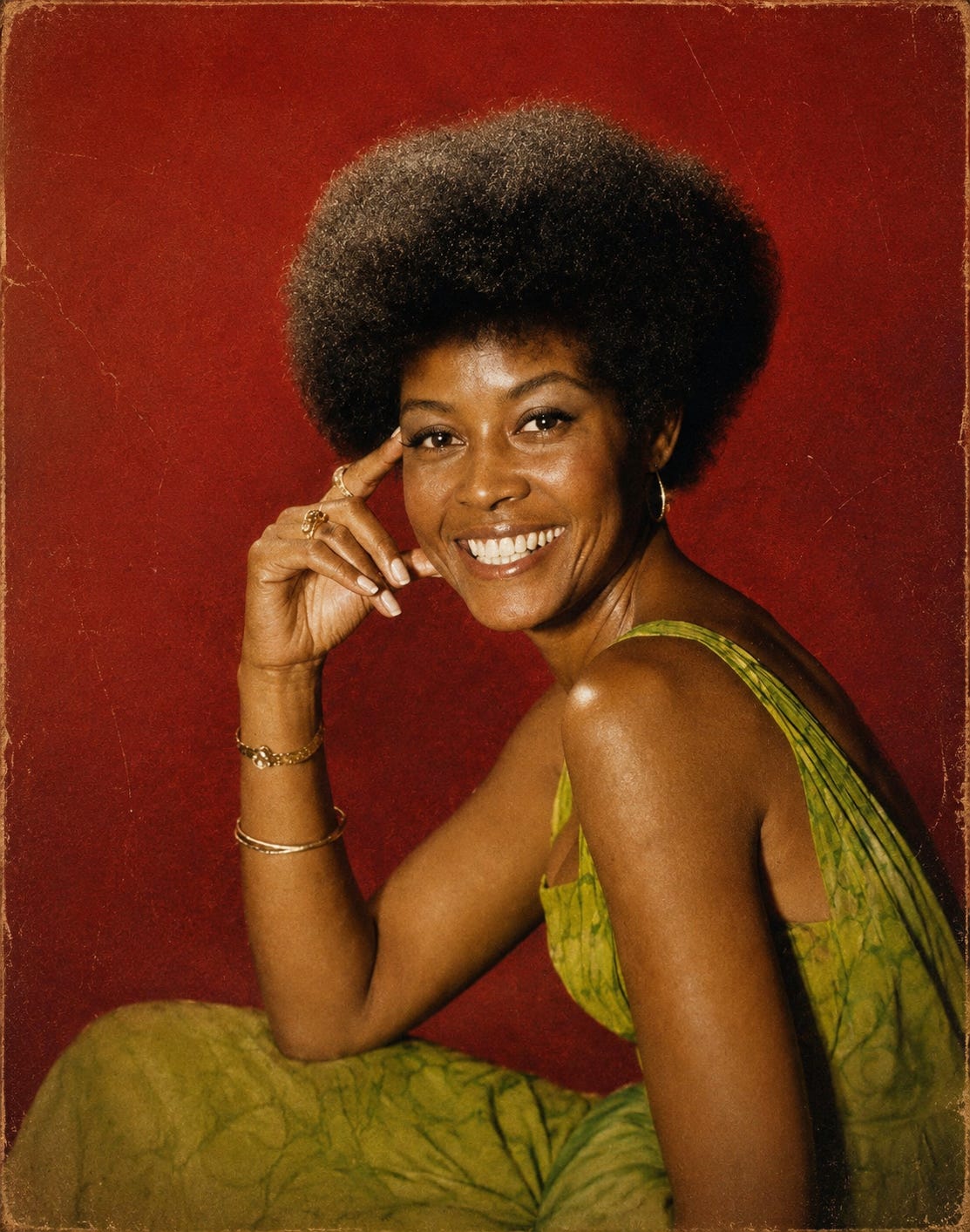
Born on this day in 1930. Happy posthumous birthday to the legendary Abbey Lincoln!
“I’ve done what I please, told people to bug off and exercised my independence.”
— Abbey Lincoln
There had always been something magnetic about Abbey Lincoln, at least to me, and it never came from her ability as a performer. It came from the ease of someone entirely comfortable in her own skin, someone who never felt the need to apologize for who she was or what she was becoming. She was a commanding figure. Everything about her, from her voice., her appearance, the way she carried herself in public and in interviews radiated a rare balance of grace and assuredness that captivated.
Across six decades, that self-possession allowed her to evolve naturally. She ascended from a talented nightclub vocalist to one of jazz’s most fearless voices because she refused to compromise who she was for the sake of fitting in. By the end of her life, she had become far more than an exceptional singer. She was a composer, actress, activist, and thought leader. Each facet of who she was emerged organically. It all happened on her own terms because the only way she knew how to show up was as her whole self.
Born Anna Marie Wooldridge on August 6, 1930, in Chicago and raised in rural Michigan, Lincoln came from a large working class family where she was the tenth of twelve children. She discovered singing early, performing in local clubs and amateur competitions before leaving home to pursue music professionally. Like many young entertainers of the era, she experimented with different identities, performing under stage names including Gaby Lee and Anna Marie before ultimately adopting the name Abbey Lincoln.
Her earliest recordings introduced her as a sophisticated vocalist whose style fit comfortably within the expectations placed on mainstream female jazz singers during the 1950s. Albums for Riverside Records, including That’s Him! and Abbey Is Blue, revealed remarkable interpretive gifts and emotional depth, even while presenting her through the glamorous nightclub image that record labels believed audiences expected. That image came at a cost she would later name plainly. “This dress was more important than I was,” she said, reflecting on those years. “People in the audience were looking at my exposed breasts and the shape of my body, and it didn’t have nothing to do with the music.” The voice was already unmistakable, but the artist behind it was still evolving.
That transformation arrived with Max Roach’s We Insist! Freedom Now Suite in 1960. Lincoln’s performance on the album remains one of the most emotionally charged moments in jazz history. Her haunting tone and anguished cries carried the full weight of slavery and oppression, rendered with a gravity equal to the horror itself. The recording expanded her audience, but more importantly, it established her as an artist willing to place moral conviction at the center of her work.
Her artistic evolution soon extended beyond music. Lincoln abandoned the carefully constructed glamour of her early career in favor of an image rooted in Black cultural pride. She embraced natural hair long before doing so became widely accepted and helped produce the landmark Naturally ’62 fashion show, featuring the Grandassa Models wearing natural hairstyles. The event challenged prevailing European centered beauty standards and helped begin a national conversation about Black identity, self-image, and the politics of appearance years before terms like Black Is Beautiful entered the mainstream.
Her marriage to Max Roach reflected their shared convictions. Together they became one of jazz’s most visible artistic partnerships, united by a belief that music could speak honestly about freedom, dignity, and social responsibility. Their relationship was documented in Max and Abbey, Stan Lathan’s 1970 short film, which captured two artists whose creative lives had become inseparable from their political commitments.
Lincoln never viewed civil rights as an isolated American struggle. Following the assassination of Congolese independence leader Patrice Lumumba in 1961, she joined protests condemning his killing and connected the fight for Black equality in the United States to broader movements for liberation throughout Africa and the African diaspora. She also spoke consistently about the importance of Black women leading within cultural and political movements rather than remaining confined to supporting roles.
Lincoln later toured several African nations, an experience that profoundly shaped her understanding of identity and heritage. She subsequently adopted the name Aminata Moseka, reflecting a deeper connection to the continent and to the cultural lineage she believed had always informed her work.
Lincoln entered another notable chapter during the 1980s and 1990s. Recording primarily for Verve, she produced a series of deeply personal albums built around her own compositions, earning renewed critical acclaim as both a songwriter and vocalist. Her artistic reach also extended to film. She delivered memorable performances in Nothing But a Man (1964), one of the defining independent films of its era, appeared in For Love of Ivy (1968), and later introduced herself to a new generation through Spike Lee’s Mo’ Better Blues (1990).
Abbey Lincoln’s legacy cannot be defined by her discography, however remarkable it is. She proved that a jazz vocalist could also become so much more without sacrificing authenticity. She continually challenged both herself and her audiences to confront difficult but necessary questions about race, identity, beauty, and the weight of cultural responsibility, all without wavering in her convictions. That may be her rarest achievement. Plenty of artists change. Few carry themselves through every transformation with grace and an unshakable refusal to be anyone other than exactly who they are.
-All Things Jazz-
No posts
Comments
Nothing yet. Say the first thing.
Sign in to join the conversation.