
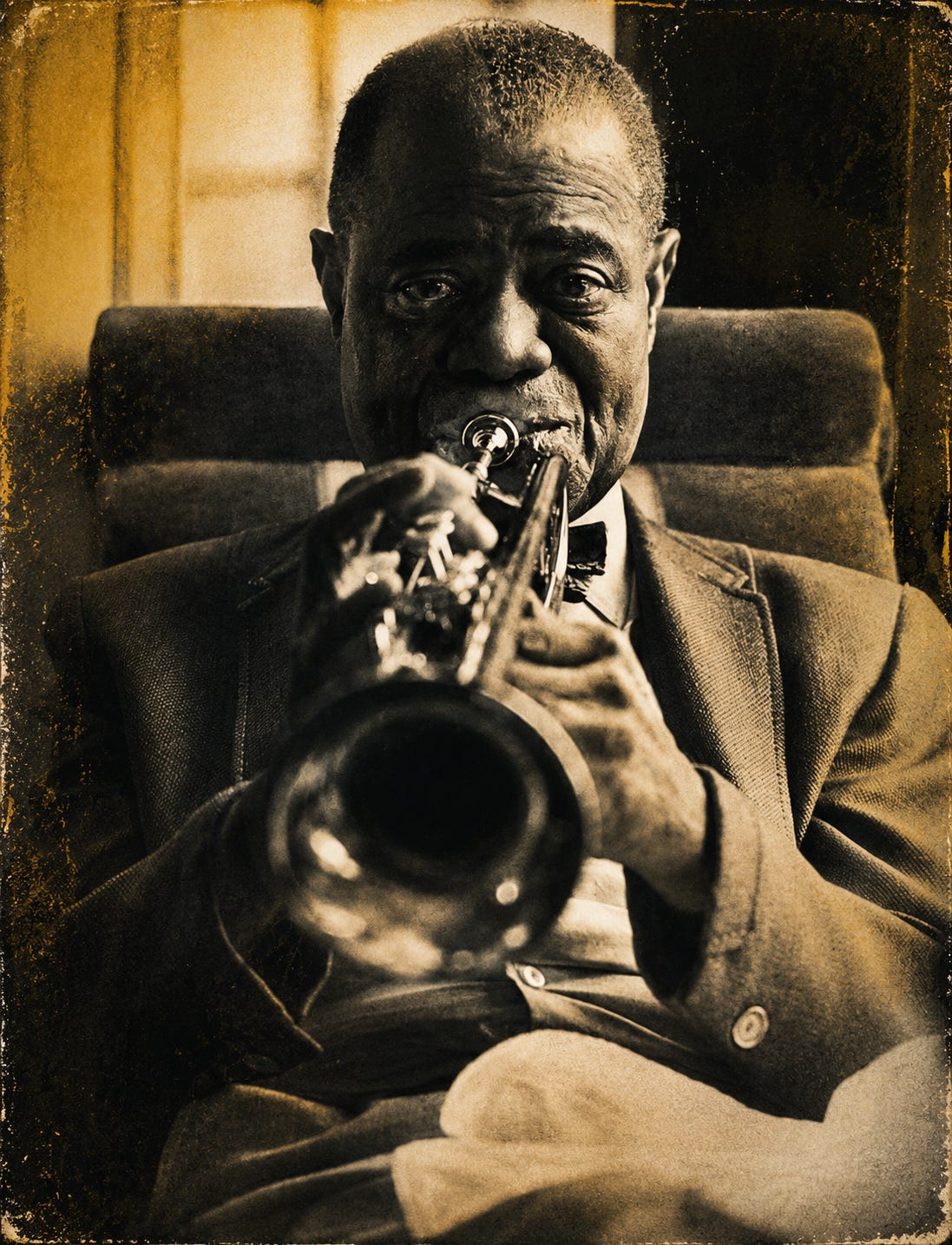
Born on this day in 1901. Happy posthumous birthday to the legendary Louis Armstrong!
Few artists have ever carried a burden as heavy as Louis Armstrong’s. Long before the Civil Rights Movement reached its defining moments, Armstrong had become one of the most recognizable Black figures in America and one of the first musicians to achieve legitimate international celebrity. His extraordinary success brought opportunities no jazz musician had previously imagined, but it also placed him at the intersection of competing expectations. White America celebrated him as an entertainer. Black America looked to him as one of its most visible cultural symbols. Balancing those realities became part of the work of being Louis Armstrong.
That he reached such heights at all is remarkable. Born in New Orleans on August 4, 1901, Armstrong entered the world under circumstances that weren’t designed to produce greatness. Poverty defined his childhood, his father was absent from it, and the city offered a Black child from the Storyville tenements nothing resembling a path forward. His childhood reached an early turning point after he was sent to the Colored Waif’s Home for firing a pistol into the air on New Year’s Eve. What appeared to be another challenging chapter in a difficult upbringing instead became the beginning of his musical education.
There, he received formal instruction on the cornet and discovered the discipline that would unlock the depths of his immense musical talent, which in turn transformed modern music. New Orleans supplied the rest of his education. Brass bands, church hymns, blues, ragtime, opera, Caribbean rhythms, and street parades all formed the spine of the city’s musical vocabulary. Armstrong absorbed those sounds before joining riverboat bands under Fate Marable, whose unrelenting standards refined his musicianship and prepared him for a career beyond Louisiana. His move to Chicago at the invitation of King Oliver accelerated that journey, and within only a few years his recordings with the Hot Five and Hot Seven had permanently influenced the direction of jazz.
Armstrong’s approach to the trumpet changed the role and expectations of the jazz soloist. His phrasing, harmonic imagination, and unique sense of swing shifted jazz away from collective improvisation toward individual expression. His innovations as a vocalist proved equally influential. Armstrong demonstrated how rhythm, timing, and personality could elevate any song to new heights. Every generation of jazz musicians, and countless artists far beyond jazz, inherited something from that revolution.
In the midst of it all, his growing fame introduced challenges that extended well beyond music. As Armstrong became one of America’s most beloved entertainers, he also became one of its most visible Black public figures. That visibility carried responsibilities no previous jazz musician had been asked to navigate. The white entertainment establishment largely embraced the warmth, humor, and optimism that it felt made him non-threatening. Many Black Americans, living under segregation and denied the most basic civil rights, understandably wanted reassurance that one of the country’s most celebrated Black figures remained connected to their lived reality. The expectation was not that Armstrong become as outspoken as Paul Robeson. It was that his public life reflected an awareness of the people and circumstances from which he had come.
Armstrong understood that responsibility, even if he expressed it differently than many expected or hoped. He was never an organizer or a full time activist, but neither was he indifferent to injustice. He carried himself with immense pride in his Blackness, employed Black musicians throughout his career, quietly supported causes, friends, and fellow artists behind the scenes, and recognized that every public statement from someone in his position carried consequences beyond himself. That awareness demanded a level of nuance and sensitivity few entertainers have ever been required to maintain.
The clearest example came in 1957 during the Little Rock crisis. Governor Orval Faubus blocked nine Black students from entering Central High School. Armstrong condemned him publicly. He said Eisenhower had failed to act, and he meant it. Then he did something no one expected: he canceled a State Department goodwill tour rather than represent a country that would not protect its own citizens.
“The way they’re treating my people in the South, the government can go to hell,” he told a reporter.
He went further.
“It’s getting almost so bad a colored man hasn’t got any country.”
These were not the words of a man who avoided politics. They were the words of a man who had simply chosen his battles.
That same fury had already taken root elsewhere, quietly, for years. Armstrong had grown bitter toward the city that made him, New Orleans, and its refusal to let him play alongside white musicians on equal terms. Near the end of his life, he said plainly that he did not want a New Orleans funeral. He expected to be buried in New York instead. For those who had mistaken his warmth for political detachment, 1957 revealed something that had always been there. Armstrong picked his moments. But when he decided silence cost more than speech, he spoke, and he did not soften it.
His life cannot be reduced to that balancing act, although it helps explain why his story remains so compelling. Armstrong succeeded where almost no one before him had. He became a global celebrity while carrying the hopes, criticisms, and expectations that accompanied unprecedented visibility. He managed those pressures without allowing them to eclipse the joy, generosity, and humanity that animated his music.
By the time Louis Armstrong’s career came to an end, he had accomplished something far more significant than commercial success. He had transformed jazz into a soloist’s art, reshaped popular singing, elevated the trumpet to new improvisational heights, and expanded the possibilities available to every musician who followed him. More than a century after his birth, his recordings continue to define the vocabulary of modern music.
That is why Louis Armstrong’s place in history extends far beyond jazz. He was a survivor of extraordinary hardship who worked his way into becoming a cultural pioneer. He carried responsibilities few public figures had ever confronted, and he did it with grace. Through it all, Louis Armstrong permanently changed the course of music itself. Few musicians have ever mattered more.
-All Things Jazz-
Comments
Nothing yet. Say the first thing.
Sign in to join the conversation.