
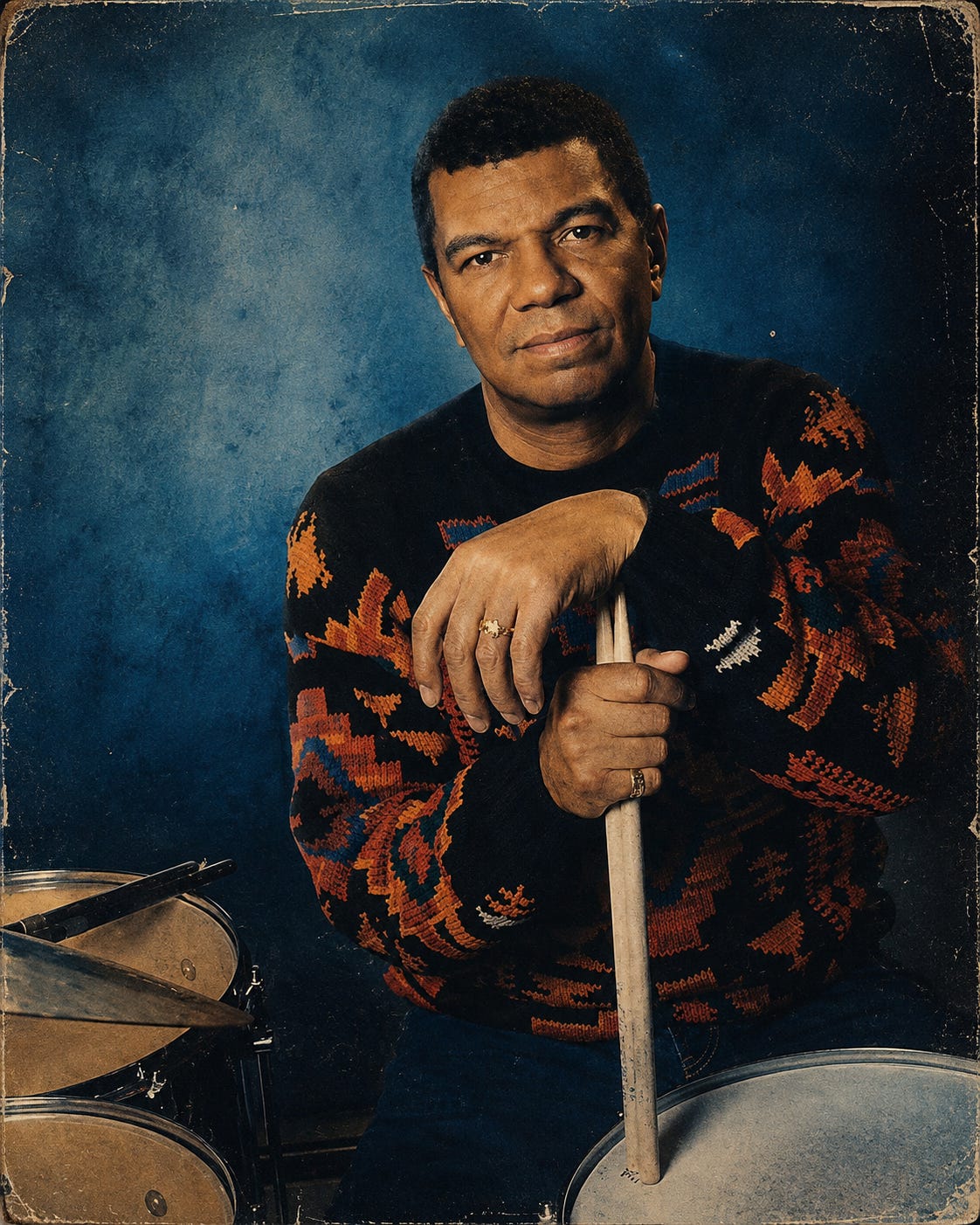
Born on this day in 1942. Happy posthumous birthday to the legendary Jack DeJohnette!
One of jazz’s great gifts is the freedom it gives artists to build ever shifting soundscapes, bound by nothing but their own imagination. For more than six decades, that radically open approach guided Jack DeJohnette as he moved through rhythm, idiom, and genre with the restless curiosity of a musician who never rested on his accolades and resisted the notion of a comfort zone.
That foundation helps explain the unique trajectory of a career that moved through Chicago’s experimental jazz community, Miles Davis’s electric period, European improvisation, acoustic standards, fusion, and the creative fluidity it took to connect each individual element to a cohesive musical philosophy.
Born in Chicago on August 9, 1942, DeJohnette began studying classical piano at the age of four under Antoinette Rich, who led an all female symphony orchestra in Chicago. Rich recognized that DeJohnette had perfect pitch and gave him a serious musical foundation early in life. His uncle Roy Wood Sr., the prominent Chicago jazz disc jockey who later became a co-founder and vice president of the National Black Network, was vital to DeJohnette’s development as well. Wood, the father of comedian Roy Wood Jr., introduced his nephew to jazz records and took him into clubs, allowing DeJohnette to experience both the music and the culture that animated it.
By fourteen, DeJohnette had begun working professionally. His musical curiosity initially took him in several directions at once. He sang lead tenor in a doo-wop quartet, played acoustic bass in a dance band, and continued developing as a pianist. He started playing drums around thirteen, with local jazz drummer Bobby Miller Jr. helping him develop his technique. DeJohnette approached the new instrument with maturity and discipline, eventually practicing three hours a day on the drums and another three on the piano. Even after drums became his primary professional instrument, he continued to regard himself as a pianist who extended his musical vision through percussion.
Chicago gave that vision room to blossom. DeJohnette worked with Richard Abrams, Roscoe Mitchell, and other musicians who would become central to the Association for the Advancement of Creative Musicians after its founding in 1965. He also encountered the expansive musical world surrounding Sun Ra. Together, those experiences exposed him to a Chicago scene in which blues, bebop, abstraction, collective improvisation, and experimentation could coexist. Long before the rest of jazz began arguing about the boundaries of the music and drawing artificial lines of demarcation, DeJohnette was learning from musicians who did not acknowledge those boundaries.
After moving to New York in 1966, DeJohnette was immediately at the center of another musical transformation. He joined the Charles Lloyd Quartet, one of the era’s most adventurous and unexpectedly popular jazz groups, and met pianist Keith Jarrett, beginning a friendship and musical partnership that would eventually span more than half a century.
Work with Jackie McLean, Abbey Lincoln, Betty Carter, and others followed, along with a brief but important stint in Bill Evans’s trio. Playing with Evans required restraint and sensitivity to harmonic movement, qualities DeJohnette could provide without abandoning the rhythmic force that had already made him distinctive.
DeJohnette joined Miles Davis in 1969, replacing Tony Williams in the working band as Miles was moving decisively into electric music. This was an environment where jazz improvisation was colliding with rock, funk, electronic instrumentation, and increasingly open formats that rewrote the rules of song structure. This period produced Bitches Brew, and DeJohnette became an integral part of Davis’s touring ensemble.
DeJohnette was perfectly suited for Davis’s new musical direction because his background in Chicago had already prepared him to work across various musical ideas, regardless of whether they seemed like logical fits. His drumming could maintain a powerful pulse while allowing the music to stretch around it. Cymbals supplied texture as well as time, the snare became a connector, and rhythmic patterns could expand or contract as easily as the flow of the music required.
DeJohnette began recording under his own name around the same period and gradually developed a body of work that reflected the diversity of his artistic upbringing. The Gateway trio with guitarist John Abercrombie and bassist Dave Holland created spacious music built around collective improvisation, while Directions and New Directions gave him different settings for exploring composition, electric experimentation, and ensemble interaction. Special Edition, formed near the end of the 1970s, became one of his most important groups, bringing his Chicago experimental roots into alignment with the expanding musical language he had spent years developing in New York.
Alongside bassist Gary Peacock, DeJohnette became part of his longtime friend and collaborator Keith Jarrett’s Standards Trio in 1983, beginning one of the most enduring and celebrated small group partnerships in modern jazz. Their performances demonstrated how much room for invention remained in familiar material. DeJohnette’s work on Jarrett’s live album The Out-of-Towners earned a Grammy nomination, further evidence of the remarkable chemistry that persisted between them decades after they had first worked together as young, hungry musicians under Charles Lloyd.
His later career followed his established pattern. DeJohnette worked with artists including Herbie Hancock, Pat Metheny, John Scofield, Sonny Rollins, Joe Henderson, Michael Brecker, and Alice Coltrane while continuing to work as a leader. Recognition followed accordingly. DeJohnette won Grammys for his 2007 album Peace Time and his 2021 collaborative album Skyline with Ron Carter and Gonzalo Rubalcaba.
DeJohnette was also inducted into the Modern Drummer Hall of Fame and named an NEA Jazz Master in 2012, taking his rightful place among jazz’s greatest musicians. Those honors acknowledged a drummer whose influence reached beyond technique and mainstream acclaim. His approach helped establish the modern drummer as a vital component of composition and improvisation as well as timekeeping.
DeJohnette died in October 2025 at 83, leaving behind a career that in many ways was the blueprint for a modern jazz drummer. He honed his craft in the same Chicago creative community that produced the AACM, entered New York through Charles Lloyd, accompanied Bill Evans, played a pivotal role as Miles Davis navigated one of the most consequential transformations of his career, and built his own influential ensembles.
Through it all, the pianist who began studying music at four never completely disappeared behind the drum kit. DeJohnette heard rhythm as an expanded musical conversation, which allowed him to move effortlessly across styles and treat genre as one connected musical language.
-All Things Jazz-
No posts
Comments
Nothing yet. Say the first thing.
Sign in to join the conversation.