
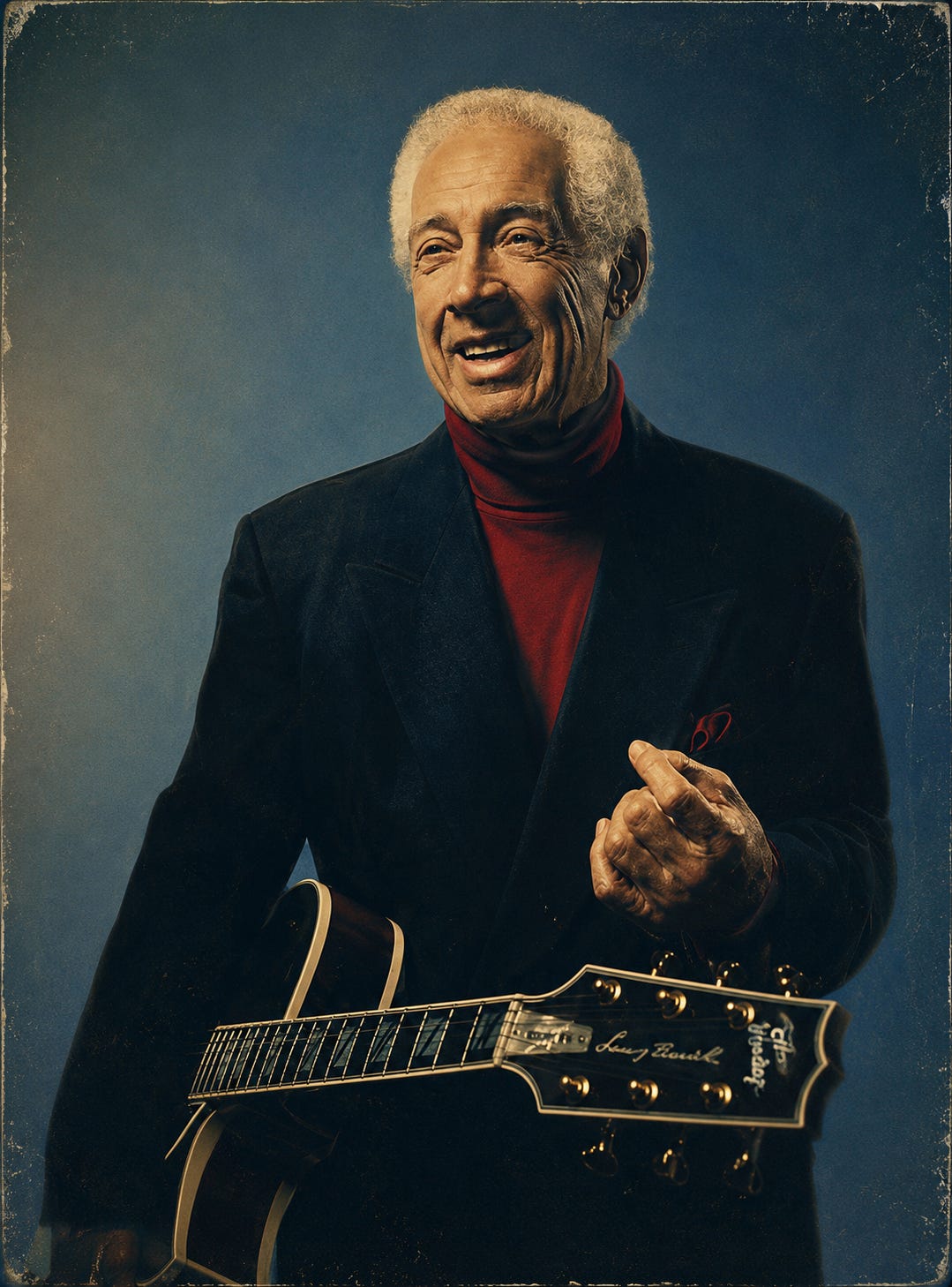
Happy 95th birthday to the legendary Kenny Burrell!
Few musicians connect jazz’s golden era to the present as directly as Kenny Burrell. His career reaches from Detroit’s postwar jazz community and Dizzy Gillespie’s recording sessions to Blue Note, Prestige, Verve, and more than four decades of teaching at UCLA. Across that extraordinary span, he has maintained one of the most recognizable sounds in jazz guitar: warm, lyrical, firmly rooted in the blues, and refined enough to make difficult music feel natural.
Kenneth Earl Burrell was born on July 31, 1931, in Detroit, the youngest of six children in a musical household. His mother played piano and sang in church, while his father played banjo and guitar. Music surrounded him early, but the guitar became his instrument after he heard Charlie Christian, whose ability to function as a fully developed jazz soloist helped establish the instrument’s modern possibilities.
Burrell’s influences soon expanded beyond jazz. He studied the melodic precision of Django Reinhardt and Oscar Moore alongside the blues language of T-Bone Walker and Muddy Waters. That combination remained central to his identity. His playing carries bebop sophistication, but the phrasing retains the directness and straight ahead grit of the blues. He understood that technical depth and accessibility could strengthen each other when both were grounded in feeling.
Detroit provided an ideal environment for that development. The city’s jazz scene produced an extraordinary generation of musicians, including Donald Byrd, Yusef Lateef, Pepper Adams, Tommy Flanagan, Barry Harris, Paul Chambers, and the Jones brothers. While studying composition and theory at Wayne State University, Burrell helped establish the New World Music Society, a musicians’ collective devoted to presenting modern jazz and creating opportunities for Detroit artists. The organization reflected a broader commitment that would define his life: musicians needed both creative freedom and institutions capable of preserving and supporting their work.
His first major recording opportunity arrived in 1951, when he joined Dizzy Gillespie for a session that also included John Coltrane, Milt Jackson, and Percy Heath. Burrell was still a college student, yet he already possessed enough composure to work alongside musicians who were helping define modern jazz. After graduating from Wayne State in 1955, he spent several months touring with Oscar Peterson, an experience that further strengthened his command of harmony, rhythm, and ensemble discipline.
Burrell moved to New York soon afterward and quickly became one of the most dependable guitarists in the city. His ability to read fluently, adapt to different settings, and support soloists without crowding them made him valuable in clubs, studios, and Broadway orchestras. He worked with musicians as varied as Coleman Hawkins, Billie Holiday, Benny Goodman, Nat King Cole, Stan Getz, and Jimmy Smith, moving comfortably across swing, bebop, blues, soul jazz, and popular music while retaining his own tonal identity.
His recordings as a leader established him as one of the essential guitarists of his generation. Introducing Kenny Burrell, Blue Lights, On View at the Five Spot Cafe, Guitar Forms, and his collaboration with John Coltrane reveal the breadth of his musical interests. Each album places his guitar in a different setting while preserving the qualities that make his playing immediately recognizable.
Midnight Blue, recorded in 1963, remains his signature achievement. The album’s blues-centered atmosphere, spacious arrangements, and unhurried confidence created music that welcomed listeners without lowering its musical standards. Burrell’s tone remains intimate throughout, while Stanley Turrentine’s tenor and the understated percussion deepen the record’s late night character.
His admiration for Duke Ellington became another defining feature of his career. Ellington reportedly counted Burrell among his favorite guitarists, and Burrell returned that respect through decades of study, performance, and education. He began teaching courses devoted to Ellington’s music at UCLA and treated the composer’s work as a complete artistic tradition worthy of the same sustained academic attention given to European classical figures.
That commitment eventually helped transform jazz education at UCLA. Burrell became the founding director of the university’s Jazz Studies program and built a curriculum that connected performance, composition, history, and African American cultural experience. His work as an educator extended his influence beyond recordings and concerts. Artists including Kamasi Washington and Gretchen Parlato developed within the UCLA jazz community he helped shape, carrying parts of that institutional and musical legacy into contemporary jazz.
Burrell’s mentorship reflects the same generosity heard in his playing. He has always understood that supporting another voice requires attention rather than passivity. His accompaniments leave room while remaining engaged, and his teaching created similar space for younger musicians to discover their own direction without losing contact with the tradition behind them.
His honors include recognition as an NEA Jazz Master, along with numerous awards celebrating his work as a performer, composer, and educator. The larger significance of his life extends beyond any individual distinction. Burrell remains one of the few living musicians whose personal history reaches directly into the formative years of hard bop, soul jazz, Blue Note, and the postwar Detroit scene.
That continuity gives his birthday particular meaning. Kenny Burrell has spent more than seven decades demonstrating how a musician can remain grounded without becoming stagnant. He has successfully balanced sophistication and accessibility without compromising technical rigor. His guitar carries the blues, the elegance of Duke Ellington, the discipline of bebop, and the warmth of someone who has always understood that great music should invite people closer.
Jazz has changed considerably since Burrell first recorded with Dizzy Gillespie in 1951. His sound continues to feel relevant because it was built on values that do not expire. As one of our remaining links to jazz’s golden era, Kenny Burrell represents both living history and the enduring possibility of passing that history forward.
-All Things Jazz-
No posts
Comments
Nothing yet. Say the first thing.
Sign in to join the conversation.