
Clark Terry
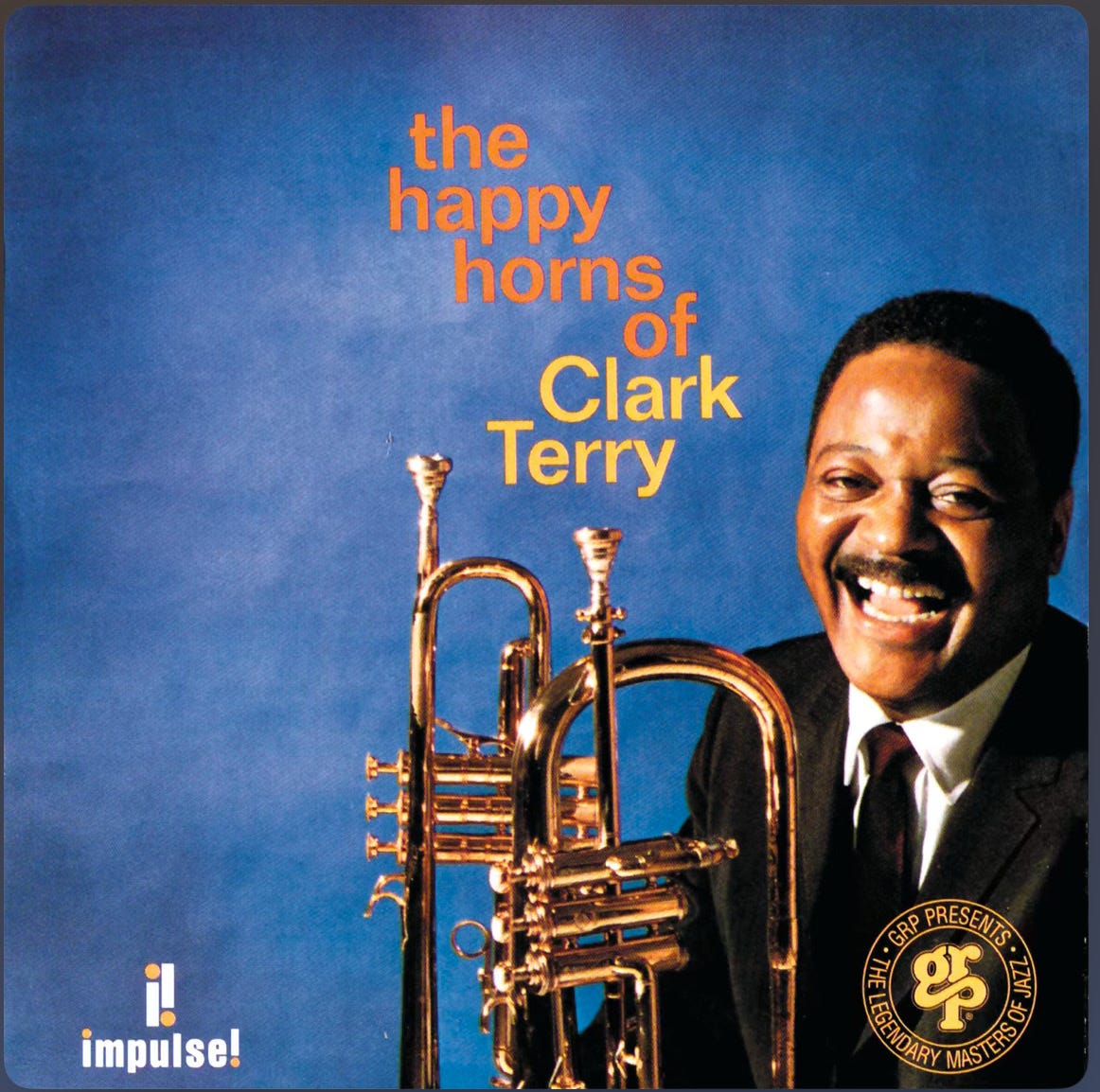
The Happy Horns of Clark Terry (1964)
Clark Terry - trumpet, flugelhorn
Phil Woods - alto sax, clarinet
Ben Webster - tenor sax
Roger Kellaway - piano
Milt Hinton - bass
Walter Perkins - drums
My favorite tracks
“Return to Swahili”
https://youtu.be/ayLB2v9IbBs?si=4CUVM6uqnALp6YGC
“Ellington Rides Again”
https://youtu.be/M4GP5ytIb00?si=eg2k9nvbx6dbfkOQ
By 1964, Clark Terry was in his mid-forties and fully embracing his status as a jazz ambassador and respected mentor to the next generation of musicians. His reputation as a musician was already sterling. He had mastered the disciplined swing of Count Basie and absorbed the orchestral sophistication of Duke Ellington. Dizzy Gillespie once described Terry as “the quintessential trumpet player. He can swing. He can bop. He can do anything he wants to do with a horn.” Terry had also broken one of American television’s most significant racial barriers as NBC’s first Black staff musician.
Yet, The Happy Horns of Clark Terry arrives before his later fame as one of jazz’s beloved elder statesmen and consummate entertainers. Here, Terry is operating at the height of his musical powers, deploying everything he had learned from two of jazz’s greatest orchestras into the tighter confines of a sextet.
The timing of the album is significant. Jazz itself stood at a crossroads. Hard bop and soul jazz continued drawing new audiences through their blues rooted, rhythmic energy, and growing accessibility. Modal innovations, propelled by Miles Davis and John Coltrane, had permanently altered the language of jazz composition and improvisation, while the avant-garde challenged nearly every convention the previous generation had accepted. Labels like Impulse! increasingly presented jazz as modern art, giving musicians greater freedom to pursue ambitious artistic visions.
Clark Terry never felt compelled to choose sides. Rather than abandoning swing for abstraction, he demonstrated that melody, impeccable phrasing, and intelligent ensemble writing remained infinitely capable of producing fresh ideas. If many musicians responded to the changing landscape by pushing outward, Terry responded by leaning into the fundamentals that shaped him, proving there was still fresh territory to uncover within a language he’d spent a lifetime mastering.
Those fundamentals had been shaped under the tutelage of jazz royalty. Born in St. Louis, Terry earned every step of his remarkable ascent. Charlie Barnet first recognized his talent nationally before Count Basie refined his understanding of swing. His years with Duke Ellington proved even more transformative. Ellington encouraged individuality, allowing Terry to develop the conversational phrasing and effortless lyricism that became his musical signature. By the time he left Ellington in 1959, Terry was no longer simply one of jazz’s finest trumpeters. He had become one of its most complete musicians.
The years immediately preceding The Happy Horns expanded Terry’s range of influences. Touring with Quincy Jones reinforced his command of sophisticated arrangements while introducing him to a broader international audience. His appointment to NBC in 1960 marked a historic breakthrough for Black musicians in network television, and by 1962 he had become a regular member of The Tonight Show orchestra. Millions of Americans who had never stepped inside a jazz club suddenly recognized Clark Terry’s unmistakable smile and sound.
None of that visibility lessened Terry’s artistic ambitions. If anything, The Happy Horns of Clark Terry reveals a musician becoming even more focused, distilling decades of orchestral experience into tightly drawn small group arrangements.
The album opens with Duke Ellington’s “Rockin’ in Rhythm.” Rather than attempting to recreate Ellington’s orchestra, Terry and his band emphasize tightly coordinated interplay that creates concise but memorable solos. Woods and Webster provide beautifully contrasting horn approaches, while Terry navigates the melody with remarkable ease, hardly surprising given the years he spent inside Ellington’s orchestra and the deep familiarity he had with its songbook.
“In a Mist,” originally composed and recorded by Bix Beiderbecke on piano in 1927, is beautifully reimagined here. One of early jazz’s most harmonically adventurous compositions, the piece proves ideal for Terry’s flugelhorn, whose famously warm, rounded tone lends the melody a remarkable sense of intimacy. The performance demonstrates Terry’s ability to find emotional depth through restraint. He remains the centerpiece, but never overwhelms the ensemble around him. Roger Kellaway’s piano work is equally notable, moving confidently through Beiderbecke’s unusual harmonic language while preserving the composition’s graceful, impressionistic character.
The blistering “Return to Swahili” broadens the album’s scope. While many jazz musicians of the 1960s increasingly explored African influences through modal improvisation and spiritual jazz, Terry’s approach remains rooted in melody and rhythmic subtlety. His flugelhorn sings with remarkable warmth and fluidity while the rhythm section continually adjusts the music’s momentum, pressing forward one moment and relaxing the next, always leaving room for the horns to breathe.
The centerpiece of the album arrives through the Ellington medley, “Ellington Rides Again,” which combines “Don't Get Around Much Anymore,” “Perdido,” and “I'm Beginning to See the Light.”
Rather than presenting the pieces as separate performances, Terry allows them to function as a suite, unfolding naturally into one another. While the band’s chemistry is remarkable, what the medley ultimately illustrates is how seamlessly Ellington’s catalog functions as a unified musical language. Terry understood those compositions from the inside, and that familiarity adds considerable depth to the performance.
The Happy Horns of Clark Terry is remarkable for many reasons, but its enduring appeal lies in how naturally it bridges multiple generations of jazz history. Terry understood that tradition should never represent stagnation. It was something to participate in and build upon. Ellington, Beiderbecke, and Terry’s own original writing coexist comfortably because he recognized them as different elements of the same conversation, unified by shared musical principles even as their individual voices remain unmistakably distinct.
The album also reminds listeners why Terry became one of jazz’s most beloved figures, not simply for his trumpet, but for how he treated the people playing beside him. As Christian McBride observed, “Every musician in the world who ever met Clark Terry is a better musician and person because of it. He now belongs to the ages.” That generosity defined Terry’s approach to the bandstand. It was never about dominance. Instead, he viewed it as a place where lifting others up ultimately made the entire ensemble stronger than the sum of its individual parts.
The Happy Horns of Clark Terry is often overlooked because it arrived during one of jazz’s most revolutionary periods, when groundbreaking movements seemed to redefine the music almost monthly. That context shouldn’t diminish what Terry accomplished here. He wasn’t interested in overturning jazz or chasing a new direction. His innovation came through refinement, building thoughtfully upon a tradition he understood as deeply as anyone alive. The album remains a reminder that swing, melody, generosity, and joy never become outdated when they’re expressed with this much imagination.
-All Things Jazz-
No posts
Comments
Nothing yet. Say the first thing.
Sign in to join the conversation.