
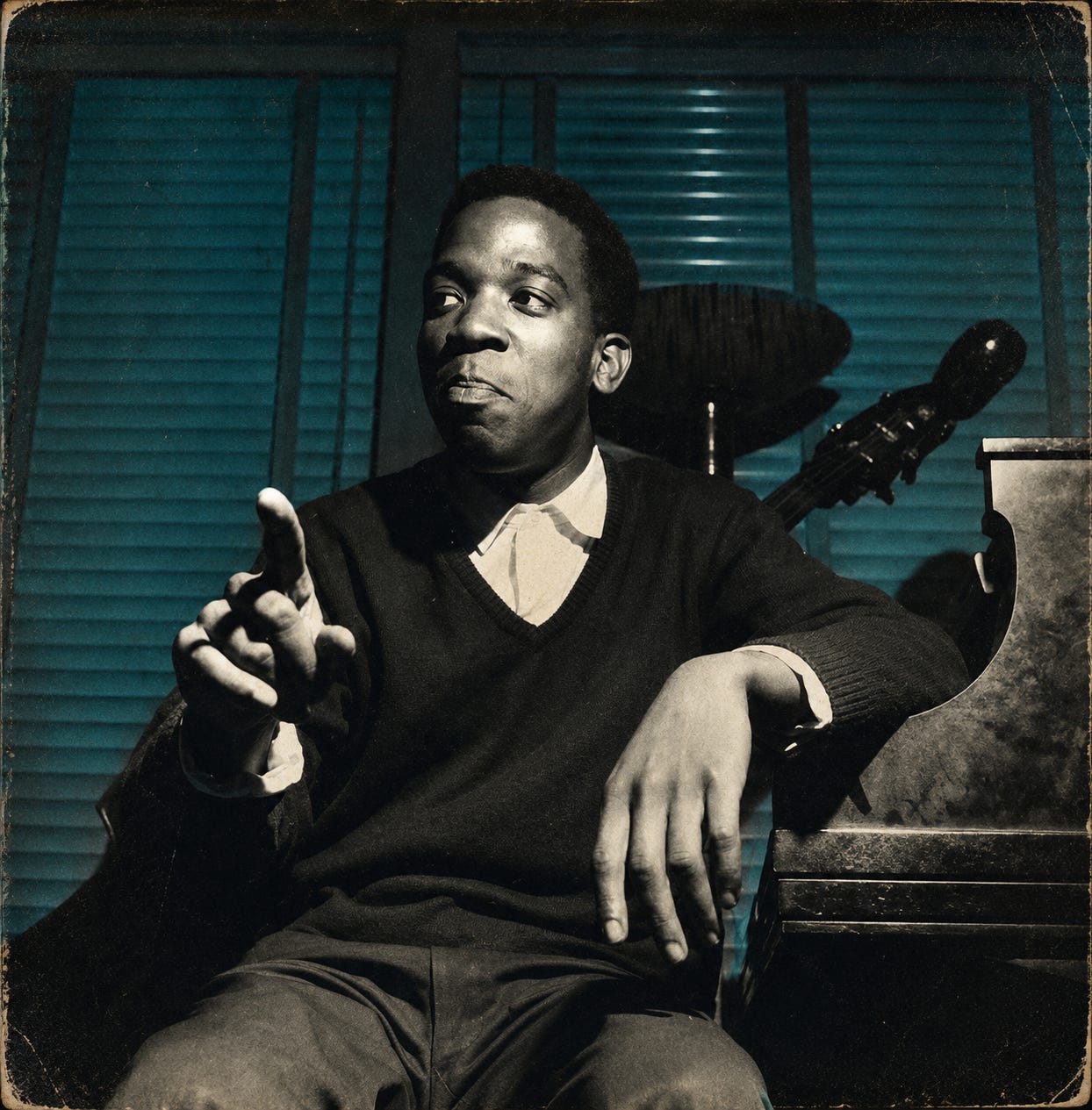
Born on this day in 1931. Happy posthumous birthday to the great Sonny Clark.
Some musicians become stars. Others become the musicians the stars rely on.
Sonny Clark belonged firmly in the second group, although history has gradually corrected that distinction. During the remarkably productive years that defined Blue Note Records in the late 1950s and early 1960s, Clark became one of the label’s indispensable voices. His name rarely appeared in headlines with the same frequency of the stars of his era, yet his piano quietly became part of the architecture of modern hard bop. Listen to enough Blue Note records from that period and his touch eventually becomes unavoidable.
Born Conrad Yeatis “Sonny” Clark on July 21, 1931, in Herminie, Pennsylvania, he grew up far from the New York clubs that would later define his career. After relocating to California in the early 1950s, Clark developed quickly on the West Coast, working with Wardell Gray, Oscar Pettiford, and Buddy DeFranco while absorbing Bud Powell’s harmonic language and bebop’s expanding vocabulary. By 1957, however, he wanted something different. New York offered a harder musical edge and a deeper competitive environment, one that rewarded musicians capable of balancing technical command with the blues.
The move changed everything. Almost immediately, Clark found himself working alongside Charles Mingus, Sonny Rollins, Dinah Washington, and many of the musicians shaping modern jazz in real time. Alfred Lion recognized almost instantly that Clark possessed exactly the qualities Blue Note needed. Within weeks of his arrival, Clark appeared on Hank Mobley’s self-titled Blue Note debut before entering the studio for his own first leader date, Dial “S” for Sonny. That recording announced more than another promising pianist. It introduced a composer whose writing possessed the same balance that defined his playing. He was lyrical without becoming sentimental, and never sacrificed sophistication for swing.
Blue Note quickly discovered something equally valuable. Clark fit almost everywhere. Between 1957 and 1962 he became the label’s unofficial house pianist, appearing on sessions with Hank Mobley, Jackie McLean, Lee Morgan, Grant Green, Dexter Gordon, Curtis Fuller, Kenny Burrell, Stanley Turrentine, Tina Brooks, Lou Donaldson, and countless others. His ability to adapt without surrendering his own musical identity made him indispensable. Every leader sounded fully like themselves with Sonny Clark in the rhythm section.
That quality deserves more attention than it often receives. Great accompanists do not simply stay out of the way. They create conditions where everyone else can sound their best. Clark understood how to support a solo without merely supplying chords beneath it. His comping nudged ideas forward, responded to rhythmic shifts, and quietly redirected momentum without drawing unnecessary attention to itself. Like the finest rhythm section players, he made complicated interaction sound inevitable.
His work as a leader reveals another dimension of his artistry. Dial “S” for Sonny, Sonny’s Crib, Sonny Clark Trio, Leapin’ and Lopin’, and especially Cool Struttin’ have gradually become cornerstones of the Blue Note catalog. Cool Struttin’, recorded in January 1958, remains one of hard bop’s defining piano albums. The title track unfolds with remarkable patience, balancing blues, melodic clarity, and rhythmic precision without ever sounding self-conscious. Like many of Clark’s finest performances, it rewards repeated listening because every return reveals another detail hidden inside what first appeared effortless.
Clark’s writing reflected similar qualities. His compositions rarely relied on unnecessary complexity to demonstrate sophistication. Strong melodies, elegant harmonic movement, and rhythmic intelligence allowed the music to remain inviting while providing improvisers with substantial material to develop. Accessibility and rigor coexisted naturally throughout his catalog because he never treated them as opposing values.
That balance explains why so many musicians admired him. His career, however, unfolded during one of the darkest periods in jazz.
The generation that followed Charlie Parker inherited more than bebop’s revolutionary musical language. Too many also inherited heroin. For some, addiction became a temporary interruption. Others managed to escape it altogether. Many did not. The losses extend far beyond the famous names that history remembers.
Regional bandleaders, gifted sidemen, promising composers, and extraordinary rhythm section players disappeared before reaching artistic maturity. Their stories rarely receive the same attention because they ended before the larger public had time to recognize what had already been lost. Sonny Clark belongs among that generation.
Addiction interrupted his Blue Note momentum and contributed to long absences from the studio during years when his musical voice should have been expanding most rapidly. When he returned, the brilliance remained evident, but the larger arc of his career had already begun narrowing. On January 13, 1963, he died in New York from a heroin overdose. He was thirty one years old.
It remains one of the great unfinished stories in jazz. Yet focusing exclusively on that ending risks obscuring everything that came before it. Clark’s recorded legacy continues to grow precisely because listeners keep discovering how central he was to the music surrounding him. His piano appears throughout one of the richest periods in Blue Note history, and his own recordings have steadily risen from overlooked sessions to essential listening for anyone seeking to understand hard bop at its highest level.
Sonny Clark never received the length of career his talent deserved. Even so, he helped define the sound of an era whose influence continues to shape modern jazz more than sixty years later. That achievement reminds us that artistic importance is not always measured by longevity. Sometimes a remarkably short life leaves behind enough music to keep introducing itself to new generations, one Blue Note record at a time.
-All Things Jazz-

No posts
Comments
Nothing yet. Say the first thing.
Sign in to join the conversation.