
The Dave Brubeck Quartet
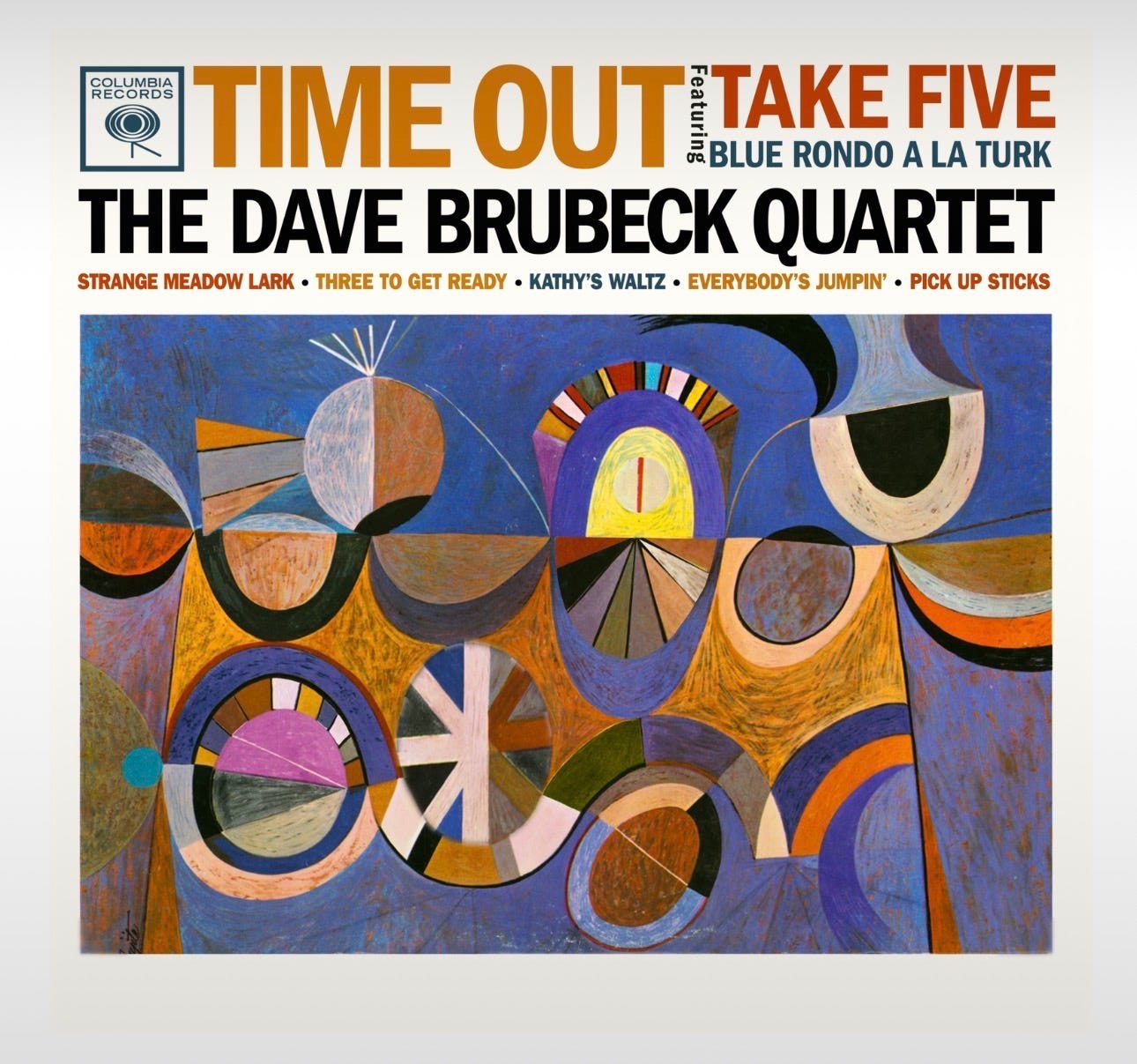
Time Out (1959)
Dave Brubeck - piano
Paul Desmond - alto sax
Eugene Wright - bass
Joe Morello - drums
My favorite tracks
“"Blue Rondo à la Turk"
https://youtu.be/vKNZqM0d-xo?si=4vkDu6Z4Xwz1L6hG
“Take Five”
https://youtu.be/ryA6eHZNnXY?si=YbQhWBjtj4jmh-Wd
There are landmark albums, and then there are landmark years. Jazz has experienced both, but few moments rival what unfolded in 1959. Within a span of a few months, Miles Davis’s Kind of Blue, John Coltrane’s Giant Steps, Charles Mingus’s Mingus Ah Um, Jackie McLean’s New Soil, and Ornette Coleman’s The Shape of Jazz to Come all reimagined the contours and conceptions of what modern jazz could be, with each record proposing a different future for where the music was going.
Dave Brubeck’s Time Out belongs comfortably alongside them, though its revolution arrived through a different entrance. Rather than rebuilding harmony or abandoning convention altogether, Brubeck asked a deceptively simple question: what happens if rhythm itself becomes the central idea? The answer produced one of the most commercially successful jazz albums ever recorded while simultaneously expanding the music’s structural vocabulary. In a year defined by artistic ambition, Time Outdemonstrated that experimentation and accessibility did not have to exist at opposite ends of the spectrum.
By 1959, Brubeck was hardly an unknown figure. The Dave Brubeck Quartet had spent nearly a decade establishing itself as one of America’s premier touring jazz groups. Their performances at colleges across the country introduced countless young listeners to modern jazz, helping cultivate an audience that viewed the music as intellectually engaging without sacrificing its emotional appeal. Brubeck’s appearance on the cover of Time magazine in 1954, only the second jazz musician after Louis Armstrong to receive that distinction, reflected how widely his influence had grown beyond traditional jazz circles.
The quartet itself had reached remarkable stability. Brubeck’s muscular piano style contrasted beautifully with Paul Desmond’s melodic alto saxophone. Eugene Wright anchored the group with unflinching steadiness while Joe Morello had quietly become one of the most inventive drummers of his generation. Their chemistry had developed over years of touring, allowing the ensemble to approach increasingly ambitious musical ideas without sacrificing the conversational interplay that defined small group jazz.
The inspiration for Time Out arrived thousands of miles from New York. During a 1958 State Department tour through Europe, the Middle East, and Asia, Brubeck encountered rhythmic traditions largely unfamiliar to American jazz audiences. Street musicians in Turkey particularly captured his attention through their use of 9/8 meter, grouped not in equal subdivisions but in asymmetrical patterns that created movement unlike anything found in traditional jazz. Similar encounters throughout India, Pakistan, Afghanistan, and Eastern Europe broadened his understanding of rhythm as something far more fluid than Western musical convention typically allowed.
Returning home, Brubeck proposed an album built around those discoveries. Columbia Records reportedly questioned the commercial wisdom of releasing an entire record centered on unusual time signatures, but Brubeck knew his audience and remained convinced that listeners would respond if the melodies remained memorable and the performances continued to swing. History quickly proved him right.
“Blue Rondo à la Turk” opens the album by presenting its central idea with no wasted motion. Inspired directly by the Turkish street rhythms Brubeck encountered abroad, the composition alternates between an asymmetrical 9/8 pulse and conventional 4/4 swing. The opening passages unfold with remarkable precision before dissolving effortlessly into blues-inflected improvisation. Rather than sounding forced or academic, the contrast reveals how comfortably jazz could absorb ideas from outside its traditional vocabulary without losing its identity.
“Strange Meadow Lark” provides an entirely different kind of rhythmic exploration. Brubeck begins alone, performing a freely paced piano introduction that feels closer to French Impressionism than modern jazz. When the quartet enters, the performance settles into relaxed swing, but the opening has already established that rhythm can be manipulated through the absence of a fixed pulse just as effectively as through unusual meter. Paul Desmond’s warm alto melody unfolds with his signature patience, reminding listeners that the quartet’s greatest strength was never technical novelty alone, but its ability to humanize sophisticated ideas.
No discussion of Time Out can avoid “Take Five,” nor should it. While it’s easy for avid jazz fans to become dismissive of commercially successful recordings that eventually take on lives of their own, it would be an injustice not to praise the brilliance of “Take Five.” Composed by Paul Desmond as a feature for Joe Morello, the piece became one of the most recognizable recordings in jazz history while permanently changing how audiences perceived odd meter. Built around an unforgettable piano ostinato and Desmond’s deceptively simple melody, the composition makes 5/4 feel almost inevitable. Morello’s celebrated drum solo deserves particular recognition, not because of its virtuosity alone, but because it never loses sight of the composition’s rhythmic identity. Every phrase reinforces the pulse, allowing complexity to emerge through clarity rather than excess. More than six decades later, it remains one of the few jazz recordings instantly recognizable to listeners far beyond the genre itself.
“Three to Get Ready” continues the rhythmic experimentation while showcasing a playful side. Alternating between measures of 3/4 and 4/4, the tune constantly shifts the listener’s footing without ever interrupting its momentum. Brubeck treats changing meter as an opportunity to reshape musical conversation. The quartet’s familiarity with one another becomes especially apparent here, each transition unfolding with the ease that only comes from profound chemistry and connection.
Part of Time Out’s enduring appeal comes from what it refuses to become. Brubeck never treats odd meter as a gimmick or a demonstration of technical superiority. Every unusual rhythmic idea serves the music rather than the concept behind it. The quartet understood that listeners remember musical ideas because they communicate emotionally, not because of a high minded inclination toward complexity.
The album’s commercial success ultimately reinforced that lesson. Time Out became the first jazz album to sell more than one million copies, while “Take Five” became the first jazz single to reach that milestone. Neither achievement came through compromise. The quartet trusted audiences to follow unfamiliar ideas as long as the music remained inviting, melodic, and lively.
Within the extraordinary landscape of 1959, Time Out occupies a unique place. Miles Davis simplified harmony to create greater improvisational freedom. Coltrane embraced harmonic density. Ornette Coleman questioned the necessity of predetermined structure altogether. Brubeck instead focused on the architecture of rhythm, demonstrating that changing the number of beats in a measure could alter the emotional character of jazz just as profoundly as changing the chords beneath it.
More than sixty years after its release, Time Out remains one of the defining statements in modern jazz because it expanded the music’s possibilities without losing sight of its purpose. Brubeck and his quartet proved that innovation does not always require tearing down tradition. Sometimes it begins by hearing familiar ideas from a different angle, and trusting that if the music swings, listeners will follow wherever it leads.
-All Things Jazz-
No posts
Comments
Nothing yet. Say the first thing.
Sign in to join the conversation.