
Welcome to Ayurveda in Modern Life — where I explore what this ancient science looks like when it meets real life, a real body, and a world that doesn’t always slow down long enough to listen.
If you enjoy this post, please tap the little heart ❤️ below — it helps more people find their way here, and it means a lot to me.
I want to be clear from the start that I am not anti-medicine. Modern medicine has its place and I am grateful for it. What I want to talk about is what I did when it reached its limits for me.
A few weeks ago I had another IBS-D (Irritable Bowel Syndrome with predominant diarrhea) flare-up. Without going into unnecessary detail, it was so bad that I was essentially living in the bathroom. I couldn’t keep anything down. I got to the point where I was afraid of food, even the thought of it — which, for a chef who has built her life around the pleasure of eating, is its own kind of hell.
At some point during those awful days — knowing that my body needed nourishment even as it was rejecting everything — I remembered something I had read years ago about rice water. It also came back to me from my Ayurveda studies, where it is taught as one of the oldest and most gentle ways to support a distressed digestive system. I dragged myself to the kitchen.
I took a heaping tablespoon of basmati rice. Washed it well, rinsed it a couple of times until the water ran clear. Added it to about three cups of water, brought it to a boil, then turned it down to the lowest possible simmer and left it for about 45 minutes to an hour. What I ended up with was a liquid that had turned opaque and slightly thick, with the rice nearly dissolved into it. I added a pinch of Himalayan pink salt and sipped it warm from a cup, the soft rice stirred through.
My body accepted it. I cannot tell you how much that meant after days of accepting nothing.
I had it for three days. That was all I ate.
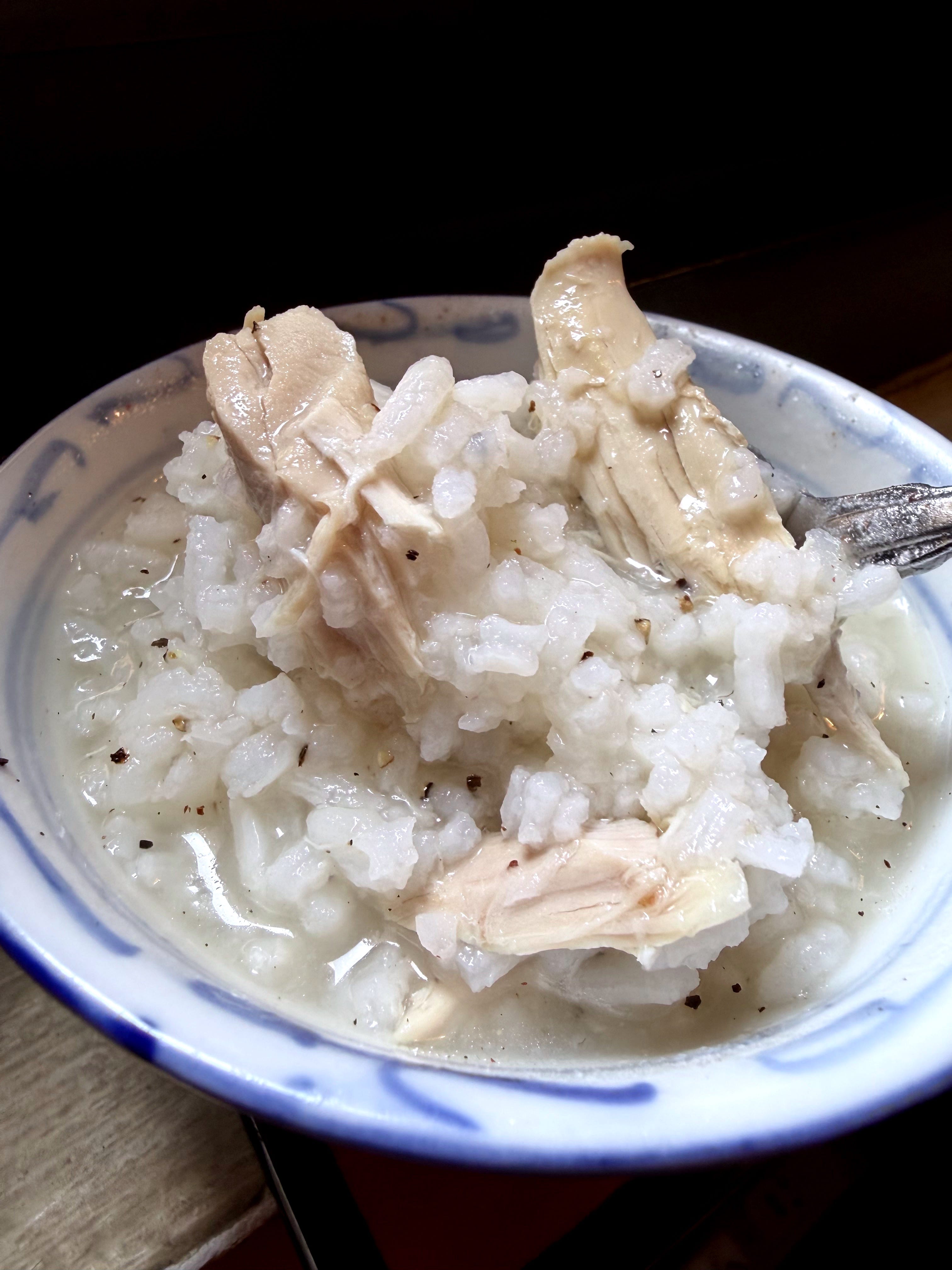
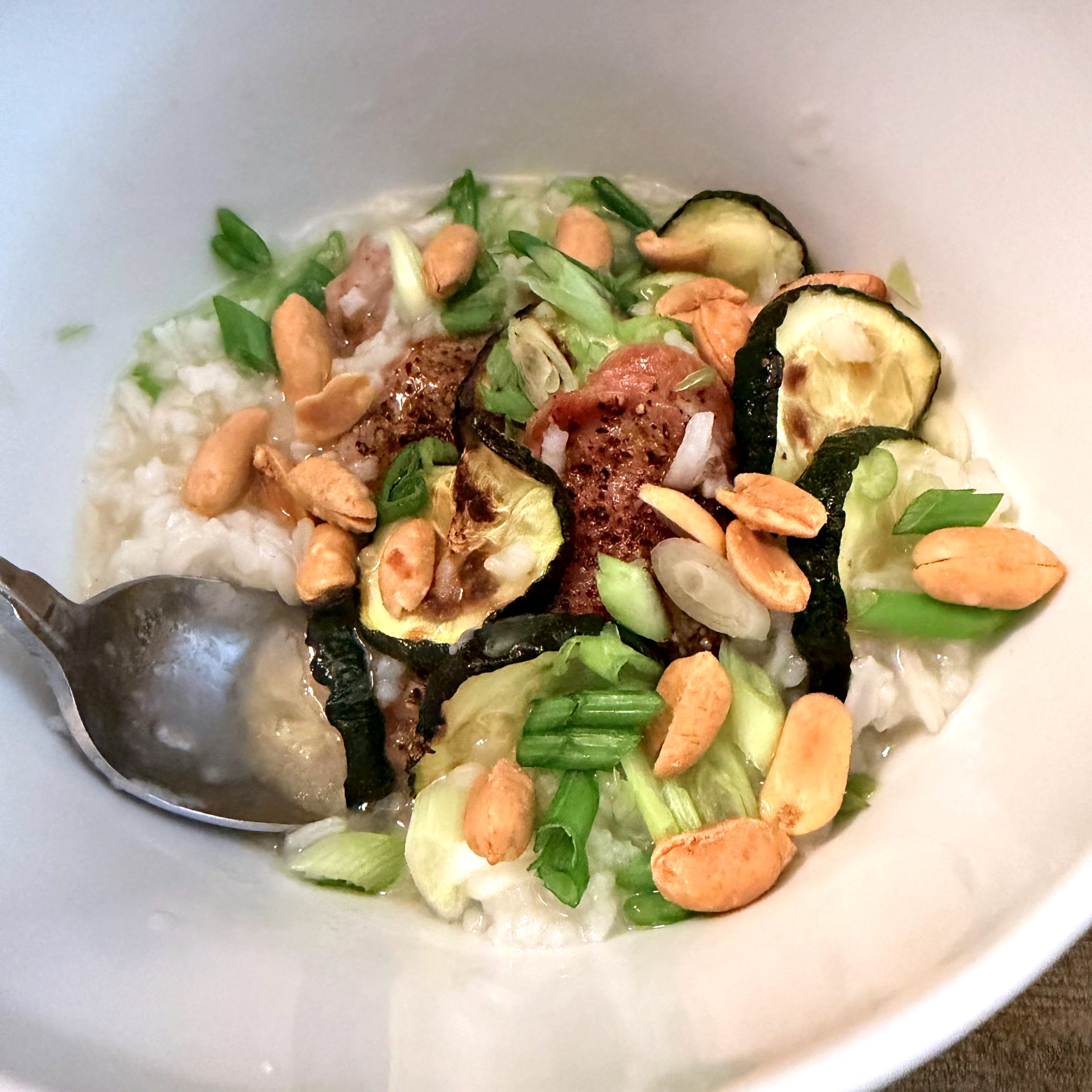
When I started to feel better, my body asked for more. I added some shredded poached chicken to the soft overcooked rice that had been on constant rotation on my stove. I moved everything into a bowl, looked down and realized I had made congee. I hadn’t planned it. I wasn’t thinking about congee. But there it was, and it made me smile even in that state, because of course. Of course this is what I made.
Every old food culture in the world has a version of this. Chinese congee, Korean juk, Indian kanji, Filipino lugaw. Across centuries and continents, different cultures arrived at the same understanding independently — that when the body is struggling, you give it the most digestible thing you can. You stop asking it to work. You give it something it can simply receive and use for nourishment. This is not accident or coincidence. It is accumulated human wisdom, and Ayurveda has always understood it: when agni, the digestive fire, is depleted, you do not challenge it. You tend to it gently, like a flame that has nearly gone out.
I had a previously scheduled appointment with my doctor around the time of the flare-up. I went, even though I already had a sense of what the visit would and wouldn’t offer. She ran a stool test to rule out infection. It came back negative. All my other vitals were normal. She referred me to a gastroenterologist.
The clean results did help me — not because they told me anything I didn’t already suspect, but because having the serious things ruled out gave me permission to trust what I was already doing. Sometimes that is what a doctor’s visit is for.
What I have been told to do about my IBS over the years by more than one doctor is to take Imodium. That is the full recommendation. Take Imodium when things get bad. I understand there are limits to what can be prescribed and treated, and I don’t say this to be unfair to doctors working within a system that has its own constraints. But for a condition that affects every aspect of how I eat, cook, move through the world, and feel in my own body — being handed an anti-diarrheal and sent home has always felt like being handed a bucket when the ceiling is leaking. It addresses the immediate inconvenience. It does not ask why the ceiling is leaking.
I do keep Imodium on hand. I use it when I have to be out in the world and cannot manage otherwise. But it has never been, and will never be, the answer.
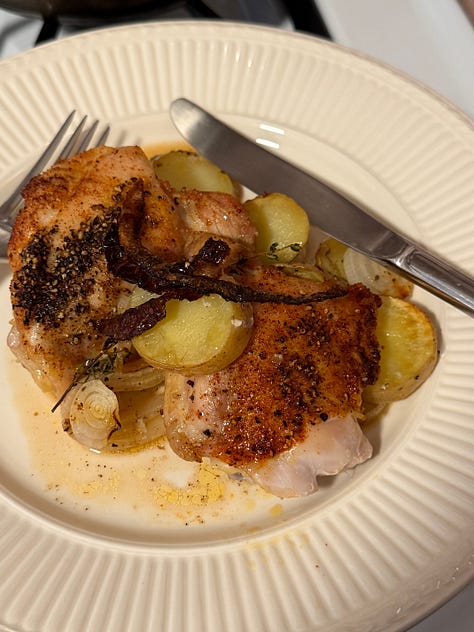
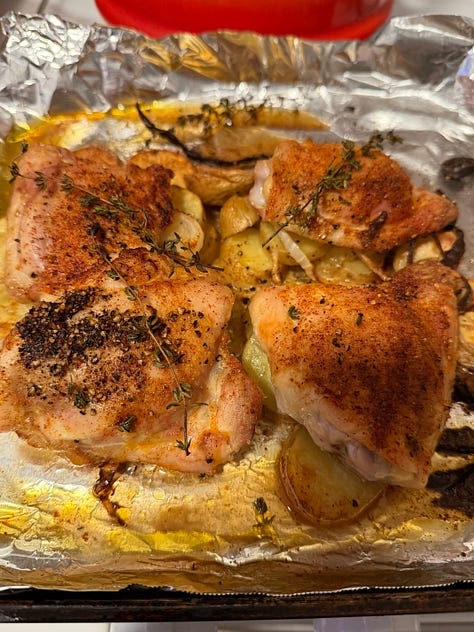
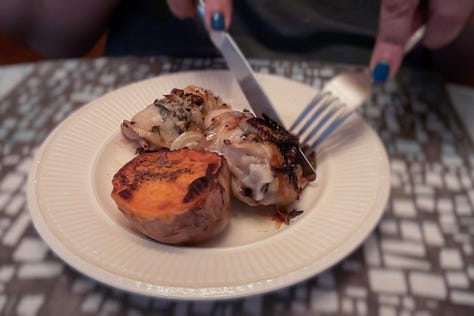
Once the rice water had settled things enough that I could think clearly again, I moved into what I call a mono diet. One protein, cooked simply. I baked chicken thighs with salt and pepper at high heat to get a proper caramelized crust — because even when you are eating what I think of as sick-person food, it should taste like something. It should taste good enough that a perfectly healthy person could sit down and eat it without complaint. That has always been my standard.
For a few days it was rice water in the afternoon, chicken thighs for dinner.
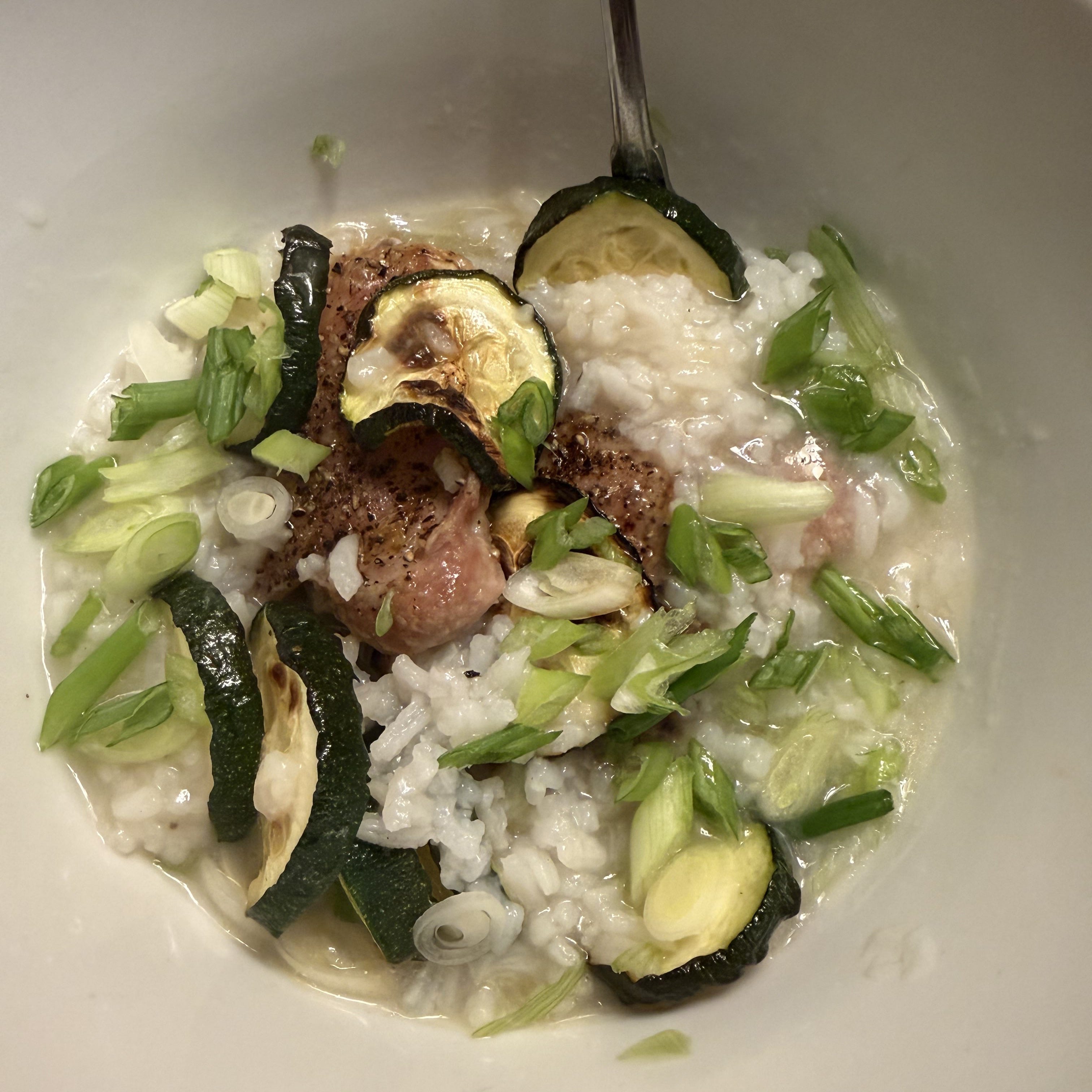
Then I added a small baked potato. Then a sweet potato. Then, a few days later, cooked zucchini, followed by a few bitter vegetables — charred radicchio. Nothing raw for several days, because cooking breaks down fibers that a recovering gut simply doesn’t need to wrestle with.
This is Ayurvedic logic: favor foods that are warm, soft, well-cooked, and easy to break down. Give the digestive system less to do, not more. I kept coming back to a thought that has always made intuitive sense to me — what do you feed a baby when you first introduce solid foods, and why? Because the digestive system is still developing, and you give it only what it can manage easily. Single ingredients, soft, warm, nothing complex. The same principle applies to a gut in recovery.
Each addition was a question I was asking my body. Can you handle this? And each day it said yes, I took the next small step forward.
As things continued to improve and my digestion grew stronger, I found myself reaching for a few extras — some peanuts scattered on top for texture and crunch. A small thing. But it felt like a milestone.
There are millions of us living with what are called diet and lifestyle diseases — conditions that developed, in whole or in part, because of how and what we have eaten and lived. What I have is that. I did not know I was creating the conditions for it. I was never taught the language that Ayurveda would later give me — the framework that explains why certain foods, certain habits, certain ways of moving through the world tax the body in ways that accumulate quietly over years and decades.
Accepting this has not been easy. I have made peace with it, but I won’t pretend I am entirely at peace with having contributed to this. What Ayurveda has given me — alongside the accountability — is the understanding that the same attention and care that created these conditions can begin to reverse them. Slowly, consistently, with knowledge and patience. The body wants to find its way back. Our job is to stop getting in its way, and to give it what it actually needs.
This is not me telling you to do what I did. What I have, you may not have. What works for my body, built over decades of this particular life, may not be what works for yours. What I am telling you is that when modern medicine hands you a bucket for a leaking ceiling, it is worth looking elsewhere for the source of the leak.
I have written before about how the body whispers before it gets loud.
Read here:
What this flare-up reminded me is that the whispers had been there. I just hadn’t been listening carefully enough. The knowledge I drew on — the rice water, the mono diet, the Ayurvedic logic of simplifying when agni is low — was available because I had been paying attention long enough for it to become fluent. None of it came from a single source. It was all of it, layered.
This is what middle age can give you, if you let it. You have more data on your own body than any doctor, any nutritionist, or any wellness influencer — especially a wellness influencer — ever will, because you have been living in it for decades. You have the patterns, the flare-ups, the recoveries, the long memory of what works and what doesn’t. That is an enormous amount of information, and most of us undervalue it completely.
Your authority on your own body is legitimate. It has been earned.
Modern medicine has real limits. Imodium is not a solution for a chronic gut condition. It is a band-aid.
When the standard answers fall short, look elsewhere — to Ayurveda, to older food cultures, to your own body’s accumulated signals.
Rice water is one of the oldest digestive remedies across cultures. It works by asking almost nothing of a depleted digestive system.
The mono diet progression — soft starches, then simple protein, then cooked vegetables, nothing raw — follows Ayurvedic logic: when agni is low, simplify.
Middle age gives you decades of data on your own body. That is not nothing. Learn to use it.
Diet and lifestyle diseases can be managed, and in many cases improved, with consistent, patient attention. Ayurveda gives you a framework to do that.
If this piece resonated — if you have ever found yourself reaching for something old and simple when everything modern fell short — I would love to hear about it in the comments.
In May, I’ll be opening a number of one-on-one Ayurveda sessions. If you have been feeling out of sync, unsure what your body is asking for, or simply ready to understand your own patterns more clearly — this is where we begin. I’ll be sharing all the details in a dedicated post soon. But if something here already resonates and you want to reach out before then, my door is open.
Also, I have finished the first draft of my book. The response from my beta readers has made me more excited about it than I dared let myself be. More on that soon.
Thank you for reading.
Namaste,

Comments
Nothing yet. Say the first thing.
Sign in to join the conversation.