
This Substack note I posted a while ago has been getting eaten up with such a visceral response from women.
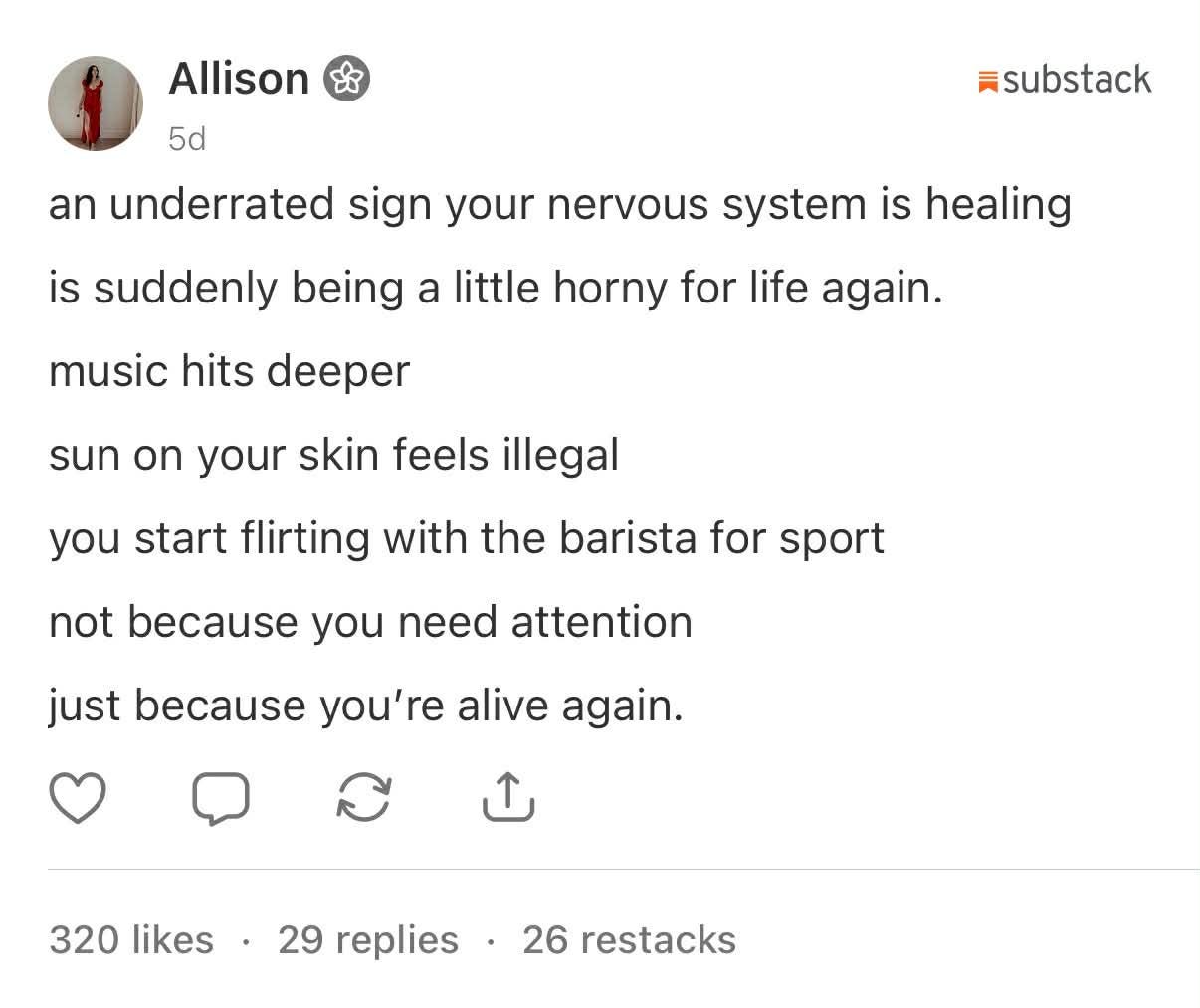
Like yesss. We want to feel sexy again. And not in the surface-level way of another wellness girlie checklist. But true horny, erotic energy for life.
A nervous system that feels safe enough, nourished enough, and curious enough to actually want to participate in being alive. To let life flirt with them.
After my notifications kept popping off on this post, I asked myself why.
For me, because this is so much of the nature of my work. After more than a decade studying the female nervous system and feminine arts, and eight years building a business in this field, I understand why women respond to this.
But what it signaled to me is that in a world where self-care and nervous system work has become trendier than ever, women aren’t just craving their spark back.
And truthfully, that’s not even what my work is for.
My work is an advanced embodiment of the foundations. For women who of depth.

Modern life dulls that instinct.
Too much optimization. Too many rules about productivity, wellness, and self-improvement.
The female nervous system was never meant to live like a checklist.
And I encourage women to stop falling into the trap of following brand-new nervous system graduates handing out protocol advice. That stage of healing is important. But depth only happens when you move past it.
I would even argue that eventually you stop identifying with being “in your healing journey” altogether.
The focus shifts toward resolution in the body and the expansion of sensation. Not just for the heavier emotions, but for beauty, curiosity, and pleasure.
Most conversations about the nervous system focus on calming down.
Regulation.
Grounding.
Reducing anxiety.
Yes, we need that.
But there’s a wellspring that often isn’t touched.
And when we don’t touch that wellspring, we miss the oceanic nature of the female body.
A woman is not just in the ocean.
She is the ocean.
And that makes a wet woman.
There is another side of nervous system health that is talked about far less often.
The ability to hold pleasure.
In neuroscience, this is sometimes described as capacity. The nervous system’s ability to experience sensation, emotion, connection, and stimulation without becoming overwhelmed.
Many women are not struggling with a lack of discipline or motivation.
They are struggling with a nervous system that has spent years adapting to stress, hyper-vigilance, emotional labor, and constant cognitive load.
When the nervous system has been living in survival for long enough, something subtle happens.
It begins to narrow the range of sensation it can tolerate.
Which means not only stress becomes difficult to hold.
Pleasure does too.
Because biologically, excitement and anxiety activate very similar physiological responses. Increased heart rate. Heightened sensation. A rise in energy through the body.
If the nervous system doesn’t have enough capacity, it will unconsciously dampen both.
This is why many women feel strangely flat even when life is objectively good.
Their body simply hasn’t had the opportunity to expand its tolerance for aliveness.
But when the nervous system begins to feel safer, something fascinating happens in the brain.
The prefrontal cortex and ventral vagal network become more active. These systems support curiosity, social connection, creativity, and emotional openness.
At the same time, dopamine pathways begin responding more easily to small sources of pleasure.
Beauty feels more stimulating.
Music feels more immersive.
Food tastes more vivid.
The body quite literally becomes more receptive to joy.
For women, this process is also deeply tied to oxytocin, the neurochemical responsible for bonding, trust, and safety in connection.
Oxytocin softens the nervous system.
It tells the body that the environment is safe enough to open.
And when the body opens, sensation returns.
This is where that horny for life energy begins to appear.
Not necessarily as sexuality.
But as Eros.
A woman who is regulated and resourced often becomes more playful. More curious. More expressive.
Her nervous system has enough capacity to experience the full spectrum of sensation again.
And when that happens, life starts to feel delicious in ways that are hard to explain but very easy to recognize.
If we’re going to talk about becoming horny for life again, I want to make a subtle distinction.
I’m not talking about the surface-level sexual liberation movement. Which honestly deserves its own essay.
I often see women who come from deeply repressed environments swing into the opposite extreme of “liberation.”
But sometimes that pendulum swing is just another trauma response dressed up with a hashtag.
That’s not what I’m talking about.
And to be clear, I’m not saying posting sensual photos of yourself online is a trauma response.
But any real liberation requires containment.
Sexual and sensual expression, in its most embodied form, is rarely loud and performative.
More often it is subtle.
Quiet.
And somehow the most powerful presence in the room.
This list of horny-for-life rituals is meant to act as a guiding post for depth.
Not another checklist.
Not another thing to optimize.
But an invitation into oxytocin-led living.
Go slowly with it.
Let it deepen your capacity to feel.
Most women have been trained to move their bodies through discipline. Steps. Workouts. Programs. Fitness goals.
But the nervous system regulates far more efficiently through organic, rhythmic movement than through performance.
This is why dancing in your kitchen, swaying to music, stretching on the floor, or walking slowly through your neighborhood can feel strangely pleasurable in a way a structured workout sometimes doesn’t.
When movement isn’t tied to improvement or achievement, the body relaxes its guard.
And when the body relaxes, sensation returns.
A dysregulated nervous system narrows perception. It prioritizes scanning for problems over experiencing pleasure.
But when the system begins to settle, the senses widen again.
You start noticing textures. The warmth of water on your back in the shower. The softness of a sweater against your skin. The smell of something cooking.
These aren’t trivial pleasures.
They are signals of safety to the nervous system.
And the more often the body receives those signals, the more it remembers that life can be something to enjoy instead of simply endure.
The female nervous system is uniquely responsive to aesthetic environments.
Flowers on a table. A beautiful film. A room that feels thoughtfully arranged. Music that makes something in your chest soften.
Beauty stimulates the parasympathetic nervous system, which is the branch responsible for rest, restoration, and connection.
It’s why women often feel more alive in spaces that are visually nourishing.
Beauty isn’t frivolous.
For many women, it’s regulatory.
A rushed nervous system doesn’t have the bandwidth to feel pleasure.
It’s too busy anticipating the next task.
When a woman slows down even slightly—eating more slowly, walking more slowly, speaking more slowly—her nervous system begins shifting out of urgency.
That shift alone can change how the body experiences the day.
Suddenly the coffee tastes better.
The sunlight feels warmer.
The moment lasts longer.
Pleasure often lives inside slower time.
One of the most powerful regulators of the female nervous system is co-regulation.
When women laugh together, share stories, or simply exist in each other’s company without performance, oxytocin rises in the body.
Oxytocin softens the nervous system.
It reduces vigilance.
It increases trust.
It allows the body to relax into connection.
And when the body feels safe in connection, Eros tends to reappear naturally.
Curiosity is one of the most reliable signs that a nervous system feels safe.
When the body isn’t in survival mode, attention begins to wander again.
You notice a café you’ve never tried.
You wander into a bookstore.
You walk down a street you usually ignore.
These small moments of exploration may seem insignificant, but biologically they represent something important.
The nervous system is no longer conserving energy for survival.
It has enough capacity to play.
Many women have been trained to keep emotional expression tidy.
But the nervous system processes emotion through movement and release.
Sighing. Crying. Laughing. Stretching. Shaking your hands after stress.
When emotion moves through the body rather than being suppressed, the nervous system completes its stress cycle more efficiently.
And when the body isn’t holding onto unresolved stress, it has far more capacity to experience pleasure.
Anticipation is deeply erotic to the nervous system.
Looking forward to a meal, a trip, a conversation, or even a quiet evening alone creates a subtle rise in dopamine.
Dopamine isn’t just about reward.
It’s about expectation of pleasure.
And when a woman regularly gives herself things to look forward to, her nervous system begins orienting toward life with curiosity again.
Sometimes the clearest sign a woman’s nervous system is repairing itself is that she starts to feel hungry for life again.
She notices beauty.
She laughs more easily.
She wants more out of her days.
In other words, she becomes a little horny for life again.

Comments
Nothing yet. Say the first thing.
Sign in to join the conversation.