
by Leah Martin
Affordable housing is a term the general public is aware of, like never been before. Everyone seems to agree that we need more of it. Another term that gets thrown around but is less understood is workforce housing? Over the last several years, when I’ve had conversations with individuals who don’t work in the housing sector, it’s clear that there’s confusion. What distinguishes affordable housing, from workforce housing, from market rate housing?
To understand these definitions, first the definition of AMI must be understood. AMI or Area Median Income is just that. It’s a mathematical output, based on census data assembled and analyzed by HUD, that identifies the median income in a geographic region. In Seattle, our Area Median Income is currently $121k. It’s calculated for each region or municipality thereby reflecting each region’s cost of living.
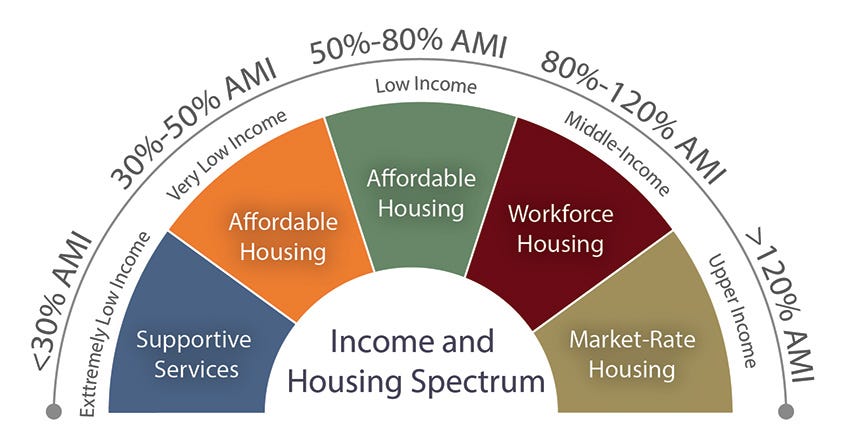
An important criterion of AMI is that a household cannot use more than 30% of its monthly gross income on residential housing costs, including utilities. A household earning 60% AMI ($72k in Seattle) must find a home where they don’t spend more than $1,800/month on housing including utilities. For those of you reading this in Seattle, you know such a home doesn’t exist. A household earning 150% AMI ($180k in Seattle) is likely to find a home since they would have a housing budget of $5,000/month. Furthermore, they could voluntarily choose to increase their housing budget above 30% since market rate lending practices allow that. Affordable housing lending practices do not.
Affordable housing is defined as housing that can be afforded by households earning between 50% - 80% AMI by HUD’s definition.
Workforce housing is defined as housing that can be afforded by households earning between 80% - 120% AMI by HUD’s definition.
Market rate housing is defined as housing that can be afforded by households earning above 120% AMI by HUD’s definition.
Now here’s where things get VERY challenging… There are almost no loan and subsidy products out there to help fund the construction of workforce housing. Historically, there was no need. Households earning between 80% and 120% AMI would be able to find a home on the MLS that they could afford. But since the average cost of a home in Seattle is roughly $900k, the average household needs to make 180% of AMI to even consider buying a home. (I share some additional Seattle specific calculations here)
Workforce households are completely being left in the lurch while the lending establishment considers how and if they can or want to retool their lending practices to offer construction loans to developers looking to build workforce housing or if they can offer down payment assistance or other typed of subsidies to buyers between 80% - 120%. For now, it’s slim pickings.
A grant or loan that is available for an affordable housing project cannot be used to serve households earning more than 80% AMI. As of this writing, I’m only aware of these three loan/grant products in our region:
For Buyers in Washington State:
The Washington State Housing Finance Commission (WSHFC) oversees a the Covenant Homeownership Program. Starting July 28th, 2025 this grant will now be available to households earning 120% of the area median income. This is down payment assistance up to $150k (potentially forgivable) intended to help people become homeowners who have been impacted by discrimination. It’s eligible to first-time homebuyers if they or their parent/grandparent/great-grandparent lived in Washington state before April 1968 and the person who lived in Washington before April 1968 is Black, Hispanic, Native American, Alaska Native, Native Hawaiian or other Pacific Islander, Korean or Asian Indian.
For Developers in Washington State:
LISC is a national CDFI that is committed to building strong and resilient communities. They have recently extended their loan products to serve up to 120% AMI for both home ownership and rental housing. They even have options for projects serving up to 150% AMI. Loan products can be found here.
JP Morgan Chase offers workforce rental housing loan products. The Workforce Housing Solutions team provides construction, rehabilitation and permanent loans to developers committed to keeping rents affordable to low- and middle-income households. At least half of a project’s units must be at least 15% below market rents.
(DM me if you know of a workforce housing grant or loan program and I will add it here).
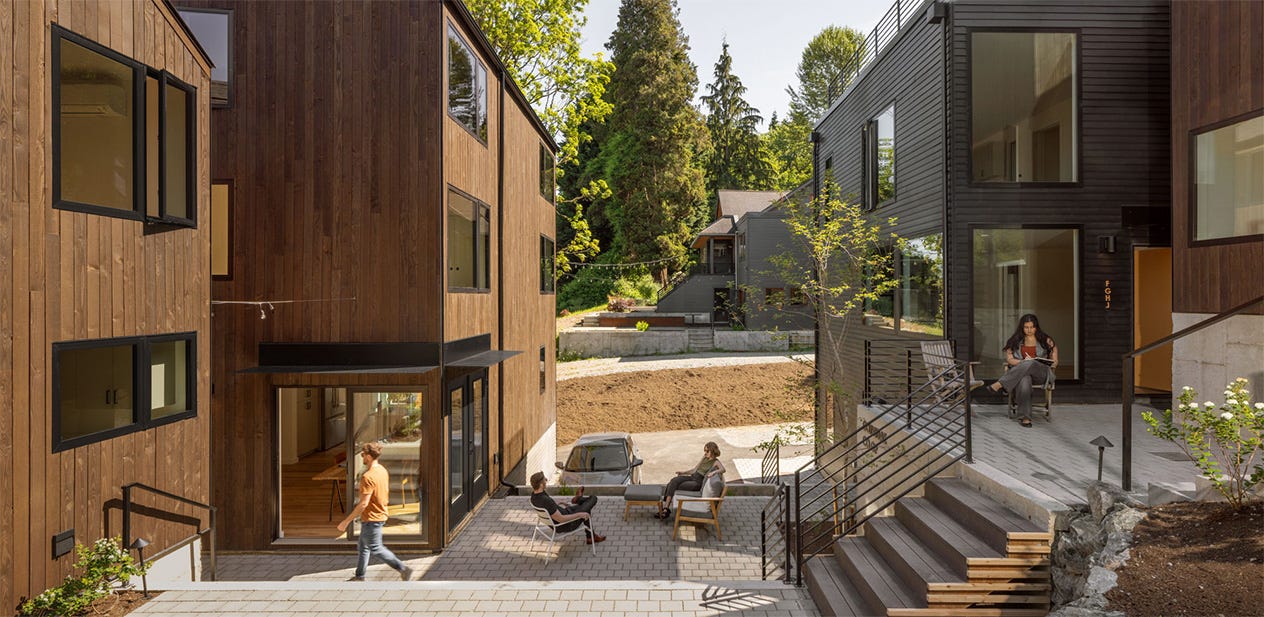
While we wait for the lending sector to step up, innovative mixed rate projects like Corvidae Co-op offer another path forward. This is a 10 home co-op. Four homes are affordable, four homes are workforce and 2 homes are very low end market rate. This technique allows developers to have a little more flexibility when establishing sales price for the homes but it can be a complicated process to navigate, particularly for small projects.
In conclusion, a critical gap remains in financing options for households earning between 80% and 120% of Area Median Income (AMI), the very group defined as the workforce. Unlike affordable housing, which benefits from established subsidies and loan programs, workforce housing lacks sufficient financial support, leaving both developers and potential buyers underserved. A call to action is needed for lenders and government agencies to expand loan products, down payment assistance, and subsidies tailored to workforce housing, ensuring that middle-income families are not left behind in the housing market.
No posts
Comments
Nothing yet. Say the first thing.
Sign in to join the conversation.