
by Barbara Busetti
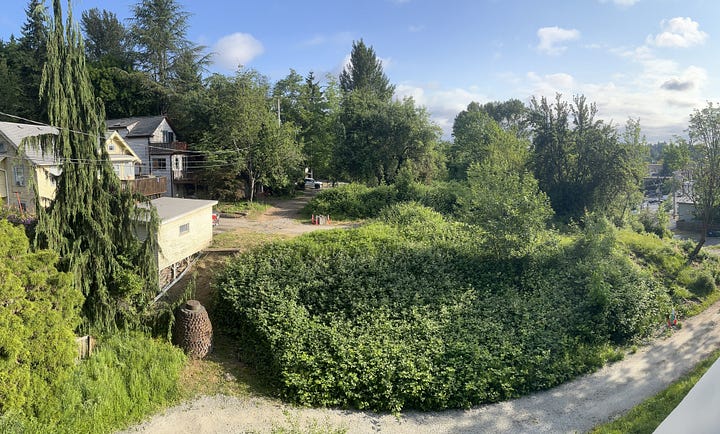
When I first bought my home, I was not captivated by its architecture or its interior spaces, honestly, the rooms were dark and awkward. I was captivated by the site: the property was located at the edge of an expansive greenbelt, and just one block from the city’s new light rail line. It was a sleepy residential neighborhood tucked into the trees where houses were spaced apart. On one side, the adjacent property was vacant undeveloped land, remnants of an old orchard that once characterized much of the slope. It was a rural landscape in an otherwise urban context; a perfect blend of both. For years, I relished the privacy of a secluded yard sheltered from view of my closest neighbors. The rhythm of nearby cars and light rail train passing would remind me that I was living in a city.
But from the very beginning, I was aware that this privacy wouldn’t last forever. The proximity of the light rail station supported the adjacent higher density “urban village” zoning, and the empty land next to me had obvious development potential. As both an architect and a housing advocate, I knew that our neighborhood would eventually have to grow to meet increased housing needs. As a property owner, I could either try to resist that change or get involved and help shape it.
When my neighbor told me he wanted to sell this vacant land next to me, I helped my business partner and fellow architect purchase it. We set out to think through a thoughtful development that would serve as a model for a new housing typology, but which also fit sensitively and contextually in its neighborhood.
It would be dishonest to say I wasn’t anxious. Despite my relationship with the project, and having some influence, I had concerns about what a new, denser housing project next door would bring for me personally: loss of privacy, more noise, parking headaches, and simply more people sharing the space I’d grown to love in its quiet state. My neighbors all shared similar concerns about the project.
Broadly speaking folks assume that greedy developers push to maximize profit at the expense of the rest of the neighbors. That development in general has become synonymous with greed is not entirely without reason, but the “greedy developer” outrage quickly unites all neighbors under the guise of “fairness” and often precedes any understanding of a project or the context of the current housing crisis context.
The instinct to protect “our property” is strong. Private property is the very definition of the American dream. And trying to anticipate change that we cannot yet see and cannot control evokes a lot of uncomfortable emotions. We assume the worst and miss the opportunities.
Knowing change can be hard-especially for neighbors that have lived in this area for more than 30 years-we shared our development plans early in the process. Sometimes this “community engagement” step is a requirement of the permit process. In our case we volunteered, as we believed that by providing context, sharing project goals, and offering some transparency, we could help mitigate some of the worst fears. Neighbors were invited to see the site and review the design drawings. We listened to their concerns, were honest about challenges, and offered them the unique opportunity to invite their own friends and family to become new neighbors themselves.
This effort connected neighbors with each other, introduced new ways of thinking about the development, and went a long way towards building trust, modeling the very type of community the project hoped to inspire; informed, compassionate, inclusive, and collaborative.
We found that most neighbors were less angry after this process, and some even became allies.
Despite my own trepidation, I also had pride in supporting the development next door. I found that by watching the structure take shape, each phase of construction revealed the project in stages and gave me some time to adjust; the clearing of the land, the grading and excavation, the framing, the finish materials, the paths and landscaping, the open house event. Each reveal added depth and reduced the unknowns. Eventually, I was meeting new neighbors, new first-time homeowners, that were as excited to live in our unique neighborhood as I had been twenty years ago.
It has been more than a year since the project next door was completed. I know all my new neighbors by name and their dogs. I have been invited to holiday parties, community message boards, neighborhood meetings, and work parties.
Like me, my new neighbors have all become advocates and stewards of our neighborhood. They share my interest in its history and share our pride in caring for this place. We all pull weeds, we all help pick up random trash, and we all provide an extra layer of safety and security that comes with more “eyes on the street.”
Most importantly, I’ve gained the richness of a community filled with people of diverse cultures and all stages of life; the joyful sounds of kids playing, someone strumming a guitar outside. What I feared would be a loss of privacy has become a sense of belonging, with spontaneous greetings, smiles, and waves from new neighbors.
There are a few aspects of this project that set it apart and made all the difference. First, we committed to an affordable homeownership model as its foundation. Homeownership is one of the most powerful ways for individuals and families to establish stability and grow equity, so the project itself supports people to thrive in life. By ensuring that our new neighbors own their homes, we cultivated a shared investment — both financially and emotionally —in caring for their properties as well as the surrounding community spaces.
Second, the project relies on a model where certain spaces and amenities are shared; sharing being one of the most important mechanisms for ensuring its affordability, and a sense of community was baked in its design.
Third, the design is beautiful, the massing is big but respectful of its context, the common spaces are contained but generous, and the exterior finishes are simple but elegant. The residents and neighbors alike appreciate how the architecture is dignified and timeless.
Designed to foster community, the higher-density project next door is now a welcome part of the neighborhood and a development that the original neighborhood now agrees is worth supporting.
Yes, change is uncomfortable. And some concerns are absolutely valid. But remember too that all change, in time, becomes the new normal. It’s easy to forget how our own home once imposed big change on someone else! So much so that when my newest neighbors recently heard news of a potential new project next door to them, they started to worry: how would a higher-development project next door affect them?
It is natural that they might be concerned about the next layer of development, but it is also ironic and paradoxical.
The best way to feel some agency in the process is by getting informed and getting engaged. Find out what population growth is projected for your county. Find out what your city’s current new housing targets are. Confirm the zoning for your area and what development is possible. Identify your specific concerns and consider solutions that could make a positive impact for all. Advocate for thoughtful design of outdoor spaces. Developers are reluctant to engage with neighbors when there is zero support for their project. But small concessions or win win solutions to bigger disputes, is something most local developers will consider.
Most importantly, cultivate ways to welcome new people to your neighborhood. Introduce yourself. Set up play dates. Encourage other neighbors. Throw a block party! After all, a community is defined by its people, not its property.
It is true that the negative impacts of development are more tangible –more people, more cars, less trees, etc. —while the advantages are more intangible— added security, added investment, new relationships, and allies with a shared interest in the place we live. When we zoom out, we see how our individual interests relate to a much bigger web: feeling connected and relevant within a community is critical to our general sense of belonging.
I’ve come to see land not as something to be controlled in exclusive isolation, but as something that exists in relationship with everything around it. Learning how to share it sets us free to learn other things. It may not feel intuitive at first, but practicing compassion, patience, courage, and even curiosity turns out to be good for us, as well as others.



For more about our housing crisis, see:
More Affordable Housing in Seattle NOW!
For more about our affordable homeownership model, see:
Allied8 Innovates New Housing Typology to Help Solve Affordability in Seattle
No posts
Comments
Nothing yet. Say the first thing.
Sign in to join the conversation.