
Sunset Boulevard (1950) is one of the most highly regarded films of the twentieth century, famous for its director, Billy Wilder (1906-2002); for its cast, headed by Gloria Swanson (1899-1983) and William Holden (1918-81); and for a clever script that embraces both horror and humor.
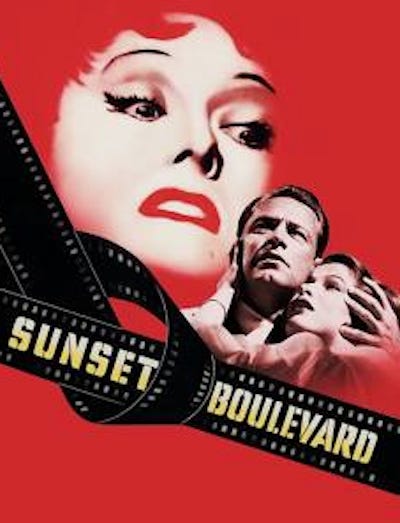
Above: Swanson, Holden, Nancy Olson (1950)
Sunset Boulevard was nominated for eleven Oscars, including best picture and best director. Both Swanson and Holden were nominated, as were their co-stars. The movie won in only three categories, however: Story & Screenplay, Art Direction (Black-and-White), and Music Score. The competition for Sunset Boulevard was very strong, with All About Eve taking most of the year’s honors (Lubin, pp. 210-13). That film too is about an aging star, with Bette Davis in the title role.
All About Eve is still, I believe, the only film in which two leading actresses (Bette Davis and Anne Baxter) and two actresses in supporting roles (Celeste Holme and Thelma Ritter) were nominated for Oscars. None of them won, but George Sanders did get the Oscar for best supporting actor in All About Eve. Marilyn Monroe also appeared in that film, which could have been called All About Women.
At the center of Sunset Boulevard is Norma Desmond, a retired star desperate to make a comeback. In this movie, art imitates life. Gloria Swanson came out of retirement for the role. She had a tremendous past, having made some 46 movies before Sunset Boulevard (many of them silent). The last one, Father Takes a Wife, had been released in 1941.At that point she had not made a film since 1934, so Father was regarded as a comeback. According to David M. Lubin, Swanson made “four or five comebacks.” She was fifty when she appeared Sunset Boulevard, which he calls “the greatest comeback in film history” (p. 21). The movie gave her a future, including television and radio.
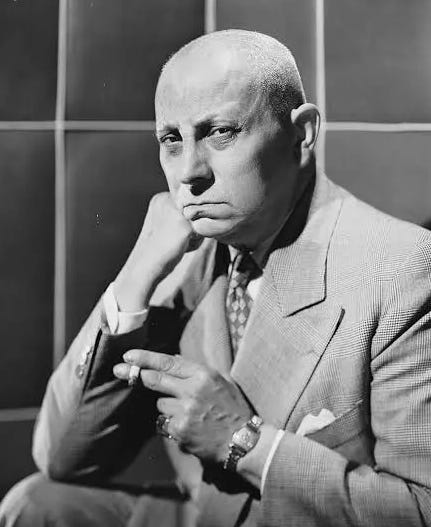
An actor with a similar profile was Erich von Stroheim, who had had a distinguished history as both performer and director. With Queen Kelly (1929), he helped to make Swanson a star (Brody). Stroheim plays Max von Mayerling, who is Desmond’s butler, driver, and former husband. By accepting a secondary role in Sunset Boulevard, Stroheim underscored the end of his power and influence. But in the film he still evokes authority. As her driver, Max steers Norma, just as he did as her director. Max also steers us as he mediates Norma’s delusions.
In Sunset Boulevard, two figures on the way up emphasize the decline of the two stars. One of them is Joe Gillis, Holden’s character. A screenwriter down on his luck, he’s broke and behind in his rent. His car is about to be repossessed, no small inconvenience in Los Angeles. When the finance men arrive, he drives to the Hollywood hills, with the finance men in pursuit. By accident, Gillis arrives at Desmond’s palatial but decrepit home.
“You there!” she calls out when she sees him. She and Max are about to bury her dead chimpanzee. She thinks Joe has come to help with the funeral. Some commentators have suggested that she will adopt Joe to replace her lost pet, making Joe, as Lubin rakishly puts it, a chump who takes the place of a chimp (p. 161).
After several visits, Joe, who is easily manipulated, becomes Norma’s gigolo. His attempts at independence and self-assertion are feeble. He understands that he is a kept man, patronized by salespeople who know that “the lady” pays for everything. Norma is working on a screenplay; Joe says he can help her. He moves into her guesthouse and then is moved into her bedroom. He tolerates Norma’s many eccentricities and affectations but at the same time strikes up a friendship with Betty Schaefer (Nancy Olson), a screenplay reader.
Joe and Betty begin working on a screenplay together, meeting secretly at night. Joe drives Norma’s car to these working sessions, and she is enraged to discover that Joe is two-timing her. She calls Betty to set her straight. Overhearing Norma’s side of this conversation, Joe invites Betty to the mansion. Once there, Betty discovers that Joe is also two-timing her and that he is a kept man.
Betty was about to marry her fiancé, Artie (a very young Jack Webb, 1920-82), but she has fallen for Joe, and Artie is now second choice. Betty breaks off their engagement, but we already know she will not end up with Joe because Sunset Boulevard does not end well for him. The first moments of the film show him face down in Norma’s swimming pool. He narrates events from the other side of the grave.
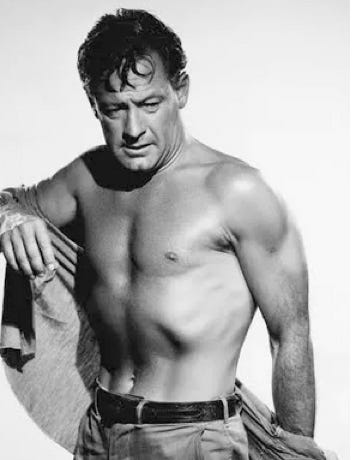
Holden dwells on the margins of the film, even though he narrates it. Sunset Boulevard seems to belong to Swanson and Stroheim. Holden had made many films before Sunset Boulevard, but he became an important leading man only after this movie. In “Sunset Boulevard”: Ready for My Close Up (2025), David M. Lubin dismisses the pre-Sunset Boulevard Holden as “a washed-up nobody” and less than a has-been. In 1949, when the film was made, Holden “was essentially a never-was,” Lubin writes (p. 135). One wonders how Holden ended up in the film, which, as Wilder’s project, had aroused much interest. (Below: Holden, Picnic, 1955; much discussion about his shaved torso.)
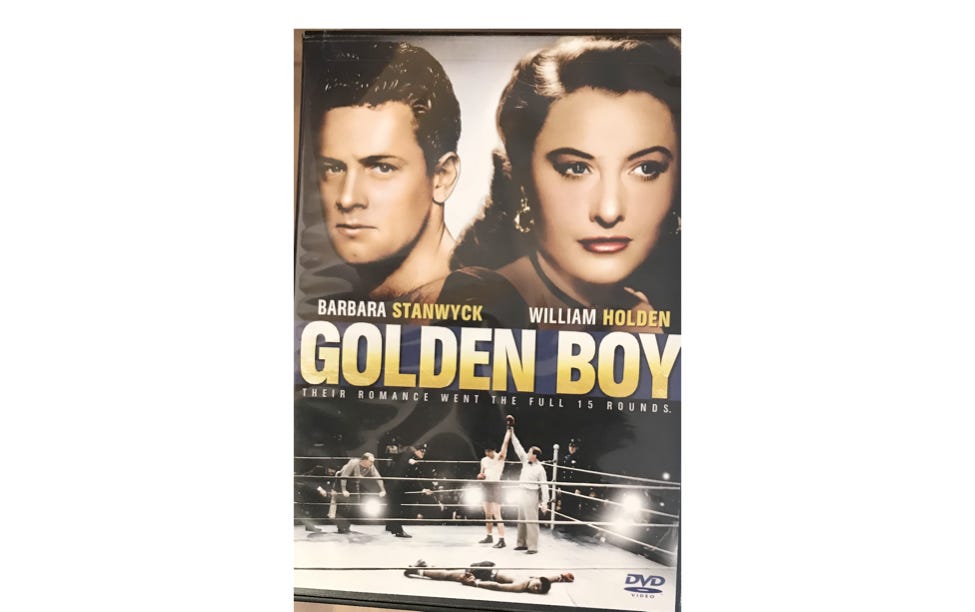
Holden had made one significant film before Sunset Boulevard, and that was Golden Boy, a 1939 boxing movie with Barbara Stanwyck and Adolphe Menjou. Rouben Mamoulian, the director, saw Holden by accident in another actor’s screen test and invited Holden to take his own screen test. Many well-known actors had passed on the role, which Mamoulian gave to Holden.
In Golden Boy, Holden, as Joe Bonapart, played opposite Stanwyck, as Lorna (seen below). Holden lacked confidence and experience, but Stanwyck patiently coached and encouraged him. He had to learn to look like he cold play the violin and that he could box, since Bonapart is a promising violinist who starts to box because he can make more money with his fists than he can with his fingers. His family fears that he will ruin his hands if he fights, but nobody can dissuade him from getting into the ring. Lorna provides the encouragement that the he needs to pursue boxing,
Holden knew about family disapproval, since his family did not want him to pursue acting or to make movies. Like Joe, Holden was notorious for doubting himself. During the filming of Golden Boy, Stanwyck did for Holden what Lorna does for Joe. But Holden never lost his tentativeness. When Wilder interviewed Holden for Sunset Boulevard, he decided that “Holden was perfect for the role of Gillis” chiefly because he lacked confidence. Actors have been typecast for many reasons, but few would want to admit to being chosen for a leading role because they didn’t believe in themselves. To know Bill Holden, Wilder told the actor, “was to know Joe Gillis” (Lubin, pp. 135-36).
However, Holden was far from Wilder’s first choice. That was Montgomery Clift, “exquisitely handsome,” Lubin calls him, “and a fast-rising star” (p. 128). Clift was worried about what a film about an attractive young man dating a much older woman might do to his career. A succession of famous names also passed on the role, for Clift’s reasons and others. They included Fred MacMurray, Gene Kelly, Burt Lancaster, and Marlon Brando.
The pivotal figure in Sunset Boulevard is Betty, the screenwriter played by Olson. Betty is a woman who, like Norma, prefers the artificiality of Hollywood to reality. But unlike Norma, Betty never confuses the two worlds. She functions as the star’s opposite, sensible, pragmatic, and effective. Early in the film, Betty pans the screenplay Joe has submitted. Like Joe, she is “enraptured” by movies. As she and Joe look at an urban movie set, she says, “All cardboard, all hollow, all phony, all done with mirrors.” But then she adds, “I like it better than any street in the world” (Lubin, p. 191). The early shot of Holden face down in the pool was done with mirrors (Lubin, p. 151; below, Nancy Olson in Battle Cry).

Betty wonders if she played on the urban set “as a kid.” Joe asks her where she is from, and she says that she “was born just two blocks from the studio, right on Lemon Grove Avenue. My father was an electrician here until he died. Mother still works in Wardrobe.” Movies are Betty’s blood and bones. For her, movie magic is better than reality, but she does not regret that she failed to have an acting career. She is satisfied to be on “the other side of the camera,” as Lubin puts it (p. 191). Betty has no illusions about the power of illusion.
Released in 1950, Sunset Boulevard was nominated for eleven Oscars, including best picture and best director. Both Swanson and Holden were nominated, as were their co-stars. The movie won in only three categories, however: Story & Screenplay, Art Direction (Black-and-White), and Music Score. All About Eve took most of the honors (Lubin, pp. 210-13).
To explain this disappointing result, film historians point to the film’s view of Hollywood, which some think was cynical and bitter. Lubin writes that the movie “treated movie glamour as an illness, a social sickness, an addiction” (p. 202). But it isn’t Hollywood itself that works the movie’s destructive mischief; that is done by aging and Hollywood’s fear of its effects on stars and also on moviegoers, a factor to this day. Age is Norma’s enemy and the enemy of Max as well. Joe isn’t as old as they are, but he too feels that his time is running out. That’s why he is preparing to return to Dayton.
The movie’s last line is one of the most famous lines in the history of film. The entire film is about Norma’s preparation for a movie in which she imagines she will star. She has misunderstood everything that has gone on around her. Desmond gets a call from her long-time studio and wrongly assumes that she is being invited to star in a film based on a script she had sent to her hero, Cecil B. DeMille. Her script is about the biblical Salomé. When the studio’s call comes, she believes it was prompted by her script. She thinks that her comeback has begun. Bits of Richard Strauss’s 1905 one-act opera Salomé are heard in the score, suitable music for this tremendously operatic movie (Lubin, p. 196).
When she can’t get DeMille on the phone, Desmond goes to see him, expecting to be received as she was in her glory days. When she arrives, DeMille is polite, even warm, but careful not to say anything about her script. We learn that Paramount called her because the studio wanted her car, not her. She owns a rare Isotta Fraschini, a luxury model that went out of production in 1949. When her visit is over, Desmond does not realize that she has come away with nothing. Instead, she is alive with excitement and believes she will star in a new picture about Salomé.
Joe is in the opposite mood. He realizes that he has no future in Hollywood and tells Norma that he is going back to Ohio. He walks out of the house. She is furious and follows him, then shoots him three times. When police and press arrive, she sees only cameras and reporters and forgets about Joe. At last, she thinks, the press has arrived to publicize her comeback. The cameras roll and reporters jostle. She is thrilled. Looking ghoulish in heavy makeup, Norma walks down a staircase lined with servants and aides, all of them stricken by her delusion. She faces the camera and says, “All right, Mr. DeMille, I’m ready for my close up.” As she approaches the camera, the film blurs and ends. (Below, Swanson delivers Norma’s famous line.)
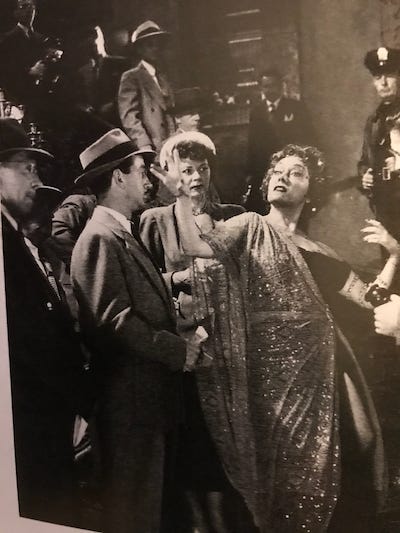
To link the lives of the actors to their roles in Sunset Boulevard seems to have been Wilder’s plan. Swanson, at that point a retired actress, really did think that she was about to make a comeback. William Holden was chosen for the role of Joe because, like Joe, he was down on his luck and looked it (Lubin, pp. 135-36). This matching extends even to Betty, played by Olson. She was a student at UCLA when she was cast, chosen because she was a new face and because, as an academic, she could pass as a writer in the film.
Some actors in the film play themselves, as do both DeMille and gossip columnist Hedda Hopper. Making cameo appearances and seen as bridge players, not as themselves, are faces once familiar from silent films, including Buster Keaton, H. B. Warner, and Anna Q. Nilsson. Joe calls them Norma’s “waxworks,” as if they were museum pieces (Lubin, p. 166). Also seen in the film are actors who were new then and who, today, are better known as faces than as names: Nancy Olson, Jack Webb, and Fred Clark. All three had significant careers in television but today they too are museum pieces (see Lubin, pp.152-53 on Clark; pp. 190-92 on Olson; and pp. 178-79 on Webb.)
Sunset Boulevard was released in 1950, in what is seen as the last stage of Hollywood’s role as a so-called “dream factory.” For decades Hollywood had been the source of escapist movies, which was its role during the Great Depression and World War II. It is said that during the war some 90 million people went to the movies every week—that is, about half the population (that figure dropped when television sets appeared). They enjoyed movies about success and hope, movies with humor and also with patriotic steel. They enjoyed the fantasy available to them when they were sitting in the dark; they escaped into illusions.
Sunset Boulevard suggests that there is no escape, even in the movies. The escapist is Norma Desmond, whose every passion—her desperate love for Joe; her sad conviction that she is going to make a comeback, or, as she calls it, “a return”—depends on ignoring the real world, a world in which a silk-lined casket for a dead monkey seems ridiculous as well as sad.
Betty is practical, even ordinary, and satisfied to be on the side of reality, behind the camera. Norma can’t imagine standing there. People behind the camera produce illusions but see through them. Having left movies behind, Norma struggles to create cinematic illusions on her own. But her anger and violence undercut that passion. She killed Joe. Her lawyers will mount a legal defense of insanity. She might get away with murder, but there can be no “happily ever after” for her. Incarcerated, she might imagine that she is in front of a camera; it will be harder for her to imagine that there is somebody behind it to preserve, say nothing of watch, her performance.
Max, Joe, and Betty have always been behind the camera. They are realists, not escapists. They live in the light, and the light is harsh. Norma does not realize that, having retired, she has become part of the audience, one of “those wonderful people out there in the dark,” as she puts it.
“We didn’t need dialogue,” she says, scorning modern films with sound. “We had faces!” Norma is in the dark in every sense, living in a dark house and staring at a dark future. She forgets that the face she had as a star is not the face she has now. She thinks she is ready for her close up, but she’s wrong. Nobody wants to see her face any longer, or for that matter, to hear her voice. Minus both her chimp and her chump, Norma’s only friends are Max and the dark that is enclosing her.
January 2026
Comments
Nothing yet. Say the first thing.
Sign in to join the conversation.