
Carson McCullers was known for telling people she had just met that she loved them. In her memorable novel, The Ballad of the Sad Café (1943), the central character, Amelia Evans, seems to have the same problem.
McCullers wrote about what Virginia Spencer Carr calls “a striking group of oddballs and misfits” from the South. McCullers’ themes include “alcoholism, cross-dressing, and mental illness” (p. 4). These themes are also found in the author’s life and in her works. In The Ballad of the Sad Café they get mixed into McCullers’ unconventional ideas about love and her equally conventional use of boxing to settle marital difficulties.

In The Ballad of the Sad Café, Amelia Evans and her husband, Marvin Macy, are at war, as lovers in McCullers’ works usually are. Events in the novel illustrate, perhaps too schematically, McCullers’ thesis about love and antagonism, which holds that “the beloved hates the lover,” who is “forever trying to strip bare his beloved” (p. 458). Those who are loved have power over those who love them.
In the myth-laden world of The Ballad of the Sad Café, we see that love is a curse. Amelia, the beloved, is doomed to hate and abuse the lover. Macy, the lover, is doomed to disappointment and isolation. The lover wants to share in a union; the beloved wants to dominate it.
The Ballad of the Sad Café introduces a third figure, a hunchback dwarf named Lymon Willis, to whom both Amelia and Macy become attached. Each of the three characters is a beloved at one point and a lover at another. Like characters in myth, they are manipulated by forces outside their control. Born into unhappiness, they are fated to die unhappy. This scenario, I believe, captures McCullers’ view of life. (Images are from the 1991 film of The Ballad directed by Simon Callow.)

Vanessa Redgrave as a boyish Amelia in the film
Macy once loved Amelia. He admired her for two years and she agreed to marry him. He had a terrible reputation, but love changed him and “reversed his character,” improving him “in every way” (p. 420). We don’t know why a woman who “cared nothing for the love of men” would marry one, but Amelia did (p. 398). “For the love of men” means that Amelia had no interest in loving men, or in being loved by them.
Nobody knows why she agreed to get married, but two explanations are offered. Perhaps she wanted wedding presents (she is very greedy); or perhaps her aunt nagged her (p. 421). But we should also note that Macy is “the handsomest man in this region.” Amelia is tall and dark, “with bones and muscles like a man.” She has short, unkempt hair and a sunburned face, “sexless and white,” with “a tense, haggard quality.” Her gray eyes are crossed (p 397). She is usually dressed in gumboots and overalls (p. 398). She is not cut our for romance. She is not happy being female.
On the night of their marriage she spurns Macy, marching downstairs from their bedroom and going to work at her desk. Amelia is intensely private, and we can infer that she is outraged by his expectation of sex. We learn later that she can doctor many ills of the people in the area but will not treat those with “a female complaint.” (p. 409). “At the mere mention of the words” her face wold “darken with shame,” perhaps because sex organs confirm that she herself is female.
The following nights are the same. She moves her bed downstairs and rejects the presents Macy brings in an effort to win her over. After three days, seeing what he takes to be her hatred, Macy leaves. He takes up a life of crime. She hears about his exploits and feels justified in her decision to get rid of him. She has driven off her lover and returned to her busy and productive life. He has sworn to take revenge. Her sex-related shame ceases to matter in the diversion his behavior supplies.
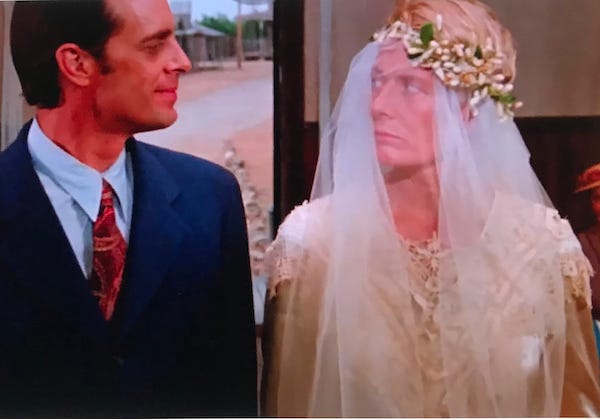
Keith Carradine as Wlliam Macy, Redgrave as the unhappy bridal Amelia (1991)
When a new man, the dwarf Lymon, appears (out of nowhere, it seems), Amelia changes. Busy untying knots in a rope, she pays attention. In myth, rope represents fate. In Die Götterdämmerung, the last work in Richard Wagner’s Ring cycle, the three Norns— Past, Present, and Future—weave the destiny of the world from the roots of the sacred ash tree. I suggest that, in a quiet way that is not at all coincidental, Germanic myth shapes McCullers’ narrative. Wagner would be no stretch for her; she was an accomplished musician.
The main business of Amelia’s town is cloth-making. Macy is, by trade, a loom fixer. The town is full of looms. Even at midnight, we hear “the faint, steady hum of the looms” (p. 399. They are like fate, always present, seldom noticed. Greek myth spells out the course of fate, from birth to death. The Three Fates of Greek myth, the Moirai, are in charge of the loom. Clotho spins the thread at birth; its length—the span of life—is measured by Lachesis; death, when the thread is cut, is the realm of Atropos.
Amelia looks Lymon over when he walks up to the store. She steps off her porch to touch his deformed back. Then she offers him a drink from her own bottle of her own whiskey. Never known for generosity or warmth, Amelia later serves him coffee and cooks for him. His presence softens her formidable reputation as a miser who trusts nobody.
The dwarf claims to be Amelia’s blood relative. Despite her suspicions about this assertion, she is drawn to him and soon she has “the lonesome look of a lover” (BSC, pp. 414-15). Formerly anti-social, violent, and supposedly indifferent to men, Amelia doesn’t quite fall in love at first sight, as McCullers seems to have done, but it’s close. She becomes a lover who is subject to the rules of the lover-beloved game.
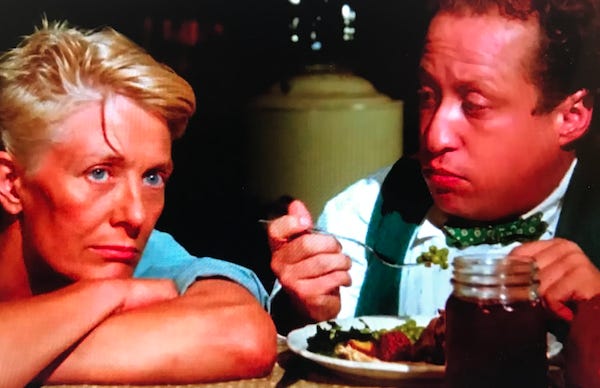
Amelia with Cousin Lymon (Cork Hubert), 1991
Love improves Amelia’s behavior, just as it improved Macy’s. She becomes less abusive and less exploitative. She takes tender care of Lymon when he becomes ill. He is afraid of the dark; she comforts him. Curious people come to see Lymon. They believe that Amelia will soon discard him, but this hoped-for drama does not materialize. The people conclude that Amelia and Lymon have found “satisfactions of the flesh” and see them as lovers (p. 417).
Time passes, as time must, giving us “an image of these years as a whole,” the narrator says (BSC, p. 416). We are learning about things that “happened long ago,” a phrase that hints at the fairy tale element in The Ballad. Amelia’s marriage to Macy was her “only personal contact, before the hunchback came to her, with this phenomenon—love” (p. 418). Amelia is unprepared to deal with love as either lover or beloved, but she and the dwarf live happily. They are not married; nobody objects.
One morning, Henry Macy, Marvin’s brother, reports that his brother is out of the penitentiary and will return. “The face of Miss Amelia was very dark” when she heard this, but Lymon is excited by the news and asks many questions about Marvin’s life of crime. His curiosity will grow. Macy makes Lymon aware of the larger world. Macy has been to Atlanta, he has been in a penitentiary, and has had many adventures (p. 441). Lymon’s attraction to Macy, then, is not necessarily about the power of love.
Late one day, a truck stops in the town and a man jumps off. He is, of course, Marvin Macy (p. 436). Amelia is away on business, but Lymon is home. She had asked him seven times to come with her on business, but to no avail. She doesn’t want him around when Macy arrives. Seven is Amelia’s favorite number, a number with resonances of religion and spirituality that touch the novel’s mythic foundation (p. 452). The townspeople have gathered at her house around the barbecue pit she had dug when the weather turned cold. She had a big hog killed, supervised the feast around the pit, and then left on business. The ceremonial sacrifice and subsequent feast are parts of many myths.
When Amelia returns, she discovers that Macy is back. He stands on one side of the pit and Lymon on the other. Like all the townspeople, she stares at Lymon, who is making facial contortions and “smiling at Marvin Macy with an entreaty that was near to desperation” (p. 438). In the serendipitous mode of the tale, Lymon has fallen in love with Macy. We should not forget that he has a self-interested motive, i.e. his longing to see the world Macy knows. Macy is contemptuous. As he watches the dwarf, Macy asks, “Is the runt throwing a fit?” Then he knocks Lymon to the ground. Nobody has ever harmed the dwarf, and the people wonder what Amelia will do to avenge this act.
Macy was once the powerless lover of Amelia. Now he is the powerful beloved of Lymon. Macy uses his position to destroy Amelia. As Lymon rhapsodizes about him, Macy “crowded into Miss Amelia’s home.” She tries to poison Macy, but she accidentally takes the poison herself and gets sick (p. 444).
Macy continues to abuse Lymon, who waits on Macy when he visits the café. When this happens, Amelia stands before Macy, her fists clenched. “Marvin Macy would also clench his fists and they would walk slowly and meaningfully around each other” (p. 445). They are ready to spar; at last, boxing!
Amelia rigs up a heavy bag in her yard, a “crocus sack tightly stuffed with sand.” She boxes with it every morning. “Already she was a fine fighter,” we are told. She is “a little heavy on her feet, but [she has] all manner of mean holds and squeezes to make up for this” (p. 448). In anticipation, she and Macy hold their fighting stances for a longer time each night (p. 450).
As boxers, they are evenly matched. Both weigh160 pounds, but Amelia is one inch taller. The townspeople are confident that she will defeat Macy. That is partly because, in addition to her fists, Amelia tries to terrorize her opponents by making faces and frightening noises. Amelia is an experienced but dirty fighter and the people think this gives her the advantage.
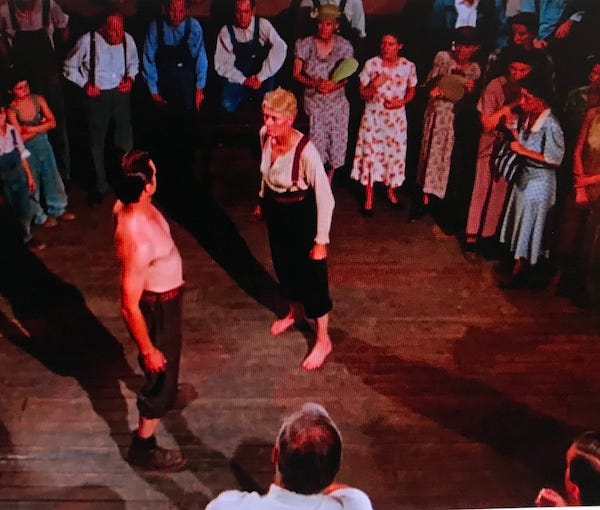
William Macy and Amelia Evans square off in the ring (ring of people, that is). 1991
They fight on Ground Hog Day, a point in the cosmic transition from Winter to Spring. To prepare for the fight, Amelia hits her heavy bag and Macy greases himself with hog fat. The boxers dress alike, in trousers with the legs rolled, Macy bare to the waist. Held in the café, the fight begins at 7 p.m. because seven is a magic number for Amelia (p. 452). Lymon watches the events from a perch.
Macy was “greased and slippery, tricky to grasp,” the narrator says, “but she was stronger.” She “bent him over backward, and inch by inch she forced him to the floor,” their “deep hoarse breaths were the only sound in the café.” She puts her hands on his throat, ready to kill him.
But “the instant Miss Amelia grasped the throat of Marvin Macy the hunchback sprang forward,” sailing through the air like a hawk. He lands on her back and puts “his clawed little fingers” around her neck. She sprawls on the floor. Macy stands over her and is now smiling. Lymon quickly disappears (p. 454). Revived when somebody splashes water on her, Amelia retreats to her office and sobs (p. 455). The townspeople disperse without saying much.
The boxing match is an attempt to settle the old score. If it had been a fair fight, Amelia would have won. But she lost. Formerly dominated by Amelia, who was once his beloved, Macy now uses Lymon, her beloved, to humiliate her. Macy has had his revenge, winning the boxing match and breaking her spirit.
Macy and the hunchback go off together, “the two of them” (p. 455). They prove to be poor winners. Having triumphed, they plunder Amelia’s treasured curios, destroy other things of hers, and wreck her whiskey still. They also season her favorite dish with poison.
The Ballad of the Sad Café is powerful not only because it is full of “oddballs and misfits” and customs, such as cross-dressing, that point to McCullers, but also because it hints at archetypes and ancient beliefs that would seem dogmatic if they were spelled out. Albert J. Griffith notes a few of them. He likens the handsome Macy to a Greek god and describes him as “a country Orpheus” with a guitar. Macy is also a man possessed of “demonic degeneracy.”
In a similar vein, we can see that Lymon has the agency of Teutonic figures such as Loki, the Norse god and mischief-maker; he dresses “like a little king.” This is possibly another medieval reference. I don’t know if McCullers was aware of medieval folklore about King Herla, who is described in some sources as a dwarf and in others as a king who bargained with a dwarf who claimed to be “a little king” himself.
Griffith suggests that Amelia is as “strong and domineering as an Amazonian queen” but also “a great healer.” After her defeat, however, Amelia changes everything about her business and her relationships with the townspeople. She raises prices in her store. She refuses help with cleaning up the wreckage Macy and the hunchback left. She ceases to tend to the medical needs of the others. Her benevolence has vanished. She loses weight and stops taking care of herself (pp. 456-57).
Her willpower gone, Amelia sits on her front porch every night for three years, waiting for the hunchback to return, as, in a fairy tale, he would. Finally she hires a carpenter to board up her store. She retires to live inside it. The town is dead and she is nearly dead. Nothing more will happen, and, the narrator says, you might as well go down the highway “and listen to the chain gang” (p. 457). There is more entertainment there than there is now at the café.
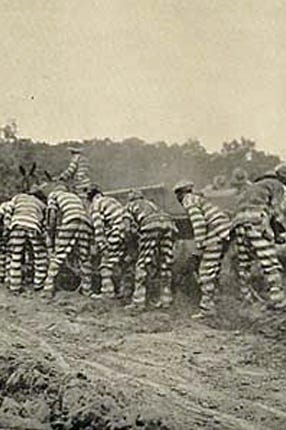
A Georgia chain gang, perhaps from the 1930s
McCullers’ coda about a chain gang is called “The Twelve Mortal Men,” a title with mythical and biblical resonance (twelve apostles, twelve labors of Hercules). The prisoners sing a glorious song, “both somber and joyful.” The music seems to come from the earth and from the sky, not from humans. It is an elemental sound that embodies the power of nature. Those who hear it will “grow cold with ecstasy and fright.” Yet this music comes from white and black “boys from the country,” from “mortal men who are together.” Whatever their deprivations, they are in harmony with the natural world and with each other.
Wearing prison uniforms and guarded by a man with a rifle, these “mortal men” exhibit vital qualities that Amelia lacks. Her final gestures complete her isolation. She retires to “those closed rooms” where she “has remained ever since” (p. 457). Hers is a living death. Carson McCullers, on life-support for the last week of her life, also had a living death (Dearborn, p. 408).
The conclusion to The Ballad of the Sad Café is appropriate for a fairy tale that reverses traditions often associated with the genre. Amelia is a princess who is content in her tower. She has driven away her suitors. She does not want a shining knight. Looking out from her tower window, which is how she is seen on the first page, she is pitiful, cross-eyed, bleached, exhausted, and, it seems, content.
Amelia will not let her hair down so suitors can climb up to her, as Rapunzel did. Happiness, even the desire for happiness, has eluded her. Her pursuit of wealth and power has come to nothing. When she was nineteen, she was the beloved of Macy. But she did not want love; she wanted money, which is easier for her to manage. She was imprisoned by avarice and suspicion long before she retreated into her sad, ruined, and boarded-up café.
McCullers found the right ending for a fairy tale that is not about a princess but about another fairy tale character, the monster who seeks to devour the world’s joy. We don’t know what song the twelve mortal men sing, but I expect that they have heard of the adventures and misadventures of Amelia Evans in stories from long ago. “In this very town there was once a café . . . unlike any other place for miles around,” but “the place was not always a café” (pp. 297-98). And so McCullers’ dark, engrossing fairy tale begins. I think we can call the song of the twelve men “The Ballad of the Sad Café,” which is entertaining fare for everybody.
December 2025
Comments
Nothing yet. Say the first thing.
Sign in to join the conversation.