
Carson McCullers’ short book, The Ballad of the Sad Café, is so pervasively combative that I think of it as The Battle of the Sad Café. The book is about love and its contradictions. Conflicts between a wife and her husband prove to be so great that they need a boxing match to settle their differences. But chance and fate will have more to say about their future than they do.
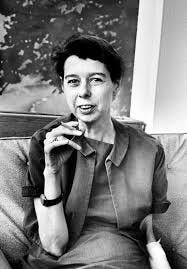
McCullers (1917-1967) ranks high among Southern Gothic writers. Biographer Mary V. Dearborn likens her to William Faulkner, who established the sub-genre’s elements of race, rural poverty, violence, and decay (pp. 56, 82-83). In 1940, Richard Wright said that McCullers’ “quality of despair is unique and individual; and it seems to me more natural and authentic than that of Faulkner.”
McCullers has been likened to other writers from the South and to such modernists as W. H. Auden and Truman Capote, both of whom she knew. Her work is distinctive in its focus on modernist themes of isolation and loneliness. Like other modernists, James Joyce, for example, she made use of myth, but did so quietly and obliquely.
McCullers’ first novel, The Heart is a Lonely Hunter, appeared in 1940. It was a publishing sensation, a work with multiple, distinctive voices that had been written by an author 23 years old. That book was quickly followed by Reflections in a Golden Eye (1941). The Ballad of the Sad Café was published in Harper’s Bazaar in 1943. The Member of the Wedding appeared in 1946. The Ballad of the Sad Café was published again, this time in book form, in 1951. The much-delayed Clock Without Hands did not appear until 1961; it was her last novel. She died at 50 and had been in poor health for several years.

Gender ambiguity appears in all these works and figured prominently in the author’s life. McCullers was born Lula Carson Smith and changed her name to the androgynous Carson when she was just 15. For her whole life, she wanted to be seen as young as well as male-appearing. The photograph below was taken on January 5, 1950, the night The Member of the Wedding opened on Broadway. Busy with cigarette, champagne, and espresso, is Julie Harris (1925-2013). She played Frankie, the boyish young woman at the center of the drama. McCullers rests her head on Ethel Waters’ shoulder (1896-1977). Waters played Berenice, a wise maternal figure in the play.
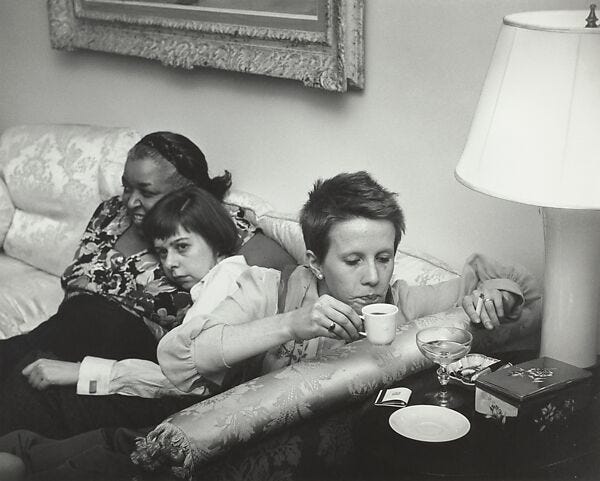
At the time this photograph was taken, McCullers was 33, Harris was 25, and Waters was 54. Few photographs capture more of McCullers’ character than this one. Wearing her trademark bangs and dressed in her signature white shirt, complete with cuff links, McCullers looks boyish and shy. Her pose suggests that of a child seeking comfort from her mother. Biographies by Dearborn (2024) and Virginia Spencer Carr (2003) attest to McCullers’ intelligence, sensitivity, and neediness. A review of Dearborn’s sympathetic book emphasizes McCullers’ life-long love affair with childhood and the “appetite” and “impulse” that come with it (Doherty).
McCullers was famously direct, and, as Albert J. Griffith pointed out, so was her narrative style. She preferred a presentational mode as opposed to one that was representational. Little is inferred in her fiction and much is explained. McCullers followed the same practice when she was photographed, it seems to me, looking directly at the camera, as above. Her poses speak less to her reputed shyness than to her strong sense of who she was.
Some of McCullers’ strongest characters embrace an unusual concept of love as unsettling and hostile. This concept cannot be separated from the author’s many affairs and her passive-aggressive behavior. I suggest that the views voiced by the narrator of The Ballad of the Sad Café (hereafter BSC in references) are also the views of McCullers. Her experience of isolation and loneliness might have generated her belief that love was antagonistic. But it is equally possible that she used her eccentric view of love to create experiences that confirmed her belief.
In McCullers’ view of love, there is no peace. Conflict rules. Love bring hate. “Most of us would rather love than be loved,” the narrator of The Ballad declares. “The beloved hates the lover,” who is “forever trying to strip bare his beloved.” The beloved, understandably annoyed, resents this persistent probing. But the lover, persistent and self-sacrificing, will accept any connection to the beloved, even one that is painful and hateful (BSC, p. 418). The lover acts; the beloved reacts; end of story. This constitutes what Doherty describes as the “universal philosophy” of The Ballad of the Sad Café.
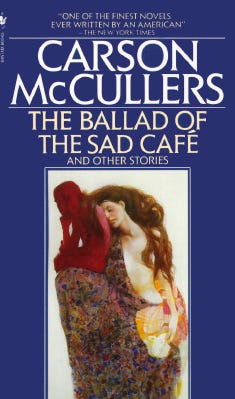
Her biographers explain that in love affairs, McCullers was often the one who “would rather love than be loved.” Dearborn writes that she “invariably spoke of love, even for those she had just met, and those she met in a professional context, and those she knew to be committed to or involved with others.” Such behavior points to a “profound insecurity and a matching defensiveness” (p. 143).
Carr connects McCullers’ unusual outlook to views of love expressed in her fiction. “She took comfort and an almost sadomasochistic pleasure in identifying with the outcast, with the quester whose Grail was always elusive,” Carr writes. She adds that McCullers “liked being the lover,” the unhappy one who is not consoled (p. 210). Most writers connect McCullers’ experience of love to the treatment of love in her fiction.
The critic Alfred Kazin saw McCullers as struggling with outsiderism. She longed “to give ‘love,’ to effect an instant embrace,” Kazin said (qtd. Dearborn, p. 143). Dearborn adds that McCullers’ “only [social] response is to love and to become close to everyone within reach” (p. 143). McCullers does not seem to have been concerned with reactions to this clingy behavior. Perhaps children think they can be “close to everyone.” Adults know better.
Indeed, it seems that McCullers pursued a selfish and childlike way of loving as her primary social (or anti-social) mode. She put herself at the mercy of the person to whom she was drawn, and this suggests a kind of masochism. “The lover craves any possible relation with the beloved,” the narrator of The Ballad of the Sad Café tells us, “even if this experience can cause him only pain” (p. 418). It might be painful, but it also ensures attention.
If you Google “McCullers and masochism” you will find discussions of this trait as it affected characters in Reflections in A Golden Eye in particular. But McCullers herself had masochistic tendencies that compelled her to love (and to profess to love) people who were manifestly not interested in her.
Her passion for Annemarie Schwarzenbach serves as a template for McCullers’ love life. She met Schwarzenbach, a Swiss-born novelist, in New York in 1940. Dearborn’s description of Schwarzenbach might well be a description of McCullers: “almost always in pants, often in a man-tailored shirt,” with “close-cropped hair,” child-like and high strung. The first lesbian to whom McCullers was attracted, Schwarzenbach had little time for McCullers (Dearborn, pp. 90-92).
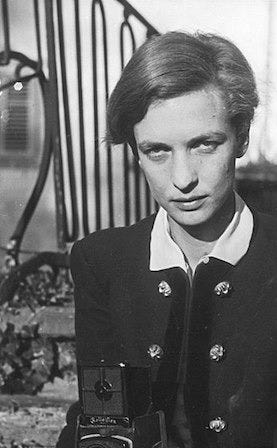
McCullers “would repeatedly fall in love with women who were very much like Annmarie: older, lesbian, dramatic, elegant, and attractive, exuding worldliness and sophistication and generally unattainable, usually because the beloved was involved with another.” Those women might “initially respond” to McCullers but would “then retreat” (Dearborn, p. 94).
McCullers offered a more intense relationship than most people wanted to accept, especially from a person they hardly knew. Some people “used similarly expansive, overblown language back at her” (Dearborn, p. 144). But, generally, McCullers failed “to engage the worldly older woman in a grand passion.” That said, “she did keep trying,” Dearborn claims (p. 94).
McCullers’ determination recalls the myth of Sisyphus. She felt was compelled to engage in behavior that was repetitive, stressful, and doomed to fail. It is not impossible that she was gratified by and perhaps enjoyed this experience, which is antagonistic at its center.
It follows from all this that McCullers led a confused and complicated love life, with both male and female partners. Dearborn’s index includes four lines of entries for “McCullers, sexuality of,” and numerous entries concerning her marriage to Reeves McCullers, their divorce, and their subsequent remarriage (see p. 475). Her lesbian tendencies meant that their marriage would be frustrating and hopeless.
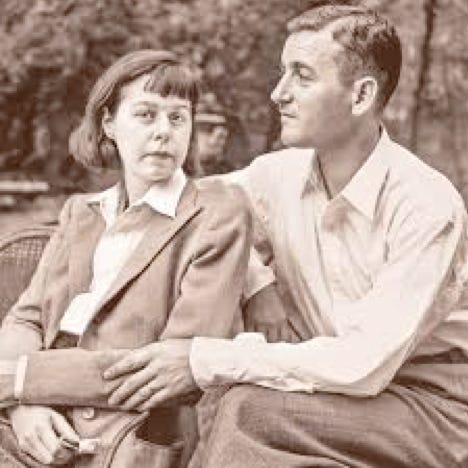
McCullers was given to “immoderate ‘crushes,’” according to Tennessee Williams (Dearborn, p. 258). Her one-sided affairs, such as one she sought with the English therapist Kathryn Cohen, are detailed by Dearborn, who notes that McCullers believed that she and Cohen were in love. Perhaps McCullers presupposed that Cohen would accept the position of the beloved as expressed in The Ballad of the Sad Café. However, McCullers was Cohen’s patient and was hypnotized by her to help her deal with her deep fears of isolation and abandonment. Cohen would not have been easily manipulated.
That McCullers “did keep trying” suggests one of two things. Either she did not learn from repeated rejections by her love objects, or she took pride, perhaps even pleasure, in being rejected. She did not want to be happy. On the contrary. She wanted to be able to say that others misunderstood her or undervalued her. It seems to me that she had no objection to the role of Sisyphus. She did not need the gods—that is, fate—to punish her, however. She found it easy enough to punish herself.
McCullers’ preference for willful isolation and asocial behavior are transferred to Amelia Evans, the woman at the center of The Ballad of the Sad Café. A powerful figure who seems to get everything she wants, Amelia becomes involved with two men. She fills the role of the beloved with one of them, that being the role that McCullers did not value. She fills the role of the lover with the other one. Amelia violently spurns the man who loves her. But soon after that, she falls in love with a man who exercises the power of the beloved and spurns her.
Amelia operates a “mercantile” in a poor, nearly deserted, and nameless town in Georgia, a landscape similar to the one we find on the first pages of The Heart Is a Lonely Hunter. Amelia’s general store carries feed and other staples, “such as meal and snuff,” for farmers and workers in the cotton mill, which is the chief business of the town. She also runs a still in the woods.
Thanks to her many endeavors, Amelia is richest woman around. But she would have been even richer—as rich as a congressman—if she did not have “a passion for lawsuits and bitter litigation over just a trifle” (BSC, p. 398). Amelia is combative, and for this she, literally, pays a price. For all her willfulness and aggression, she is not wise enough to protect her own interests. Her passion overcomes her wisdom.
At 6’2” and 160 pounds, Amelia dresses in boots and overalls, complete with corncob pipe. She has “bones and muscles like a man” (BSC, p. 398). On Sundays she wears an ill-fitting (of course) red dress, but she does not aspire to be seen as a lady (pp. 415-16). Her only use for people is to make money from her business with them (pp. 398-99). Yet she has a compassionate, admirable side. For a while she served as the town’s doctor, skilled in folk medicine. The narrator notes that she would not treat those with “female” problems, and this suggests an aversion to the female body that aligns with Amelia’s appearance (p. 409). Amelia epitomizes what Wright called “a sheen of weird tenderness” that sometimes appears in McCullers’ work.
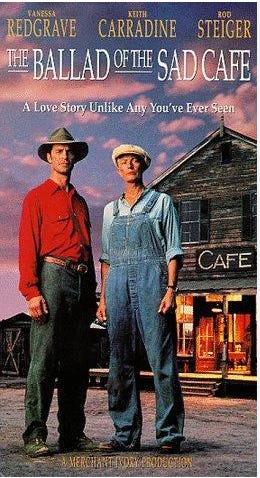
From the 1991 film.
At the time of The Ballad, Amelia is 30. Eleven years earlier, when she was 19, Amelia (Vanessa Redgrave in the film) married William Macy (Keith Carradine), who worked in the mill as a loom-fixer. For two years before he proposed, Macy had admired her from afar. Amelia “cared nothing for the love of men and was “a solitary person,” yet she married Macy (BSC, pp. 398-99). He chose her out of love, we are told, not out of a desire for her wealth. A very handsome man, Macy is nonetheless is “an evil character” with a reputation for violence; he has been in the penitentiary for several years. In spite of his bad deeds, Macy was the beloved of some of the area’s most eligible young women. He was not good to these women, however, instead degrading and shaming them as would-be lovers (pp. 418-19).
Macy had grown up bitter and violent; he behaved deplorably as an adult. But when he met Amelia, Macy became a lover. Love “reversed” his character, the narrator says. Pining for Amelia, he transformed himself. He went to church, learned good manners, and finally proposed to her. She accepted him and became his beloved. At that point, those around Amelia hoped that marriage would improve her anti-social behavior (BSC, pp. 421-22). But this was not to be. As Macy’s beloved, she lives up to her willful and destructive reputation.
The marriage ceremony was fraught. Amelia strode up the aisle “with great steps,” wearing her dead mother’s yellow wedding dress, more female attire that fits poorly. She was nervous and distracted throughout the ceremony and is described as impatient, bored, and exasperated, looking to put her hands into pockets on her dress, as if it had pockets like those on her overalls (BSC, p. 421). If she knows what is expected of her as a bride, including deference and sex, she gives no indication of wanting to live up to the role. Walking home, she treats the groom as if he were a customer, as though business talk were the only talk she had. We remember that she loves to argue with her customers.
That night, she stormed out of their bedroom and began to work at her desk, her medical aversion to dealing with “female” parts apparently getting the better of her. The next day she acted as if nothing had happened (p. 422). Angry, impatient, and so contemptuous of her husband that she thinks about killing him, Amelia seems to reject even the idea of love, say nothing of its sexual implications. Her asocial habits seem to have protected her not only from sexual experience but also from sexual knowledge.
The marriage lasted only 10 days, and then Macy, who was heartbroken, left. But first he inexplicably signed over all his possessions to her. The lover, knowing that he has offended the beloved, seeks to placate her. Before leaving, Macy put his hand on her shoulder and began to speak. She hit him so hard that she broke one of his front teeth and knocked him over (BSC, p. 423). He does not fight back. The lover, he suffers at the beloved’s will.
This display of violence is not unique in Amelia’s history. Physically powerful, she had fought before. She once badly beat a lawyer who had tried to cheat her. She has more violence in store for Macy. He will return, and when he does, she will try to settle their differences in a boxing match decided by another man, a hunchback dwarf. (Part 2 forthcoming.)
December 2025
Sources
Carr, Virginia Spencer. The Lonely Hunter: A Biography of Carson McCullers. Athens: University of Georgia Press, 2003.
Carson McCullers Society. Scholars’ Resource Guide. https://carsonmccullerssociety. Wordpress. com/resources/. Seen December 2025.
Dearborn, Mary V. Carson McCullers: A Life. New York: Alfred A. Knopf, 2024.
Doherty, Maggie. “The Arrested Development of Carson McCullers.” The New Yorker. February 25, 2024. Review of Dearborn, Carson McCullers. Https://thenewyorker.com/magazine/2024/03/04/carsonmccullers-a-.
Griffith, Albert J. “Carson McCullers’ Myth of the Sad Café.” The Georgia Review 21. (1967). https://www.enotes.com/topics/ballad-sad-cafe/criticism/criticism/albert-j-griffith-essay-date-1967.
McCullers, Carson. The Ballad of The Sad Café and Other Stories. 1951. New York: Bantam, 1971.
——-. The Ballad of The Sad Café. In Carson McCullers: The Complete Novels. Ed. Carlos L. Dewes. The Library of America. New York: Penguin Random House, 2001. 395-458.
Comments
Nothing yet. Say the first thing.
Sign in to join the conversation.