
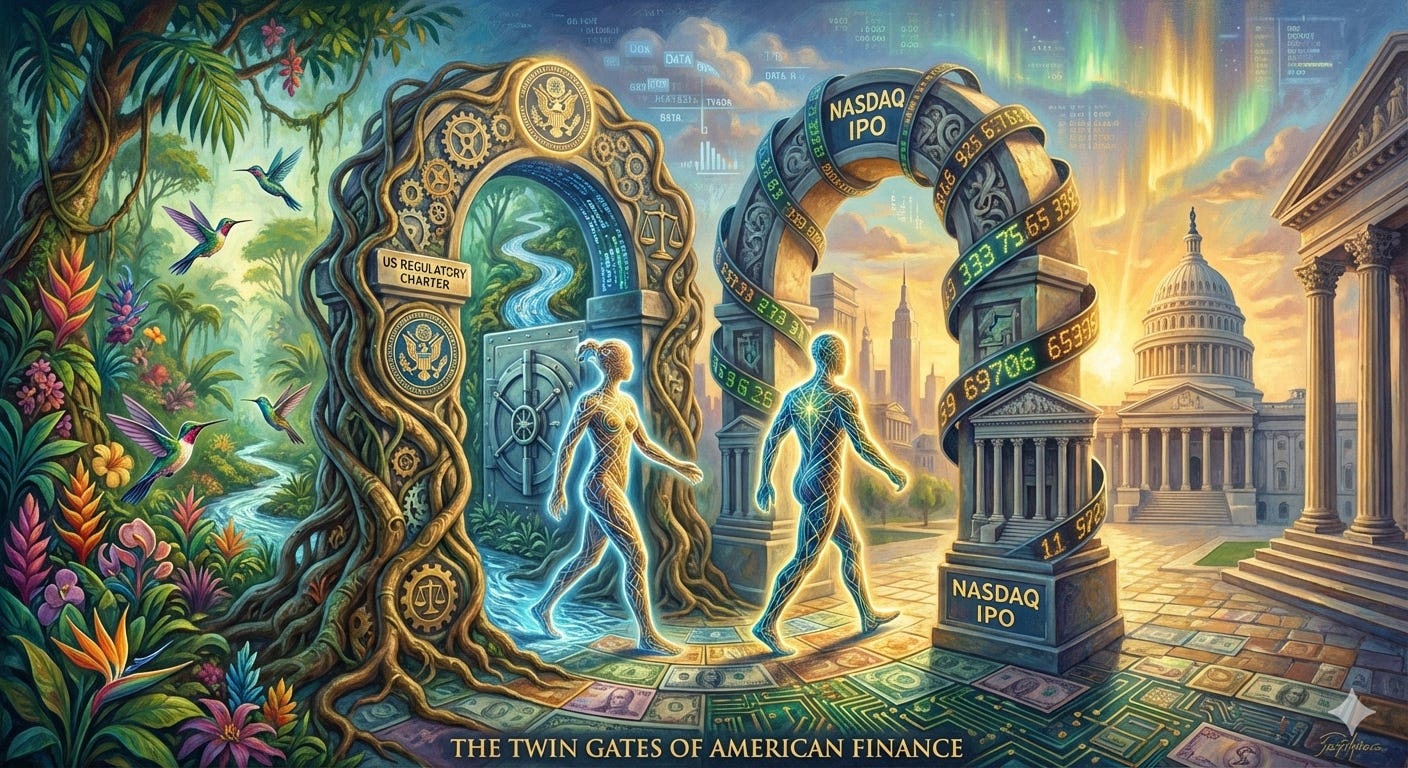
Two headlines passed almost unnoticed outside fintech.
Nubank just received conditional approval from the Office of the Comptroller of the Currency for a de novo national bank charter in the United States.
PicPay priced its IPO on Nasdaq at $19 and was valued at about $2.5B, raising roughly $434M.
This is not Brazil exporting apps.
This is Brazilian operators getting validated by the two strictest filters in American finance: regulators and public markets.
Here’s the clean way to think about it.
A US bank charter is not a branding exercise. It is permission to hold insured deposits and run inside the core banking perimeter. Conditional approval is the regulator saying: “We can imagine you operating safely, if you meet the conditions.”
A US IPO is not a fundraising round. It is continuous price discovery under a much wider investor base.
When two Brazilian fintechs clear these gates in the same week, it’s a signal that a specific operating playbook built in Brazil is becoming exportable.
The interesting question becomes: what did Brazil force these companies to learn that now matters in the US?
Brazil’s banking system is far more concentrated than the US. One simple proxy: the top five banks held ~79% of commercial banking assets in 2021 (World Bank data via FRED).
In a concentrated system, incumbents can sustain higher prices and slower product cycles for longer.
That creates two things at once:
A larger “rent pool” (fees, spreads, friction) for challengers to attack
A clearer target (fewer incumbents to displace)
The US is the opposite: thousands of banks and credit unions, multiple charters, and intense competition for deposits and prime borrowers.
So the value proposition that works in Brazil (“cheap, simple, all-in-one”) needs adaptation in the US (“trust, distribution, and regulatory-grade risk”).
Brazil’s central bank pushed the system into real-time money movement with Pix going into full operation on Nov 16, 2020.
The US is only now building comparable reach through FedNow (live since 2023), and adoption is still a bank-by-bank rollout.
Practical implication: Brazilian fintechs grew up assuming instant settlement and low-cost transfers are the default. US fintech economics still depend heavily on cards, ACH timing, and a more layered payments stack.
In Brazil, the central bank can set a national standard, sequence the rollout, and force interoperability.
Open Banking in Brazil (now broader Open Finance) was implemented in phased deadlines starting in 2020, including payment initiation as an explicit phase.
The US regulatory structure is structurally more fragmented: different primary regulators depending on charter and membership, plus separate consumer, state, and payments oversight.
Because of that, moving to the US is less like entering a new market, and more like entering a new compliance production system.
Nubank already has US capital markets credibility through .
The new move is different: regulated permission to operate as a national bank through a newly formed subsidiary (Nu Financial Services), with a clear checklist and deadlines, plus remaining approvals.
Strategically, this is about lowering the marginal cost of funding and expanding product scope, not launching an app in America.
PicPay’s IPO is a different kind of US win: it’s not US operations, it’s US capital.
Reuters reports the IPO priced at the top of the range, implying solid demand.
That demand only shows up when investors believe the unit economics are durable under scrutiny.
Brazil forces you to build banking under three harsh realities:
high transaction volume
high fraud pressure
thin tolerance for operational errors
That environment rewards automation, risk discipline, and data infrastructure. AI is the compounding tool for all three.
Nubank acquired Hyperplane specifically to accelerate an “AI-first” approach and build foundation-model capabilities for financial behavior.
This matters in the US because the compliance bar is higher and the labor cost is higher.
If you can use models to reduce fraud losses, improve underwriting, and automate servicing while staying inside model governance constraints, you create a structural cost advantage that is hard to copy.
PicPay has historically partnered with Feedzai for AI-driven transaction risk controls.
Even if vendors change over time, the point is stable: payments at Brazilian scale incentivize machine-led risk systems early. That muscle transfers well to any market where fraud and chargebacks compress margins.
The competitor is not a Brazilian app.
The competitor is a team trained in a system where:
rails changed fast
incumbents were expensive
efficiency became existential
Takeaways:
Assume they will compete on operating cost, not branding.
Assume they will over-invest in risk automation earlier than US-native challengers.
Watch where they anchor distribution. In the US, distribution is the moat more often than product.
The product is rarely the problem.
The bottleneck is regulatory manufacturing:
charter strategy
compliance staffing
model governance
auditability of decisions (especially credit and fraud)
The founders who win will treat compliance like a production line, not a legal memo.
The investable insight is not that Brazilian fintech is hot.
The insight is: Brazil is producing companies that can survive a hostile cost and risk environment, and those companies are now being validated by US gatekeepers.
That narrows your search space.
A US charter process and a US IPO in the same week is not coincidence.
It’s the market acknowledging something:
Brazil has been a fintech pressure cooker. Now some of its winners are graduating into the deepest capital market and the strictest regulatory perimeter in the world.
If you want to understand where banking margins go next, you start with which operators have already been forced to build a low-cost, high-control banking machine... and are now being allowed to run it in the US.
𝘈𝘯𝘺 𝘷𝘪𝘦𝘸𝘴 𝘰𝘳 𝘴𝘵𝘢𝘵𝘦𝘮𝘦𝘯𝘵𝘴 𝘦𝘹𝘱𝘳𝘦𝘴𝘴𝘦𝘥 𝘢𝘳𝘦 𝘮𝘪𝘯𝘦 𝘢𝘯𝘥 𝘯𝘰𝘵 𝘵𝘩𝘰𝘴𝘦 𝘰𝘧 𝘮𝘺 𝘦𝘮𝘱𝘭𝘰𝘺𝘦𝘳
No posts
Comments
Nothing yet. Say the first thing.
Sign in to join the conversation.