
Most companies find out about regulatory changes the same way they find out about traffic jams: when they’re already stuck in one.
A new rule gets published. Legal reviews it in two weeks. Strategy gets briefed in four. The board discusses it next quarter. By then, the market has already repriced. The window for first-mover advantage is gone.
This is not a legal problem. It’s a capital allocation problem.
If you operate in financial services, AI, or any regulated deep tech vertical, the speed at which you process regulatory signals is now a competitive variable. Not a compliance checkbox. A strategic weapon.
Here’s the good news: the AI tooling available today makes it possible for a lean team, even a solo founder, to build a regulatory intelligence system that would have required a six-person policy team 18 months ago.
This article is a practical guide. Not theory. I’ll walk through the exact stack, the specific tools, and the workflows that let you turn regulatory noise into strategic clarity - daily.
The regulatory environment is moving faster than at any point in the last two decades.
In the US alone, the Federal Register publishes thousands of proposed and final rules every year. State legislatures are passing AI governance bills at an accelerating pace. The EU AI Act is being implemented in phases. Stablecoin legislation is being debated across multiple jurisdictions simultaneously.
For founders and investors in regulated sectors, this creates a specific and underappreciated risk: asymmetric information decay. The team that reads a proposed rule 48 hours before you do has 48 hours to adjust pricing, restructure a deal, or pivot a product roadmap. In markets where regulation moves billions, those 48 hours can be worth millions.
The traditional approach - subscribing to newsletters, hiring outside counsel, attending conferences - is expensive, slow, and reactive. It’s optimized for compliance, not for strategy.
AI changes this equation entirely.
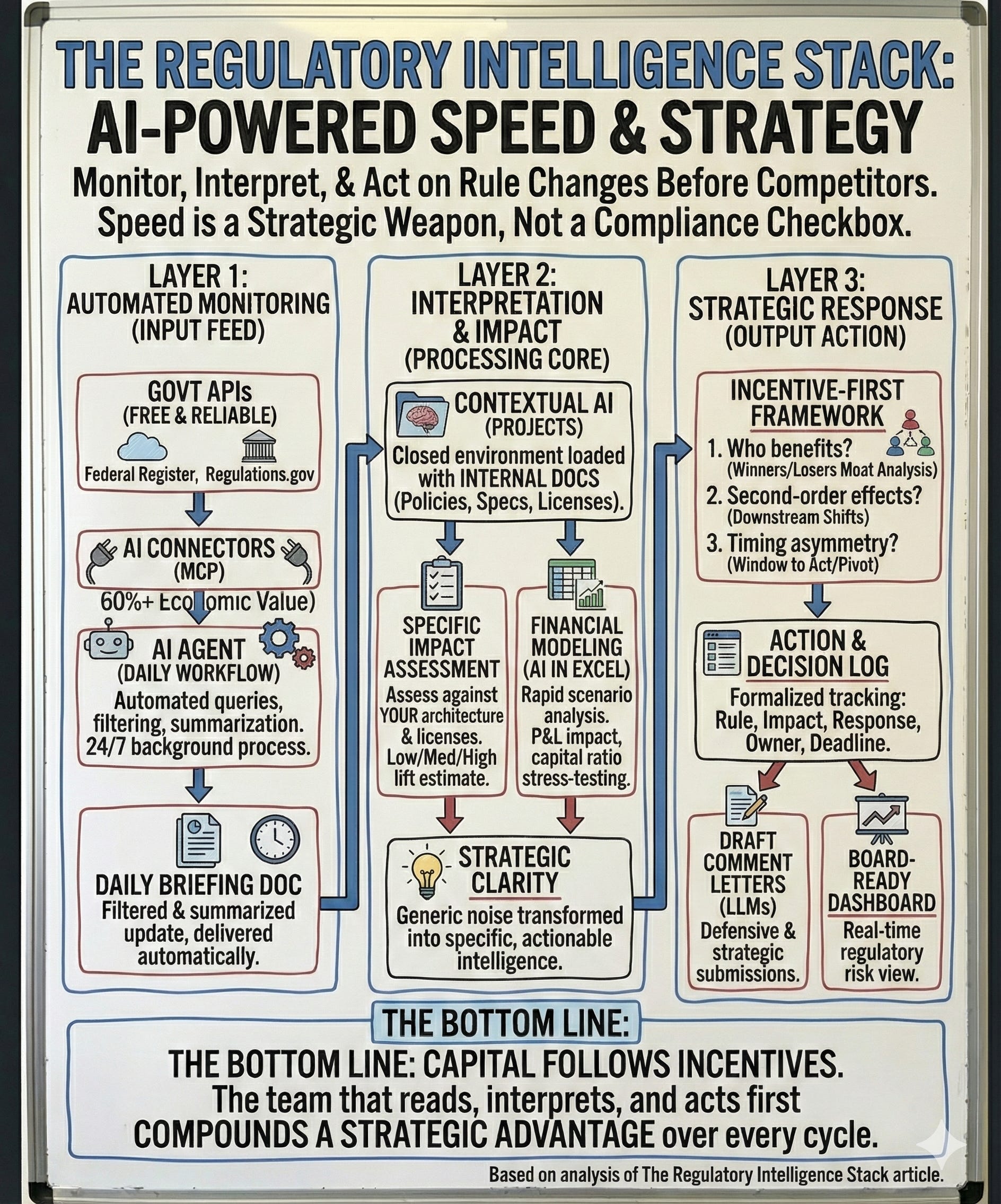
The foundation of any regulatory intelligence system is a reliable, automated feed of relevant changes. Here’s how to build one.
Government APIs are free and underused. The Federal Register has a public REST API (federalregister.gov/developers) that returns data in JSON or CSV. No API key required. You can query by agency, document type (proposed rules, final rules, notices), date range, and keyword. The Regulations.gov API offers similar access to federal regulatory documents, including public comment periods.
Most founders don’t know these exist. That’s the opportunity.
Connect these APIs to Claude using MCP servers. The Model Context Protocol lets AI assistants like Claude interact directly with external data sources. There is already an open-source Federal Register MCP server (github.com/aml25/federal-register-mcp) that you can configure with Claude Desktop or Claude Code. Once connected, you can ask Claude to search executive orders, proposed rules, and agency guidance in natural language.
Similarly, the US Compliance MCP server (by Ansvar Systems) covers HIPAA, CCPA, SOX, and other frameworks, allowing you to query regulatory text and map requirements to your internal processes - directly from your AI assistant.
Set up a daily automated workflow with Claude Code or Cowork. Here’s where it gets practical. Claude Code, Anthropic’s command-line agent, can run scripts that pull from these APIs every morning, filter results by your specific regulatory domains, and generate a briefing document. If you’re not technical, Cowork - Anthropic’s newer desktop agent - does the same thing through a simple chat interface. You point Cowork at a folder, describe what you need, and it executes.
A daily workflow might look like this: Claude pulls new documents from the Federal Register API filtered by keywords relevant to your business (e.g., “payment processing,” “stablecoin,” “data privacy,” “AI governance”). It then summarizes each document, flags items that require strategic attention, and saves the briefing as a formatted Word document in your designated folder. Every morning. Automatically.
This is not hypothetical. The tools exist today.
Raw monitoring is necessary but insufficient. The real value is in the interpretation layer - understanding what a regulatory change actually means for your business.
Use Claude Projects with your company’s context loaded. Claude Projects let you upload your internal documents - your compliance framework, product documentation, licensing structure, investor agreements - and then ask Claude to assess new regulations against that specific context. Instead of asking “what does this rule say?”, you’re asking “how does this rule affect our payment processing license in Texas?”
This is the difference between generic intelligence and strategic intelligence.
Build custom Claude plugins for recurring analysis. Anthropic recently launched plugins for Cowork - modular automation tools that specialize in specific workflows. You can create a plugin that takes any new regulatory document, runs it through a standardized analysis framework (who is affected, what changes, what’s the timeline, what’s the penalty for non-compliance), and outputs a structured impact assessment.
For teams using Cursor or Claude Code, you can build similar automation by writing prompt templates that feed regulatory text through a structured analysis chain. The output can be a markdown file, a spreadsheet row, or a Slack notification - whatever fits your workflow.
Leverage Claude in Excel for financial impact modeling. Claude’s Excel integration, now available to Pro subscribers, lets you work with Claude directly inside your spreadsheets. If a new capital requirement is proposed for your sector, you can ask Claude to model the impact on your balance sheet, run scenarios with different implementation timelines, and stress-test your assumptions. Claude reads your entire workbook, navigates across tabs, and maintains formula dependencies while making changes.
For investors doing due diligence on regulated companies, this is extraordinarily powerful. You can upload a company’s financial model, feed in a proposed regulation, and ask Claude to estimate the margin impact. In minutes, not weeks.
Monitoring and interpretation are inputs. The output that matters is the decision.
Structure your response using an incentive-first framework. For every regulatory change, ask three questions:
First, who benefits? Every regulation creates winners and losers. A new compliance requirement that costs $2M to implement is a moat for incumbents and a death sentence for underfunded startups. If you’re the incumbent, that’s an advantage to press. If you’re the startup, you need to know now - not in six months.
Second, what’s the second-order effect? A rule that caps interchange fees doesn’t just affect payment processors. It changes the unit economics of every fintech that depends on interchange revenue. It shifts capital allocation across the entire payments stack. Map the downstream effects before the market does.
Third, what’s the timing asymmetry? Proposed rules have comment periods. Final rules have implementation timelines. Between announcement and enforcement, there’s a window. The question is whether you use that window to prepare, pivot, or position - or whether you waste it debating internally.
Use your favorite LLM to draft your regulatory comment submissions. If you’re in fintech, banking, or any sector where proposed rules have comment periods, submitting thoughtful comments is both a strategic and defensive move. Claude/ChatGPT/Gemini/Grok can draft these submissions based on your company’s position, referencing the specific regulatory language and framing your arguments in terms regulators care about - consumer protection, market stability, competitive fairness.
Build a regulatory decision log. Use Claude in Excel or Cowork to maintain a living spreadsheet that tracks every regulatory development relevant to your business, its assessed impact, the strategic response chosen, and the deadline for action. This becomes your board-ready regulatory risk dashboard.
The regulatory surface area for fintech founders is enormous and expanding. Stablecoin legislation, state money transmitter licenses, open banking rules, CFPB enforcement actions - any one of these can reshape your business overnight.
Set up Federal Register monitoring filtered by CFPB, OCC, FinCEN, and state banking regulators. Use the Compliance.ai API or a custom MCP server to track state-level legislative changes across all 50 states. Load your licensing matrix into a Claude Project so that every new rule is automatically assessed against your specific state-by-state compliance posture.
For stablecoin companies specifically, track both US Congressional activity and EU MiCA implementation timelines. The regulatory divergence between jurisdictions is itself a strategic variable - it determines where you incorporate, where you launch, and how you structure reserves.
Large financial institutions have compliance teams. What they often lack is speed. The gap between regulatory publication and internal strategic response is where value leaks.
Use Claude in Excel to build scenario models for proposed capital requirements (Basel III endgame, for example). Connect Claude to market data connectors like LSEG and Moody’s (now available as Claude connectors) to enrich your analysis with real-time data. Use Cowork to generate weekly regulatory briefings that go directly to senior leadership - formatted, prioritized, and actionable.
For risk and compliance officers, the US Compliance MCP server can map new regulatory requirements directly to your existing control framework. Instead of manually cross-referencing HIPAA, SOX, or GLBA requirements against your policies, Claude does the mapping and highlights gaps.
Law firms and advisory practices that serve regulated industries have a specific opportunity: use AI to deliver regulatory intelligence as a service, not just as a byproduct of billable hours.
Build a Cowork plugin that generates client-specific regulatory briefings by pulling from government APIs, filtering by each client’s industry and jurisdiction, and formatting the output with your firm’s branding. This turns a $500/hour manual process into a scalable product.
Use Codex, Google Antigravity or Claude Code to build internal tools that cross-reference new regulations against your client database and flag which clients are affected. The firms that operationalize this first will win mandates from the firms that don’t.
Regulatory intelligence is not a compliance function. It’s a strategic function. And the cost of building a sophisticated regulatory monitoring and analysis system just dropped by an order of magnitude.
The tools - Claude Code/Codex/Antigravity, Cowork, Claude in Excel, MCP servers, government APIs, custom plugins - are available today. Most are free or included in existing subscriptions. The barrier is not technology. It’s the decision to build the system.
For founders in regulated sectors: build this before you need it. The worst time to start monitoring regulatory risk is after a rule has already been published.
For investors allocating capital to regulated industries: ask your portfolio companies what their regulatory intelligence workflow looks like. If the answer involves “we have outside counsel review things quarterly,” that’s a red flag. The market is moving faster than that.
Capital follows incentives. Incentives are shaped by regulation. The team that reads the regulatory signal first, interprets it accurately, and acts on it decisively will compound that advantage over every cycle.
Build the system. Run it daily. Make better decisions.
𝘈𝘯𝘺 𝘷𝘪𝘦𝘸𝘴 𝘰𝘳 𝘴𝘵𝘢𝘵𝘦𝘮𝘦𝘯𝘵𝘴 𝘦𝘹𝘱𝘳𝘦𝘴𝘴𝘦𝘥 𝘢𝘳𝘦 𝘮𝘪𝘯𝘦 𝘢𝘯𝘥 𝘯𝘰𝘵 𝘵𝘩𝘰𝘴𝘦 𝘰𝘧 𝘮𝘺 𝘦𝘮𝘱𝘭𝘰𝘺𝘦𝘳
No posts
Comments
Nothing yet. Say the first thing.
Sign in to join the conversation.