
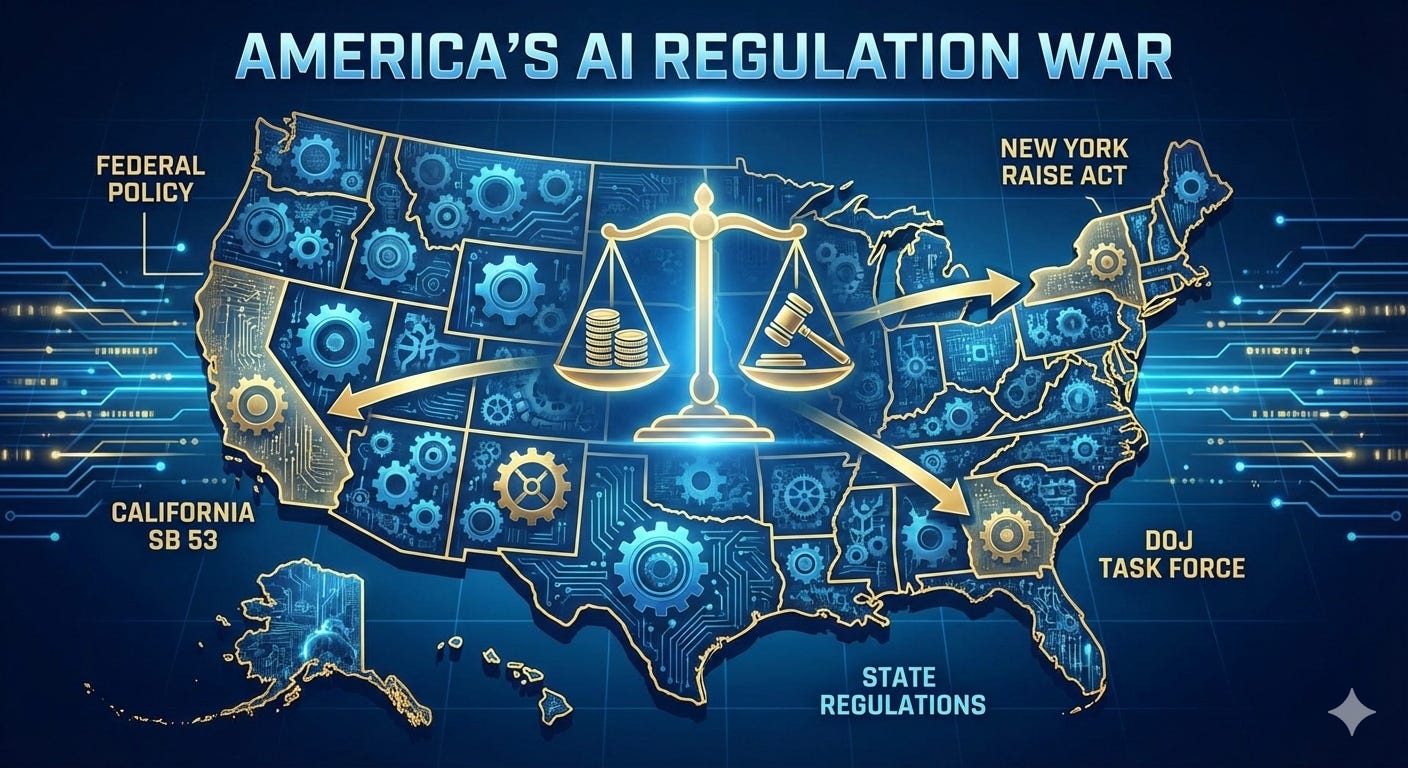
2026 won’t be the year the world figures out AI regulation.
It will be the year you learn whether your AI strategy is built to survive regulatory geography.
Because the fight has moved from policy memos to enforcement leverage: lawsuits, funding conditions, liability claims, and state-by-state rulemaking.
If you allocate capital in AI, fintech, or AI-adjacent infrastructure (energy, data centers, chips), this is not background noise. It’s a variable that changes your cost of capital, your go-to-market sequencing, and your downside.
Let’s walk through what’s happening in the U.S., why it matters, and what to do with it.
In December 2025, the White House issued an executive order framed around a minimally burdensome national AI policy, and aimed at deterring state AI regulation.
The mechanism matters more than the rhetoric:
A DOJ AI Litigation Task Force is created to identify and challenge state AI laws the administration views as conflicting with federal policy.
Federal funding leverage shows up via broadband grants (BEAD), with the threat of withholding funds from states deemed “onerous.”
The order sets near-term implementation deadlines, including a task force timeline and a process for flagging “onerous” laws.
However, at the same time, states did not pause.
New York signed the RAISE Act on December 19, 2025, requiring covered frontier-model developers to publish safety protocols and report certain incidents, among other provisions.
California’s SB 53 (often described as the first frontier AI safety law) created a transparency-and-governance regime aimed at catastrophic-risk scenarios.
Separately, child safety has shifted from “policy debate” to courtroom reality:
Google and Character.AI settled multiple lawsuits tied to teen self-harm and suicide allegations in early January 2026. Kentucky’s attorney general filed a lawsuit against Character Technologies on January 8, 2026. OpenAI and Common Sense Media announced a joint California ballot effort focused on youth chatbot protections.
So the regulatory surface area is already trying to expand while the federal government is trying to compress it.
That compression attempt will run through courts, agencies, and funding programs - not just through a clean federal statute.
People keep framing this as “federal vs. state” or “pro-innovation vs. safety.”
As a capital allocator, here’s the cleaner frame:
Jurisdictions are competing to set the operating constraints of the AI economy. And they are using the tools they actually control.
States control:
consumer protection enforcement
tort environment (in practice, through local litigation dynamics)
permitting and land use (data centers live and die here)
utility regulation and grid interconnection complexity
procurement rules for state agencies
education and child safety policy
The federal government controls:
interstate commerce arguments and preemption strategy (often litigated)
federal funding programs as carrots and sticks
national security framing and export controls
agency interpretations that shift compliance expectations
When all sides push at once, you don’t get clarity.
You get a patchwork with motion.
And motion is what raises your risk premium.
This is not a few activist states problem anymore.
In 2025, state legislators introduced over 1,000 AI-related measures, and 38 states adopted or enacted around 100 measures, per the National Conference of State Legislatures.
You can dislike the patchwork. You can lobby against it.
But you still have to price it.
Washington tried a legislative preemption approach and it failed.
In July 2025, the Senate voted 99–1 to strip a 10-year moratorium on state AI regulation from a major reconciliation bill.
Later in 2025, another preemption attempt tied to defense legislation was reportedly left out as well, even as the broader debate continued.
This matters because it tells you something about incentives:
Federal lawmakers want “one rule,” until they have to put their names on it.
States want to be seen doing something, especially on kids, safety, and local resource constraints.
The industry wants certainty, but certainty is not on offer when incentives are misaligned.
So the executive order route becomes the substitute: litigation + funding leverage + agency posture.
California SB 53 and New York’s RAISE Act lean heavily on transparency, safety frameworks, and incident reporting.
Second-order effect:
Big players can absorb governance overhead more easily than challengers.
Compliance capacity becomes a moat, even if the law was sold as a safety measure.
This is economics. When fixed compliance costs rise, market structure tends to tilt toward larger balance sheets.
Even without a comprehensive AI statute, child harm claims are already forcing behavior changes.
Settlements and active state enforcement reshape how courts, insurers, and enterprise buyers view product design, warnings, and user protections.
You don’t need Congress to regulate. A few high-profile cases can create a de facto standard for age gating, parental controls, audit trails, and escalation protocols.
And if California advances a youth-focused ballot measure, you should assume copycats.
The easiest part of the AI stack to regulate is the physical one.
Permits, water, power bills, grid constraints, zoning: this is all state and local terrain.
That pushes a subtle shift:
Model labs argue about preemption.
Infrastructure operators negotiate with counties, utilities, and state agencies.
Second-order effect:
Compute geography becomes strategy.
Energy procurement sophistication becomes competitive advantage.
If you’re building, financing, or acquiring anything AI-adjacent, the killer is not any single rule.
It’s the inability to answer basic questions with confidence:
Which states will enforce aggressively?
Which requirements survive court challenges?
Which behaviors become “industry standard” through liability pressure?
How do funding penalties alter state behavior at the margin?
What disclosures will customers and enterprise buyers start demanding as a default?
Uncertainty is a cost.
Markets price cost.
Your job is to decide where you can carry it, where you can hedge it, and where you simply should not take it.
Here’s a simple way to think about it without getting lost in legal minutiae.
Do you train, fine-tune, or deploy “frontier-ish” models in jurisdictions that want safety frameworks and incident reporting?
Do you touch minors, education, mental health, companionship, or anything that can be characterized as manipulative design?
Do you rely on power-hungry compute, local permits, water, and grid interconnection?
Do you operate in states where federal broadband funding is politically and fiscally critical?
Different companies have different mixes.
Your strategy should change based on your mix.
Design for “multi-jurisdiction compliance” upfront. Not because you love regulation, but because retrofitting governance under pressure is expensive and slow.
Separate your product surfaces. Youth-facing experiences should have different defaults, logging, guardrails, and escalation paths than general-purpose tools. Courts and AGs will not treat them the same.
Build an incident-reporting muscle before you “need” it. Even if your jurisdiction doesn’t require it today, enterprise customers and insurers will start asking for it.
Choose compute geography like you choose tax strategy. Not for the lowest sticker price, but for stability, permitting predictability, and power reliability.
Stop underwriting “regulatory clarity” as a base-case assumption. Underwrite ranges, not narratives.
Price compliance capacity as an asset. Teams that can ship governance and controls fast will outcompete teams that treat it as PR.
Watch for consolidation opportunities created by fixed-cost pressure. When the rules raise fixed costs, smaller players either specialize or sell.
Avoid sunk-cost thinking. If a company’s regulatory exposure profile becomes structurally unattractive, don’t “average down” emotionally. Cut or reshape. (You already know how this movie ends in markets.)
March 11, 2026: a key milestone in the executive order’s implementation timeline for identifying onerous state laws.
Court filings and early injunction fights: watch where DOJ chooses to focus first; that tells you what the administration views as strategically important.
State AG activity on youth harms: more enforcement actions will shape behavior faster than legislatures.
California ballot initiative progress: if the youth measure gains traction, it becomes a template.
Energy and permitting backlash: any sign that localities are tightening rules on data center resource usage is a leading indicator for compute siting shifts.
If you build or finance AI, treat 2026 as a year of regulatory volatility, not regulatory resolution.
The winners won’t be the loudest voices arguing for their preferred rulebook.
They’ll be the operators who:
can adapt fast,
can document what they do,
can move workloads and go-to-market sequencing across jurisdictions,
and can turn compliance capability into a commercial advantage.
Capital follows incentives, not narratives.
Right now, the incentive is clear: build systems that remain investable even when the rules move.
𝘈𝘯𝘺 𝘷𝘪𝘦𝘸𝘴 𝘰𝘳 𝘴𝘵𝘢𝘵𝘦𝘮𝘦𝘯𝘵𝘴 𝘦𝘹𝘱𝘳𝘦𝘴𝘴𝘦𝘥 𝘢𝘳𝘦 𝘮𝘪𝘯𝘦 𝘢𝘯𝘥 𝘯𝘰𝘵 𝘵𝘩𝘰𝘴𝘦 𝘰𝘧 𝘮𝘺 𝘦𝘮𝘱𝘭𝘰𝘺𝘦𝘳
No posts
Comments
Nothing yet. Say the first thing.
Sign in to join the conversation.