

This article is one of a small number of previous publications that have been updated and republished for new subscribers and anyone who may have missed it the first time round.
I definitely consider myself an introvert but I’ve never felt that the label fully captures who I am. For example, I enjoy my own company and cosy early nights but I also enjoy deep conversations late into the night with some of my closest friends. I absolutely hate attending social events with people I don’t know, but occasionally I’ll get through the discomfort and end up having a great time.
As with many personality traits, introversion is nuanced and research points to different types of introversion rather than one broad classification. Using the acronym STAR, professor of personality psychology Jonathan Cheek and his colleagues contend that there are four shades of introversion, social, thinking, anxious, and restrained.
Social introverts are what most people think of when someone is described as an “introvert.” Social introverts much prefer being in small groups or on their own. This doesn’t mean that they can never enjoy a party or a concert, it’s just that given the choice they would prefer the company of a few old friends or a great book. For the social introvert, solitude is restorative.
Social introversion shouldn’t be confused with shyness or social anxiety. A social introvert isn’t automatically nervous around strangers or afraid of meeting new people. Their preferences are motivated by comfort and personal enjoyment. Social introverts are happiest in a calm, relaxed and low-key setting. In such settings, they can be as warm and talkative as anyone else, and are often admired for their willingness to listen.
The thinking introvert is someone often lost in thought. They are the daydreamers who spend lots of time reflecting on things. For the thinking introvert, their introversion is driven by their minds typically turning inward, regardless of the social setting they find themselves in. You may see a thinking introvert staring off into the distance, not because they are bored or rude but because they’re contemplating something that has just popped into their head.
Thinking introverts have vivid imaginations and can spend hours working on creative projects and pondering over life’s great mysteries. They are drawn to anything that lets them take a deep dive into their mind. Here’s a great example.
I was at the pub with a small group of friends, including a friend of a friend who I hadn’t met before. He was asked something and took a while to notice that the question was directed at him. He apologized for being “miles away” and told us that he was thinking about what it must have been like living during the reign of Henry VIII (he had just finished a book about the infamous king of England). This was the most random yet interesting of all the conversations that day.
Thinking introverts make great storytellers, innovators and problem-solvers because they love exploring ideas in depth.
The anxious introvert often feels uneasy or self-conscious in social settings. Being around people, especially new people in an unfamiliar setting triggers nervous energy. Whereas a social introvert seeks solitude out of preference, the anxious introvert does so for relief. They feel much more comfortable and relaxed on their own or with a trusted friend or two.
Because the anxious introvert tries to limit the potential for negative social judgement, it’s not unusual for them to cancel plans or avoid get-togethers such as a work do. The anxious introvert is a habitual overthinker when it comes to social interactions, before, during and after.
The good news for anxious introverts is that they have their strengths. Enhanced sensitivity can make them very thoughtful friends. Because they know what it’s like, they are much more likely to notice if someone appears uncomfortable in a social setting and will do their best to make them feel less ill at ease.
With understanding friends and a degree of self-compassion, the anxious introvert can enjoy socializing, Provided it’s on their terms.
The restrained introvert moves through life at a measured pace. They carefully consider things before doing or saying something. For the restrained introvert slow and steady wins the race, which is why they prefer to test the water rather than diving head first into things, particularly social encounters. When a restrained introvert starts a new job or joins a new club they will hang back at first and assess the vibe within the group. Most of us can think of a friend who was initially hard to get to know, which is typically the way the restrained introvert is described.
Restrained introverts often make well-considered decisions and tend to be the ones people turn to for sensible, level-headed advice. They can be invaluable in making sure things are properly thought through and they provide a stabilizing presence in a group whose members are rushing ahead too quickly with important choices that have to be made.
In a world of diminishing attention to detail, the restrained introvert provides a great reminder of the importance of patience and reflection.
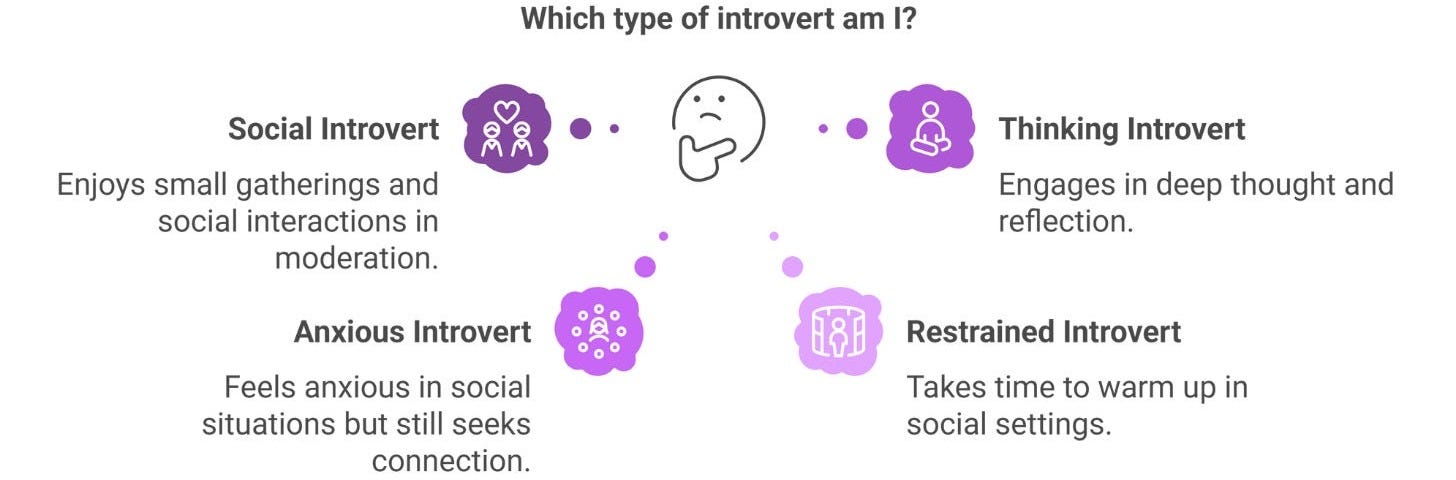
Types of introversion are not mutually exclusive. Jonathan Cheek’s research mentioned above found that many introverts are a mix of all four types. You might be a thinking introvert with a touch of social introversion. Or you may be reserved and restrained, except when you’re with your closest friends.
Most introverts relate strongly to one or two of the STAR categories while recognizing aspects of the others depending on the social situation. This is certainly the case for me. I relate most strongly to anxious and thinking introversion.
Which of the four types of introversion do you relate to most?
For a fascinating and thoroughly entertaining take on introversion, watch this TED talk by Dr. Brian Little, an internationally renowned expert in the field of personality psychology.
Professor Little explores how introversion and extroversion shape the way we think, communicate and respond to stimulation. This great presentation draws on his own experience as an introvert and explains why introverts will sometimes act in extroverted ways to pursue important goals.
I had the honor of interviewing professor Little a few years ago. We explored the development of personality psychology, his influential work on “free traits,” his own introversion, and the need for “restorative niches”. You can read the interview HERE.
Are you looking to raise your profile, strengthen your professional credibility, or bring more attention to your work, ideas, book, research, business, or Substack?
Featured interview opportunities are available for psychologists, authors, researchers, founders, Substack writers, and other relevant professionals.
Each interview is professionally researched, published on the All About Psychology website and this Substack, and promoted across my social channels, including my Facebook community of 800,000+ followers and 200,000+ member LinkedIn psychology group.
Find out more about the featured expert interview opportunity
Comments
Nothing yet. Say the first thing.
Sign in to join the conversation.