
For as long as I can remember, I’ve always been a perfectionist. Back in the days when we wrote things down, if I didn’t think it was neat enough, I would scrumple up the paper I’d written on, throw it in the bin and start again. Today, if I send a text message or WhatsApp, (even during a real-time exchange) I always construct a full and proper proofread reply with correct spelling and grammar.

Any personal doubts as to whether I am truly a perfectionist were quashed when I realized I’d spent a ridiculous amount of time contemplating whether the sleepy Jerry meme I created above should be included in this article because of a semantic mismatch. The meme caption says ‘sons’ plural but there is only one mouse!
While my decision to take a close look at perfectionism was genuinely prompted by a BBC reel on the alarming rise of perfectionism among young people, it was also driven by the knowledge that my perfectionism can be detrimental to my psychological well-being.
Perfectionism is not a quest for the best. It is a pursuit of the worst in ourselves, the part that tells us that nothing we do will ever be good enough. (Julia Cameron)
Arguably the most useful model used to understand perfectionism was produced by Paul Hewitt and Gordon Flett, who identified three different forms of perfectionism.
Self-oriented perfectionism. This is where you place extremely high demands on yourself and judge your own performance harshly when you fall short.
Other-oriented perfectionism. This is where you expect perfectionism from other people. The result of this is often impatience, criticism and the notion that if you want a job doing properly, you will have to do it yourself.
Socially prescribed perfectionism. This is the firmly held belief that other people expect you to be perfect and that the only way to secure their approval is to meet this perceived expectation.
Another informative model was by Randy Frost and his colleagues, whose work on the dimensions of perfectionism identified such things as high personal standards, concern over mistakes and doubts about whether something has been done correctly.
Subsequent research drawing on these models typically examined two broad dimensions, perfectionistic strivings and perfectionistic concerns.
Perfectionistic strivings involve setting very high standards and pushing yourself hard to meet them. Perfectionistic concerns involve worrying about mistakes, doubting whether you have done something properly and the feeling that other people always expect too much from you.
This is an important distinction because simply wanting to do something well isn’t the problem. High standards and the fear of falling short of high standards aren’t the same thing.
Given that many perfectionists are motivated, hard-working high achievers, it’s reasonable to assume that perfectionism has played a part in their success. However, according to Patrick Gaudreau, this is a misguided assumption. To show why this is the case, he introduced the concept of excellencism in order to highlight the difference between striving for excellence and striving for perfection.
The key difference is this. A person striving for excellence can set extremely high standards while accepting that mistakes can happen and so sometimes standards need to be flexible. The mindset of a person striving for perfection is rigid. Their aim is not simply to do something really well, but to make sure it is done flawlessly.
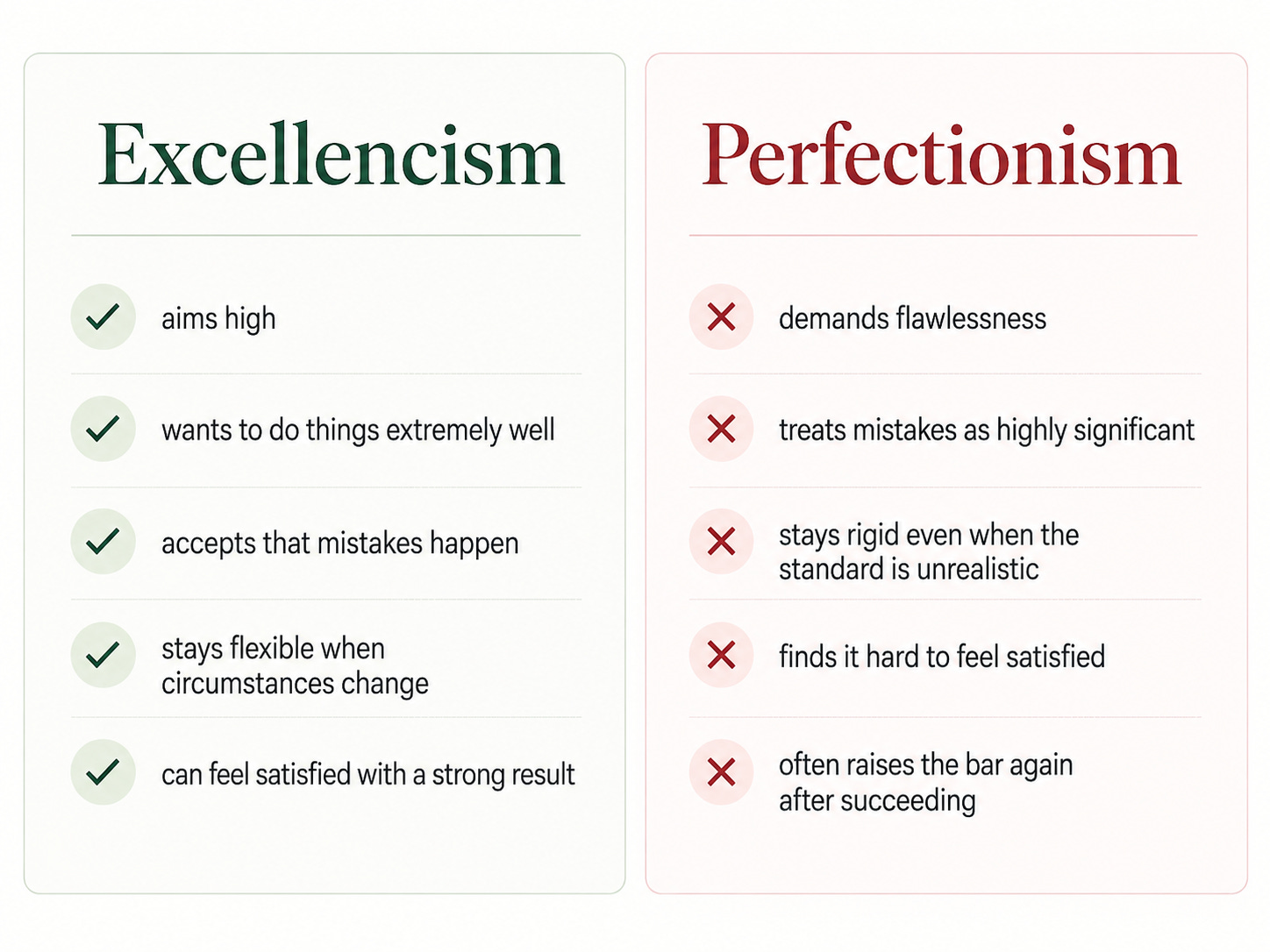
Gaudreau and his colleagues put this difference to the test in a series of studies and found that students striving for perfection achieved poorer grades than students striving for excellence.
What this suggests is that high standards, sustained effort and putting in the necessary hard work is the major determinant of success, not the self-imposed demand that the end result must be perfect. The key is not to lower your standards, it’s to let go of the need for flawlessness.
The BBC Reel that piqued my interest in perfectionism featured an interview with Professor Thomas Curran, a leading researcher in the field. In 2019 his meta-analysis of over 40,000 college students in the US, UK and Canada found that self-oriented, other-oriented and socially prescribed perfectionism had all increased between 1989 and 2016. In an extensive update to this research, covering 35 years of data and over 80,000 students, Curran and his colleagues included additional measures of perfectionism such as concerns over making mistakes and whether a task had been done correctly. This study once again showed that perfectionism was on the rise.
What’s behind the increase?
The latest Curran study found that higher levels of income inequality were associated with an increase in perfectionistic concerns, and that a lower gross domestic product (GDP), a measure employed to assess a country’s economic health and activity, was associated with higher levels of perfectionistic striving. One possible explanation for these correlations is that economic uncertainty increases the pressure on people to compete, achieve and avoid mistakes.
That doesn’t mean inequality or economic insecurity has been shown to cause perfectionism. The researchers are looking at patterns that move together at the level of countries and time periods. Even so, the findings fit with the idea that when economic opportunities feel less secure and the consequences of falling behind appear greater, people may feel more pressure to compete, achieve and avoid mistakes.
Social media is often cited as a major contributing factor in the rise of perfectionism. However, Curran notes that rates of perfectionism began accelerating around the year 2000, before platforms such as TikTok and Instagram existed. While accepting that social media has undoubtedly intensified the need to appear perfect, it doesn’t explain why perfectionism began increasing when it did.
It should also be pointed out that Curran and his colleagues acknowledge that their findings shouldn’t be generalised to all young people, countries and cultures.
What about older adults?
While it’s clear that perfectionism persists later in life, very little, if any, systematic peer-reviewed research has been conducted to examine whether it is increasing among middle-aged or older adults. This is an obvious gap in the literature and would be a worthwhile area for future research.
Informed by insights from cognitive behavioral therapy (CBT), the clinical model of perfectionism developed by psychologist Roz Shafran and her colleagues provides a useful way of understanding what drives and maintains the range of maladaptive behaviors perfectionism gives rise to.
Those suffering from clinical perfectionism tend to judge themselves predominantly in terms of the pursuit and attainment of personally demanding standards and often feel unable to be flexible and change their goals, despite the significant negative impact that the pursuit of perfectionism may have on their quality of life. (Roz Shafran, Sarah Egan and Tracey Wade)
As a result, default positions for a clinical perfectionist include:
Constantly checking, overpreparing and seeking reassurance in an attempt to mitigate the chance of getting something wrong
Never questioning whether excessive diligence is necessary
Seeking temporary anxiety relief rather than addressing long term underlying concerns
Achievements discounted or reassessed as not demanding enough.
Difficulty feeling satisfied with a job well done
Another finding I can certaintly relate to is that perfectionists often struggle with procrastination. At first glance, this seems counterintuitive. You would have thought if you were fixated with doing something as well as possible, you’d be keen to get on with any pending task straight away. A logical explanation would be that perfectionists put things off because of their exacting standards. Research, however, suggests that it’s more complicated than this.
A 2017 meta-analysis examining perfectionism and procrastination conducted by lead author Fuschia Sirois found that perfectionists who worried more about mistakes, doubted their performance and feared negative evaluation (Perfectionistic concerns) were more likely to procrastinate. In contrast, perfectionists who focused more on setting and pursuing very high standards (Perfectionistic strivings) were less likely to procrastinate. This finding based on over 10,000 participants across 43 studies is important, because it not only confirms that perfectionism consists of more than one explanatory dimension, but also that simply wanting to do something well isn’t what makes all perfectionists procrastinate.
Perfectionism isn’t a formal psychiatric diagnosis but it does appear as a contributing factor across a number of psychological problems. This is why you’ll often see perfectionism described as transdiagnostic. For example, in a systematic review published in 2022, Dr. Jessica Lunn and colleagues state that: Perfectionism is a transdiagnostic process contributing to the onset and maintenance of anxiety, obsessive-compulsive disorder (OCD) and depression.
While it’s fair to state that perfectionism is associated with psychological distress and dysfunction, it would be an overstatement to suggest that perfectionism causes such things as depression, anxiety, and OCD. As with any finding suggesting an association, it’s important to always remember that correlation does not imply causation. A relationship between variables of interest can be influenced by multiple factors and as we’ve seen when discussing perfectionism and procrastination, the relationship between two things can operate in opposite directions.
Assuming like me, you would like to rein in your perfectionism, there’s solid evidence that it can be reduced. A review of randomized controlled trials found that cognitive behavioral therapy produced medium-to-large reductions across several measures of perfectionism.
Testing your assumptions via behavioral thought experiments is an easy, actionable way of taking the intensity out of your perfectionism.
For instance, suppose you believe that if you reduce your preparation time or check your work less often, the quality of your work will inevitably suffer, try turning these kinds of beliefs into a prediction.
If I only check this email once before sending it, I’ll miss an important mistake and the recipient will think I’m careless.
If I stop preparing after two hours instead of four, my presentation will go badly.
If I don’t ask somebody whether this is good enough, I’ll make a mistake I should have caught.
Now test your prediction. Reduce your usual perfectionist behavior and reflect on what happens. Did it play out as badly as you expected? There’s a very good chance it didn’t, and if that’s the case, you need to keep repeating these little experiments in order to build up your tolerance.
I intend to start super simple by reducing my time sending text messages by not checking the spelling and grammar on text messages I send to family and friends and hopefully in time, extend this less pedantic behavior to more formal messages.
It’s baby steps for me. Like this mom, I’m not quite ready for textism abbreviations. 😂

The more I look into this topic, the less convinced I am that perfectionism is simply a byproduct of caring about doing things well.
When it comes to negative consequences, research shows that high standards on their own aren’t the problem. It’s when mistakes become unacceptable, achievement becomes too closely associated with self-worth, and doing something well is never quite satisfying enough that psychological problems are most likely to arise.
Whatever combination of economic, social and cultural pressures is contributing to the concerning rise in perfectionism, particularly among young people, the answer to reversing this trend is not about getting perfectionists to become less conscientious, less ambitious or less interested in doing the best they can. It’s about getting them to recognize that striving for flawlessness often comes at a cost, which in turn should allow those of us with perfectionistic tendencies to start testing the assumptions underpinning our behavior.
Are you a perfectionist? I’d be really interested to hear about your experience when it comes to psychological well-being.
The All About Psychology Substack is your go-to source for all things psychology. Subscribe today and instantly receive my bestselling Psychology Student Guide right in your inbox.
Upgrade to a paid subscription and as an extra thank you, you’ll also get the eBook version of my book Psychology Q & A: Great Answers to Fascinating Psychology Questions.
Why Upgrade to Paid?
Every penny of paid subscriber support goes directly towards hosting and running costs, helping keep All-About-Psychology.com free for everyone.
Your support ensures that:
Students and educators can continue to access the most important and influential journal articles in the history of psychology, completely free.
Readers everywhere can hear directly from world-renowned psychologists, authors and leading experts in the field.
High-quality free content for students, educators, and the general public continues to be created and shared on a regular basis.
Are you looking to raise your profile, strengthen your professional credibility, or bring more attention to your work, ideas, book, research, business, or Substack?
Featured interview opportunities are available for psychologists, authors, researchers, founders, Substack writers, and other relevant professionals.
Each interview is professionally researched, published on the All About Psychology website and this Substack, and promoted across my social channels, including my Facebook community of 800,000+ followers and 200,000+ member LinkedIn psychology group.
Find out more about the featured expert interview opportunity
Comments
Nothing yet. Say the first thing.
Sign in to join the conversation.