
I first published this short article in September 2024. For the subscribers who have joined since then, I hope you enjoy it.
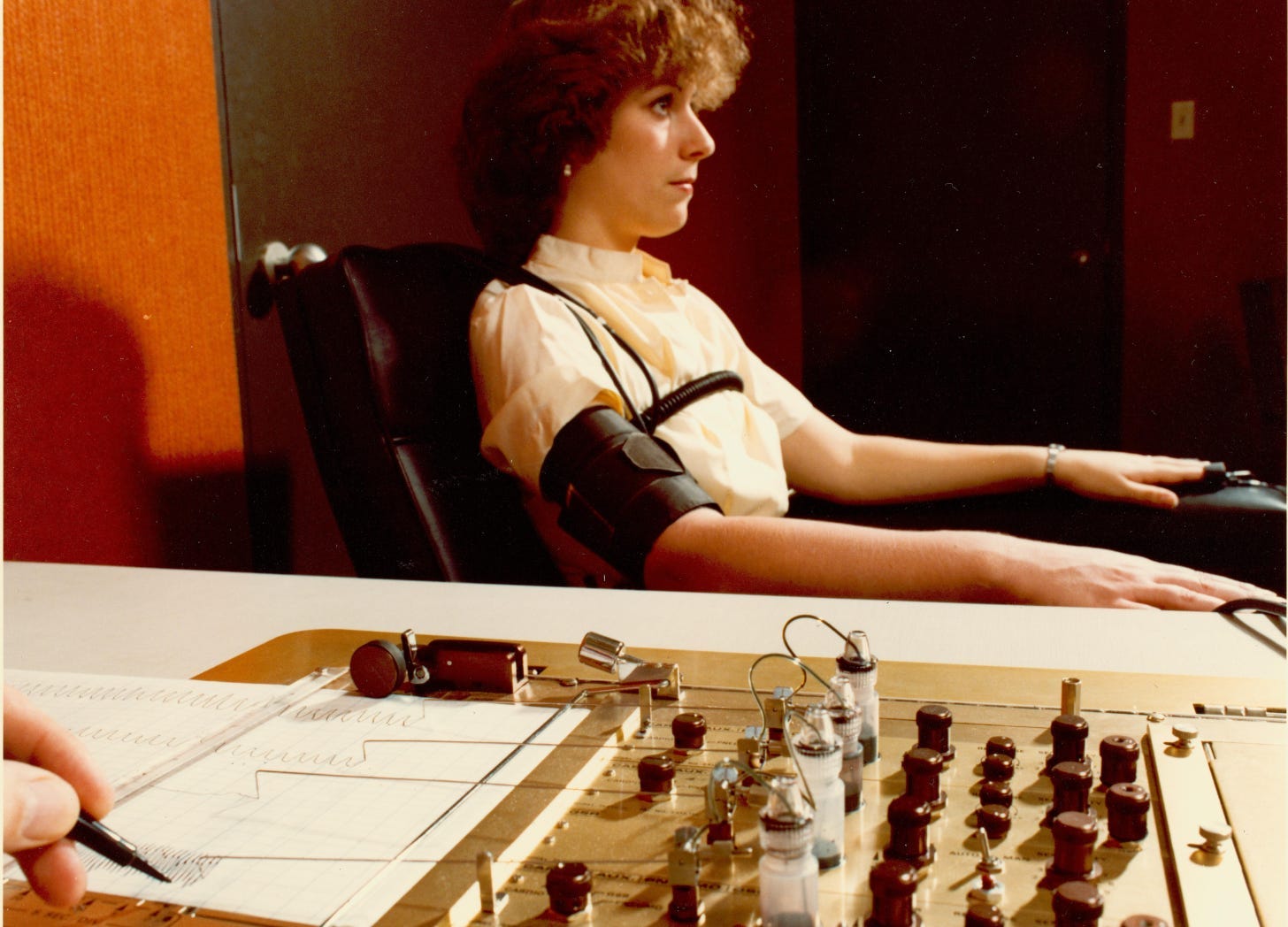
The lie detector test (or polygraph, to give it its official name) is a fascinating topic. A staple of reality TV shows and crime dramas, it's more than likely that you already have a good idea of what a polygraph is. But did you know that the term "lie detector" is actually a misnomer? A polygraph test simply measures a person's physiological responses when answering questions: most typically, blood pressure, heart rate, sweating (galvanic skin response), and respiration (breathing rate). This is done to look for signs of autonomic arousal, from which deception can be inferred.
Surely one of the most pernicious misnomers in psychology, the term 'lie detector test' is often used synonymously with the storied polygraph test. This test is misnamed: it is an arousal detector, not a lie detector because it measures non-specific psychophysiological arousal rather than the fear of detection per se.
(Scott Lilienfeld, Ph.D.)
The history of the lie detector
Investigating the link between physiology and deception has a long history within psychology. In 1915, William Moulton Marston began to study the physiological symptoms of deception during his time as a graduate student at Harvard University; as a result, Marston would go on to develop the first systolic blood pressure deception (’lie detector’) test.
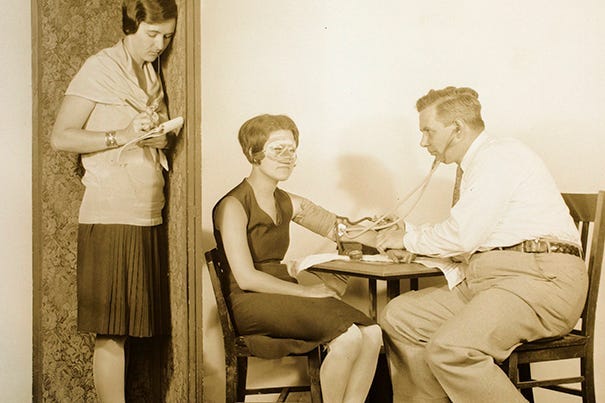
This wonderful (pun intended) image from the papers of William Moulton Marston, housed at the Schlesinger Library, shows Marston conducting one of his many experiments on blood pressure and deception.
The person in the photograph taking notes, sporting a distinctive bracelet which looks like it could be used to deflect bullets, is Olive Byrne, the inspiration behind Wonder Woman, the superhero character created by William Moulton Marston under the pseudonym Charles Moulton.
The fact that it was a psychologist who created, wrote, and produced the Wonder Woman comic strip is something all psychology lovers should know! Marston’s work on lie detection is the reason why Wonder Woman has a Lasso of Truth! How cool is that?
Can a polygraph really detect lies?
The scientific evidence would suggest not. The American Psychological Association notes that:
Most psychologists and other scientists agree that there is little basis for the validity of polygraph tests and that the most practical advice is to remain skeptical about any conclusion wrung from a polygraph.
In 2002, a committee commissioned by the National Academy of Sciences to review and report on the scientific evidence on the polygraph stated that:
Almost a century of research in scientific psychology and physiology provides little basis for the expectation that a polygraph test could have extremely high accuracy. Although psychological states often associated with deception (e.g., fear of being judged deceptive) do tend to affect the physiological responses that the polygraph measures, these same states can arise in the absence of deception.
Teaching ideas
If you teach psychology, the ‘lie detector test’ is a great topic to cover with your students. Here are some questions you could introduce and explore as part of a class discussion.
What are the most likely reasons for a false-positive result, i.e., when a polygraph labels an honest individual as dishonest?
In what other ways is it believed that we can identify the deceitful, e.g., reading body language? How valid are these alternative approaches to lie detection?
What do you think is the most reliable or effective method for determining if someone is lying? Is there a scientific basis for this method?
What ethical concerns arise when using polygraphs or other methods of lie detection in legal settings? Should such methods be admissible in court?
These questions are designed to encourage students to think critically about the science and ethics of lie detection.
Give your writing the attention it deserves
If you write about psychology, mental health, or human behavior on Substack, this is a great opportunity to get your work in front of one of the largest, most established and engaged psychology audiences online.
I’m opening up a limited number of featured writer guest article slots, giving Substack writers direct access to my All About Psychology platform and audience for just $295.
Your guest article will be published on All-About-Psychology.com, a high-traffic website generating over 300,000 weekly search impressions, and promoted across the All About Psychology platform. It will be:
Shared with my 200,000+ member LinkedIn psychology community, including direct inbox delivery
Distributed across All About Psychology social media channels with a combined audience of 1M+ followers
You also get two highly valued backlinks, one to your Substack and one to a destination of your choice, whether that’s a personal website, social media channel, or elsewhere online. Search engines like Google view these links as a vote of confidence in the quality and relevance of your work, helping to increase the credibility, trustworthiness and visibility of your online presence.
About me

I’m David Webb, a psychology educator and author who has spent over twenty-five years helping people make sense of why we think, feel, and behave the way we do.
I founded the All About Psychology website in 2008 and have been building it ever since as a place where students, educators, and curious readers can explore the many branches of psychology, learn about the field’s history and most influential pioneers, and access thousands of full-text journal articles and other quality psychology materials. Today the site is home to one of the largest and most engaged independent psychology communities online. This Substack is the latest addition to the All About Psychology platform.
My books, including Why We Are The Way We Are, are written for anyone interested in what makes us tick.
You can explore more of my work and books on my Amazon author page.
Keep learning with All About Psychology
The All About Psychology Substack is your go-to source for all things psychology. Subscribe today and instantly receive my bestselling Psychology Student Guide right in your inbox.
Upgrade to a paid subscription and as an extra thank you, you’ll also get the eBook version of my book Psychology Q & A: Great Answers to Fascinating Psychology Questions.
Why Upgrade to Paid?
Every penny of paid subscriber support goes directly towards hosting and running costs, helping keep All-About-Psychology.com free for everyone.
Your support ensures that:
Students and educators can continue to access the most important and influential journal articles in the history of psychology, completely free.
Readers everywhere can hear directly from world-renowned psychologists, authors and leading experts in the field.
High-quality free content for students, educators, and the general public continues to be created and shared on a regular basis.
Comments
Nothing yet. Say the first thing.
Sign in to join the conversation.