
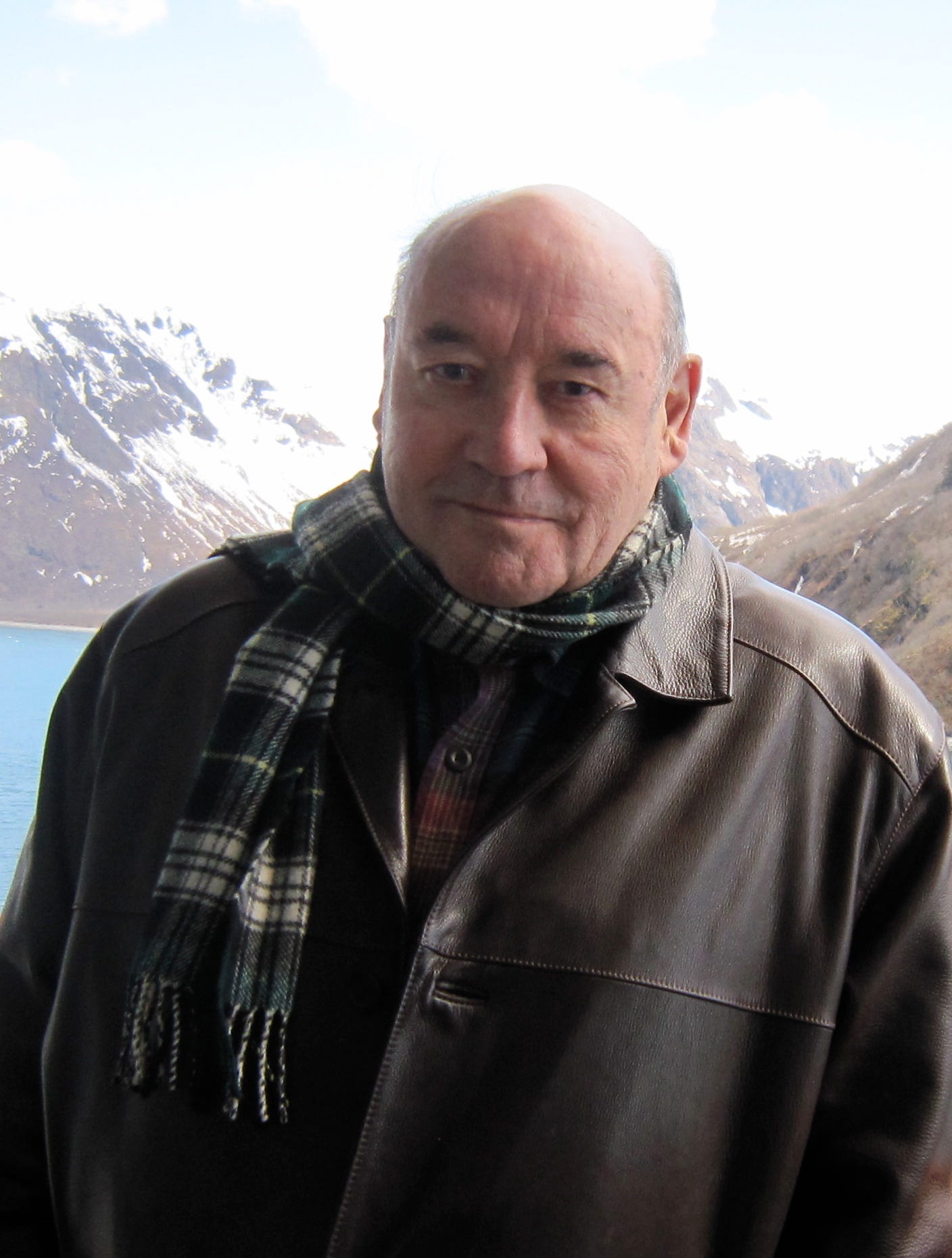
I was very sad to hear of the death of Desmond Morris, who died on 19 April 2026 at the age of 98. He was a zoologist by training, but that only begins to describe a life that moved effortlessly between science, art, and broadcasting, bringing him into contact with an extraordinary cast of characters and taking him around the world, driven by what he later described as an insatiable urge to see every aspect of human activity.
He first came to global attention with The Naked Ape, a book that reframed human behavior through the lens of zoology and went on to reach millions of readers. But that success sits within a much broader story. Morris published dozens of books over more than half a century, presented hundreds of hours of television, conducted scientific research, and maintained a serious parallel career as an exhibiting artist. Along the way, he formed connections with figures as varied as Stanley Kubrick, Konrad Lorenz, Marlon Brando and Joan Miró, reflecting a life that never stayed within the boundaries of any one field.
What stands out is not just the range of what he did, but the drive behind it. Whether he was observing animals, writing about body language, or creating art, the same instinct ran through it all: a curiosity to look closely, to understand, and then communicate that understanding in a way others could engage with. It leaves the sense of a life that was not only long, but richly and purposefully lived.
In March 2013, along with my good friend Craig Baxter, we had the privilege of interviewing Desmond Morris for a body language project we were working on.
Here are a selection of questions and answers from that interview.
As a pioneer in the field of human body language, by definition, you wouldn’t have had an established body of knowledge to draw upon when you first developed an interest in the topic. With this in mind, how did you initially go about formulating your ideas?
In the 1960s I commented that there were many dictionaries of words but none dealing with actions. As a student of animal behavior I had previously been studying species where there were no words. Actions, movements, postures, signals, displays - these were the things that I was analyzing in fish, birds and mammals. When I turned to the human species I used the same method - direct observation of what people do, rather than what they say. I set out to make a complete ‘ethogram’ of human behavior - that is to say a complete record of every action that a human being is seen to make. I am still working on that.
Drawing on your book ‘Baby: A Portrait of the Amazing First Two Years of Life’ What in your opinion is the most amazing thing a baby does in the first two years of life?
Perhaps the most astonishing fact about human babies is that, during the nine months between conception and birth, their weight increases by a staggering 3000 million times.
One of the most astonishing discoveries of recent years has been the swimming ability of newborn babies. It used to be claimed that a new baby, placed in water, would quickly drown, but this was due to the way in which early tests were carried out. In those tests, when a baby was gently lowered into warm water face up, it soon began to panic and struggle, and the attempt had to be abandoned without delay.
But then, in more recent experiments, the reverse position was tried, with the baby face-down, and a parental hand under its tummy. To everyone’s surprise, the newborn baby now showed no sign of panic, held its breath automatically, and floated happily in the water with its eyes fully open, gazing at the underwater scene. If, very gently, the supporting hand was removed, the baby then started making swimming movements with its limbs and set off down the swimming pool...So the human baby can swim before it can walk. It can even swim before it can crawl.
You’re quoted as saying “My favorite place in the world to visit is one that I haven’t been to before!” What favorite places would you like to visit in the future?
I have recently fulfilled my schoolboy ambition of visiting 100 countries before I die. Top of my list of regions yet to be visited are Tibet and Peru.
Of all the places you have visited, which culture’s body language and non-verbal communication did you find the most fascinating and why?
Italy. When Italians argue with one another their hands are as eloquent as those of orchestra conductors. And Japan, where the body language is so different, so precise, so disciplined. They find the expansive asymmetry of Western body language very clumsy.
In your memoir ‘Watching - Encounters with Humans and Other Animals’ you mention that in 1967 your bestselling book ‘The Naked Ape’ caused an outrage. What was the nature of this outrage? And do you think it would court as much controversy if The Naked Ape were being published for the first time today?
It caused an outrage because, at the time, it was generally believed that everything human beings do is the result of learning. I argued that a lot of human behavior is the result of a set of genetic suggestions. Today this view is widely accepted, but not when The Naked Ape first appeared. Also some people were insulted at being called animals. I saw it differently. For me, to be called an animal was a compliment.
In trying to find a connection between your passion for art and human behavior we noted with interest that in the late 1940's you gave a lecture on "The Biology of Art" in which you describe human artistic activities as the result of neoteny. For anybody who hasn't heard of the concept could you briefly explain what neoteny is about?
Neoteny is the extension into adult life of childhood features. You could call it the Peter Pan syndrome. In humans what has happened is that childhood play has persisted into adulthood. Other animals play when they are young but then stop playing when they mature. Humans do not stop, but they call adult play something else - they call it art, science etc., Childhood curiosity doesn’t fade. We never stop asking questions and trying out new ideas. This is our greatest strength as a species.
What has been your proudest achievement in the field of human behavior and why?
I do not allow myself the luxury of pride. I am my most severe critic. But I have to admit that seeing The Naked Ape listed in the top hundred bestsellers of all time did give me a pang of pleasure.
Which one accomplishment would you most like to be remembered for?
Developing the study of body language into a serious scientific pursuit back in the 1960s.
After the interview Desmond Morris provided us with with some wonderful body language images. Here are two of them, along with an explanation of why he liked them so much.
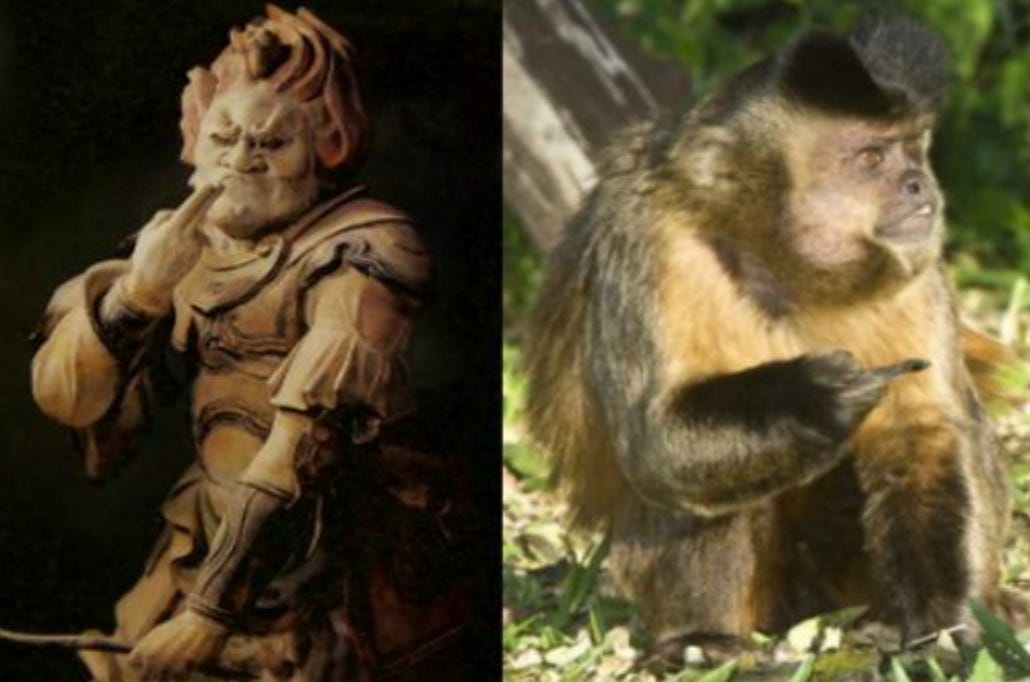
These two images amuse me as examples of how easy it is to misinterpret gestures. The human one is Japanese, perhaps an early Samurai warrior, but what is he signalling? It looks superficially like the famous British insult signal, which is why is amuses me. But what is he really doing? Is he signalling two of something, or is he closely examining something that has stuck to his fingertips, or is he an archer who has hurt his bow fingers? Or are the two fingers, pressed tightly side by side, meant to represent a mating couple (as they do in some cultures). Or was there some other arcane meaning to this gesture among early Samurai? If they used it simply as an emphatic baton gesture it is very unusual example of a baton, having the third and fourth fingers held down by the thumb.
The monkey one is just a joke - an animal caught accidentally giving 'the finger'. Not to be taken seriously.
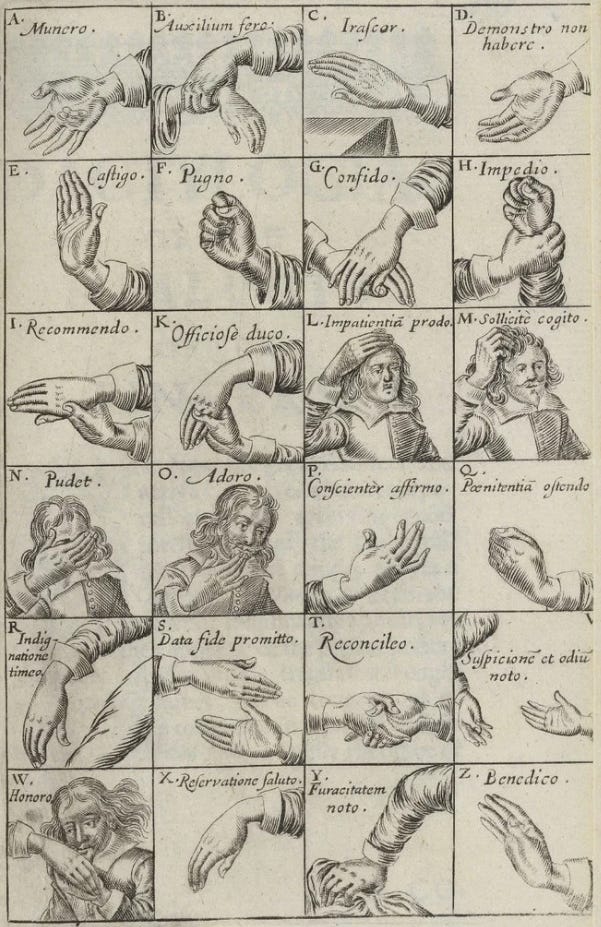
The illustration below is from one of the most precious books in Dr. Morris’ library - John Bulwer’s Chirologia (The Natural Language of the Hand) published in 1644. Dr Morris considered the illustrations in this book to be the most significant in the whole history of body language studies!
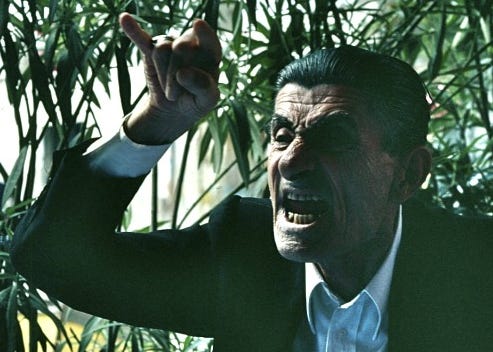
And here is what was Dr. Desmond Morris' favorite image of the Neapolitan Cornuta insult gesture.
The following extract is taken from Watching: Encounters with Humans and Other Animals, which Desmond Morris kindly allowed us to use. It provides a fascinating insight into how his human body language studies began.
After writing The Naked Ape I had come to the conclusion that there was something missing from the traditional studies of human behaviour. There were plenty of reports on abnormal behaviour, on tribal rites and rituals, on kinship structures and social institutions, on intelligence tests and learning processes, but there was very little indeed on the central subject of ordinary, everyday, human actions. The way we interact with one another in our homes and streets, in shops and restaurants, on beaches and buses, was rarely honoured with serious, observational analysis. Perhaps, for scientists, it was all too commonplace, too familiar. But by the same token it was at the very heart of what it was to be human, and I decided to make a stab at investigating it in a systematic way.
In my library there were dozens of dictionaries of words, but no dictionaries of human actions. To a zoologist this was a major omission. The first step one takes when starting to study a new species is to draw up an ‘ethogram’ — a complete, classified list of every type of action that the animal makes. In each case, the movement is carefully described, along with what causes it and what effect it has. In a moment of boldness bordering on arrogance, I decided to do this for the human species, treating it as though it were a new animal species, encountered for the very first time.
In attempting this I would employ a technique that was the precise opposite of the one employed by Sigmund Freud. When the great man had a patient lying on his famous couch in Vienna, he himself sat facing away, so that he could only hear his patient’s voice, but could not set eyes him. I, by contrast, would only watch my subjects and would not listen to a word they said. I would confine myself entirely to non-verbal ‘body language’. As a zoologist, I could not speak to an antelope or ask questions of a lion, so, treating humans in the same way, I would only observe and record.
One spring day [in 1969] I was sitting at a table in the main square of Malta’s capital city, Valletta, sipping coffee and chatting to my publisher, Tom Maschler, who had flown out to discuss my next book. I explained what I was proposing to do, and he was slightly alarmed. An encyclopaedia of human actions seemed like a massive project, taking years and ending up almost unpublishable. But he encouraged me to make a start and see where it went.
We were watching an old man shrugging his shoulders. I pointed out to Tom that, unlike the English, the Maltese use a directional shrug. When an Englishman shrugs he directs himself forwards, at his companion, regardless of the subject being discussed. A Maltese, however, aims his hands in the general direction of the subject. If, for instance, he is complaining about something political, he will shrug his hands in the direction of the seat of government. If he is complaining about the lack of work in the docks, he will shrug towards the harbour, and so on. It was a tiny difference, but it made the body language of the Maltese subtly different from that of the English visitors to the island.
We continued to watch. The old man to whom the shrugger was addressing himself suddenly tossed his head backwards, closing his eyes and pursing his lips as he did so. If an Englishman did this, it would be a sign of irritation or scorn. But if this action is done by a Maltese it simply means ‘No!’. Again, a subtle difference. By spending hours observing the Maltese population, I had already come to understand a whole range of gestures and small communication actions that differ in some slight way from those of the country where I myself grew up. Strangely, though, I did not use these Maltese actions when I was talking to my Maltese friends. It would seem strange to perform a head toss instead of a head shake. But I understood the actions even though I did not personally employ them. This was rather like the condition a human toddler finds itself — understanding its parents words before it uses them itself.
As I kept up a running commentary on the body language around us, Tom remarked:
‘You look at people like a birdwatcher looks at birds.’
‘Yes’ I replied, ‘You could call me a manwatcher.’
‘That’s it,’ said Tom, ‘That’s the title of your next book. We’ll call it ‘Manwatching’’.
I was none to happy about this, still having in mind my big ‘Encyclopaedia of Human Actions’. But I made a mental note of it, all the same.
After Tom left I decided to set up a special office where I could start assembling my checklist of human body language. The Villa was big, but throughout the summer months it was always full of house-guests — friends taking holidays in the sun — and the atmosphere was wrong. I found a spacious office right on the Sliema sea-front, rented it and set to work. I took on an assistant, Trisha Pike, the lively, intelligent daughter of an Army officer who was stationed in Malta. We ordered a dozen huge boards, 8 feet tall by 3 feet wide, and stood them all around the walls. On these we planned to pin up hundreds of slips of paper. On each slip would be written one human action. We would then be able to juggle these slips around as we improved our classification system.
At first, it seemed a daunting task, but as the days passed, something was beginning to emerge. It turned out that human beings do not make as many different types of action as might be imagined. Because we could combine them in many ways and because we could vary their intensity, this gave a false impression that there were countless ways of using the human body. But if you simply took the basic elements involved, and classified those, the picture did not look so confusing.
To give three random examples: We only move our eyebrows in five ways — we raise, lower, knit, flash or cock them. We only cross our legs in four different ways — ankle-on-ankle, ankle-on-knee, knee-on-knee, or tight-twine. And we only fold our arms in four different ways — both-hands-showing; left-hand-showing + right-tucked in; right- hand- showing + left-tucked-in; both hands tucked in.
And so Trisha and I toiled on, pursuing our eccentric task of mapping the human ethogram. It took weeks, then months. The boards were now covered in hundreds of slips. At the same time, we were compiling files of photographs of all the actions. I was out recording actions on the streets, and every newspaper and magazine we could lay our hands on was being hacked to pieces. Slowly the repertoire of human actions was taking shape. It was amazing the way in which, once you had identified a particular action, it started coming up again and again, in the same sort of context. Nobody had ever named these actions before, so we had to do it ourselves. And the names had to be purely descriptive and could never imply a particular function or message.
After several more months it was clear that we were reaching saturation point. It would take a professional contortionist now to perform an action we had not identified and classified. And it looked as though there were about 3000 different actions that the human body performed in ordinary everyday life. I now started to write up my results, describing and discussing each action in detail.
At this point, Tom Maschler contacted me to find out how the new book is coming along. I announced proudly that I had reached the eyebrows. There was a pause. Then he asked: ‘Are you going up or down?’ When I reply ‘Down’ I sensed that he was not a happy publisher. After much debate it was decided that I should use my encyclopaedic records as the information base for some less ambitious books, and this was what I did.
The first book to emerge from this study was Intimate Behaviour. I then started work on the larger volume Manwatching, but it soon became clear that I needed to make field observations on a much wider range of cultures. In 1974 Ramona and I returned to England, where I took up a research post at Oxford, my old university. From there I began a new series of travels, with a team of 29 research workers and interpreters, exploring the body language of 25 different countries, right across Scandinavia, Europe, and the Mediterranean, an enterprise that proved to be highly rewarding, if at times slightly hazardous.
Desmond Morris (24 January 1928 – 19 April 2026)
The All About Psychology Substack is your go-to source for all things psychology. Subscribe today and instantly receive my bestselling Psychology Student Guide right in your inbox.
Upgrade to a paid subscription and as an extra thank you, you’ll also get the eBook version of my book Psychology Q & A: Great Answers to Fascinating Psychology Questions.
Why Upgrade to Paid?
Every penny of paid subscriber support goes directly towards hosting and running costs, helping keep All-About-Psychology.com free for everyone.
Your support ensures that:
Students and educators can continue to access the most important and influential journal articles in the history of psychology, completely free.
Readers everywhere can hear directly from world-renowned psychologists, authors and leading experts in the field.
High-quality free content for students, educators, and the general public continues to be created and shared on a regular basis.
Comments
Nothing yet. Say the first thing.
Sign in to join the conversation.