

First published in 2024, this article has been lightly updated and republished for the many new readers who have joined All About Psychology since then.
I once assumed that character and personality were more or less interchangeable. Two words for the same idea, with character perhaps being the older, more antiquated way of saying personality.
Personality is certainly the dominant term within academic psychology. Personality psychology is a core topic for many students taking psychology courses, degrees, or programs, and for good reason. It plays a central role in how psychologists think about individual differences, behavior, and the ways people interact with the world around them.
The study of personality also has a rich and varied history. From trait theory to psychodynamic, humanistic, biological, behaviorist, evolutionary, and social learning perspectives, psychologists have spent decades trying to understand the patterns that make us recognisably ourselves.
Yet despite the prominence of personality psychology, I’ve always been drawn to the concept of character. It’s a word that carries a different kind of weight. Character suggests something moral, ethical, and deeply human. There’s also something timeless about it, especially when it appears in older writing.
One of my favorite references comes from William James’s 1905 tribute to his friend Thomas Davidson. In it, James quoted from a letter in which Davidson summed up his experience of life through a series of maxims, including this one:
Let not your goodness be professional; let it be the simple, natural outcome of your character.
Therefore cultivate character.
The short video below includes this maxim along with several others from the same letter.
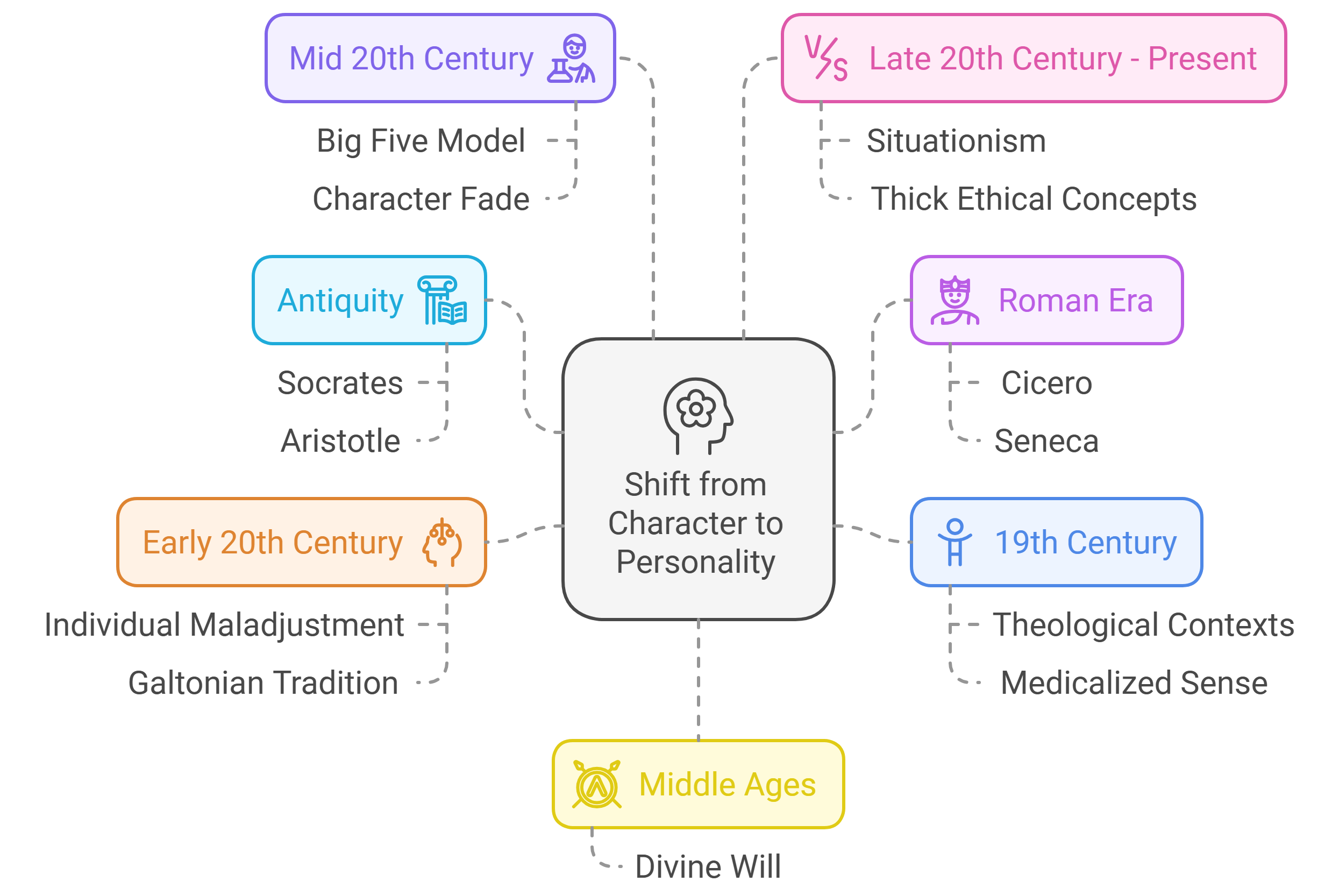
The shift from character to personality as the dominant way of understanding individual differences did not happen overnight. It reflects a long movement from moral and philosophical ideas about how people should live toward psychological and scientific ideas about how people differ.
In ancient Greece, the concept of character was closely tied to ethics. Philosophers such as Socrates and Aristotle were concerned with virtues and vices, and with the qualities that made a good life possible. For Aristotle, the cultivation of good character was central to human flourishing, or eudaimonia.
Roman thinkers such as Cicero, Seneca, and Plutarch built on these Greek ideas. They emphasized reason, reflection, courage, temperance, and wisdom. Character was not treated as a fixed label, but as something shaped over time through habits, choices, and moral discipline.
During the Middle Ages, theological perspectives deeply influenced how character was understood. Moral development was often framed in relation to divine will, humility, piety, and self-discipline. To have good character was to align oneself with religious teachings and moral obligations.
By the 19th century, the term personality began to appear more often in theological, legal, ethical, and medical contexts. In France, medical professionals used personality in a more medicalized sense, connecting it with disorders and contributing to the later study of personality disorders. Character still dominated moral and ethical discussions, but personality offered a different way of thinking about individual differences.
In the early 20th century, personality became increasingly important within psychology. The mental hygiene movement emphasized individual maladjustment as a source of personal and social problems, which helped shift attention away from moral evaluation and toward psychological explanation.
At the same time, psychologists interested in mental testing and individual differences began to study non-cognitive traits. Gordon W. Allport played an especially important role in distinguishing personality from character. He treated personality as a more neutral psychological concept, while character carried stronger moral and evaluative meaning. This helped make personality the preferred term in scientific psychology.
By the mid-20th century, academic personality psychology was firmly established. Researchers increasingly focused on identifying and measuring basic personality traits. This work eventually contributed to models such as the Big Five, which organizes personality around openness, conscientiousness, extraversion, agreeableness, and neuroticism.
As personality became more prominent in academic psychology, character faded into the background. It did not disappear, though. It remained part of everyday language, moral reflection, popular culture, and philosophy.
From the late 20th century onward, debates about personality and character continued. Situationist arguments challenged the idea that people have stable traits that show up consistently across different situations. Philosophers also revisited the question of whether character and personality can really be separated. After all, many of the words we use to describe people do both things at once. They describe how someone tends to behave, but they also carry moral judgment.
That is one reason the distinction between personality and character remains so interesting. Personality may tell us something about our patterns, tendencies, and traits. Character asks a different question. What do we do with those tendencies, especially when our choices matter?
Personality is the broader concept. It includes the patterns of thought, feeling, behavior, interests, preferences, habits, and traits that help make a person recognizably themselves. It reflects both inherited tendencies and learned patterns shaped by experience, culture, relationships, and environment.
In this sense, personality is not just one thing. It includes temperament, which refers to the more biologically rooted aspects of personality, such as emotional reactivity, energy levels, and sensitivity to the environment. It also includes learned patterns, such as habits, beliefs, coping styles, and social behaviors that develop over time.
Character is different. It refers more specifically to the moral and ethical dimension of a person. It includes qualities such as honesty, integrity, courage, fairness, kindness, and responsibility. Character is not simply about how someone comes across. It’s about the values they live by and the choices they make, especially when those choices cost them something.
That is why the distinction matters.
A person can have an appealing personality without having strong character. Someone may be charming, funny, confident, sociable, or charismatic, while still being dishonest, selfish, or unreliable. Likewise, someone may have a quiet or reserved personality but possess deep courage, loyalty, and integrity.
Personality often shapes first impressions. Character is revealed over time.
This matters in relationships, leadership, friendship, work, and public life. We can easily mistake confidence for competence, charm for kindness, or charisma for trustworthiness. Separating personality from character helps us look beyond surface appeal and ask deeper questions about judgment, responsibility, and how someone treats others.
The distinction also matters for personal growth. Some aspects of personality, especially temperament, may be relatively stable. Character, however, can be cultivated. Through reflection, practice, difficult choices, and repeated action, people can strengthen qualities such as patience, honesty, empathy, resilience, and self-control.
Of course, character and personality are not completely separate. They interact constantly. Our temperament may influence how easily we become angry, anxious, impulsive, or withdrawn. But character shapes what we do with those tendencies. It asks whether we excuse them, understand them, regulate them, or work to become better than our first impulse.
A simple way to put it is this:
Personality describes many of the patterns that make us who we are.
Character reflects what we choose to stand for.
Together, they offer a fuller picture of a person. Personality helps explain how someone tends to think, feel, and behave. Character points to something deeper. It asks how that person acts when values, pressure, temptation, or responsibility enter the picture.
When someone uses the word “character,” you might assume they mean personality, but that’s not always the case. (Psych Central)
Our personalities, with their inherited traits and familiar tendencies, can shape the development of our character. But they do not have to define it completely. Through conscious effort, repeated choices, and the way we respond to difficulty, we can cultivate qualities that may not come naturally to us.
With that in mind, here are a few examples of people, real and fictional, who seem to embody character through their actions and choices.
Atticus Finch, from To Kill a Mockingbird, is often seen as an example of moral courage and integrity. Despite facing intense social pressure, he remains committed to justice and fairness. His character is revealed not through charm or popularity, but through his willingness to do what he believes is right when doing so is difficult.
Elizabeth Bennet, from Pride and Prejudice, shows strength of character through her independence, honesty, and refusal to compromise her principles. She rejects Mr. Collins’s proposal despite the social and financial pressures around her, and she challenges Mr. Darcy in ways that force him to examine his own pride and prejudice. Her character lies in her commitment to authenticity and self-respect.
Nelson Mandela’s long struggle against apartheid, including 27 years in prison, reflects extraordinary resilience and moral conviction. After becoming president of South Africa, he chose reconciliation over revenge, helping to turn personal suffering into a wider commitment to justice, healing, and unity.
Malala Yousafzai offers another powerful example. After surviving an assassination attempt for advocating girls’ education, she continued to speak publicly for education equality. Her courage, resilience, and refusal to be silenced reflect a deep commitment to justice in the face of fear.
These examples remind us that character is not simply something we admire from a distance. It is something we build through action. It shows up in what we defend, what we refuse, what we forgive, and what we keep choosing when easier options are available.
Who comes to mind when you think of someone, real or fictional, who embodies remarkable character? Share your thoughts and say why they inspire you.
The All About Psychology Substack is your go-to source for all things psychology. Subscribe today and instantly receive my bestselling Psychology Student Guide right in your inbox.
Upgrade to a paid subscription and as an extra thank you, you’ll also get the eBook version of my book Psychology Q & A: Great Answers to Fascinating Psychology Questions.
Why Upgrade to Paid?
Every penny of paid subscriber support goes directly towards hosting and running costs, helping keep All-About-Psychology.com free for everyone.
Your support ensures that:
Students and educators can continue to access the most important and influential journal articles in the history of psychology, completely free.
Readers everywhere can hear directly from world-renowned psychologists, authors and leading experts in the field.
High-quality free content for students, educators, and the general public continues to be created and shared on a regular basis.

I’m David Webb, a psychology educator and author who has spent over twenty-five years helping people make sense of why we think, feel, and behave the way we do.
I founded the All About Psychology website in 2008 and have been building it ever since as a place where students, educators, and curious minds can explore the many branches of psychology, learn about the field’s history and most influential pioneers, and access thousands of full-text journal articles and other quality psychology materials. Today the site is home to one of the largest and most engaged independent psychology communities online. This Substack is the latest addition to the All About Psychology platform.
My books, including Why We Are The Way We Are, are written for anyone interested in what makes us tick.
You can explore more of my work and books on my Amazon author page.
Comments
Nothing yet. Say the first thing.
Sign in to join the conversation.