
The mainstream story runs like this: Taylor Swift, wronged artist, discovers her masters have been sold to her nemesis Scooter Braun without her knowledge. She fights back. She re-records six albums. She wins. Girl power, artist empowerment, narrative reclaimed. It is one of the most effective pieces of brand mythology in contemporary pop culture.
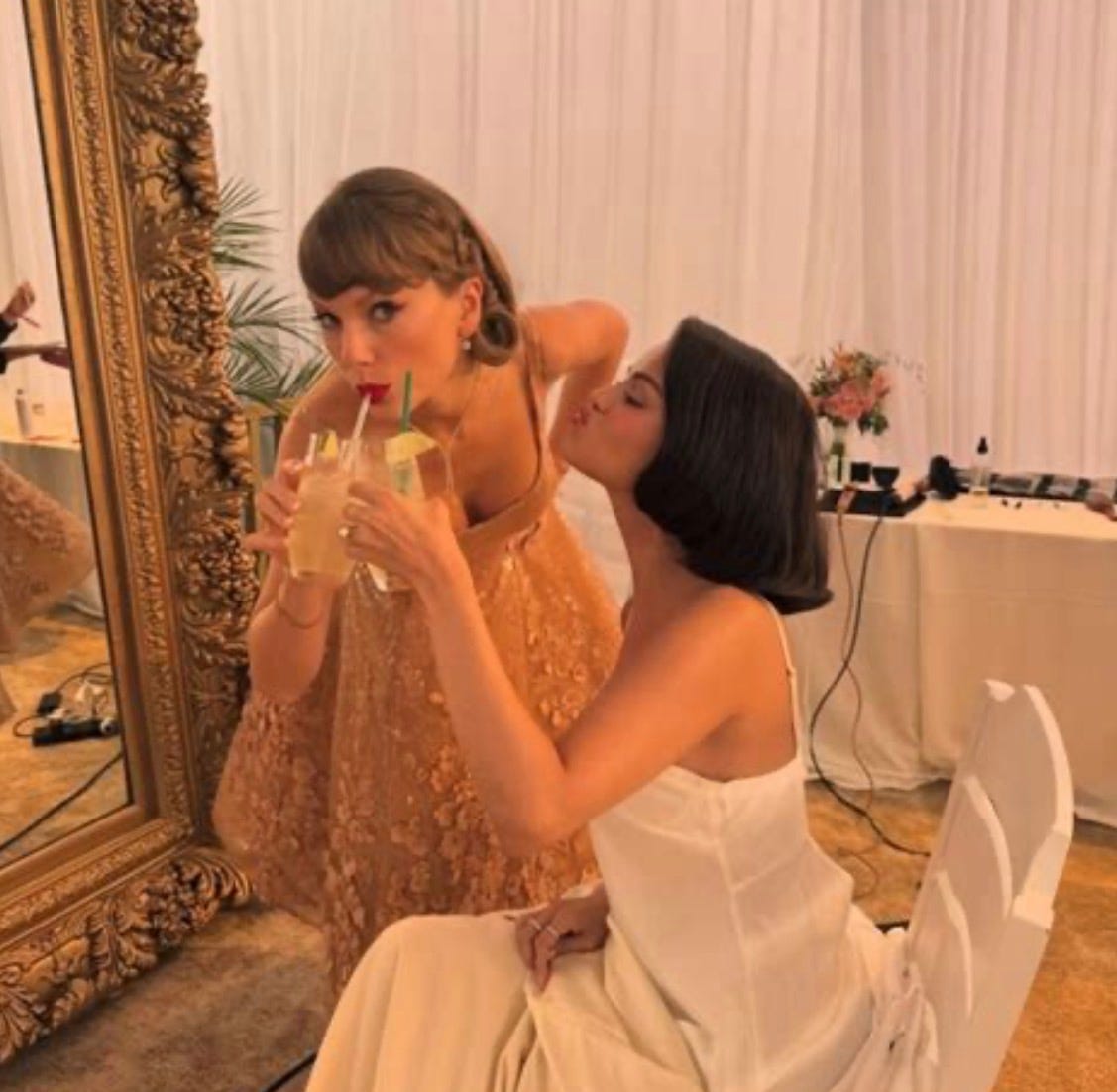
Here is what actually happened, transaction by transaction.
MOVE 1: THE ACQUISITION (2019)
Braun's Ithaca Holdings buys Big Machine Records for $300 million. The funding source: the Carlyle Group — Frank Carlucci's firm, founded by Reagan's Secretary of Defense, built on Pentagon contracts, Saudi sovereign wealth, and the bin Laden family's investment portfolio. Swift states publicly she was given no warning and no right of first refusal. That is confirmed.[1][2]
But here is what the narrative erases: Scott Swift, her father, owned 3% of Big Machine. Scott Borchetta, who sold the company, had known the Swift family since Taylor was 14. The sale of Big Machine was announced internally in October 2018 — eight months before the June 2019 close. Scott Swift, as an equity holder, would have received proceeds from that sale. The father who transferred his family to Nashville so his daughter could sign the contract that created the asset that Carlyle then bought — he cashed out. Whether Taylor knew is not the question. The question is whether the family financial structure that enabled her career was ever actually separate from the machine that sold her.[2][1]
MOVE 2: THE SHAMROCK SALE (2020)
In November 2020, Ithaca Holdings sold the Taylor Swift master recordings to Shamrock Holdings — a private equity and investment firm founded by Roy E. Disney, the Walt Disney Company family — for a reported $405 million. Ithaca paid $300m, sold the masters alone for $405m, pocketing $265 million profit in under 18 months.[3]
This is the transaction the re-recording narrative is designed to distract from. By the time Swift announced the re-recordings — framed as her reclaiming power — Braun had already sold the originals and banked a quarter of a billion dollars. The re-recordings do not claw back that money. They cannot. They create a competing product. They do not reverse the extraction.
Shamrock Holdings currently owns the original masters. Not Braun. Not Carlyle. Disney money.[3]
MOVE 3: THE HYBE ACQUISITION (2021)
Ithaca Holdings — now minus the Swift masters but plus everything else — is sold to Hybe Corporation (South Korea) for $1.05 billion. Braun becomes CEO of Hybe America. The Nashville country infrastructure, the Big Machine label, Scott Borchetta — all now owned by a South Korean entertainment conglomerate whose flagship act is BTS, whose revenue model is built on parasocial fan relationship management at industrial scale.[3]
The pipeline is now complete:
Carlyle (Pentagon/Carlucci) funds Braun → Braun extracts $265m from Swift's catalogue → Disney buys masters → South Korean K-pop conglomerate buys the shell.
WHAT THE RE-RECORDING NARRATIVE DOES
It is not false. Swift did re-record. The Taylor's Versions did chart. Fearless (TV) and Red (TV) both debuted at Number 1. Speak Now (TV) and 1989 (TV) followed. The re-recordings are commercially real.[3]
But the framing — "Taylor takes back control" — performs several functions simultaneously:
1. It makes the audience participants in an asset depreciation strategy presented as personal empowerment. Swifties streaming Taylor's Version are performing activism. What they are actually doing is helping depreciate an asset owned by the Disney family fortune while generating new revenue for Universal Music Group (Republic Records), one of the three major label oligopolists that control global music distribution.
2. It makes Braun the villain of a story whose actual villain is the contract structure Swift signed at 15. The contract that assigned master ownership to the label — standard industry practice — was signed with Scott Borchetta's Big Machine, co-funded by Scott Swift's 3% stake. The villain was always the contract. Braun is the third owner of the asset. He is not the architect of the system.
3. It produces enormous free press for every re-recorded album — which is to say, it is a marketing strategy dressed as a political act. The discourse around "Taylor's Version" is itself the promotional infrastructure. Every think-piece, every Swiftie streaming decision, every academic paper published about the re-recordings is unpaid labour in service of a Republic Records release strategy.[3]
4. It obscures the Carlyle connection entirely. In the entire media ecosystem around this story — thousands of articles, two documentary specials, academic philosophical analyses — the words "Carlyle Group" appear almost nowhere in the mainstream narrative. Frank Carlucci's name appears nowhere. The Pentagon does not appear. The bin Laden family investment does not appear. The Shamrock/Disney acquisition is a footnote. The story is reduced to: Bad Man Takes Girl's Music. Girl Fights Back. Girl Wins.
THE PENNSYLVANIA STRUCTURE
Given the two families now mapped, the Braun-Swift conflict reads differently.
Baldi used Italian immigrant community banking in Philadelphia's Republican machine to consolidate ethnic political capital. His descendant's father uses Wall Street infrastructure (Merrill Lynch) to purchase equity in the vehicle that will control his daughter's creative output.
Carlucci arrived in Scranton as the grandson of Italian stonemasons, ascended through Princeton (roommate: Rumsfeld), ran the CIA, ran the Pentagon, and built the private equity firm whose capital arm finances the acquisition of Baldi's descendant's masters.
These are not two people in conflict. These are two Pennsylvania Italian immigrant family lines that both ascended through American institutional power structures and whose grandchildren's financial interests briefly intersected — with the appearance of a fight staged over it.
The "dispute" between Taylor Swift and Scooter Braun is the story told above the waterline. Below it: Carlyle capital extracts a quarter billion from a catalogue built on a Wall Street family's Nashville investment, and the artist's re-recording campaign generates new revenue for Universal while the audience believes it is watching a liberation.
The iceberg does not care about the fight on the surface. It is still the iceberg.
Sources
[1] The Intangibles Song in Takeover Announcements: Good Tempo, Hollow Tune https://basepub.dauphine.psl.eu/bitstream/123456789/21861/2/IntangiblesSongFMA.pdf
[2] Rome reborn on the Arno: Republican spatialities and the uses of the past https://www.tandfonline.com/doi/pdf/10.1080/23311983.2023.2264019?needAccess=true
[3] Taylor Swift and the Philosophy of Re-recording https://www.bloomsburycollections.com/monograph?docid=b-9781350421592
[4] “Lavender Haze” in the Airways https://journal.media-culture.org.au/index.php/mcjournal/article/view/3185
[5] The Eras Tour: Mapping the Eras of Taylor Swift to the Cosmological Eras
of the Universe https://arxiv.org/html/2503.22795v1
[6] I Knew You Were Trouble: Emotional Trends in the Repertoire of Taylor
Swift https://arxiv.org/pdf/2103.16737.pdf
[7] Is Taylor Swift leading a new Pop revolution? A cross-generation analysis of Pop/Rock cover songs https://f1000research.com/articles/11-1273/pdf
[8] Research on popularity of American pop singers songs based on machine learning https://tns.ewapublishing.org/media/de7854b28be8408485694e17d4a1194a.marked.pdf
[9] Assessing the Impact of Sampling, Remixes, and Covers on Original Song
Popularity https://arxiv.org/pdf/2411.01242.pdf
[10] Avoiding an AI-imposed Taylor's Version of all music history https://arxiv.org/pdf/2402.14589.pdf
[11] Drew a map on your bedroom ceiling: fandoms, nostalgic girlhood and digital bedroom cultures in the Swiftie-sphere https://www.tandfonline.com/doi/pdf/10.1080/19392397.2024.2338540?needAccess=true
[12] Brand community protection through contested brand revival https://www.tandfonline.com/doi/full/10.1080/0267257X.2024.2430672
Comments
Nothing yet. Say the first thing.
Sign in to join the conversation.